
Kaival Brands Innovations: Confronting Revenue Collapse and Patent Litigation Impact
Analyzing the steep revenue decline at Kaival Brands driven by ITC patent litigation and the company's strategic and liquidity challenges.
Kaival Brands Innovations Group, Inc. has experienced a dramatic collapse in revenue, exceeding a 93% year-over-year drop, largely due to a consent order halting imports of its flagship Bidi Stick product following patent litigation by RJ Reynolds. Despite notable operating income in prior years, ongoing bans and limited disclosures cloud the company's near-term financial viability. The failure of a merger with Delta Corp Holdings and Nasdaq's classification of Kaival as a public shell further complicate its strategic outlook. With no dividends or share buybacks, alongside extremely negative returns on equity and cash flow deficits, Kaival's ability to recover hinges on the expiration of patent exclusions in late 2026 and regulatory developments surrounding ongoing ITC proceedings.
Scrutinizing Kaival’s Declining Revenue Stream and Historic Operating Income Performance
Kaival Brands Innovations Group has undergone a stark financial transformation over recent years. Historical data reveals revenues that tumbled precipitously by roughly 93% from about $6.9 million in fiscal year (FY) 2024 to just under $485 thousand in FY2025 [F1]. This revenue contraction starkly contrasts with earlier years where top-line figures were relatively stable around $12.7 million to $13 million during FY2022–FY2023 before a more modest decline in FY2024.
Interestingly, operating income spiked significantly to $29.8 million in FY2024, up from $4.5 million two years earlier in FY2022 [F1]. However, this operating robustness appears decoupled from net profitability — net income remained negative each year, widening further to a loss of over $16.6 million by FY2025. This divergence suggests that accounting entries, potentially related to non-cash gains or reversals such as licensing rights valuation adjustments or intellectual property reclassification, may have buoyed operating income temporarily but did not translate into real cash profits.
Cash flow metrics confirm this interpretation: operating cash flow deteriorated deeply to a negative $2.77 million in FY2025 after already negative cash flows in prior years [F1]. These indicators underscore that actual liquidity generation failed to keep pace with reported operating results.
Historical performance (annual)
| FY | Rev ($mm) | Net ($mm) | CFO ($mm) | OpInc ($mm) | Rev YoY | Net YoY |
|---|---|---|---|---|---|---|
| 2025 | 0 | -17 | -3 | -93.0% | -148.2% | |
| 2024 | 7 | -7 | -1 | 30 | -47.4% | +39.8% |
| 2023 | 13 | -11 | -3 | 24 | +2.6% | +22.5% |
| 2022 | 13 | -14 | -6 | 5 |
Source: SEC companyfacts cache [F1].
Capital returns and efficiency (annual)
| FY | FCF ($mm) | ROE% |
|---|---|---|
| 2025 | -16635.4 | |
| 2024 | -1 | -48.5 |
| 2023 | -3 | -82.1 |
| 2022 | -146.6 |
Source: SEC companyfacts cache [F1].
Note: Capex figures only available for FY2023-24 showing consistent low investment.
Legal Barriers and the ITC Patent Case: The Core Catalyst Behind Product Import Halt
The most decisive inflection point for Kaival's business was the International Trade Commission (ITC) patent infringement complaint filed by RJ Reynolds Entities on June 11, 2024 [S1]. Allegations centered around infringement of U.S. Patent No. 11,925,202 relating specifically to components used in Kaival’s Bidi Stick vaping products. The complaint invoked Section 337 of the Tariff Act of 1930 provisions seeking exclusion orders barring importation and cease and desist orders halting domestic sales.
Despite legal contestation by Bidi (the licensee), the company entered into a consent order by early November 2024 agreeing to cease all importation and distribution of Bidi Sticks effective December 6, 2024 [S1]. This consent order effectively halted revenues tied directly to the flagship product until the patent expiration date scheduled for October 2026.
From an industry perspective — within tobacco-alternative sectors — Section 337 exclusion orders are formidable enforcement tools that instantly disrupt supply chains and market access. The ITC Administrative Law Judge affirmed violation findings by August 29, 2025 [S1], passing final decision authority to the Commission with expected ruling deadlines subject to procedural extensions. The embargo has placed significant strain on Kaival’s product lifecycle management; licensing agreements anchored on Bidi Sticks are essentially frozen pending regulatory resolution.
Disrupted Merger Prospects and Market Classification Challenges Impacting Strategic Direction
Initially viewed as a growth catalyst was Kaival’s proposed business combination with Delta Corp Holdings Limited announced prior but mutually terminated on September 11, 2025 [S15]. Termination of this merger agreement extinguished anticipated valuation uplifts or operational synergies ordinarily factored into smaller reporting companies’ expansions.
Compounding strategic headwinds is Nasdaq’s November 10, 2025 staff determination classifying Kaival as a “public shell company” based on diminished assets weighted heavily towards patents without immediate commercialization plans and reduced operational scale [S18]. This classification jeopardizes continued listing on Nasdaq Capital Market unless successfully appealed.
Nasdaq's view leveraged factors including drastic revenue reductions—$400K reported over nine months ended July 31, 2025 compared with $6.1M one year prior—and employee count reductions post-October 2023 [S18]. While Kaival disputes this designation asserting ongoing operations existence and intends an appeal process stay [S18], failure could force delisting and further depress share liquidity.
Liquidity Status and Capital Structure Navigated Amid Severe Cash Constraints
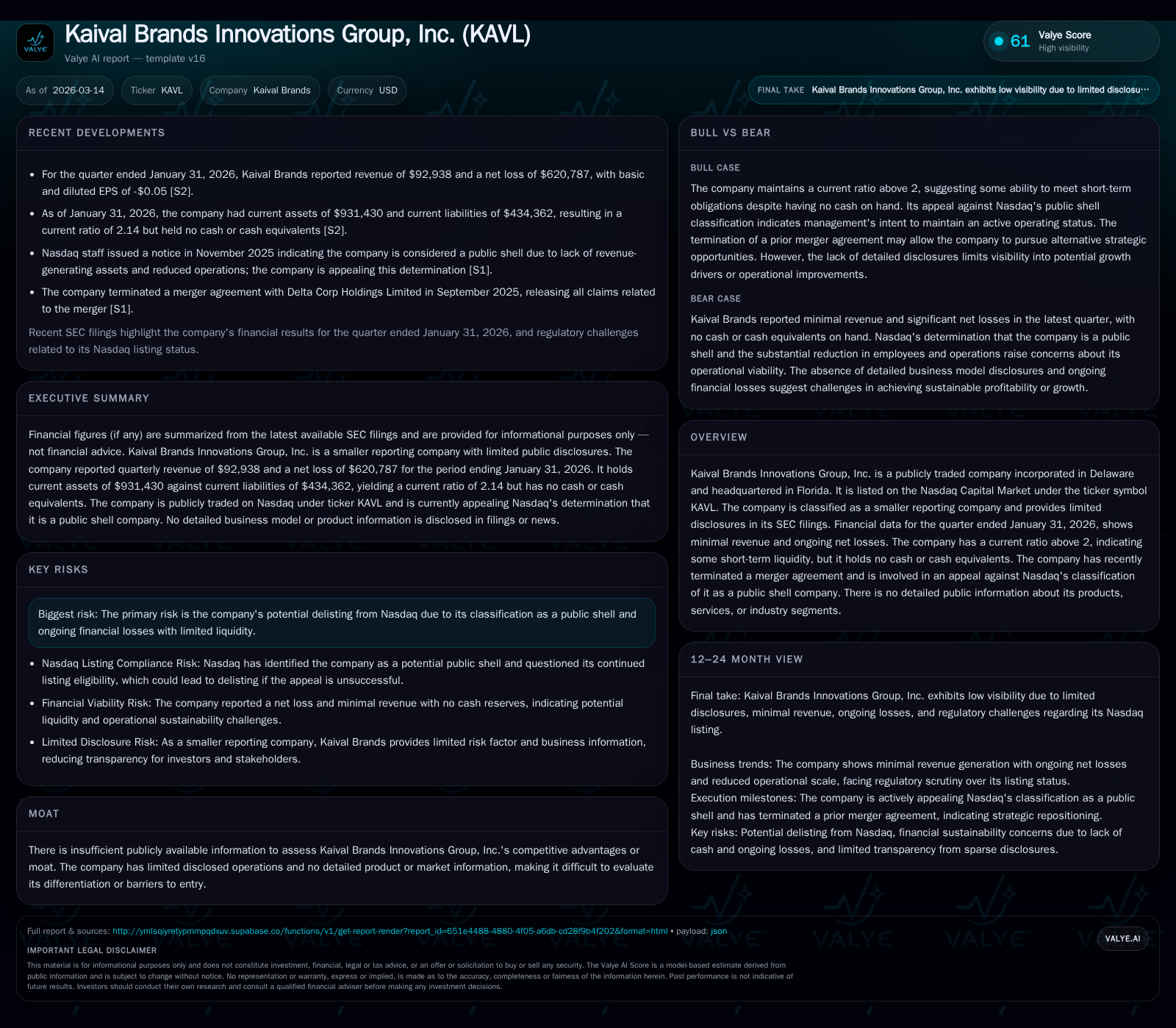
As of January 31, 2026 balance sheet data illustrates critical liquidity stress points [F1],[S22]: current assets are approximately $931K while current liabilities stand at roughly $434K yielding a nominal current ratio near 2.14; yet crucially the company reports zero cash or equivalents at period end.
This indicates working capital is tied up mostly in non-liquid short-term assets with no immediate cash buffers available for operational needs or contingencies. Coupled with chronic negative operating cash flows exceeding $2.7M annually [F1], Kaival faces acute cash burn issues requiring external financing or asset monetization to sustain operations through the exclusion moratorium.
The combination of zero liquid reserves juxtaposed against ongoing liabilities frames significant going-concern uncertainties flagged within SEC filings [S1], underscoring risky capital structure dynamics common among litigation-encumbered small caps lacking steady revenue inflows.
Capital Allocation History: Absence of Dividends and Lack of Share Repurchase Activity
Reviewing filings from late 2024 through early 2026 reveals no declarations or payments of dividends nor share repurchase programs by Kaival . This aligns with prudent capital preservation behavior typical for companies facing protracted losses combined with imminent liquidity threats.
The lack of shareholder distributions reflects free cash flow constraints given consistent negative CFOs ranging from hundreds of thousands to millions annually without evident turnaround operational cash generation [F1]. Additionally, negligible capital expenditures reported ($3.48K across FY23-24) reinforce an austere investment posture focused on cost containment rather than growth initiatives during adverse conditions.
Forecasting Recovery: Milestone Watches Beyond Patent Expiry in Late 2026
Investor focus must remain sharply on key catalysts poised beyond late-2026 when RJ Reynolds’ asserted patent expires thus potentially enabling lifting of Section 337 exclusion orders [S1]. The ITC Commission review timeline anticipated for November 24, 2025—subject to extension—will clarify finality around enforcement measures but cannot override the statutory patent expiration cutoff.
Any successful challenge or negotiation yielding earlier reinstatement of importation rights would materially alter revenue trajectories but remains speculative absent explicit disclosures [S1]. Regulatory pathways including FDA approvals or new licensing arrangements may also influence revival prospects but require cautious monitoring given past litigations’ impact on market access.
Investor Returns and Risks: Assessing Negative ROE and Persistent Operating Losses
Kaival Brands Innovation’s equity base shrunk precipitously from roughly $13.8 million at end-FY24 to under $100K by end-FY25 reflecting depleted retained earnings [F1]. With net losses surpassing $16 million against minimal shareholder equity during FY25 implies an approximate return on equity (ROE) approaching negative sixteen thousand percent (-16,635%), signaling drastic erosion of invested capital value.
Such extreme negative ROE characterizes severe shareholder value destruction common among microcap firms entangled in prolonged legal disputes restricting commercial activities. Persistent deficits coupled with absence of positive operating cash flow raise substantive risks around financial sustainability absent structural shifts post-litigation resolution.
In sum, Kaival Brands Innovations currently operates under substantial burdens arising from patent litigation-induced product bans compounded by failed strategic transactions and rigorous Nasdaq compliance challenges. The company’s financial trajectory underscores existential liquidity constraints paired with highly speculative recovery contingent on regulatory developments surrounding RJ Reynolds’ patent expiry window late in calendar year 2026.
Disclaimer: This analysis is based exclusively on publicly disclosed SEC filings dated through March 14, 2026 and does not constitute investment advice or a recommendation regarding any securities mentioned herein.
Disclaimer: This is research-only, informational analysis and not investment advice. It may include AI-generated interpretation and general industry context. Always verify important details using primary sources.

Comments