
NorthEast Community Bancorp’s Regional Loan Concentration Challenges Growth and Capital Returns
NorthEast Community Bancorp, Inc. leverages deep regional roots in New York and Massachusetts to specialize in construction and real estate lending, facing growth constraints from market concentration and competitive pressures.
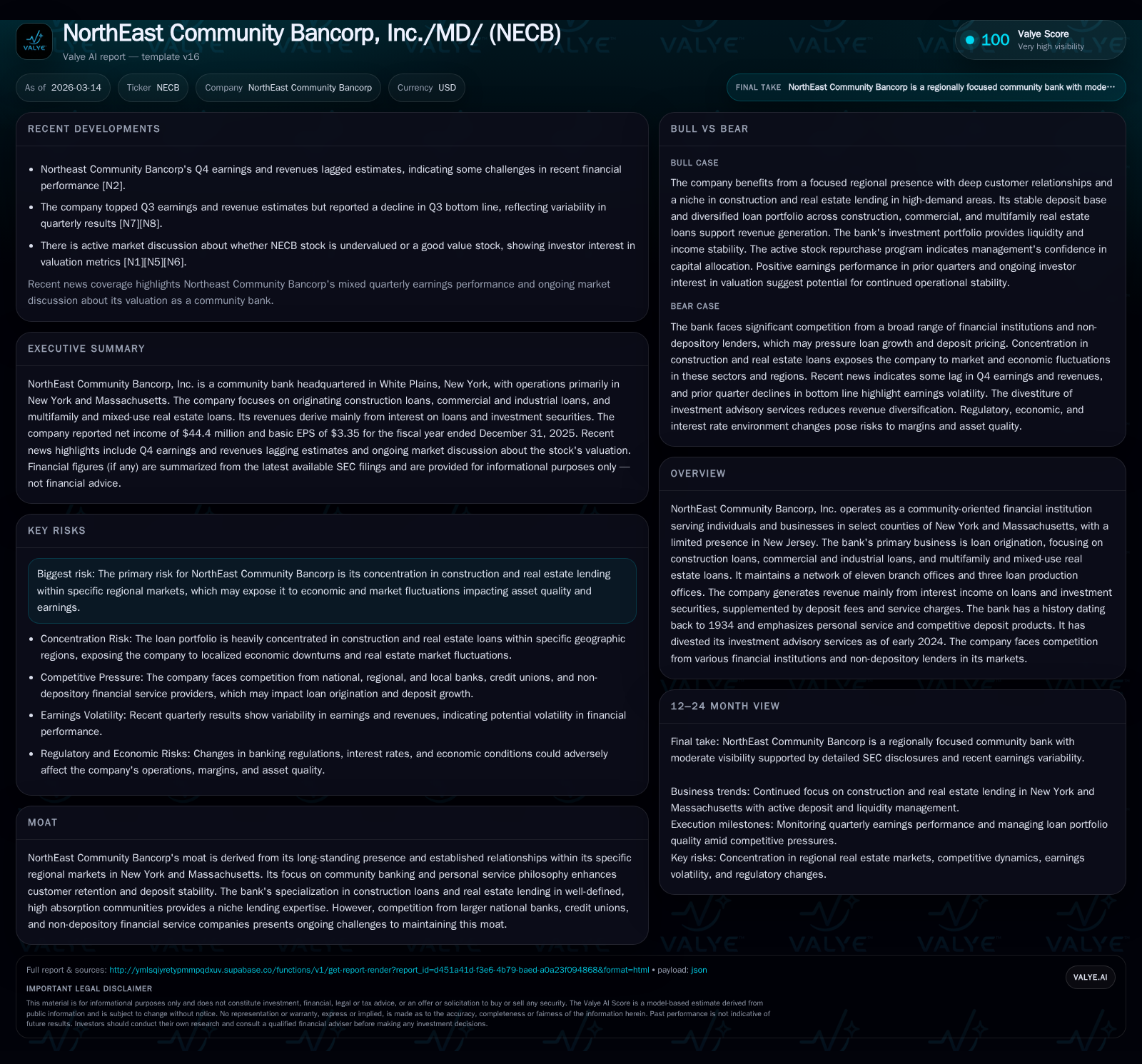
NorthEast Community Bancorp has demonstrated steady earnings growth, driven primarily by its niche focus on construction loans and multifamily real estate lending within select Northeast markets. The bank’s capital allocation favors consistent dividends with modest buybacks, reflecting cautious capital management amid loan concentration risk. Future expansion relies on sustained demand in high absorption communities, but competitive dynamics and geographic concentration remain key challenges to scaling earnings. Observers should watch loan portfolio quality trends and deposit funding costs to assess sustainability of returns.
Company Overview
NorthEast Community Bancorp (NECB) has cultivated a distinct identity as a community-centric financial institution since its founding in 1934. Primarily servicing select counties across New York State (including parts of the Bronx, Westchester, Orange, Rockland, Sullivan) and Massachusetts (Essex, Middlesex, Norfolk), NECB operates through eleven branches supplemented by three loan production offices located strategically to support its focused lending activities [S1][S6][S8]. Although it once held investment advisory services through Harbor West Wealth Management Group, this segment was divested early 2024 to concentrate solely on traditional banking operations [S8].
Fundamental to NECB’s business model is its specialization in lending products tailored to the Northeast region's multi-family housing and commercial real estate landscape. Construction loans dominate the portfolio; as of December 31, 2025, NECB reported approximately $1.8 billion in committed construction loans spanning high absorption locales characterized by strong demand-supply imbalances for rental or purchase properties [S17][S18]. Complementing this are multifamily (including cooperative apartments) and mixed-use real estate loans totaling over $300 million distributed between New York and Massachusetts markets [S13][S21]. This geographic and product concentration defines both the company’s moat—deep community relationships and localized expertise—and its principal risk exposure.
Historical Performance
Financially, NECB’s results reflect steady profitability with clear growth from a lower earnings base in 2022 followed by modest volatility thereafter. Net income increased significantly from $24.8 million in FY2022 to $46.3 million in FY2023 (+86%) before peaking at $47.1 million in FY2024 and dipping slightly (-5.7%) to $44.4 million in FY2025 [F1]. Operating cash flows have grown consistently (+8% YoY FY2025), reaching $52.6 million last fiscal year which demonstrates solid underlying cash generation despite some net income contraction [F1]. Capital expenditures remain minimal relative to scale given the branch-light strategy.
Historical performance (annual)
| FY | Net ($mm) | CFO ($mm) | Capex ($mm) | Net YoY |
|---|---|---|---|---|
| 2025 | 44 | 53 | 2 | -5.7% |
| 2024 | 47 | 49 | 1 | +1.7% |
| 2023 | 46 | 43 | 1 | +86.3% |
| 2022 | 25 | 28 | 3 |
Source: SEC companyfacts cache [F1].
Capital returns and efficiency (annual)
| FY | Div ($mm) | Buybacks ($mm) | FCF ($mm) |
|---|---|---|---|
| 2025 | 13 | 2 | 51 |
| 2024 | 8 | 3 | 48 |
| 2023 | 4 | 29 | 42 |
| 2022 | 7 | 9 | 24 |
Source: SEC companyfacts cache [F1].
Note: Operating cash flow reflects cash from operating activities per SEC filings [F1]. Dividends paid show a rising payout trend consistent with earnings growth.
Business Model & Moat
NECB’s entrenched position within tightly defined regional markets provides a moat centered on strong personal relationships bolstered by community banking principles [S19]. The bank maintains deep penetration especially in Bronx County’s high absorption neighborhoods where rental demand outstrips supply markedly—a niche lending specialization that larger banks often overlook due to scale inefficiencies [S19]. This nuanced market knowledge combined with competitive deposit products supported by longstanding client bases underpins enduring deposit stability—a vital funding source.
Importantly, NECB supplements retail deposits with brokered and listing service deposits which are cost-effective and optimized against loan maturities—a critical liquidity matching tactic particularly given the predominance of longer-duration construction loans [S4][S10]. Unlike many peers reliant on wholesale funds or wholesale borrowing structures that can fluctuate sharply during dislocations, NECB’s conservative use of Federal Home Loan Bank advances is absent as of end-2025; it instead holds sizeable borrowings at the Federal Reserve Discount Window authorized under the Borrower-in-Custody program ($70 million outstanding) providing contingent liquidity without immediate dilution risk [S10].
Loan Portfolio Characteristics & Risk Profile
Construction loans represent approximately two-thirds of NECB's portfolio commitment mix; these include multi-family residential developments with granular average commitments (~$4 million per loan if counted individually; ~$7 million when aggregated at project level), emphasizing projects located within Bronx County plus other NY counties like Orange and Rockland [S17][S18]. Loan underwriting standards incorporate rigorous collateral inspections, debt service coverage targets between approximately 1.25x-1.40x for multi-family properties ascending to ~2-3x actual coverage based on observed portfolio averages—a buffer against real estate market cyclicality [S20][S21].
Multifamily and mixed-use real estate loans sum nearly half a billion dollars split between New York City area apartments/coops ($148 million) and Massachusetts metropolitan markets ($177 million). These loans feature fixed-to-adjustable rate structures tied principally to Federal Home Loan Bank advance rates with capped lifetime increases protecting borrower affordability while preserving bank yield stability [S21]. Their average loan sizes (~$2 million for multi-family) indicate deliberate middle-market targeting.
Commercial & industrial lending makes up a smaller piece but remains significant (~$14-15 million outstanding on large accounts), often linked closely to existing construction clients or smaller local businesses; borrower limits are self-imposed below regulated caps to mitigate concentration risks [S11][S16]. Consumer unsecured loan exposure is de minimis (<0.01% of total loans), highlighting NECB’s focused business model away from higher credit risk retail segments.
Concentration risk remains elevated given sizable individual loan commitments approaching internal limits ($45 million self-imposed cap vs regulatory ~$51 million)[S11]. The largest construction loan balance ended December at $34.8 million (recently repaid January ‘26), underscoring the bank’s willingness to fund sizable projects within its chosen geographies while using participations sales to reduce line utilization where appropriate [S18][S15].
Competitive Landscape & Market Dynamics
NECB competes within mature Northeast metropolitan markets characterized by slow demographic growth but entrenched demand patterns shaped by socioeconomic diversity—from affluent Westchester/NYC counties to working-class Bronx areas—offering a differentiated opportunity set requiring localized underwriting expertise [S6][S19]. Competition for deposits is intense among national/regional banks as well as credit unions; similarly, commercial real estate lending faces encroachment from fintech lenders specializing in faster underwriting cycles albeit frequently higher-cost capital structures [S17].
The company's competitive advantage hinges on its personal service approach coupled with specialized knowledge of regulatory environments (e.g., rent stabilization impacts largely avoided by selective multifamily lending) that larger players may find challenging to replicate profitably [S16]. However, this narrow geographic footprint also constrains scale economies limiting margin expansion opportunities compared with diversified regional banks.
Capital Allocation & Returns
NECB exhibits a disciplined capital return profile aligned with its stable earnings base but cautious risk tolerance amid localized concentration risk considerations.
- Dividend distributions have grown steadily from $3.7 million in FY2023 to $13.3 million FY2025 reflecting commitment to returning excess capital while balancing reserve needs [F1].
- Share repurchases have been opportunistic; after a notable $28.7 million buyback in FY2023 following the step-up conversion in July ‘21 offering clarity post equity raise events, buybacks moderated sharply in subsequent years totaling $1.6 million in FY2025 evidencing measured capital redeployment [F1][N2].
- Return-on-equity calculated approximately at ~12.6% for FY2025 signals reasonable profitability consistent with peer group expectations given community bank size constraints but possibly capped by limited branching expansion and credit concentration risk [F1].
- Free cash flow remains healthy exceeding $50 million annually enabling sustained dividend coverage while fueling organic growth investments such as incremental technology upgrades or minimal branch expansions with capex under $2M annually despite loan growth ambitions [F1][N1].
Overall capital structure appears conservative with no Federal Home Loan Bank advances outstanding ending FY25 but sizable categorical borrowings via FRBNY Discount Window facilities provide optionality without levered liabilities amplifying strain under stress scenarios [S10][S26].
Growth Outlook & Headwinds
Future growth catalysts lean heavily on sustained or increasing demand for residential construction financing bolstered by favorable demographics within high absorption zones — especially where supply-demand imbalances persist across Bronx County luxury/affordable apartment developments alongside suburban expansions around White Plains metro areas [S18][N2]. Incremental branch network optimization planned around core locales could incrementally enhance new customer acquisition although no aggressive expansion plans disclosed thus far [S19].
Risks curtailing upside center on:
- Real estate market shifts impacting asset quality amid tightening lending conditions or rising interest rates affecting developer economics;
- Increased competition particularly fintech/private non-depository entrants eroding pricing power or customer wallet share;
- Regulatory changes including potential rent control expansions complicating underwriting assumptions specifically within heavily NYC-rooted portfolios;
- Concentrated portfolio credit risks exacerbated by exposure size limits pushing sales or participation arrangements reducing yield capture;
- Macro-economic uncertainties restraining new loan originations due to developments such as inflationary pressures or monetary policy shifts influencing deposit costs.
Absent explicit forward guidance disclosures from recent filings or press releases beyond early ’26 Q4 results confirming revenue misses versus estimates (indicative of transient pressure rather than structural impairment) investors should monitor quarterly trends for delinquencies or charge-offs plus deposit pricing strategies adapting competition-induced headwinds [N1][N2].
Conclusion
NorthEast Community Bancorp epitomizes a regional lender leveraging deep market knowledge across distinct Northeast submarkets emphasizing personal banking alongside specialized construction and multifamily lending expertise—a strategy underpinning stable deposit relationships and resilient franchise economics over decades.
Nonetheless, concentrated geographic footprints combined with concentrated lending exposures necessitate prudent risk management limiting aggressive growth narratives despite robust cash flow generation enabling steady dividends complemented by judicious opportunistic buybacks.
This balance positions NECB soundly within its niche yet mandates vigilant navigation of evolving marketplace dynamics encompassing increasing competition from non-bank lenders alongside ongoing asset quality vigilance amid cyclical fluctuations intrinsic to Northeast commercial residential markets.
Investors should prioritize ongoing monitoring of credit metrics trends, regulatory developments impacting rent regulation frameworks affecting portfolio sectors, competition evolution particularly from fintech entrants disrupting traditional underwriting models, as well as deposit cost trajectories pivotal to net interest margin sustainability.
Disclaimer: This report is for informational purposes only, synthesizing publicly available data without offering investment advice or recommendations regarding NorthEast Community Bancorp securities.
Disclaimer: This is research-only, informational analysis and not investment advice. It may include AI-generated interpretation and general industry context. Always verify important details using primary sources.

Comments