
AudioEye Inc.'s Rising Revenues and Profitability Hurdles Highlight Accessibility Market Dynamics
AudioEye's solid revenue growth underscores demand for digital accessibility, yet sustained losses and liquidity challenges complicate its path forward.
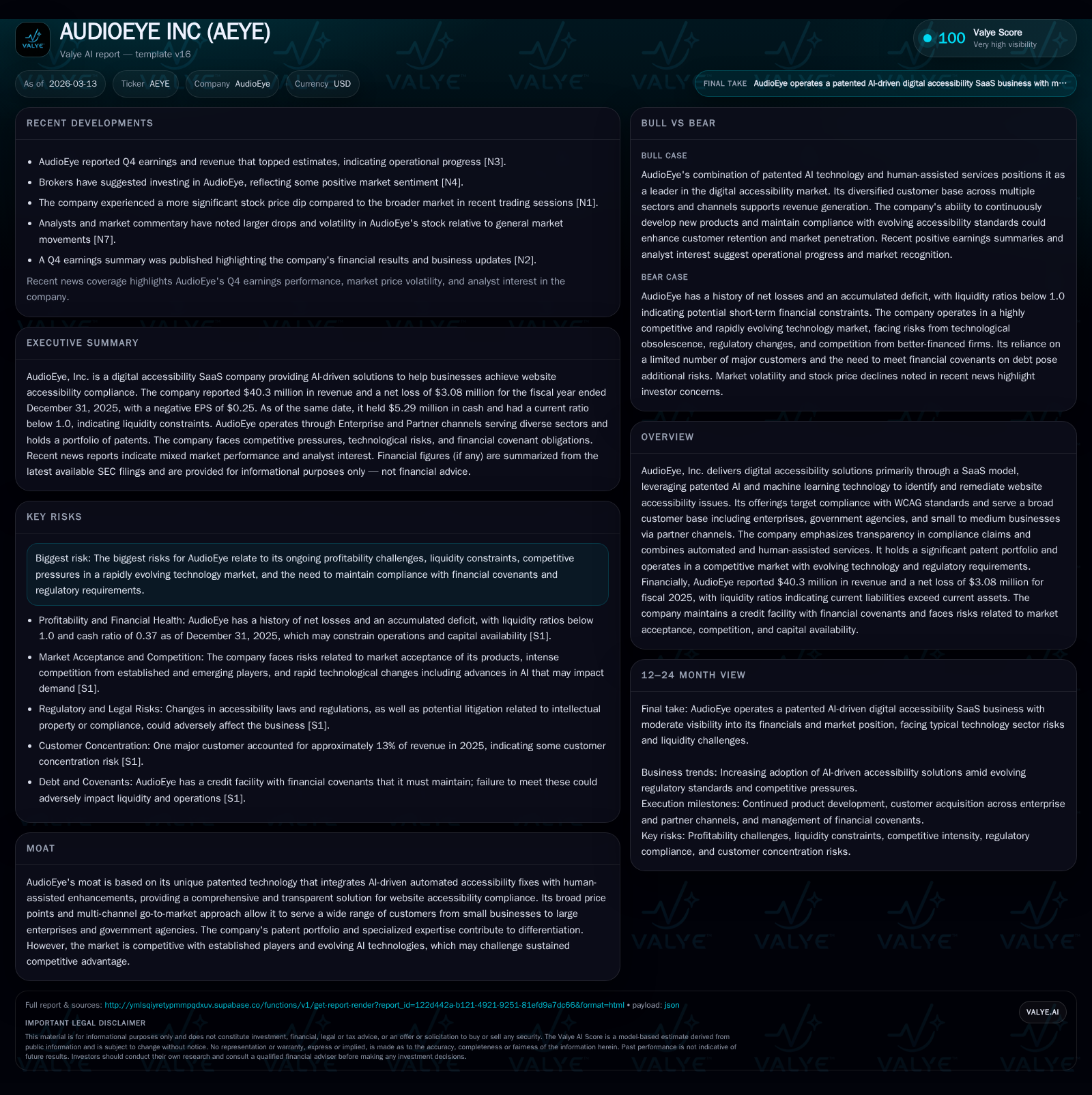
AudioEye, Inc. has demonstrated consistent revenue expansion through its SaaS offerings and multi-channel sales approach, growing revenues by 14.5% in fiscal 2025 to $40.3 million [F1]. Its patented AI-driven hybrid remediation platform differentiates it in a competitive accessibility market driven by evolving regulatory requirements [S8]. Despite operating expense leverage shown by narrowing operating losses (from -$10.4M in 2022 to -$1.8M in 2025), the company remains unprofitable, with a net loss of $3.08 million in FY2025 and liquidity pressures, including a current ratio below one and significant debt facilities on restrictive covenants [F1], [S4]. Key monitoring points include maintenance of financial covenants, customer diversification, and continued innovation investment amid intensifying AI competition.
Recent Revenue Growth Trends and Key Historical Drivers
Historical performance (annual)
| FY | Rev ($mm) | Net ($mm) | CFO ($mm) | OpInc ($mm) | Rev YoY | Net YoY |
|---|---|---|---|---|---|---|
| 2025 | 40 | -3 | 5 | -2 | +14.5% | +27.7% |
| 2024 | 35 | -4 | 3 | -3 | +12.4% | +27.6% |
| 2023 | 31 | -6 | 0 | -6 | +4.7% | +43.7% |
| 2022 | 30 | -10 | -5 | -10 |
Source: SEC companyfacts cache [F1].
Capital returns and efficiency (annual)
| FY | Buybacks ($mm) | FCF ($mm) | ROE% |
|---|---|---|---|
| 2025 | 5 | 5 | -64.1 |
| 2024 | 2 | 3 | -45.1 |
| 2023 | 1 | 0 | -87.6 |
| 2022 | 1 | -5 | -98.5 |
Source: SEC companyfacts cache [F1].
AudioEye’s top-line trajectory reflects steady momentum in the digital accessibility market. Revenue expanded from $29.9 million in FY2022 to $40.3 million in FY2025, representing a compound annual growth rate near 12% across this period with a notable 14.5% year-over-year increase in the latest fiscal year alone [F1]. This advance was powered primarily by its scalable SaaS delivery model combined with a multi-channel go-to-market approach that targets both enterprise clients and smaller businesses through partner and marketplace channels [S6]. The company’s ability to penetrate federal government agencies—mandated under Section 508 regulations—alongside sectors such as finance, retail, education, and transportation has diversified demand sources.
The leveraging of automated AI-driven solutions complemented by human-assisted fix services has facilitated client retention while expanding market share [N1], [S6]. Engagement via CMS partners and resellers for SMBs provides cost-effective access to emerging segments while enterprise deals contribute customized solution revenues. This balanced approach supported AudioEye’s growing annual recurring revenue base.
Technology Differentiation: Patented AI and Hybrid Remediation Approach
AudioEye’s moat rests significantly on its patented technology portfolio comprising 26 issued U.S. patents alongside three pending applications [S8]. The core software leverages artificial intelligence to conduct automated remediation of digital accessibility barriers keyed to WCAG standards—a compliance framework entrenched across U.S. regulatory regimes [S16]. However, unlike competitors relying solely on automation or consulting-based audits without direct remediation capabilities, AudioEye couples these automated fixes with expert human assistance to address more complex or nuanced accessibility challenges.
In practice, this manifests as continuous monitoring coupled with an issue reporting dashboard designed for non-technical users—enhancing transparency around compliance status and end-user experience impacts [S8]. This hybrid approach aligns closely with industry best practices emphasizing ongoing testing and repair rather than one-time fixes [S25]. Such comprehensive coverage addresses a broad spectrum of disabilities beyond visual impairments, including dyslexia and epilepsy.
Market Channels and Customer Segments Shaping Demand
Voice-of-customer data illustrates two principal channels: Enterprise and Partner & Marketplace [S6]. Enterprise customers include larger organizations often engaged directly via dedicated sales teams with tailored pricing models. This segment also accounts for government contracts requiring stringent adherence to accessibility mandates such as the ADA Title II/III provisions recently clarified through DOJ regulations [S16]. The Partner & Marketplace channel facilitates reach into SMBs primarily through CMS platforms or reseller marketplaces offering subscription flexibility.
This segmentation not only broadens AudioEye’s addressable market but captures regulatory-driven urgency that persists among public institutions and sectors prone to litigation risk over non-compliance claims [S29]. Notably, one major customer constituted about 13% of revenue in FY2025 showing moderate concentration risk but reflecting stable anchor clientele relationships [S6].
Profitability Trends and Operating Income Improvements
Financial discipline is evident as operating income losses have improved significantly from -$10.4 million in FY2022 to -$1.83 million in FY2025 [F1]. This progress is partly due to scale efficiencies achieved alongside stable revenue growth notwithstanding ongoing investments. Net losses likewise narrowed from -$10.4 million to -$3.08 million over the same stretch reflecting improved operational leverage.
Cash flow generation exhibits an encouraging trend: Operating cash flow shifted from negative $5 million in FY2022 to positive $4.75 million in FY2025—a striking +74% year-over-year surge most recently—underscoring better working capital management and potentially stronger collections or deferred spend timing [F1]. Capital expenditure remained modest relative to CFO (~$54k capex vs $4.75m CFO), contributing to free cash flow exceeding $4.6 million annually.
Nonetheless, return on equity remains negative at approximately -64%, reflecting cumulative losses over years since inception; thus path to consistent profitability requires continued focus on cost control paired with sustained revenue gains.
Capital Structure, Liquidity Status, and Covenant Implications
The company’s liquidity position presents constraints worth scrutiny. As of December 31, 2025, current assets stood at $12.6 million against current liabilities of $14.4 million yielding a current ratio of roughly 0.88—below the typical benchmark indicating potential short-term strain [F1]. Cash balances were approximately $5.3 million providing limited runway.
To bolster funding flexibility, AudioEye entered a Loan and Security Agreement on March 31, 2025 granting access to up to $20 million including an initial $12 million term loan advance plus revolving credit facilities capped at $3 million; borrowings mature in 2030 but include restrictive financial covenants tied to cash balances, debt-to-ARR ratios, adjusted EBITDA leverage limits, and fixed charge coverage ratios [S4], [S5].
Management explicitly acknowledges risks associated with covenant compliance especially amid macroeconomic uncertainty impacting IT spending patterns across client sectors that could delay purchases or renewals [S4], [S5]. Failure to meet these covenants or refinance on favorable terms may constrain strategic initiatives or cause liquidity crises.
Research, Development, and Intellectual Property Investments
Investment into innovation remains prioritized though capital expenditures are small relative to total expenses—capex declined nearly 58% YoY from $128k in FY2024 to just $54k in FY2025 while substantial software development costs are capitalized consistent with industry accounting practice [F1], [S7], [S20]. R&D focuses on advancing AI models used for automated remediation as well as expanding patent filings supporting differentiated features [S8], enhancing sustainability versus competitors increasingly leveraging off-the-shelf large language models without comparable proprietary systems.
Competitive Environment and Emerging Threats
The digital accessibility market sports competitive pressures from multiple fronts: pure-play audit platforms lacking fix mechanisms; consultancy-heavy providers emphasizing manual audits; established tech companies possibly integrating native accessibility via CMS or browser updates; as well as emerging AI-enabled entrants deploying novel generative techniques potentially displacing AudioEye’s hybrid approach [S8], [S9], [S12].
Furthermore, rapid advances in AI necessitate continual investment lest new entrants capture market share through faster or cheaper options compromising AudioEye's differentiation built around patented algorithms combined with human expertise.
Forecast Indicators and Milestones to Track
Explicit forward-looking guidance remains absent from public disclosures requiring analysts to track key performance indicators such as:
- Annual Recurring Revenue growth rates reflecting SaaS subscription traction,
- Channel mix shifts particularly Partner & Marketplace penetration relative to Enterprise,
- Concentration risk changes especially reliance on the largest customer,
- Compliance with financial covenants attached to credit facilities,
- Progression of patent filings signaling sustained innovation pipeline,
- Margin trends indicating movement towards profitability,
- Operating cash flow consistency maintaining liquidity cushion. Monitoring quarterly results for these metrics will be essential given no formal forecasts accompany earnings releases [N1], [N2].
Capital Allocation: Buybacks, Cash Flow Trends, and Return Metrics
Unlike many growth-stage tech firms foregoing capital returns entirely, AudioEye engaged actively in stock repurchases totaling approximately $4.58 million during FY2025—a more than doubling versus the prior year’s ~$2 million buybacks indicating management’s visible commitment towards shareholder value despite unprofitable operations [F1], [S23]. These buybacks coincide with positive free cash flow generation circa $4.7 million.
Dividend payments are not part of the capital distribution strategy reflecting reinvestment preference during current scale-up phase alongside strengthening the balance sheet post-debt financing activity.
The persistent negative return on equity emphasizes room for improvement in translating revenue expansion into sustainable bottom-line results albeit signs of operating margin progress provide cautious optimism.
This report is based solely on publicly available information as of March 13, 2026. It presents an analytical overview without any investment advice or recommendations regarding AudioEye Inc.’s securities. Readers should consider additional sources before forming opinions related to valuation or ownership decisions.
Disclaimer: This is research-only, informational analysis and not investment advice. It may include AI-generated interpretation and general industry context. Always verify important details using primary sources.

Comments