
Mid Penn Bancorp Expands via Acquisitions While Managing Credit and Interest Rate Risks
Mid Penn Bancorp relies on a concentrated commercial loan portfolio and strategic acquisitions to drive moderate growth amid regulatory and competitive challenges.
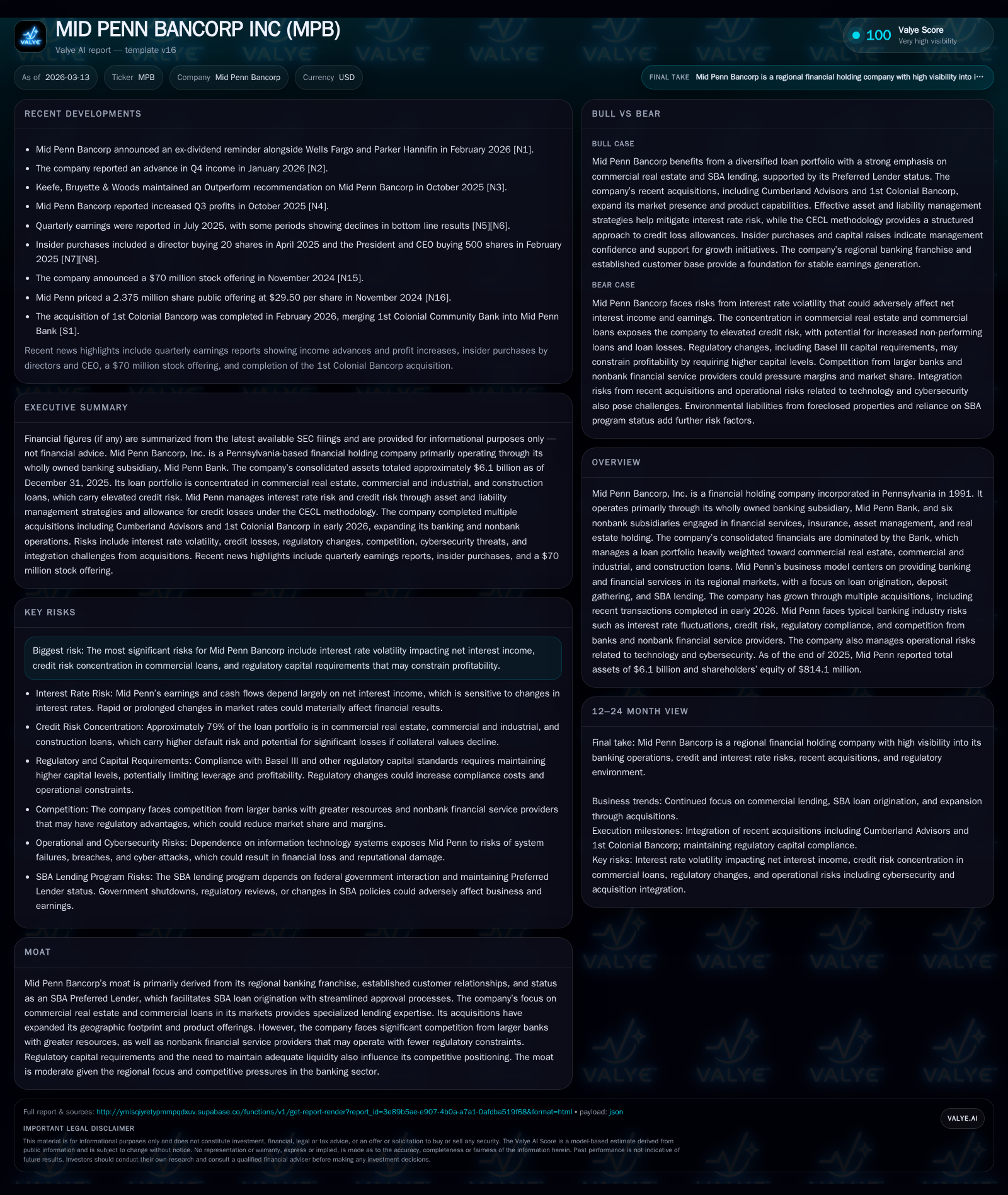
Mid Penn Bancorp, a Pennsylvania-based financial holding company, has grown through targeted acquisitions and a focus on commercial real estate and SBA lending. Its loan portfolio remains concentrated in higher-risk commercial loans, exposing it to credit risk and interest rate volatility especially given the fluctuating monetary policy environment. The company reported steady net income growth over the past three years with an improving capital base and increased cash flow generation. However, competition from larger banks and regulatory capital requirements pose constraints on future profitability. The recent acquisitions of Cumberland Advisors and 1st Colonial expand Mid Penn’s footprint but integration risks and cost pressures remain key concerns.
Company Overview
Mid Penn Bancorp, Inc., headquartered in Pennsylvania since its formation in 1991, operates primarily through its wholly owned subsidiary Mid Penn Bank along with six nonbank subsidiaries focused on financial services, insurance, asset management, and real estate holding [S1]. Its core business centers on regional banking activities including loan origination predominantly in commercial real estate (CRE), commercial and industrial (C&I), construction loans, deposit gathering, and SBA lending—a segment benefiting from its status as an SBA Preferred Lender which expedites government-backed loan approvals .
As of December 31, 2025, Mid Penn reported consolidated assets totaling $6.1 billion, deposits of $5.2 billion, and shareholders’ equity of approximately $814 million [F1], reflecting a significant capital base for a regional bank.
Historical Financial Performance
Mid Penn’s financial performance has displayed resilience over recent years characterized by measured earnings growth supported by both organic expansion and strategic acquisitions. Net income advanced from approximately $37.4 million in FY2023 to $49.4 million in FY2024 (+32% YoY), driven by higher loan volume and improved efficiency metrics before further rising to $56.2 million in FY2025 (+13.8% YoY) as synergies from acquisitions took hold [F1].
Operating cash flow showed even stronger acceleration reaching $80 million in FY2025 up from about $51 million prior year (+55.7% YoY), demonstrating increasing conversion of profits into liquidity. Capital expenditures rose moderately consistent with branch expansions, technology upgrades, and infrastructure modernization needs.
Historical performance (annual)
| FY | Net ($mm) | CFO ($mm) | Capex ($mm) | Net YoY |
|---|---|---|---|---|
| 2025 | 56 | 80 | 8 | +13.8% |
| 2024 | 49 | 51 | 7 | +32.2% |
| 2023 | 37 | 52 | 3 | -31.8% |
| 2022 | 55 | 60 | 4 |
Source: SEC companyfacts cache [F1].
Capital returns and efficiency (annual)
| FY | Div ($mm) | Buybacks ($mm) | FCF ($mm) |
|---|---|---|---|
| 2025 | 18 | 2 | 72 |
| 2024 | 14 | 0 | 44 |
| 2023 | 13 | 5 | 49 |
| 2022 | 13 | 3 | 56 |
Source: SEC companyfacts cache [F1].
Mid Penn’s approximate return on equity (ROE) stood at around 6.9% at the end of FY2025 based on reported net income relative to equity in that period—a moderate level reflecting the tradeoff between growing capital buffers under Basel III regulations and profitability constraints stemming from concentration risks and competitive pressures [F1].
Portfolio Composition & Credit Risk
The Bank’s loan portfolio concentration remains notably skewed toward commercial real estate (CRE), C&I loans, and construction lending which together constitute roughly 79% of total loans as of year-end 2025 [S1]. These categories inherently carry higher default risk compared with residential mortgages or consumer loans due to larger individual loan sizes inherently linked to single borrowers or projects.
Management acknowledges that deterioration in local economic conditions impacting these sectors—such as downturns in Pennsylvania’s property markets or shifts in industrial activity—could significantly elevate non-performing assets and credit losses [S8]. Additionally, restrictions on realizing full value on collateral tied to foreclosed real estate introduce further downside exposure.
To mitigate credit risk concentration issues, Mid Penn maintains an allowance for credit losses calibrated under the Current Expected Credit Loss (CECL) methodology implemented since early 2023 which incorporates historical loss trends along with forward-looking economic indicators [S10]. Nevertheless, allowances may prove insufficient during abrupt downturns or unexpected borrower defaults.
Interest Rate Risk & Asset Liability Management
Earnings are substantially dependent on net interest income (NII), defined as the spread between yields earned on interest-bearing assets principally loans/securities versus interest paid on deposits/borrowings [S1]. The company faces pronounced interest rate risk especially given the post-pandemic environment where Federal Reserve policy has caused volatility by raising rates to combat inflation.
If deposit costs rise faster than asset yields or if loan yields lag concurrent funding expenses due to repricing mismatches or competitive pressure limiting pricing power, Mid Penn’s NII—and consequently earnings—would be negatively impacted [S18]. The firm employs asset-liability management strategies aimed at offsetting such imbalances but recognizes that rapid or large rate shifts could have material adverse outcomes.
Strategic Growth Through Acquisitions
Mid Penn has pursued accelerated growth via bank mergers: it has completed six whole bank mergers since late-2010s including recent early-2026 transactions acquiring Cumberland Advisors (a nonbank financial asset manager) and merging with Pennsylvania-based competitor 1st Colonial Bancorp effectively expanding geographic reach as well as diversifying revenue streams beyond traditional banking products [S3, S15].
While such growth supports scale economies and customer base expansion, integration complexity presents risks: combining disparate systems/processes requires substantial investments of time and resources while maintaining customer relationships during transitions is challenging especially amid competitive markets [S15].
Competitive & Regulatory Challenges
Mid Penn operates within a competitive landscape involving other regional/national banks boasting broader geographic scope, larger capital bases allowing more aggressive pricing/lending limits as well as emerging fintech/nonbank lenders operating under lighter regulatory burdens providing specialized products [S5,S7]. This competitive pressure moderates margin expansion potential.
Regulatory requirements imposed by Basel III necessitate maintaining higher common equity levels that potentially reduce leverage capacity restricting interest earning asset growth which limits profitability prospects despite otherwise favorable market conditions [S6]. Furthermore, the bank holding company structure restricts dividend flows subject to upstreaming earnings primarily from the bank subsidiary that must operate within profitability/regulatory frameworks governing dividend payments impacting shareholder returns sustainability [S27].
Capital Allocation & Returns Context
Despite growth challenges Mid Penn has demonstrated disciplined capital allocation evidenced by: steady increases in dividend payouts each year (reaching roughly $18 million distributed during FY2025), alongside ongoing albeit smaller share repurchases totaling approximately $2.3 million for FY2025 reflective of conservative share buyback policies appropriate for a mid-sized institution managing regulatory capital requirements prudently [F1].
Operating cash flows comfortably cover both reinvestment needs indicated by capex outlays ($8 million annually reflecting branch upgrades/technology investment efforts) plus distributions to shareholders leaving a robust free cash flow profile ($71 million positive FCF in FY2025) supporting ongoing financial flexibility while maintaining capital ratios above minimum thresholds [F1].
Future Growth Prospects & Risks Analysis
Growth drivers include:
- Leveraging SBA Preferred Lender status to originate government-backed loans more efficiently attracting small businesses within the region.
- Expanding market share through successful integration of recent acquisitions enhancing product suite breadth including asset management via Cumberland Advisors.
- Enhancing technology platforms enabling competitive multi-channel delivery improving customer retention/acquisition.
However, several constraining factors prevail:
- Elevated credit risk concentration aligned with regional economic cycles could trigger higher provisions hurting near-term earnings.
- Sustained interest rate volatility may compress net interest margins despite existing hedging techniques.
- Competitive intensity fueled by larger banks’ scale advantages plus agile nonbank entrants applying digital-centric models erodes pricing power.
- Regulatory capital constraints delay balance sheet scaling requiring cautious capital raises potentially dilutive to shareholders if done under adverse market conditions.[N1]
- Integration execution risks for recent mergers could uncover unforeseen costs reducing anticipated synergy capture timing or scale [S25].
What To Watch Going Forward (Analysis)
Key metrics investors would monitor include quarterly net interest margin trends given evolving monetary policy stance; nonperforming loan ratios focused on CRE/C&I segments signaling emerging credit stress; progress on merger integration milestones quantifying cost savings or revenue enhancement achievements; regulatory filings updating capital adequacy status balancing growth ambitions against compliance; technological adoption outcomes impacting efficiency ratios; alongside dividend policy continuity reflective of underlying cash flow stability.
As detailed earnings guidance appears absent for upcoming periods due to acquisition-related transitional dynamics , market participants should evaluate press releases or call disclosures addressing first-year post-merger operational integration updates along with any SBA program changes which influence fee income.
Conclusion
Mid Penn Bancorp stands at a crossroads where solid historical profitability growth driven by strategic acquisition-led expansion meets sizeable challenges inherent in managing credit risk concentration within commercial-heavy portfolios alongside navigating volatile interest rate environments common across community/regional banking sectors today.
The firm’s cautious yet confident approach involving measured capital deployment balanced against dividend returns supports ongoing resilience though near-term performance will hinge critically on merger integration success plus prudent management of evolving regulatory/competitive headwinds.
Apart from execution factors intrinsic to mid-tier regional banking franchises expanding capacity amid tightening rulesets creates nuanced tradeoffs appearing emblematic in Mid Penn’s current positioning.
This analysis is intended solely for informational purposes based on available data as of early-2026 filings and does not constitute investment advice.
Disclaimer: This is research-only, informational analysis and not investment advice. It may include AI-generated interpretation and general industry context. Always verify important details using primary sources.

Comments