
Immersion Corporation's Surging Earnings Offset by Patent Battles and Tax Disputes
Strong financial gains in FY2025 contrast with ongoing litigation and tax challenges that cloud near-term clarity.
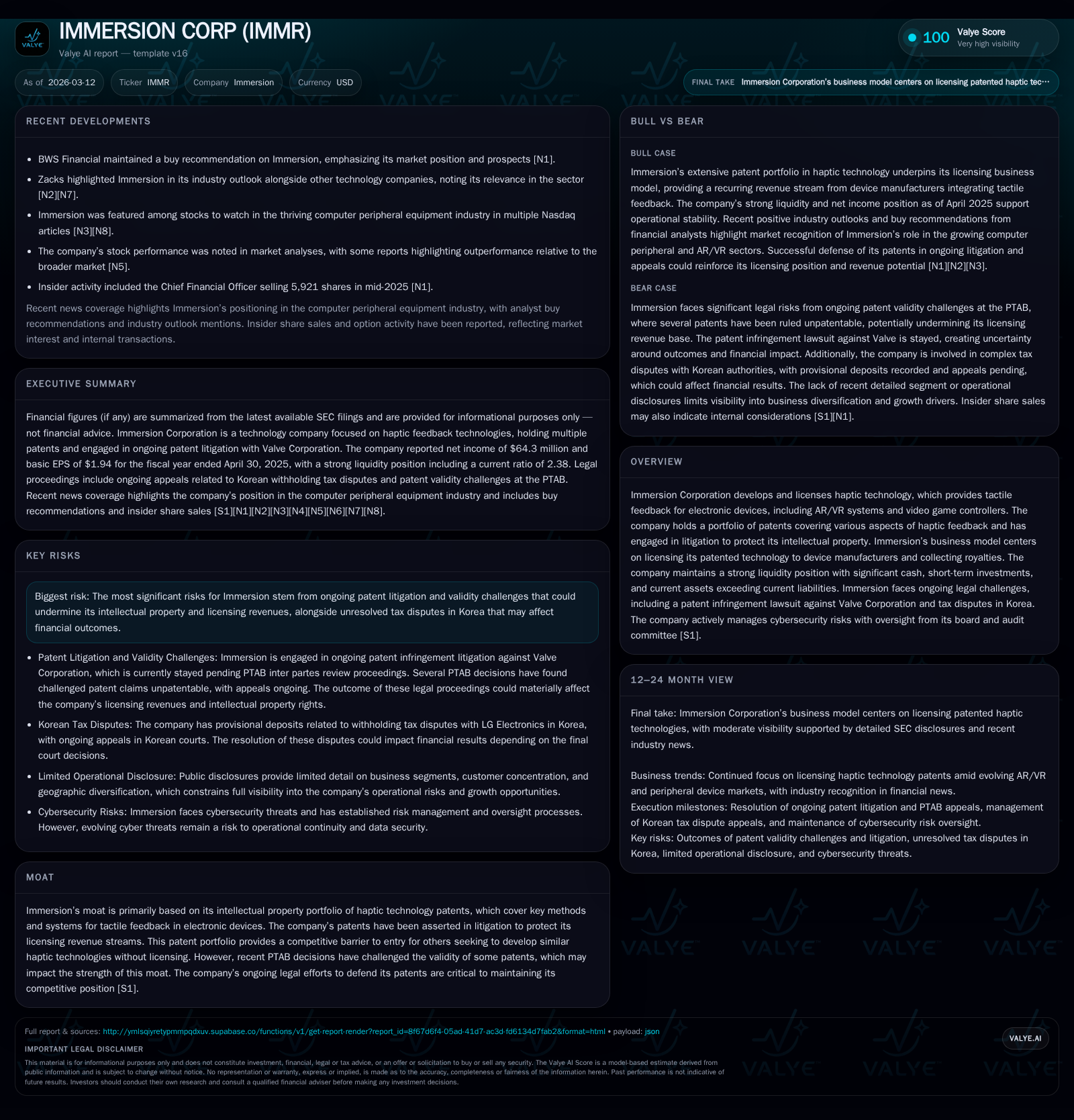
Immersion Corporation reported exceptional revenue growth of 57.6% and a staggering 558% increase in operating income for the fiscal year ended April 30, 2025, driven primarily by robust licensing revenues from its haptic technology patents. However, the company faces significant headwinds from patent validity challenges mounted by Valve Corporation through inter partes reviews (IPRs) and an ongoing patent infringement lawsuit currently stayed pending these outcomes. Simultaneously, tax disputes with Korean authorities over withholding taxes related to LG Electronics have led to provisional deposits and protracted legal appeals. These legal and regulatory pressures introduce uncertainty despite Immersion's strong liquidity position and solid capital returns including dividends and modest buybacks.
A Breakout Year: Review of Immersion’s Historical Financial Growth
Immersion Corporation delivered robust financial performance for fiscal year ended April 30, 2025 (FY2025), marking a strategic inflection point. The company recorded a revenue increase of approximately 57.6% year-over-year compared to prior periods; operating income surged by about 558%, reaching $118 million, reflecting scaling licensing success and operational leverage [F1]. Net income rose nearly 89% to approximately $64 million, indicating effective cost management despite elevated legal expenses.
However, operating cash flow turned negative at -$57.6 million in FY2025 compared with positive inflows in previous years. This decline primarily reflects higher investment activities including capital expenditures exceeding $11 million versus negligible amounts previously—likely associated with patent defense and technology development efforts [F1].
Historical performance (annual)
| FY | Net ($mm) | CFO ($mm) | OpInc ($mm) | Capex ($mm) | Net YoY |
|---|---|---|---|---|---|
| 2025 | 64 | -58 | 118 | 11 | |
| 2023 | 34 | 21 | 18 | +10.8% | |
| 2022 | 31 | 40 | 24 | 0 | +145.6% |
| 2021 | 12 | 17 | 18 | 0 |
Source: SEC companyfacts cache [F1].
Capital returns and efficiency (annual)
| FY | Div ($mm) | Buybacks ($mm) | FCF ($mm) |
|---|---|---|---|
| 2025 | 13 | 2 | -69 |
| 2023 | 7 | 8 | |
| 2022 | 13 | 40 | |
| 2021 | 0 | 17 |
Source: SEC companyfacts cache [F1].
Note: Revenue figures for recent years are based on latest available data points; percentages reflect year-over-year changes where available.
Drivers Behind Revenue and Profit Acceleration
The primary driver behind Immersion’s growth is its licensing model anchored on a broad portfolio of haptic feedback patents integral to augmented reality (AR), virtual reality (VR), and next-generation gaming controllers [S1]. Royalty income stems from agreements with consumer electronics manufacturers embedding Immersion's patented tactile feedback technologies.
Business segments include intellectual property licensing facilitated via subsidiaries such as those in Ireland that manage global royalty inflows [S5]. The company's focus on expanding patent coverage ensures exclusivity for various vibration and sensor-based tactile effects critical for immersive digital experiences.
While client concentration supports revenue consistency, it also introduces exposure risk if key partners face contractual or patent validity challenges impacting future royalties.
Legal Battles: Patent Litigation Against Valve
Since May 2023, Immersion initiated patent infringement litigation against Valve Corporation alleging that Valve’s Steam Deck handheld system and Valve Index VR hardware infringe seven patents covering fundamental haptic feedback technologies [S8]. These patents relate to methods for delivering tactile sensations through adaptive input interpretation and proximity-based haptics overlay in AR contexts.
Valve responded with motions which were superseded by motions to stay litigation pending inter partes review (IPR) proceedings before the U.S. Patent Trial and Appeal Board (PTAB) challenging these patents’ validity [S9]. Multiple IPRs were instituted between mid-2024 and mid-2025 resulting in final written decisions declaring all challenged claims unpatentable during FY2025 [S15]. Immersion has filed appeals at the Federal Circuit Court seeking reversal of these rulings.
The district court case remains stayed until PTAB appeals conclude, prolonging litigation risk that may affect royalty revenue sustainability depending on appeal outcomes.
Korean Tax Disputes Impacting Financials
Immersion faces complex withholding tax disputes stemming from investigations by Korean tax authorities into royalty payments made by LG Electronics between fiscal years roughly spanning 2012–2017 and again from about 2018–2022 [S6,S7]. Authorities allege LG Electronics failed to withhold appropriate taxes on royalties routed through Immersion’s Ireland subsidiary.
The company provided provisional deposits totaling approximately $7+ million KRW equivalent under agreements pending appeal outcomes; these deposits remain recorded on the balance sheet net of impairment charges per accounting standards [S7,S8].
Legal proceedings have seen initial unfavorable rulings overturned at the Korean Administrative Court level in June 2023; however, appeals by tax authorities continue at the Seoul High Court with hearings as recent as early calendar year 2026 [S7].
This ongoing dispute introduces cross-border taxation uncertainty potentially affecting cash flow timing if additional payments or penalties arise.
Intellectual Property: Defensive Moat Under Pressure
Immersion’s competitive advantage rests heavily on its extensive intellectual property estate protecting core haptics technologies essential for tactile feedback experiences in consumer devices [S1]. This portfolio underpins royalty revenues but requires sustained enforcement involving costly litigation.
Recent adverse PTAB decisions invalidating multiple key patents expose vulnerabilities inherent in reliance on an IP moat subject to administrative challenges affecting long-term sustainability.
The company’s active defense strategy includes responses to IPR petitions, sur-replies, oral arguments, appeals filings, alongside district court actions—balancing protection of existing royalties with efforts toward patent portfolio renewal through research and development.
Financial Health and Capital Allocation Overview
Despite legal headwinds, Immersion holds a solid liquidity position supported by current assets of $631.8 million against current liabilities of $265.9 million yielding a current ratio near 2.38 — indicative of strong short-term financial flexibility [F1]. Equity expanded substantially to $298 million as of FY2025 reinforcing balance sheet strength.
Capital returns continue but reflect prudence amid uncertainties; dividends rose meaningfully to approximately $12.85 million while share repurchases slowed to around $2.4 million in FY2025 [F1,S14,S16].
Return on equity is estimated near 21.6%, demonstrating efficient equity utilization considering substantial net income growth alongside elevated capex spending exceeding $11 million—a more than thirtyfold increase over prior periods—which negatively impacted free cash flow pushing it into negative territory near -$68 million due to reinvestment into proprietary technology assets [F1].
Outlook: Key Milestones and Risks Ahead
Investors should monitor critical upcoming events including PTAB final written decisions expected by March–April calendar year 2026 concluding inter partes reviews challenging core patents which may materially affect IP enforceability [S15]. Federal Circuit appellate briefs due thereafter will further shape resolution timelines.
Simultaneously, appellate court progress regarding Korean withholding tax matters at the Seoul High Court remains vital due to potential financial implications impacting earnings realization.[S7]
Licensing revenue trends amid these legal risks will indicate whether royalty contributions maintain growth momentum or face pressure aligned with evolving patent defensibility.
Management disclosures within upcoming quarterly filings will be important for assessing shifts in legal outlooks or capital allocation strategies influencing investor perspectives.
Analysis based solely on publicly available SEC filings as of March 12, 2026 ([F1],[S1]-[S29]). This is not financial advice or investment recommendation.
Disclaimer: This is research-only, informational analysis and not investment advice. It may include AI-generated interpretation and general industry context. Always verify important details using primary sources.

Comments