
INOVIO Pharmaceuticals Struggles with Rising Losses and Liquidity Constraints as DNA Medicine Platform Advances
Company faces growing financial pressures while advancing proprietary DNA medicine and device technology amid regulatory and commercialization challenges.
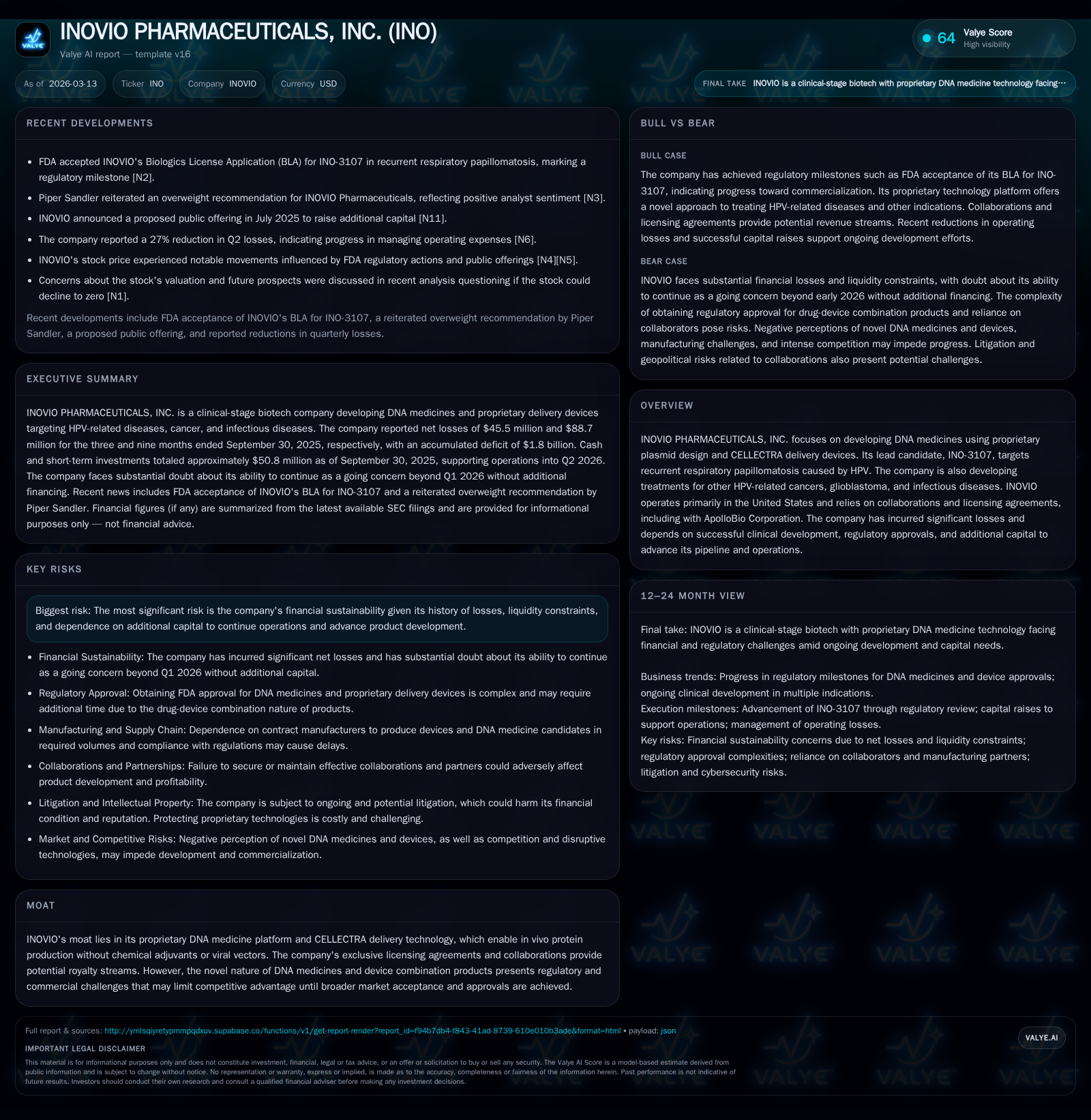
INOVIO PHARMACEUTICALS, INC. has historically generated modest revenue, with top-line figures rising slowly from $2.5 million in 2014 to $8.8 million in 2017, driven primarily by collaborations and licensing agreements. The firm's breakthrough DNA medicine platform paired with its CELLECTRA device remains promising but faces regulatory complexity due to the novelty of drug-device combination products. Despite ongoing development of candidates such as INO-3107 for HPV-related diseases, the company incurs steep operating losses, totaling about $87 million in 2025, while burning substantial cash flow. Liquidity constraints present a key risk with a going concern qualification noted beyond Q2 2026, as continued operations depend on successful clinical progress and new capital raises. Capital allocation has focused on financing R&D and warrant issuances rather than dividends or buybacks, reflecting INOVIO's developmental stage and financial pressures.
Historical Growth and Financial Performance
INOVIO PHARMACEUTICALS has demonstrated incremental revenue growth over the years, anchored largely by partnership deals rather than product sales. The company's top-line climbed steadily from approximately $2.46 million in fiscal year (FY) 2014 to nearly $8.79 million by FY2017 [F1]. This growth was driven primarily through collaborations such as licensing agreements with ApolloBio Corporation for the VGX-3100 DNA immunotherapy targeting HPV-associated pre-cancers [S13]. However, total revenues have remained limited given INOVIO’s developmental status and absence of marketed products.
Despite this modest revenue expansion, INOVIO incurred substantial operating losses every year reported since at least FY2022 — peaking at a loss of about $268 million in FY2022 before improving to approximately -$112 million in FY2024 and further narrowing to roughly -$86.8 million in FY2025 [F1]. Net income mirrored this trend of sizable net deficits: a high negative $280 million in FY2022 shrinking to nearly -$85 million by end-2025 [F1].
The company’s operating cash flow remains deeply negative, signaling a continued burn largely related to research and clinical development activities—registering an outflow of approximately $88.6 million during FY2025 alone [F1]. Capital expenditures have been relatively small compared to operating spend but consistent with maintaining their proprietary facilities and device manufacturing capability.
Historical performance (annual)
| FY | Net ($mm) | CFO ($mm) | OpInc ($mm) | Capex ($) | Net YoY |
|---|---|---|---|---|---|
| 2025 | -85 | -89 | -87 | 285698 | +20.8% |
| 2024 | -107 | -104 | -112 | 487832 | +20.6% |
| 2023 | -135 | -124 | -144 | 320898 | +51.7% |
| 2022 | -280 | -216 | -268 | 969153 |
Source: SEC companyfacts cache [F1].
Capital returns and efficiency (annual)
| FY | FCF ($mm) | ROE% |
|---|---|---|
| 2025 | -89 | -352.5 |
| 2024 | -105 | -156.6 |
| 2023 | -125 | -115.1 |
| 2022 | -217 | -125.8 |
Source: SEC companyfacts cache [F1].
*Data for latest full year (FY2025) per latest filings [F1]
Future Growth Prospects: Drivers and Constraints
INOVIO’s central competitive advantage resides in its proprietary DNA medicine platform coupled with the CELLECTRA delivery system — an electroporation device enabling plasmid DNA uptake into cells without chemical adjuvants or viral vectors [S2]. This novel approach allows potentially safer and repeatable administration of therapeutic proteins or vaccines directly.
The lead clinical candidate INO-3107 targets recurrent respiratory papillomatosis caused by human papillomavirus (HPV), aiming to address an underserved patient population with few alternatives . The company’s pipeline also includes candidates directed at other HPV-mediated cancers, glioblastoma multiforme—a notoriously difficult brain cancer—and certain infectious diseases.
However, translating this innovative platform into commercial products faces multiple headwinds:
Regulatory complexity: Being combination drug-device products requires simultaneous approvals that may extend timelines or require additional data compared to conventional drugs alone [S2]. Delays or denials here could cap near-term growth potential.
Commercial acceptance: Market skepticism regarding DNA therapies’ efficacy or safety profile compared with mRNA or viral vector vaccines may slow adoption until proven clinically and commercially validated.
Supply chain risks: Disputes over manufacturing partnerships, such as those previously encountered with VGXI regarding plasmid supply, can disrupt development schedules [S4].
Financial capacity: Given ongoing losses and depleted cash resources, the ability to secure sufficient capital is essential for continued R&D progress and eventual commercialization.
On the upside, collaboration agreements like the exclusive deal with ApolloBio for VGX-3100 development outside the US may provide milestone-based payments up to $20 million plus royalties if approved — representing potential non-dilutive value once realized [S13].
Forecasts, Milestones, and What to Watch
Explicit guidance from INOVIO remains limited publicly within recent filings; however, critical near-term milestones revolve around:
- Clinical trial progression for INO-3107 in recurrent respiratory papillomatosis and other pipeline candidates.
- Regulatory submissions including potential Biologics License Application (BLA) filings contingent on trial success.
- Achievement of milestone payments linked to ApolloBio collaboration upon regulatory approvals abroad.
- Securing additional financing rounds or strategic partnerships crucial for bridging operations beyond mid-2026 considering existing cash runway [S12][N1].
Monitoring progress against these milestones will be vital for assessing viability beyond current financial constraints.
Capital Allocation and Returns Analysis
INOVIO currently does not generate positive earnings or free cash flow; instead it relies heavily on equity financings supported by issuance of common stock and warrants to fund R&D commitments [S11][F1]. For example:
- Multiple offerings in late 2024 through mid-2025 raised net proceeds collectively exceeding $50 million via combined sales of common stock and attached warrants priced mostly between $1.75 to $7+ per share equivalent units.
- As of late September 2025, common stock warrants outstanding exceed 38 million shares carrying significant liability values recorded under accounting fair value requirements — causing marked swings between liability classification and shareholders’ equity upon exercise events [S21][S25][F1].
No dividends or share repurchase programs are reported given the developmental status and capital preservation focus.
The company’s approximate return on equity remains negative at nearly -350%, reflecting ongoing accumulated deficits relative to shareholders’ equity which contracted below zero recently due to losses outweighing paid-in capital despite substantial equity raises over time [F1].
Working capital stood positive but tight as of December 31, 2025 — current assets approximated $61 million versus current liabilities near $44 million yielding a current ratio around 1.4x; however, notes remain about substantial doubt concerning going concern status beyond second quarter of calendar year 2026 without further capital inflows or operational improvements [F1][S12].
Industry Context (Analysis)
DNA medicines represent an emerging therapeutic class differentiated from mRNA platforms that surged during COVID vaccination campaigns by offering potentially more stable storage profiles and repeated dosing capabilities due to non-immunogenic delivery methods like electroporation devices used by INOVIO’s CELLECTRA technology. However, this nascent field confronts significant moments of truth regarding scale-up manufacturing reliability—especially with plasmid production—and cost competitiveness against more established modalities.
Combination product regulation remains relatively uncharted territory posing distinct challenges; companies pioneering approval pathways often encounter protracted review cycles requiring both device usage validation alongside traditional pharmacological assessments.
Furthermore, partnership models encompassing licensing agreements enable smaller biotech firms like INOVIO to leverage regional commercial expertise while mitigating direct marketing expense burdens but place reliance on external parties’ execution effectiveness.
Legal and Operational Risks
INOVIO faces ongoing litigation risks highlighted by disputes around contract manufacturing partners such as VGXI alleging breaches impacting supply continuity—factors that could lead to costly outcomes although no material adverse judgments are anticipated currently based on management disclosures [S4][S10][S28]. Cybersecurity governance tracks proactively given sensitivities around proprietary technology assets managed under board oversight frameworks incorporating certified IT leadership roles addressing threat mitigation protocols [S1]. Additionally, geopolitical concerns arise from collaborations involving Chinese entities which may complicate operational fluidity amid uncertain regulatory environments abroad.
Conclusion
INOVIO Pharmaceuticals embodies a high-risk/high-reward early-stage biotech anchored by innovative DNA-based therapeutics delivered through proprietary device technology with promising indications targeting unmet medical needs such as HPV-related diseases and glioblastoma cancer forms. While historical revenue traction exists albeit limited, persistent operating losses combined with looming liquidity constraints underscore a precarious financial position necessitating successful clinical data readouts or regulatory achievements alongside renewed capital injections for survival past mid-2026.
Stakeholders should closely monitor the company’s pathway through upcoming clinical milestones, regulatory engagements particularly FDA approvals involving their complex drug-device combination candidates, progress within collaborative commercialization efforts such as those through ApolloBio Corporation, funding execution outcomes including warrant exercises or public offerings, and any material legal developments which could affect operations.
DISCLAIMER: This analysis is provided solely for informational purposes without any investment advice or recommendations intended or implied herein.
Disclaimer: This is research-only, informational analysis and not investment advice. It may include AI-generated interpretation and general industry context. Always verify important details using primary sources.

Comments