
America's Car-Mart Faces Margin Pressures and Credit Losses While Refining Dealership Footprint
The company confronts declining sales volume and rising credit provisions amidst strategic consolidation and financing challenges.
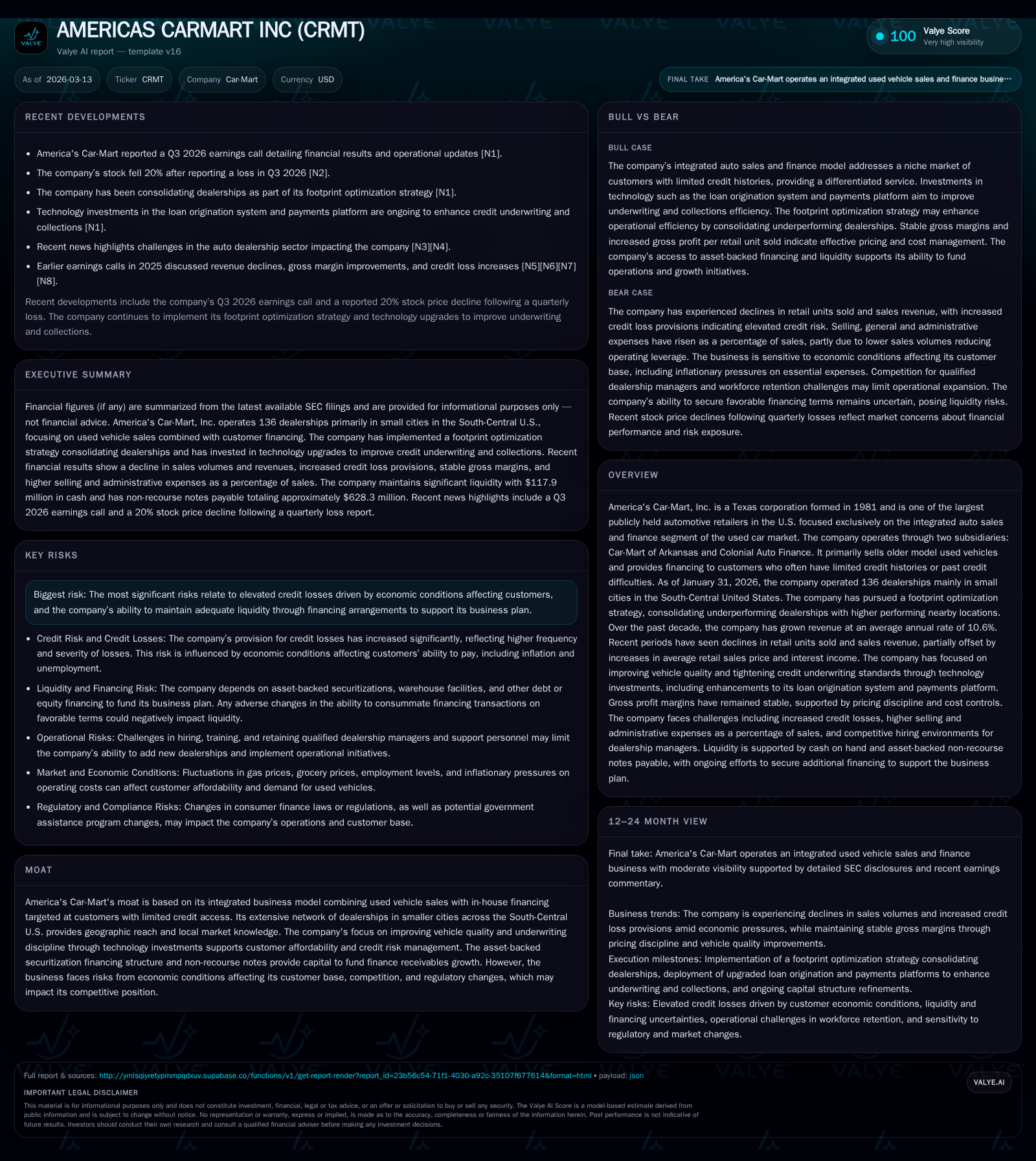
America's Car-Mart, Inc. reported a slight revenue decline and a net loss in recent quarters after a decade of steady growth averaging 10.6% annually. Operationally, the company is optimizing its footprint by consolidating underperforming dealerships and investing in technology to strengthen underwriting and collections. However, elevated credit losses and tighter liquidity conditions pose significant risks, with gross margins remaining stable due to disciplined pricing despite vehicle procurement cost pressures. The company maintains substantial asset-backed securitized debt and leasing commitments while pursuing selective finance receivables growth and fleet quality improvements.
Company Overview
America's Car-Mart, Inc., founded in 1981 and headquartered in Texas, is one of the largest publicly held automotive retailers focused exclusively on the integrated auto sales and finance segment of the used car market [S16]. Operating through subsidiaries Car-Mart of Arkansas and Colonial Auto Finance, the company primarily serves customers with limited or impaired credit histories by selling older model used vehicles paired with tailored financing.
As of January 31, 2026, America's Car-Mart managed approximately 136 dealerships concentrated mainly in small cities across the South-Central U.S., down from about 154 dealerships a year earlier as part of an active footprint optimization strategy consolidating underperforming outlets into higher performing nearby locations [S24], [S25]. This geographic focus grants localized market knowledge and access to less competitive secondary markets.
Historical Performance and Growth Drivers
The company achieved nearly $1.39 billion in revenue for FY2025, representing a slight contraction (-0.2%) from FY2024 levels of $1.393 billion [F1]. This follows a decade of revenue growth averaging about 10.6% annually [S16]. Recent quarterly reports reveal a decline in retail units sold by about 5.7% year-over-year alongside a corresponding dip in total revenues despite a 7.1% increase in average retail sales prices that include ancillary products such as accident protection plans and service contracts [S4].
Historical performance (annual)
| FY | Rev ($mm) | CFO ($mm) | Capex ($mm) | Rev YoY |
|---|---|---|---|---|
| 2025 | 1391 | -49 | 4 | -0.2% |
| 2024 | 1394 | -74 | 6 | -0.8% |
| 2023 | 1405 | -136 | 22 | +15.9% |
| 2022 | 1212 | -114 | 21 |
Source: SEC companyfacts cache [F1].
Capital returns and efficiency (annual)
| FY | Div ($) | Buybacks ($mm) | FCF ($mm) |
|---|---|---|---|
| 2025 | 40000 | 0 | -53 |
| 2024 | 40000 | 0 | -80 |
| 2023 | 40000 | 5 | -158 |
| 2022 | 40000 | 35 | -135 |
Source: SEC companyfacts cache [F1].
Net income data not available beyond FY2020; operating cash flow (CFO), capex, dividends, and buybacks reflect reported values from SEC filings [F1]
Efforts have intensified around procuring lower-mileage vehicles to reduce repair costs borne either directly or through service contract claims, supporting gross margins [S15], [S27]. Pricing discipline combined with tighter inventory management helped stabilize gross margins near mid-30%s despite inflationary pressures impacting purchase prices [S4], [S15].
Margin Dynamics and Unit Economics
Gross margin percentages have remained consistent around approximately 35-37%, reflecting disciplined pricing strategies that adjust retail prices proportionally with vehicle acquisition cost changes [S4], [S13], [S20]. Gross profit per retail unit sold increased modestly to $7,762 compared with $7,131 in the prior year quarter, reinforcing incremental profitability per sale despite volume softness [S4].
Ancillary product revenues such as accident protection plans and vehicle service contracts contribute to overall margin stability, though accounting changes have previously affected recognition patterns [S11]. Wholesale sales of repossessed vehicles tend to compress margins due to near-cost pricing.
Selling, general & administrative (SG&A) expenses rose materially as a percentage of sales—from roughly 17-18% up to above 23%—driven by lower volumes reducing operating leverage alongside technology investments and leadership expansion within finance and accounting functions [S4], [S11], [S13]. Initiatives include implementing new loan origination systems (LOS) for better risk profiling plus upgraded digital payment platforms facilitating shifts toward online customer payments to improve collection consistency [S15], [S27].
Rising Credit Losses Challenge Profitability
Provision for credit losses relative to sales increased sharply—from an average baseline near mid-30%s up above 41% for the nine months ended January 31, 2026—driven by increased frequency and severity of defaults amid challenging economic conditions affecting the typical subprime customer base reliant on niche financing [S24], [N2].
This trend weighed heavily on operating income, contributing to recent quarterly losses despite stable vehicle unit economics; it also presents liquidity risks given dependence on efficient servicing of finance receivables under tightening macroeconomic constraints.
Balance Sheet Strength & Capital Structure
As of January 31, 2026, America's Car-Mart held approximately $117.9 million in cash alongside significant financed debt principally structured as non-recourse asset-backed securitizations totaling about $628 million with weighted average fixed coupon rates near 7.18%, maturing through August 2032 but repayable earlier depending on collections from underlying auto finance receivables [S5], [S6], [S21].
A senior secured term loan facility drawn during fiscal year 2026 was partially used to repay revolving credit facility balances—shifting capital structure towards longer-duration debt instruments providing some stability amid elevated interest costs given current rates environment [S21]. The revolving credit facility remains available but is moderately utilized following repayments.
Leasing comprises a major component of operating real estate costs: roughly 84% of dealership properties are leased under operating leases with commitments exceeding $75 million including non-cancelable terms plus reasonably assured renewal periods reflecting the company's preference for flexible local footprints without heavy fixed asset burdens [S5], [S9], [S19].
Cash Flow Trends & Capital Allocation
Operating cash flows have been negative consistently over several years, totaling approximately -$48.8 million for FY2025—an improvement versus prior years' larger outflows (-$73.9 million in FY2024)—attributed largely to working capital management including inventory controls and improved collections efforts [F1], [S10]. Capital expenditures declined sharply from prior years’ elevated levels as remodeling projects concluded; maintenance capex predominates near $3-4 million annually.
Dividend payments remain nominal at around $40k annually; share repurchases have tapered significantly since FY2023 from multi-million dollar buyback programs down below half-a-million recently indicating capital prioritization towards deleveraging and operational investments amid profitability pressure rather than aggressive returns to shareholders [F1].
Strategic Outlook & Risks Analysis
Growth drivers center on enhancing underwriting standards through expanded LOS deployment enabling better risk scoring aligned with customer affordability that may reduce future credit losses while cautiously expanding financing volumes supported by stable asset-backed financing arrangements expected subject to market availability uncertainty throughout calendar year 2026 [S2], [N1].
Footprint optimization completed early implementation phases by consolidating eighteen dealerships into higher-performing nearby locations reducing overhead but maintaining local market presence while managing resource allocation amid competitive labor markets constraining new openings or operational improvements [S24], [S25], [S27], [S28].
Key risks include elevated credit losses exacerbated by economic pressures such as inflation impacting discretionary budgets that reduce customers’ ability to meet installment obligations alongside competition from alternative financing providers or digital disruptors targeting similar subprime niches [N2], . Liquidity constraints could emerge if asset-backed securitization markets experience disruption or if cost structures grow faster than revenue recovery prospects particularly relating to SG&A increases needed for compliance technology investments combined with dealer network maintenance expenses; management’s execution will be critical herein.
What to Watch Next:
- Outcomes from planned securitization financings impacting liquidity flexibility.
- Credit loss trends as loan originations mature under upgraded underwriting models.
- Sales unit stabilization or improvement post footprint consolidation.
- Margin impacts from evolving retail vs wholesale vehicle sale mix.
- SG&A expense trajectory linked to technology investment returns.
- Potential consumer auto finance regulatory changes across key states in South-Central U.S..
Conclusion
America's Car-Mart faces mounting profitability headwinds primarily driven by rising credit losses amid pressured consumer environments despite stable gross margins supported by disciplined pricing and vehicle quality improvements. Its integrated used-car sales-finance model targeting underserved subprime customers leveraged through an evolving dealership network offers defensibility provided execution fidelity around underwriting enhancements and liquidity management does not falter.
Management is focused on technology upgrades supporting more disciplined credit issuance plus collection effectiveness while wisely managing dealership footprints amidst volatile used car supply dynamics influenced also by broader automotive industry factors including tariffs affecting procurement costs passed onto consumers.
Investors should monitor credit loss developments closely alongside refinancing activities underpinning capacity for planned finance receivables growth balanced against incremental capital needs within intensely competitive regional marketplaces.
This analysis is based solely on publicly available information including SEC filings (Forms 10-Q, 8-K), regulatory disclosures as referenced herein, and reputable news sources without providing investment advice or recommendations.
Disclaimer: This is research-only, informational analysis and not investment advice. It may include AI-generated interpretation and general industry context. Always verify important details using primary sources.

Comments