
Unilever PLC's Strategic Shift After Ice Cream Demerger and Innovation Drive
Unilever’s 2025 financials reveal a sharp revenue contraction influenced by strategic portfolio changes but record profitability driven by innovation and capital discipline.
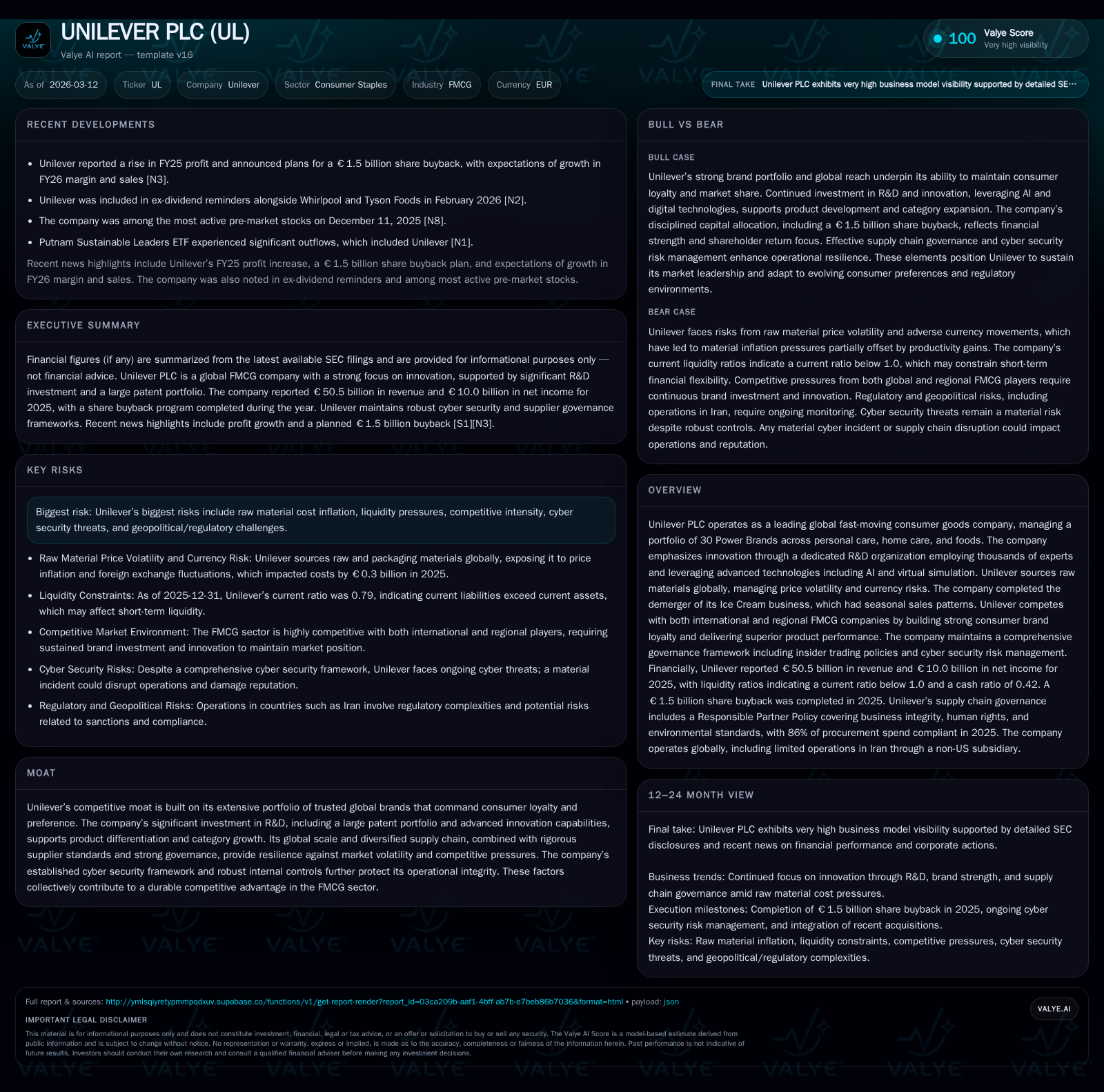
In 2025, Unilever PLC faced a notable 16.9% drop in revenue primarily due to the demerger of its seasonal Ice Cream business, yet achieved a strong 57.2% increase in net income, reaching €10.0 billion. This profitability surge was supported by rigorous cost productivity measures counterbalancing raw material inflation pressures and bolstered by increased R&D investment leveraging AI-driven innovation. The company completed an aggressive €1.5 billion share buyback, illustrating a disciplined capital allocation approach alongside steady dividend payouts. Governance enhancements and robust risk management frameworks continue to underpin operational resilience as Unilever eyes margin expansion and sales growth in 2026.
Revenue Decline Amid Structural Changes and Inflation Headwinds in 2025
Unilever PLC recorded a significant revenue decline of 16.9% in fiscal year 2025, dropping from €60.8 billion in 2024 to €50.5 billion [F1]. This contraction primarily reflects the strategic demerger of its Ice Cream business earlier in the year, which previously contributed seasonal sales fluctuations complicating year-round comparability [S1], [N1]. The seasonality inherent to this business line obscured consistent revenue visibility; its removal aims to enhance focus on more stable product segments.
Despite commodity deflation in the preceding year, raw material prices rebounded sharply in the first half of 2025 with net inflation reaching approximately €0.5 billion overall [S1], [S9]. This inflationary pressure was partially offset by productivity gains from cost management programs emphasizing supply chain efficiencies and operational improvements, which helped support margin stability even as top-line growth was curtailed.
Innovation Investment Fuelling Differentiation: The Role of R&D and AI
Continuing its strategic emphasis on product innovation as a core driver for competitive advantage, Unilever invested €836 million in R&D during 2025 excluding the divested Ice Cream segment [S1], [S12]. With over 4,500 scientific experts including more than 500 PhDs across global R&D centers situated prominently in high-growth markets like the US and India, Unilever leverages cutting-edge science spanning microbiome research, biotechnology breakthroughs, and digital product design.
AI-powered virtual simulation technologies have become instrumental in compressing innovation cycles—what traditionally required years in labs can now be accelerated into days through computational modelling, mapping, and digital experimentation before physical scaling [S1]. This advanced capability permits rapid refinement of sensory experiences and ingredient performance that underpin Unilever's 30 Power Brands, fuelling consumer preference and value market share gains.
Raw Material Price Inflation: Impact and Mitigation Strategies
The transition from commodity price deflation in 2024 to inflationary pressures in 2025 posed a material challenge for cost control [S1], [S9]. The cumulative net material inflation totaled about €0.5 billion driven by commodity price rebounds coupled with adverse currency movements during the year’s first half.
Unilever’s diversified global supply chain played a pivotal role in mitigating these pressures—strategic sourcing flexibility allowed replacement or renegotiation with suppliers alongside rigorous supplier standards outlined within its Responsible Partner Policy (RPP) [S15], ensuring compliance while managing costs effectively. Productivity improvements gained through internal efficiency initiatives also softened the inflationary impact while maintaining product quality.
Segments Performance and Geographic Exposure After Ice Cream Spin-Off
The spin-off of the Ice Cream division effectively recalibrated Unilever’s business mix by eliminating a high seasonality category [S1], yielding benefits for predictability though at the expense of top-line scale.
Geographically, Unilever maintains broad exposure across developed and emerging markets but keeps limited footprint exposure in higher-risk areas such as Iran where sales represent less than 0.5% of global turnover [S6], [S8]. This conservative positioning minimizes geopolitical risks linked to regulatory changes or sanctions while sustaining strong competitive positioning via trusted brands.
The firm reports value share metrics instead of pure volume share data—an important distinction indicating that price premium capture is integral to sustaining profitability despite competitive FMCG market dynamics [S9].
Capital Allocation Excellence: Share Repurchases, Dividends, and ROE
Demonstrating disciplined capital allocation post-demerger, Unilever executed an aggressive share repurchase program authorized up to €1.5 billion early in the year and completed it within four months acquiring nearly 27.8 million ordinary shares at an average price around €54.65 per share [N1], [F1], [S4], [S5]. This sizable buyback signals confidence in underlying earnings power despite volatile top-line trends.
Dividend payments held steady at approximately €4.45 billion in FY25 versus prior years reflecting stable shareholder return priorities even amid structural portfolio adjustments and cost pressures [F1]. Liquidity management remains prudent with cash and equivalents totaling about €3.9 billion against current liabilities nearing €21.7 billion resulting in a constrained current ratio near 0.79—typical for large FMCG firms reliant on working capital cycle efficiency rather than high liquidity buffers [F1], [S11].
Return on equity (ROE) surged towards approximately 56.9% calculated using reported net income over equity base at year-end—a testament to robust profitability generation following structural simplification and capital return measures [F1].
Historical Financial Performance Summary
Historical performance (annual)
| FY | Rev ($bn) | Net ($bn) | Rev YoY | Net YoY |
|---|---|---|---|---|
| 2025 | 50.5 | 10.0 | -16.9% | +57.2% |
| 2024 | 60.8 | 6.4 | +1.9% | -10.8% |
| 2023 | 59.6 | 7.1 | -0.8% | -13.7% |
| 2022 | 60.1 | 8.3 |
Source: SEC companyfacts cache [F1].
Capital returns and efficiency (annual)
| FY | Div ($bn) | ROE% |
|---|---|---|
| 2025 | 4.5 | 56.9 |
| 2024 | 4.3 | 28.2 |
| 2023 | 4.3 | 34.4 |
| 2022 | 4.4 | 38.1 |
Source: SEC companyfacts cache [F1].
Governance, Risk Management, and Cybersecurity Safeguards
Robust governance frameworks underpin Unilever’s operational integrity amidst a complex global footprint encompassing regulatory shifts, raw material volatility, geopolitical risks, and cyber threats [S15], [S17], [S24], [S27], [S29].
The company practices comprehensive cyber security risk management aligned with NIST CSF standards supported by continuous monitoring, penetration testing, bug bounty programs, and incident response protocols overseen directly by senior leadership including the Audit Committee [S14], [S25].
Corporate ethics extend into strict anti-corruption policies enforced through mandatory training across all levels supported by formal investigation mechanisms ensuring transparency without retaliation for whistleblowers [S27], [S29]. These measures collectively safeguard brand reputation essential for consumer trust-driven moats characteristic of leading FMCG players.
Outlook: Monitoring Margin Expansion and Growth Drivers in FY26
While explicit financial forecasts for fiscal year 2026 are not detailed extensively within filings or news releases, Unilever articulated expectations for continued margin expansion driven by sustained innovation capacity and effective cost control disciplines initiated during FY25 [N1]. Analysts should monitor actual sales momentum across personal care, home care, and foods categories alongside raw material pricing trends which remain a key lever for profitability.
Management’s guidance points toward leveraging AI-accelerated R&D pipelines to bring new products rapidly to market aiming to deepen consumer engagement while balancing input cost volatility through enhanced supply chain agility.
Disclaimer: This analysis synthesizes publicly filed financial data from SEC reports including Form 20-F filings, corroborated news sources, and company disclosures without providing investment advice or valuation recommendations. Readers should consult additional sources for investment decisions.
Disclaimer: This is research-only, informational analysis and not investment advice. It may include AI-generated interpretation and general industry context. Always verify important details using primary sources.

Comments