
First Northwest Bancorp Confronts Leadership Shifts and Financial Losses to Find Stability
Leadership changes, legal challenges, and financial setbacks have defined First Northwest Bancorp's recent operational landscape.
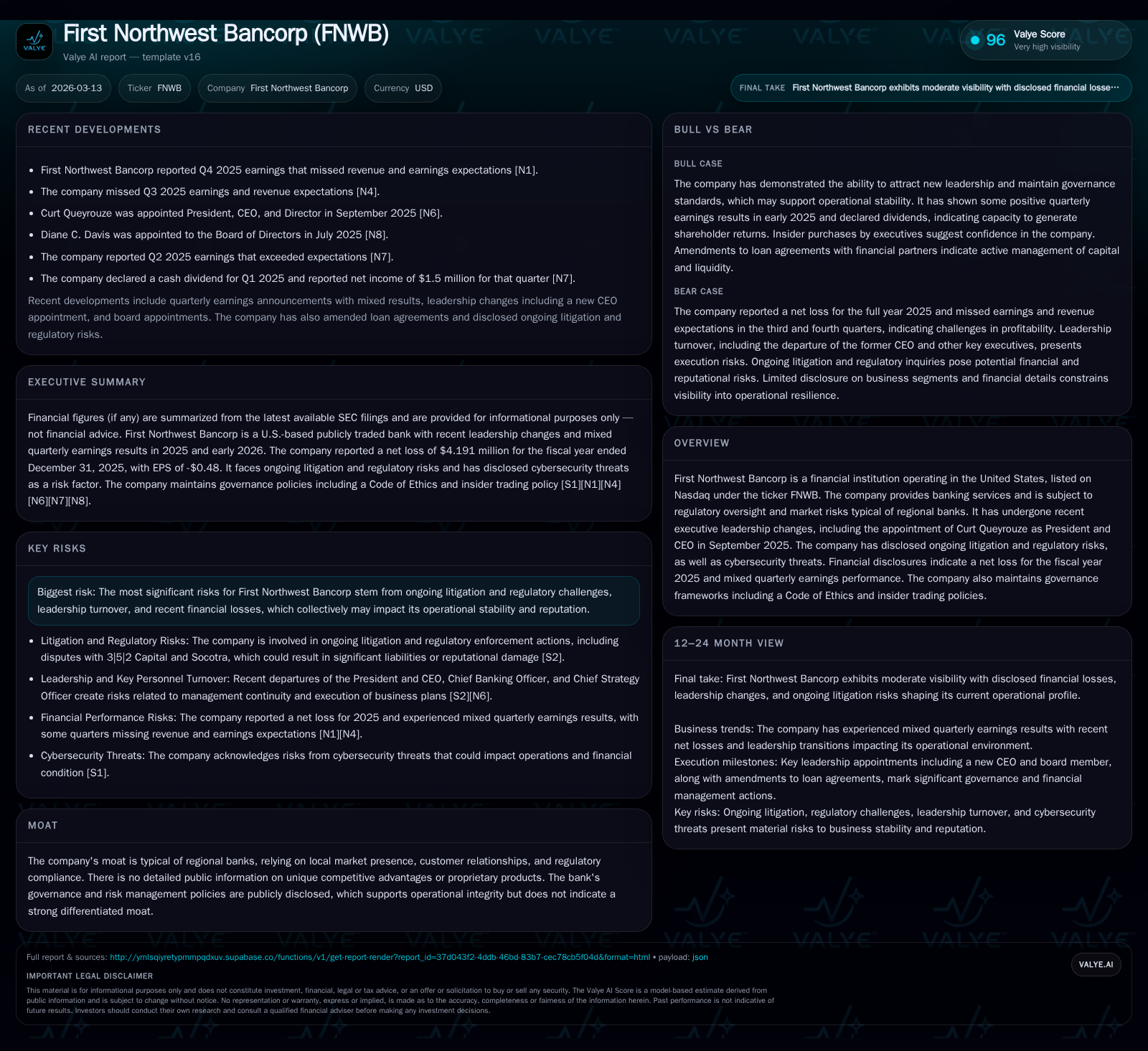
First Northwest Bancorp experienced significant executive turnover in mid-2025 alongside mounting legal and regulatory pressures that compounded an ongoing financial loss trend. While the bank managed steady equity levels, deteriorating net income and negative operating cash flows indicate growing operational strain. Dividend payouts have contracted and no share repurchases occurred in 2025 as capital preservation took precedence. Looking ahead, the new CEO’s strategic agenda and resolution of litigation are key milestones to watch that could influence the company's return to financial stability.
Executive Turnover and Risk Environment: Setting the Stage
First Northwest Bancorp faced a pivotal juncture in 2025 marked by the departure of its former President and CEO effective July 12, the retirement of its Chief Banking Officer on July 2, and another key executive — Chief Strategy Officer — leaving August 9 [S2], [S7]. These departures drained seasoned leadership amid heightened regulatory scrutiny and cybersecurity concerns outlined in periodic filings [S4], [S10]. The company appointed Curt Queyrouze as President and CEO in September 2025 [N1], aiming to steer the institution through elevated litigation risk involving significant counterparties such as 3|5|2 Capital and Socotra [S2], [S4]. This leadership upheaval occurred alongside increased external legal pressures, introducing operational uncertainties at a fragile time.
Tracking Historical Profitability: Analyzing 2023-2025 Net Income and Cash Flow Trends
The financial trajectory from 2023 to 2025 reveals sharp deterioration after profitability peaked in FY23. Net income fell from a positive $2.29 million to losses of $6.61 million in FY24 and $4.19 million in FY25 respectively—a partial recovery but sustained negative profit trend [F1]. Operating cash flow mirrored this reversal, plunging from over $17.87 million (FY23) to $16.88 million (FY24) before collapsing into a deficit of about -$2.76 million in FY25 [F1]. Concurrently, capital expenditures dropped by nearly half from $1.57 million (FY23) to approximately $850k (estimated from YoY) by FY25 indicating constrained reinvestment capacity.
Dividends paid contracted sharply by roughly half between FY24 ($2.65 million) and FY25 ($1.32 million), while share repurchases ceased altogether post-FY24's $4.06 million buybacks [F1]. Equity remained relatively stable though slightly rising from about $161.57 million (FY22) to $163.34 million (FY23), implying limited erosion of net book value but reflecting the hemorrhage through earnings volatility rather than capital destruction.
Historical performance (annual)
| FY | Net ($mm) | CFO ($mm) | Capex ($mm) | Net YoY |
|---|---|---|---|---|
| 2025 | -4 | -3 | +36.6% | |
| 2024 | -7 | 17 | -389.3% | |
| 2023 | 2 | 18 | 2 | -85.4% |
| 2022 | 16 | 16 | 3 |
Source: SEC companyfacts cache [F1].
Capital returns and efficiency (annual)
| FY | Div ($mm) | Buybacks ($mm) | FCF ($mm) |
|---|---|---|---|
| 2025 | 1 | 0 | |
| 2024 | 3 | 4 | |
| 2023 | 3 | 1 | 16 |
| 2022 | 3 | 5 | 13 |
Source: SEC companyfacts cache [F1].
Table summarizes key annual financial metrics for First Northwest Bancorp covering net income, operating cash flow, capital expenditure trends, dividend payouts, and repurchase activities sourced directly from company data [F1].
Regulatory and Legal Headwinds: The Ongoing Litigation Impact
Litigation remains a foremost risk factor weighing on FNWB’s outlook [S4], [S7]. The company disclosed active lawsuits involving specialized finance entities like 3|5|2 Capital and Socotra that have introduced potential contingent liabilities not fully quantifiable publicly but sufficient to cause operational caution [S2], [S4], [S10]. Coupled with regulatory enforcement probes that can bring sanctions or remedial mandates, these proceedings amplify reputational dilution risks and increase expense volatility due to legal defense costs even if outcomes are ultimately favorable.
Such litigation exposure is compounded by FNWB’s relatively narrow competitive moat typical of regional banks largely reliant on local relationships without pronounced proprietary products or services differentiation . This heightens vulnerability as legal disputes may shake depositor or counterparty confidence more acutely compared with diversified national institutions.
Assessing Capital Deployment: Dividends, Buybacks, and Cash Management
In response to adverse earnings performance and external uncertainties, First Northwest Bancorp markedly tightened its capital allocation stance during FY25 [S19], [S20]. Dividend payments contracted nearly by half year-over-year reflecting prudent cash conservation amid losses noted above [F1]. Moreover, share buyback programs were suspended after producing modest activity totaling $4.06 million in FY24 down from prior years’ pass-through levels.
This capital preservation approach aligns with typical regional bank strategies prioritizing liquidity retention under stressed conditions while balancing shareholder remuneration expectations cautiously.
Leadership Transition Effects on Strategy and Market Confidence
The arrival of Curt Queyrouze as CEO represents an effort to stabilize executive ranks following mid-year departures including those at President/CEO, Chief Banking Officer, and Chief Strategy Officer levels within a short span during mid-2025 [N1], [S8], [S9]. While public disclosures provide limited directional specifics on his strategic agenda beyond standard references to risk management enhancement and operational integrity maintenance, his role will be pivotal for restoring trust among investors, regulators, clients, and employees alike.
Key personnel dependences evidenced by resignations raise operational execution risks until new management cohesion is attained [S7]. The company’s governance framework including insider trading policies and ethics codes provides a baseline for integrity assurance but cannot alone offset transition-induced uncertainty.
Financial Health Indicators: ROE, Cash Flow, and Liquidity Dynamics
FNWB reported an approximate return on equity of negative 2.6% for FY25 using last reported net income against reported shareholders' equity of around $163 million—a stark contrast to positive ROE norms needed for sustainable bank profitability [F1]. Negative operating cash flow combined with capex outlays resulted in an estimated negative free cash flow near -$4.3 million underscoring continued internal resource constraints.
Liquidity positions supported by recent loan agreement amendments with NexBank suggest some buffer for near-term obligations [S8], but ongoing asset-liability mismatches common among regional banks could weigh on regulatory capital ratios if loss trends persist without corrective action or profitability rebounds.
Forecast Considerations: Key Milestones and Risks to Monitor
The company has not issued explicit forward guidance; hence monitoring upcoming quarterly earnings reports for Q1/Q2 2026 will serve as early indicators of operational trajectory [N1], [S3]. Important milestones include resolutions or developments related to major litigations against named counterparties which could materially affect contingent liabilities disclosure.
Additionally, progress on executive team stabilization post-CEO appointment remains critical alongside any evolving regulatory investigations or cybersecurity incident disclosures that may emerge given highlighted threats ([S10]). Investors should watch for adjustments to dividend policies contingent on emerging cash flow realities.
This analysis synthesizes publicly available information without offering investment recommendations or price targets regarding First Northwest Bancorp (FNWB). Readers should consider full company filings for comprehensive understanding of risks inherent in regional banking operations subject to fluid economic conditions and regulatory environments.
Disclaimer: This is research-only, informational analysis and not investment advice. It may include AI-generated interpretation and general industry context. Always verify important details using primary sources.

Comments