
Foghorn Therapeutics Evolves Clinical-Stage Pipeline While Managing Capital and Cash Burn
Clinical progress and collaboration revenues contrast with ongoing operating losses and increased R&D investment.
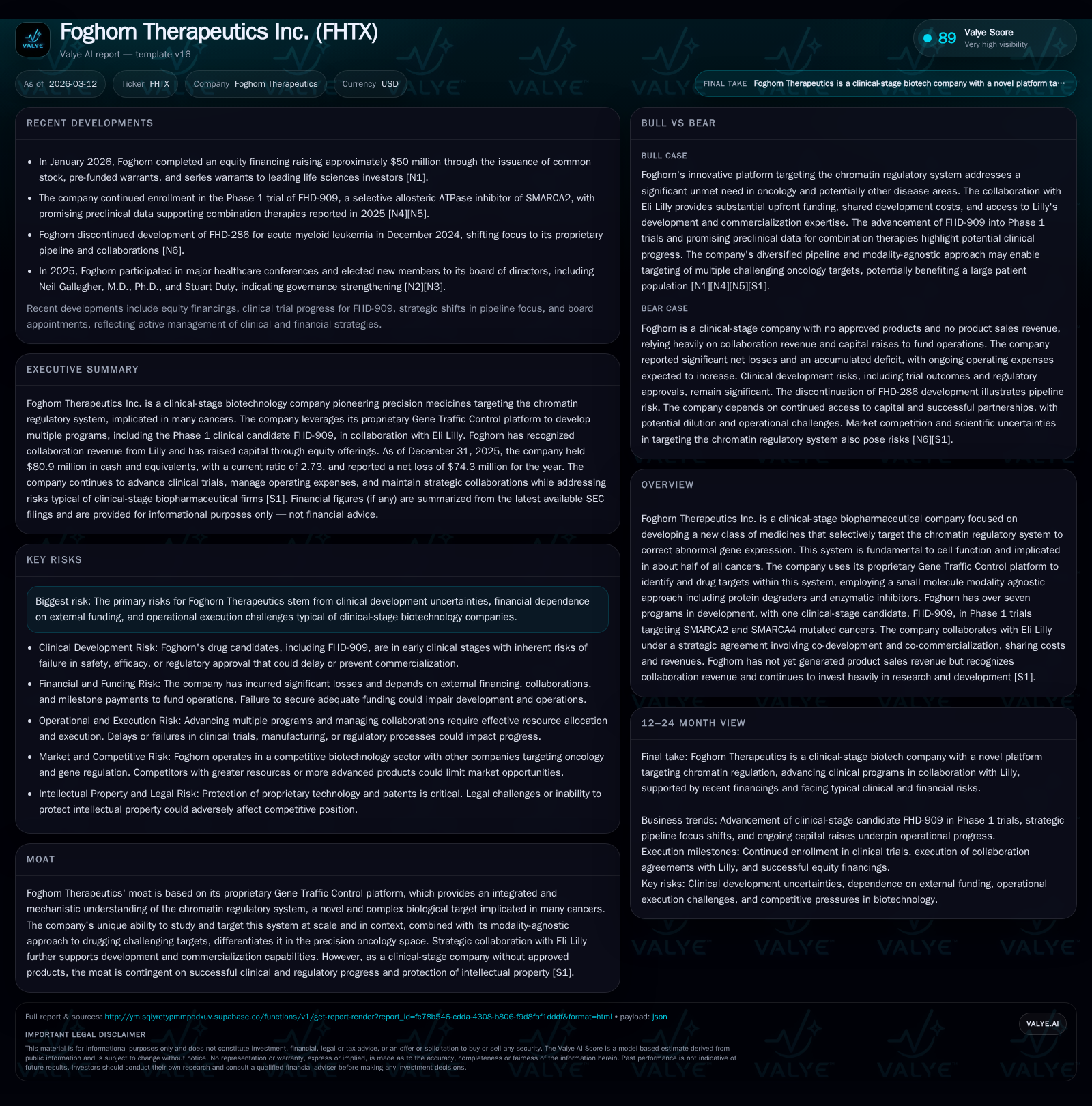
Foghorn Therapeutics continues advancing its proprietary chromatin-targeting platform with its lead clinical candidate FHD-909 in Phase 1 trials, supported by strategic collaboration with Eli Lilly. The company’s operating losses narrowed slightly in 2025 compared to 2024, reflecting a gradual ramp in partnered programs and platform development alongside non-cash asset impairments and lease restructuring costs. While no product sales revenues have yet emerged, deferred collaboration revenue provides some near-term financial cushioning, complemented by over $158 million in cash and securities as of the end of 2025. Despite improving operating cash flow trends, the company remains dependent on external capital markets for funding its pipeline expansion and commercialization readiness.
Company Background and Strategic Focus
Foghorn Therapeutics Inc., founded in October 2015 and headquartered in Watertown, Massachusetts, operates as a clinical-stage biotechnology company pioneering precision therapeutics that selectively target the chromatin regulatory system. Central to fundamental cellular functions and implicated in approximately half of all cancers, this epigenetic mechanism is the basis for Foghorn’s innovative approach leveraging its proprietary Gene Traffic Control platform.
This platform enables identification and mechanistic interrogation of druggable targets within chromatin regulation utilizing multiple modalities such as small molecule enzymatic inhibitors and targeted protein degraders—a modality-agnostic approach advantageous for challenging targets common in oncology.
Historical Financial Performance and Growth Drivers
Since inception through fiscal 2025, Foghorn’s trajectory has been primarily research-driven without product commercialization revenues. Instead, development efforts have been substantially funded through equity financings, upfront payments, milestone incomes from collaboration agreements (notably with Eli Lilly), and licensing deals.
Financial Summary Table (Annual):
Historical performance (annual)
| FY | Net ($mm) | CFO ($mm) | OpInc ($mm) | Capex ($) | Net YoY |
|---|---|---|---|---|---|
| 2025 | -74 | -86 | -86 | 50000 | +14.2% |
| 2024 | -87 | -100 | -103 | 906000 | +12.0% |
| 2023 | -98 | -118 | -108 | 1224000 | +9.6% |
| 2022 | -109 | 194 | -117 | 1210000 |
Source: SEC companyfacts cache [F1].
Capital returns and efficiency (annual)
| FY | FCF ($mm) | ROE% |
|---|---|---|
| 2025 | -86 | 68.5 |
| 2024 | -101 | 190.3 |
| 2023 | -119 | 127.5 |
| 2022 | 192 | -97216.1 |
Source: SEC companyfacts cache [F1].
*Note: The positive operating cash flow figure in 2022 likely relates to non-recurring financing events or working capital changes.
Collaboration revenue increased from $22.6 million in 2024 to nearly $31 million in 2025, reflecting enhanced partner contributions under agreements such as that with Eli Lilly including a significant upfront payment [S14],[F1]. Despite this revenue recognition from partnerships, the company continues reporting substantial operating losses indicative of high R&D spend supporting multiple internal programs.
Operating income loss narrowed by about 15.9% year-over-year to approximately -$86 million in FY25 versus FY24 signaling some improvement amid scaling pipeline activities.
Product Pipeline Status and Future Growth Prospects
Currently advancing over seven programs leveraging its Gene Traffic Control platform, Foghorn's lead candidate FHD-909 entered Phase 1 clinical trials targeting cancers harboring SMARCA2/SMARCA4 mutations associated with synthetic lethality approaches . This effort is strongly supported by the collaboration deal structure with Eli Lilly which provides joint development resources.
Additional proprietary programs remain at preclinical stages aiming at various genetically defined vulnerabilities within chromatin biology.
Future growth hinges on several key factors:
- Successful progression of FHD-909 through early phase trials toward proof-of-concept data.
- Expansion of partnered pipeline offerings under Lilly collaboration including potential new co-development candidates.
- Advancement of other proprietary pipeline candidates into IND-enabling studies enabling future clinical trial initiation.
- Strengthening intellectual property protections underpinning novel compounds derived from their platform.
- Ability to secure further collaborations leveraging their platform’s unique mechanistic insights.
Growth could be constrained by typical biopharma risks such as clinical trial failures or delays, regulatory hurdles, competitive innovations particularly within epigenetics and chromatin regulation niche, or funding constraints impacting pace of development [S1],[S7].
Financial Position, Capital Allocation, and Cash Flow Trends
Return metrics such as ROE are challenging given cumulative operating losses totaling approximately $632 million as of end-2025 reflecting ongoing investment phase without commercial product revenues [F1]. Nevertheless an approximate ROE derived from latest annual net loss versus negative equity balance suggests a very high absolute magnitude but fundamentally representing loss absorption rather than returns generation (approximate computed ROE ~68%, negative equity context).
Operating cash flow improved sequentially but still consumed approximately $86 million in FY25 compared to over $100 million prior year indicating early signs of operational leverage beginning to manifest with scale [F1].
Capital expenditures remain minimal (~$50K FY25) consistent with asset-light R&D operations emphasizing external CROs/CDMOs engagement rather than fixed asset investments [F1],[S6].
No dividends nor share buybacks were conducted or indicated given pre-commercial stage funding priorities [S25]. Equity raises continued: notably a January 2026 offering brought gross proceeds near $50 million via common stock sales coupled with pre-funded warrants plus two series of exercisable warrants enhancing liquidity runway beyond one year horizon without underwriter involvement [S13,S15].
As of December 31, 2025, cash, cash equivalents and marketable securities totaled approximately $158.9 million providing runway for ongoing operations [F1],[S14]. Deferred revenue stood at about $249 million related primarily to upfront payments from partners supporting future development obligations [S9],[S14].
Operational Developments & Risk Management
Substantial lease restructuring completed at headquarters resulted in non-cash impairment charges ($5.9M in FY25) related to office relocations aimed at optimizing facilities footprint aligning cost structure with evolving operational needs [S19,S20].
Cybersecurity oversight is actively managed by an experienced IT executive embedded within legal functions reflecting heightened industry norms around digital security risk mitigation for proprietary molecular data platforms [S1],[S16].
Risks notwithstanding include clinical trial uncertainties inherent in early-stage biotech companies; reliance on future external capital raises subject to market conditions; competitive innovation pressures; potential IP challenges; as well as operational execution risks typical of scaling biotech ventures [S7,S22]. Litigation exposure currently minimal without material adverse proceedings outstanding [S16,S24].
Disclaimer: This is research-only, informational analysis and not investment advice. It may include AI-generated interpretation and general industry context. Always verify important details using primary sources.

Comments