
Himalaya Shipping’s Expansion of a Modern Capesize Fleet Drives Steady Revenue Growth
Himalaya Shipping Ltd. strengthens its position in the dry bulk sector through a modern fleet, strategic financing, and resilient operational metrics amid market volatility.
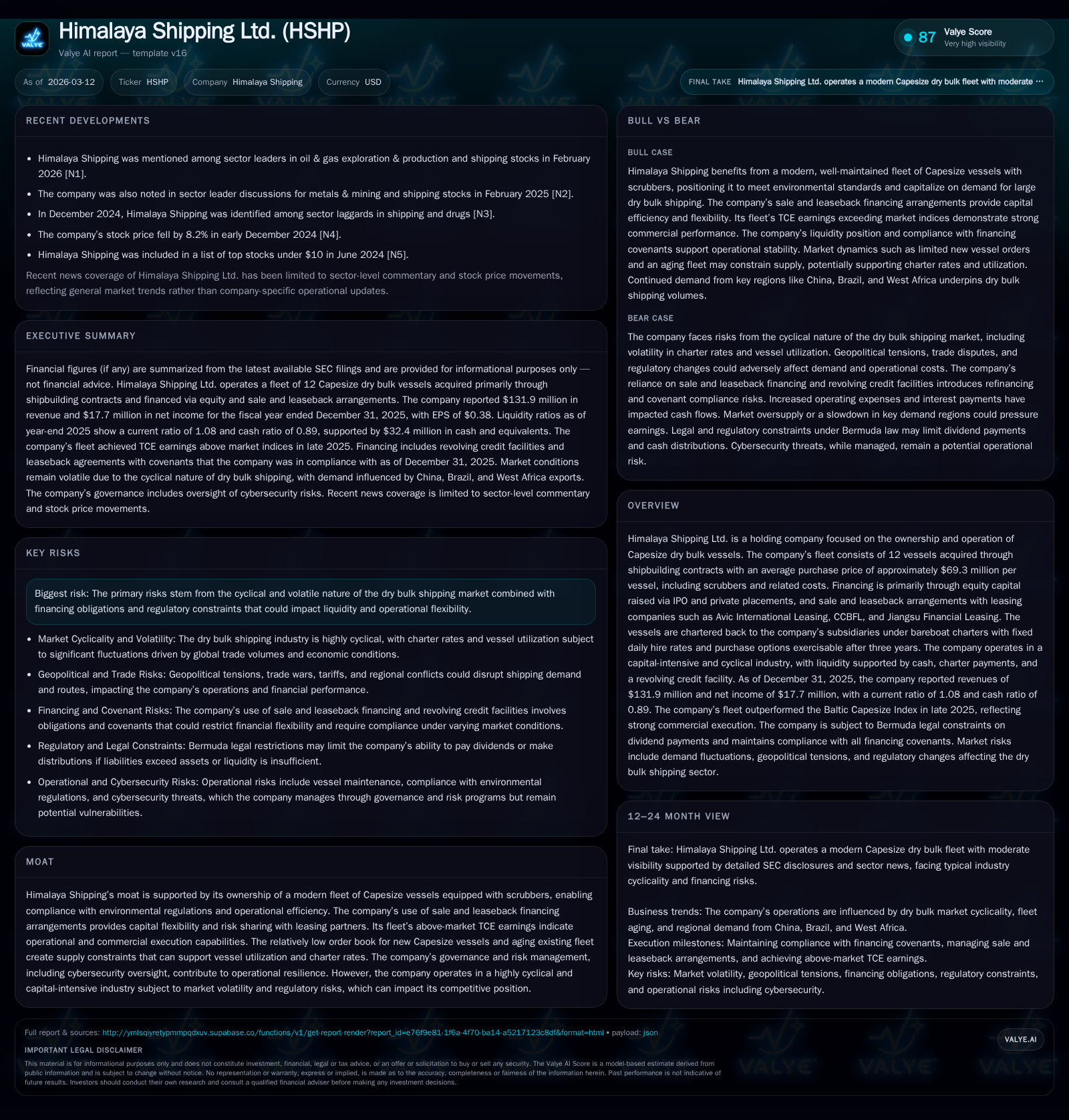
Himalaya Shipping Ltd. has expanded its capacity by operating 12 modern Capesize vessels equipped with scrubber technology, contributing to revenue growth to $132 million in 2025. Despite a near 16% decline in net income due to higher interest and operating expenses, the company maintained strong operating cash flows and disciplined capital management. Strategic sale and leaseback financing arrangements provide liquidity flexibility while supporting fleet expansion. The firm’s outlook benefits from supply constraints in the Capesize sector and rising demand ton-miles, although market volatility and regulatory risks remain significant.
Fleet Expansion Driving Revenue Growth
Himalaya Shipping's recent financial performance reflects rapid growth aligned with its strategy of acquiring modern Capesize bulk carriers. The fleet comprises twelve vessels obtained through shipbuilding contracts at an average cost of approximately $69.3 million per vessel inclusive of scrubber installations critical for environmental compliance [S1][S7].
This expansion propelled revenue from $36.7 million in FY2023 to $123.6 million in FY2024 following deliveries ramp-up, reaching $131.9 million in FY2025 — nearly a fourfold increase over two years demonstrating operational scaling success [F1]. Operating income also grew strongly from $14.6 million in FY2023 to $66.6 million in FY2024 before increasing further to $68.2 million in FY2025 despite rising cost pressures [F1].
Historical performance (annual)
| FY | Rev ($mm) | Net ($mm) | CFO ($mm) | OpInc ($mm) | Rev YoY | Net YoY |
|---|---|---|---|---|---|---|
| 2025 | 132 | 18 | 52 | 68 | +6.7% | -15.9% |
| 2024 | 124 | 21 | 56 | 67 | +236.4% | +1290.0% |
| 2023 | 37 | 2 | 6 | 15 |
Source: SEC companyfacts cache [F1].
Capital returns and efficiency (annual)
| FY | Div ($mm) | ROE% |
|---|---|---|
| 2025 | 27 | 10.9 |
| 2024 | 21 | 13.6 |
| 2023 | 1.0 |
Source: SEC companyfacts cache [F1].
Capital expenditures were significant in FY2024 due to vessel installment payments; no major capex occurred in FY2025 consistent with no new acquisitions or upgrades post-delivery.
Operational Efficiency Supported by Scrubber Technology
All vessels are equipped with scrubbers that enable compliance with IMO sulfur emission regulations while enhancing fuel efficiency compared to older fleets lacking such technology [S10]. This technical advantage contributes to Himalaya Shipping's ability to achieve Time Charter Equivalent earnings that outperformed the Baltic Capesize Index during Q4-2025.
Bareboat charter agreements under sale-leaseback financing create stable revenue streams via fixed daily hire rates, providing insulation against spot market volatility common in dry bulk shipping economics characterized by fluctuating indices such as BCI [F1][S10].
Financial Performance Amid Market Cyclicality
Although revenue increased in FY2025 relative to prior years, net income declined by nearly 16%, from $21 million to $17.7 million ([F1]). This decline was primarily due to increased vessel operating expenses (+$4.2 million) alongside higher interest payments ($49.5 million vs $40 million prior year) linked to financing structures supporting fleet expansion ([S13]).
However, operating cash flow remained strong at approximately $51.7 million in FY2025—only slightly below the previous year—indicating effective working capital management despite cyclical pressures ([F1]). This cash flow stability is vital given the volatile nature of net profits influenced heavily by freight rate fluctuations.
Sale-and-Leaseback Financing Enables Capital Efficiency
Given the capital intensity of acquiring Capesize vessels costing around $69 million each including scrubbers ([S1]), Himalaya Shipping extensively uses sale-leaseback arrangements with leasing partners like Avic International Leasing Co., CCBFL, and Jiangsu Financial Leasing ([S6],[S11]). Through these arrangements, vessel-owning subsidiaries transfer ownership temporarily while chartering back ships under fixed bareboat hires.
This approach reduces upfront capital requirements but embeds long-term lease obligations totaling approximately $72.6 million annually ([S7]). Purchase options exercisable three years post-delivery provide flexibility for eventual ownership at predetermined amortizing prices ([S19]). Lease covenants impose borrowing limits fostering disciplined capital structure management ([S6],[S11]).
Liquidity Position Supported by Cash Reserves and Credit Facility
As of December 31, 2025, Himalaya Shipping held cash and equivalents of $32.4 million supported by a revolving credit facility of up to $10 million extended through December 2026 for drawdowns until end-2027 maturity ([F1],[S4],[S8]). The facility carries interest linked to SOFR plus a margin reflecting prevailing credit conditions ([S5],[S8]).
The company complied with all relevant debt covenants across financing arrangements at year-end reflecting prudent liquidity oversight despite market cyclicality ([S4]). Subsidiary-level minimum cash balance requirements tied to lease coverage tests underscore the importance of maintaining liquidity buffers ([S6]).
Dividend Policy Balances Returns with Legal Constraints
Dividend payments rose to approximately $26.9 million in FY2025 from about $20.6 million previously indicating commitment to shareholder returns amid earnings volatility ([F1],[S14]). However, Bermuda law restricts dividend declarations if solvency or asset-to-liability ratios would be impaired ([S14]). Himalaya’s holding company structure reliant on subsidiary distributions inherently moderates payout capacity requiring careful alignment with distributable earnings ([S14]).
Positive Market Outlook Supported by Supply Constraints and Demand Growth
Outlook remains favorable driven by expanding iron ore exports primarily from Atlantic hubs such as Guinea and Brazil supporting increased ton miles typically served by Capesize vessels ([N1],[S22]).
The limited newbuild order book (~11% of fleet), reduced shipyard capacity, and an aging fleet (about 14% over twenty years old) contribute supply-side support for freight rates ([N1],[S22]). Additionally, mandatory drydock surveys impacting nearly one-third of vessels further underpin utilization levels.
Fleet compliance via scrubber installations provides competitive advantage amid tightening environmental regulations without incurring costly fuel switching penalties ([N1],[S10]). Nonetheless, geopolitical risks remain an ongoing factor influencing sector volatility.
Key Metrics for Investor Monitoring
Investors should focus on:
- Quarterly TCE earnings relative to Baltic indices as indicators of pricing strength;
- Lease payment schedules and covenant compliance ahead of purchase option windows;
- Maintenance capex trends following newbuild completion;
- Dividend sustainability balanced against cash flow generation;
- Any equity or debt financing activities signaling strategic shifts.
These factors will illuminate Himalaya Shipping’s capacity to sustain growth balanced against industry cyclicality.
This analysis is based on publicly filed documents as of March 12, 2026 without investment advice.
Disclaimer: This is research-only, informational analysis and not investment advice. It may include AI-generated interpretation and general industry context. Always verify important details using primary sources.

Comments