
Tucows Inc Faces Growth Constraints with Ting's Capital Strain and Domain Services Resilience
Examining Tucows' segment dynamics under tightening liquidity and strategic shifts in 2025.
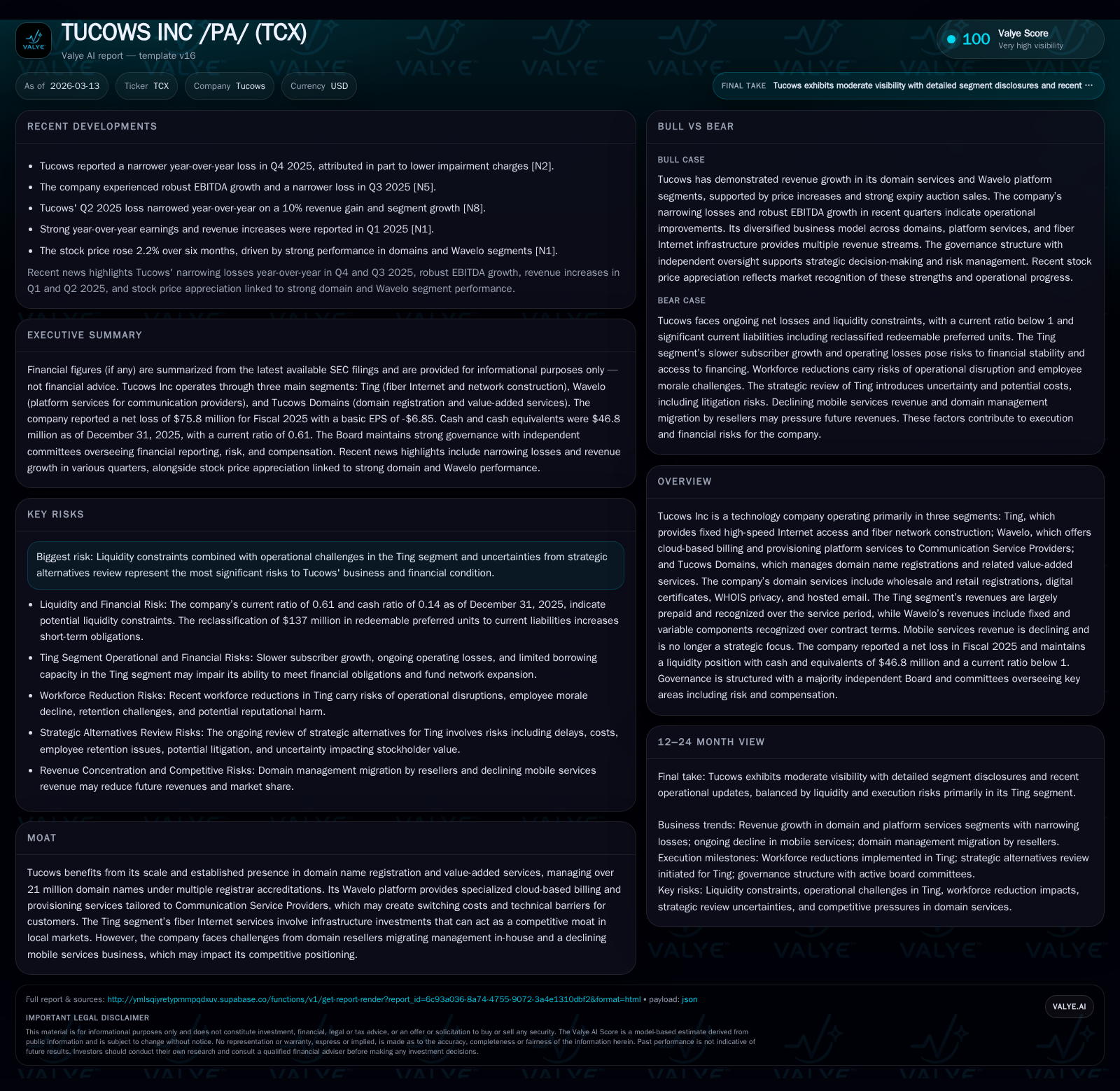
Tucows Inc operates three core segments—Ting Internet, Wavelo platform services, and Tucows Domains. While domain registrations and Wavelo's growth helped reduce adjusted EBITDA losses in 2025, Ting continues to weigh on overall profitability due to high operating losses and cash flow deficits tied to capital-intensive fiber network expansion. The company's liquidity remains pressured with a current ratio below 1 and sizable short-term liabilities, amplified by redeemable preferred units reclassification. Debt covenants are currently met but future growth hinges on Ting’s subscriber expansion and prudent capital management amid ongoing operational challenges.
Introduction
Tucows Inc (TCX), a technology company best known for its domain name registration business, operates three core segments: Ting Internet broadband services, the Wavelo cloud-based billing and provisioning platform, and its domain services segment. In fiscal year 2025, the company faced significant challenges balancing growth ambitions against liquidity risks driven largely by Ting’s capital-intensive fiber expansion.
This report reviews Tucows’ historical financial performance, segment dynamics influencing growth outlooks, balance sheet constraints including debt maturities, and capital allocation priorities relevant to investors.
Historical Performance Overview
Tucows reported steady revenue growth from FY 2022 through FY 2024, reaching $362.3 million in 2024—a compound annual growth rate near 6.8%. This was propelled mainly by strong performance in domain registrations supported by wholesale and retail channels alongside incremental contributions from Wavelo platform services.[F1]
Despite topline gains, operating income remained negative throughout these years but improved notably in FY 2025 to a loss of $23.5 million from larger losses exceeding $63 million in previous years.[F1] Net losses followed a similar pattern, narrowing to $75.8 million in FY 2025 from approximately $110 million in FY 2024.[F1]
Operating cash flows have historically been volatile with a marked improvement in FY 2025 where outflows shrank to $5.8 million from nearly $19.7 million in FY 2024.[F1] Capital expenditures also declined sharply to $17.1 million in FY 2025 compared to over $136 million two years prior reflecting a reduction of large-scale fiber investments alongside software development capitalization supporting platform enhancements.[F1][S14][S22]
Financial Summary Table
Historical performance (annual)
| FY | Rev ($mm) | Net ($mm) | CFO ($mm) | OpInc ($mm) | Rev YoY | Net YoY |
|---|---|---|---|---|---|---|
| 2025 | -76 | -6 | -23 | +31.0% | ||
| 2024 | 362 | -110 | -20 | -65 | +6.8% | -14.2% |
| 2023 | 339 | -96 | -5 | -64 | +5.7% | -248.9% |
| 2022 | 321 | -28 | 20 | -32 |
Source: SEC companyfacts cache [F1].
Capital returns and efficiency (annual)
| FY | FCF ($mm) | ROE% |
|---|---|---|
| 2025 | -23 | 46.2 |
| 2024 | -76 | 115.3 |
| 2023 | -97 | -974.1 |
| 2022 | -117 | -28.5 |
Source: SEC companyfacts cache [F1].
Note: Revenue for FY25 not disclosed separately; operating metrics derived from latest filings.
Segment Analysis & Growth Outlook
Ting Internet
Ting provides high-speed fiber internet access across select U.S. towns alongside fixed wireless options. This segment requires substantial upfront capital investment into fiber optic infrastructure.
Revenue recognition aligns with prepaid billing cycles while subscriber growth has lagged internal forecasts contributing to ongoing operating losses exceeding $26 million recently.[S2][N2] Ting finances its operations through asset-backed securitizations secured by fiber network assets totaling over $300 million with principal repayments scheduled between mid-2027 and late-2029.[S10][S12]
While some margin improvements occurred via subscriber additions and cost-cutting measures,[S17] continued subscriber growth is critical for debt servicing capacity.
Wavelo Platform Services
Wavelo delivers cloud-based subscription billing and network orchestration software solutions tailored for CSPs. Key customers include EchoStar leveraging Wavelo’s MONOS suite,[S1] with Ting Internet also integrating Wavelo platforms for accelerated scaling.
Revenue comprises fixed fees recognized ratably plus variable usage fees billed monthly based on consumption volume.[S1] Expansion depends on increasing customer adoption within telecom verticals amid competitive pressures.
Tucows Domains
Managing over 21 million domains globally,[N1] this segment facilitates wholesale domain registrations alongside retail value-added services such as WHOIS privacy protection.
Domain contracts are prepaid but revenue is recognized evenly over contract durations up to ten years.[S1] Although historically the largest revenue contributor, margin pressures arise as resellers internalize registration management functions reducing Tucows’ intermediary fees.
Mobile services have been deprioritized due to declining revenue trends,[S1] heightening reliance on fiber broadband infrastructure and domain-related recurring revenues.
Liquidity & Capital Structure
As of December 31, 2025,Tucows held approximately $46.8 million in cash and equivalents,[F1] while current liabilities surged above $330 million largely due to reclassification of redeemable preferred units valued at about $137 million.[S6][S15] This resulted in a constrained current ratio near 0.61 signaling limited short-term liquidity.
The company maintains a revolving credit facility extended through September 22, 2027,[S11][S13] requiring compliance with financial covenants including a leverage ratio below 3.75x and minimum interest coverage above three times. At fiscal year-end leverage stood at approximately 3.12x with interest coverage at about four times.[S6][S11]
Scheduled principal repayments nearing $190 million are due by late-2027 covering term notes issued under asset-backed securitizations tied primarily to Ting’s fiber assets.[S10][S12]
Negative operating cash flow after capex underscores ongoing funding needs absent profitable operations or successful capital raises.[F1]
Capital Allocation & Returns
No common stock repurchases have been executed since at least fiscal year ended December 31 2022,[F1][S20] reflecting prioritization of debt reduction over shareholder returns such as dividends or buybacks.
Free cash flow remains negative given capex outlays despite improvements,[F1] while equity position deteriorated further into negative territory ($-164M at FY25 close), signifying accumulated losses impacting book value.[F1]
Return on equity calculations are distorted by negative equity base due to net losses; thus no meaningful profitability-driven shareholder returns are evident currently.[F1]
Risks & Challenges
Liquidity pressures stem primarily from Ting’s slower-than-expected subscriber ramp alongside substantial impending debt repayments that could impair operational flexibility if milestones are missed.[S2]
Domain service margins face risks as reseller customers internalize registry management reducing Tucows’ intermediary fees,[N1] while mobile service declines remove diversification cushions.
The ability to extend credit facilities or raise incremental funding largely depends on predictable revenue streams from fiber subscribers underpinning securitized notes.[S4][S21]
Strategic Outlook & Milestones To Monitor
- Subscriber growth trajectory for Ting: A key driver impacting recurring revenues and financing capacity.
- Execution progress of Capital Efficiency initiatives targeting EBITDA improvement.
- Expansion pace of Wavelo platform beyond anchor clients like EchoStar indicating scalable SaaS adoption within telecom verticals.
- Evolution of domain reseller ecosystem affecting wholesale retention rates.
- Management actions addressing redeemable preferred units redemption risk influencing near-term liquidity.
- Developments regarding strategic alternatives review potentially affecting capital structure or portfolio composition.[N2][S1]
Conclusion
Tucows continues balancing structural challenges across its business mix through cost discipline and platform expansion efforts. Nonetheless prudence is warranted given ongoing cash flow deficits coupled with concentrated exposure to Ting internet infrastructure growth dependency amid significant upcoming debt maturities.
Investor attention should focus on quarterly subscriber metrics at Ting along with incremental wins at Wavelo balanced against risks embedded within the evolving domain reseller landscape.
Disclaimer: This report is for informational purposes only and does not constitute investment advice.
Disclaimer: This is research-only, informational analysis and not investment advice. It may include AI-generated interpretation and general industry context. Always verify important details using primary sources.

Comments