
Basel Medical Group’s 2025 Expansion into General Practice Dims Profitability Amid Integration Challenges
Acquisition-driven revenue growth is overshadowed in FY2025 by goodwill impairment and rising costs at Basel Medical Group.
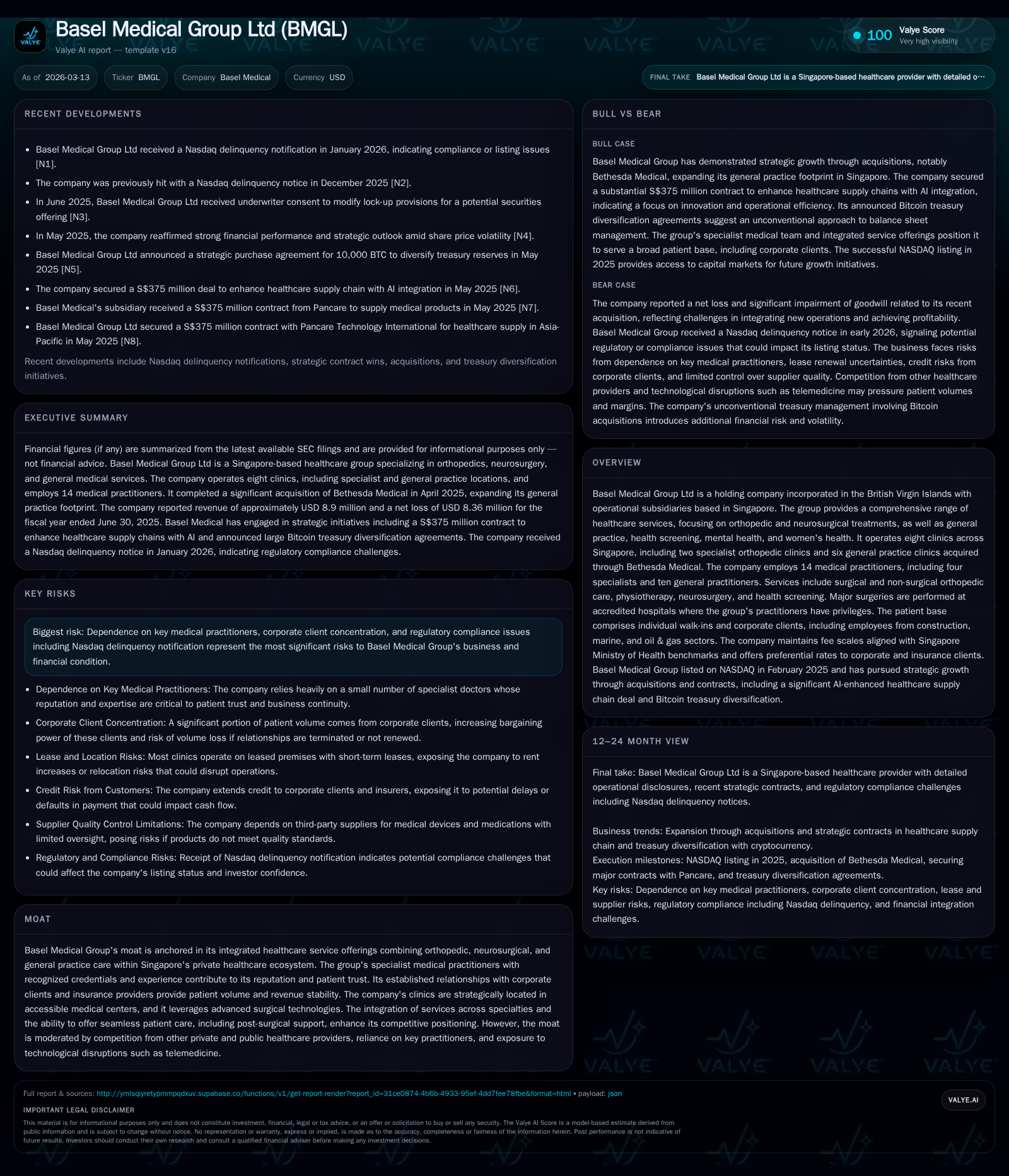
Basel Medical Group Ltd, a Singapore-based healthcare operator specializing in orthopedics and general practice, reported a 12.6% revenue increase in fiscal 2025 to approximately US$8.9 million, driven largely by the acquisition of Bethesda Medical’s six general practice clinics. However, this expansion resulted in a significant S$11.1 million impairment of goodwill related to Bethesda, dragging profit before tax into a loss of nearly S$12.5 million. Rising employee expenses and operating costs further weighed on margins. The company holds solid current assets relative to liabilities but faces risks from key practitioner dependence, regulatory compliance, and competitive pressures in Singapore’s private healthcare sector.
Company Background and Business Model
Basel Medical Group Ltd (BMGL) is a holding company incorporated in the British Virgin Islands with operational subsidiaries based primarily in Singapore. The group’s healthcare services encompass orthopedic surgeries and non-surgical treatments, neurosurgery, physiotherapy, general practice, mental health, women’s health, and health screening across eight clinics in Singapore. These include two specialist orthopedic clinics inherited from its legacy Singmed Specialists operations established since 2001 and six general practice clinics acquired through Bethesda Medical Pte Ltd in April 2025 [S1][S3][S27].
The company's model integrates specialist services with general practice under one roof while partnering with accredited hospitals where major surgeries are performed by their credentialed practitioners who maintain privileges at these institutions. Corporate client relationships generate considerable patient volume alongside individual walk-in patients enabling some revenue stability within Singapore's competitive private healthcare sector [S27].
Following its listing on NASDAQ in February 2025 under ticker BMGL, Basel Medical pursues regional Southeast Asian growth beyond Singapore focusing on expanding specialty medical offerings while leveraging innovations in surgical technology alongside seamless patient care journeys [S3][S27].
Historical Financial Performance & Growth Drivers
The fiscal year ended June 30, 2025 saw Basel Medical increase total revenue by approximately S$1.27 million (+12.6%) to S$11.32 million (US$8.9 million) compared with FY2024’s S$10.05 million [F1][S1]. This increase was mainly attributable to organic growth within the original orthopedic clinics plus an incremental S$895k from the Bethesda general practice clinics added post-April acquisition.
Orthopedic clinic revenue rose by around S$374k (+3.7%) largely driven by higher visit volumes from corporate patients rebounding post-COVID-19 disruptions; however, revenues from individual walk-in patients declined slightly by about S$91k [S1].
Other income also more than doubled (+139%) to approximately S$1.10 million aided by contributions from Bethesda operations along with interest income and waivers on aged payables [S1].
Historical performance (annual)
| FY |
|---|
| 2025 |
Source: SEC companyfacts cache [F1].
*Operating loss primarily due to impairment of goodwill amounting to approximately S$11.15 million impacting reported net loss.
Employee benefit expenses swelled by approximately 75.8% YoY to S$6.40 million on increased headcount after the Bethesda acquisition plus higher bonus payments related primarily to performance incentives [S1]. Depreciation also rose substantially (+123%) due mainly to new right-of-use asset depreciation following lease commitments for acquired facilities.
Other operating expenses more than doubled partly due to Bethesda integration costs including professional fees and currency exchange losses amid USD strengthening against SGD [S1]. Finance cost rose moderately (~16%) connected primarily with term loan interest expense increases.
Impairment Impact & Profitability Setbacks
A significant feature of FY2025 results was the recognition of a full goodwill impairment charged against Bethesda Medical exceeding S$11 million (~US$8.76 million), indicating management's prudent assessment that the newly acquired operations had not yet met performance expectations since completion less than two months prior to fiscal year-end [S1][S16].
This non-cash charge substantially worsened Basel Medical's profitability outlook turning previous profit before tax into a net pre-tax loss of roughly S$12.5 million despite top-line gains.
Net income accordingly swung into losses totaling approximately USD -8.36 million for FY2025 per latest SEC filing data [F1]. Income tax expense turned into a credit primarily due to reversal of prior years’ over-provision.
Capital Structure and Liquidity Position
As at June 30, 2025 Basel Medical held roughly USD 2.34 million (SGD ~2.98M) cash and cash equivalents alongside total current assets approximating USD 10.45 million versus current liabilities near USD 7.99 million yielding a current ratio of about 1.31x indicating reasonable near-term liquidity coverage despite operating cash flow deficits during the year [F1][S4][S7].
Operating cash flows were negative (USD -3.42M) mainly impacted by large increases in trade receivables owing from corporate clients following Bethesda's consolidation plus inventory growth; financing activities included proceeds from share issuance (USD7.67M), new borrowings (USD3.14M), offset partially by loan repayments (USD6.50M). Investing activities reflected almost USD8.68M cash outflow principally related to Bethesda acquisition costs [S15].
Total equity stood near USD ~3.82M with share capital accounting for over USD25M but retained earnings deeply negative post-impairment reflecting recent losses sustained during integration phase.
Future Growth Prospects & Strategic Outlook
Basel Medical aims for broader geographic penetration beyond Singapore into Southeast Asia combined with vertical expansion across specialties—including mental health and women's health—and horizontal growth via general practice clinics acquired through Bethesda Medical group acquisition completed April 2025 [S3][S27].
Growth drivers include:
- Recovery-driven increases in orthopedic patient volume fueled by rebounds in workplace injury incidences notably construction-related injuries.
- Leveraging integrated specialty care models offering convenience attracting individuals and corporate contracts requiring comprehensive employee healthcare solutions.
- Enhancing digital engagement channels potentially integrating telemedicine despite sector technology disruption risks.
- Expanding partnerships with corporate clients while managing concentration risks prudently.
- Potential future rollouts into adjacent markets once critical mass achieved domestically.
Challenges include intense local competition; dependence on few key specialists; rising operating costs especially rent subject to landlord negotiations; regulatory compliance complexity; technological innovation threats; cyber/data privacy vulnerabilities; pandemic or epidemic interruptions; and potential pricing regulation impacts within private healthcare sector .
Returns & Capital Allocation Priorities
Currently Basel Medical does not distribute dividends nor conduct share repurchases given cash needs focused on operational scaling post-IPO and recent large acquisition expenditures [S25]. The company recorded a negative ROE near -195% given net losses relative to equity as of FY2025 end per SEC data [F1]. Capital allocation prioritizes debt servicing capacity enhancement combined with selective M&A targeting network consolidation rather than shareholder distributions.
Key Risks Summary
Key risks facing Basel Medical include:
- Dependence on key medical specialists crucial for patient retention and referrals;
- Revenue concentration among corporate clients vulnerable to economic cycles or contract terminations;
- Regulatory compliance complexity affecting licensing renewals and pricing power;
- Competitive pressure from private providers and public alternatives impacting margins;
- Exposure to technological disruption such as telemedicine platforms;
- Nasdaq listing compliance challenges including prior delinquency notifications affecting investor confidence;
- Credit risk arising from trade receivables predominantly from corporate customers;
- Execution risks evidenced by goodwill impairment highlighting challenges integrating acquisitions;
- Increasing data security law enforcement requiring ongoing investment increasing cost burdens;
- Insurance coverage uncertainties especially regarding malpractice claims or product liability risks associated with prescribed medical devices .
Conclusion
Basel Medical Group Ltd stands at an inflection point marked by promising top-line advances enabled via strategic acquisitions expanding its multispecialty footprint but facing profound near-term profitability pressures incurred through impairment charges reflecting transaction risks associated with rapid scaling amid complex healthcare environment challenges inherent to Singapore’s private sector dynamics.
Liquidity profiles appear adequate for immediate needs reflecting prudent capital sourcing efforts post-listing including equity raises aligned with borrowing management; ongoing operational execution will require enhanced efficiency gains around cost controls coupled with improved revenue mix diversification alongside careful stewardship of regulatory compliance risks if Basel is to navigate successfully toward delivering shareholder value enhancement beyond its nascent public company stage.
This analysis relies exclusively on official company filings with the SEC including audited annual reports (20-F/A), interim reports (6-K), and company disclosures as well as validated numeric data snapshots without speculative forecasts or subjective investment opinions.
Disclaimer: This is research-only, informational analysis and not investment advice. It may include AI-generated interpretation and general industry context. Always verify important details using primary sources.

Comments