
Melco Resorts & Entertainment’s 2025 Growth Fueled by Macau Recovery and Global Resort Expansion Amid High Leverage
Melco’s diverse resort portfolio and technology investments support growth as financial leverage and regulatory risks weigh on future flexibility.
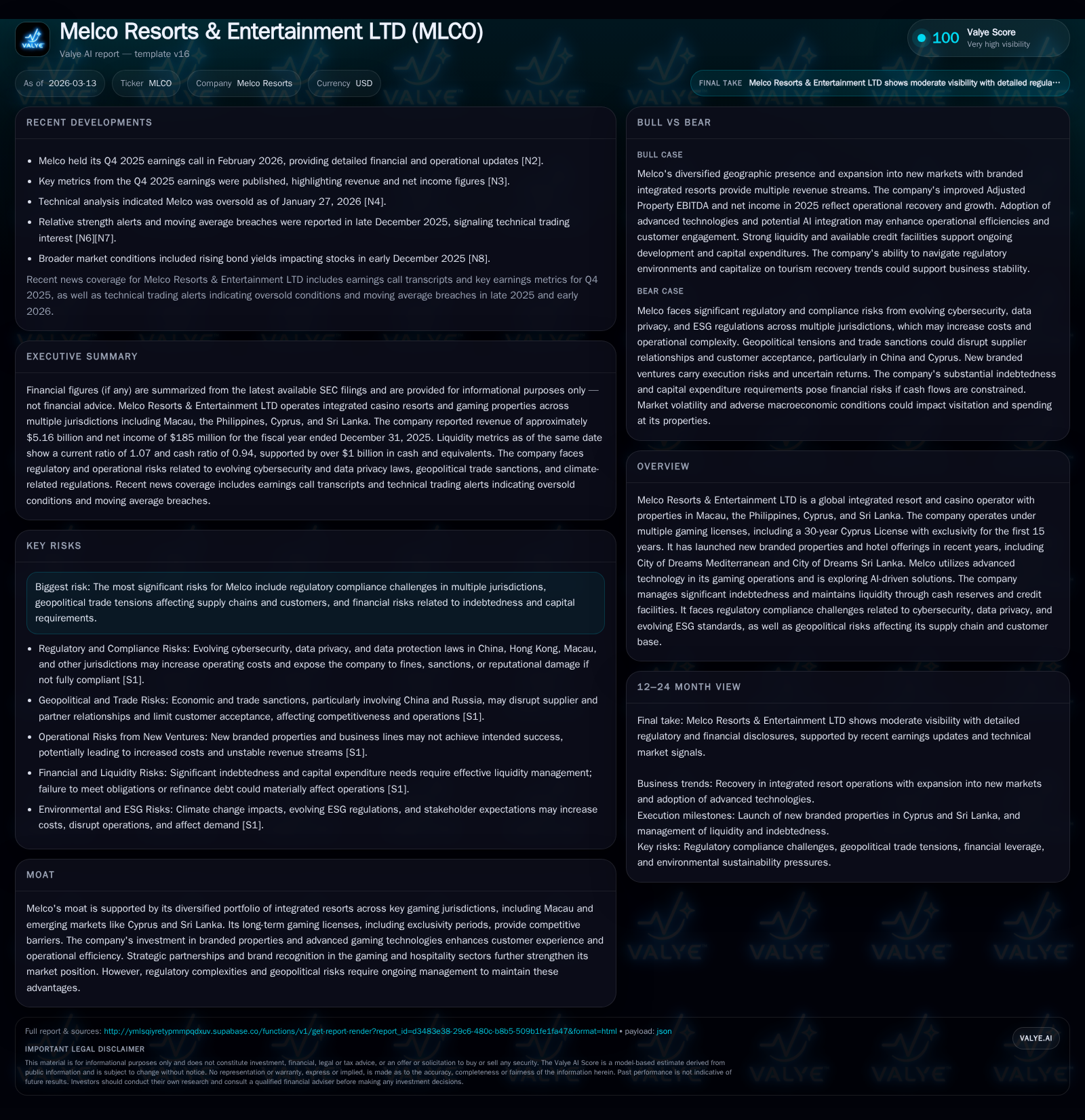
Melco Resorts & Entertainment LTD reported robust financial and operational growth in 2025, driven primarily by Macau’s tourism rebound and expanded integrated resort offerings across emerging gaming markets such as Cyprus and Sri Lanka. The company’s strategic asset diversification, including newly launched properties and advanced gaming technologies, supports growing EBITDA and operating income. However, Melco continues to navigate considerable indebtedness with complex credit facilities alongside regulatory compliance challenges related to cybersecurity, data privacy, and geopolitical trade tensions. Capital expenditures remain elevated to sustain expansion plans, while liquidity positions are bolstered by over $2 billion in available cash and undrawn credit facilities.
Historical Financial Performance
Melco Resorts & Entertainment LTD demonstrated a clear upward trajectory over the recent three years spanning fiscal years 2023 through 2025. Revenue increased steadily from $3.78 billion in 2023 to an estimated $5.16 billion in 2025, an 11.3% year-over-year gain from 2024 to 2025 alone [F1]. This top-line expansion was underpinned primarily by recovering tourism demand in Macau—where Melco operates several flagship integrated resorts—and further assisted by newer assets in the Philippines, Cyprus, and Sri Lanka.
Operating income mirrored this growth trend reflecting improved operational efficiency and scale benefits with a notable jump to $600 million in 2025, up nearly 24% from the prior year [F1]. Net income turned positive again after losses recorded during pandemic-affected periods, reaching $185 million in 2025 up from only $43 million in 2024 [F1]. This swing illustrates both a return to normalized market conditions plus effective cost controls despite inflationary headwinds.
Cash flow from operations expanded robustly by over 30% year-on-year to exceed $818 million in the most recent fiscal year, facilitating ongoing investment programs without eroding financial stability [F1]. Capital expenditures remained elevated at approximately $342 million directed primarily toward property enhancements and new resort development projects [S23][F1].
Historical performance (annual)
| FY | Rev ($bn) | Net ($mm) | CFO ($mm) | OpInc ($mm) | Rev YoY | Net YoY |
|---|---|---|---|---|---|---|
| 2025 | 5.2 | 185 | 818 | 600 | +11.3% | +325.0% |
| 2024 | 4.6 | 44 | 627 | 485 | +22.9% | +113.3% |
| 2023 | 3.8 | -327 | 623 | 65 | +179.7% | +64.9% |
| 2022 | 1.3 | -931 | -619 | -743 |
Source: SEC companyfacts cache [F1].
Capital returns and efficiency (annual)
| FY | Div ($) | ROE% |
|---|---|---|
| 2025 | 78000 | -14.8 |
| 2024 | 344000 | -3.3 |
| 2023 | 314000 | 25.4 |
| 2022 | 196000 | 109.4 |
Source: SEC companyfacts cache [F1].
Note: Capex for earlier years estimated from disclosed SEC excerpts where direct figures unavailable.
Operational Drivers Behind Past Growth
Melco’s significant improvements stem chiefly from its core Macau integrated resorts—City of Dreams and Studio City—which together boosted adjusted property EBITDA substantially due to rebound of rolling chip volumes and mass market table games performance after pandemic restrictions eased [S1]. The re-launch of prominent non-gaming attractions such as the “House of Dancing Water” show further aided non-gaming revenue streams.
Emerging markets contribute meaningfully to the portfolio diversification advantage. The recently opened City of Dreams Mediterranean (Cyprus) delivered improved profitability with $68 million adjusted property EBITDA reported in 2025 compared with about half that figure the prior year [S1]. Similarly, operations at City of Dreams Sri Lanka have been consolidated into “Other Operations” segment since mid-2025 providing incremental growth albeit with some initial start-up costs [S1].
By contrast, smaller segments such as Altira Macau continue facing operational headwinds resulting negative EBITDA contributions though losses remain marginal relative to total portfolio scale [S1]. Mocha’s closure of select casinos softly impacted mass market volumes but was offset by strategic refocus on core gaming assets [S1]. Meanwhile City of Dreams Manila experienced some performance softness attributed partially to competitive dynamics and slower regional economic conditions [S1].
Future Growth Prospects
Looking ahead, Melco aims to capitalize further on its multi-jurisdictional franchise advantage for integrated resorts that combine gaming with luxury hospitality, retail, entertainment, and dining experiences under one brand umbrella [N1][S1]. Its long-term licenses—including a rare exclusive period for its Cyprus concession—create barriers against new entrants while offering stable market access.
Technology adoption is central to future growth strategy. Melco is actively implementing AI-driven solutions such as RFID-enabled gaming tables enhancing operational monitoring and customer engagement capabilities [S22][N1]. These innovations are expected to improve yield per customer visit along with employee productivity.
Expansion initiatives will likely continue with measured capital deployment given heightened leverage levels; Sri Lanka site development reflects pursuit of untapped regional demand corridors beyond traditional Asian gaming hubs [N1,S1]. Adjacent non-gaming amenities such as premium hotel rooms launched under new brands diversify revenue streams but require ongoing marketing spend.
However, potential growth ceilings exist around regulatory frameworks which are tightening globally particularly regarding cybersecurity compliance (e.g., GDPR impact on its Cyprus operations) and anti-money laundering enforcement across jurisdictions [S11][S22][S29]. Geopolitical factors such as sanctions affecting Russian tourists historically important for Cyprus pose near-term uncertainties [S13][S14]. Currency exchange limitations tied especially to Renminbi flows could continue dampening Macau visitation patterns if unresolved [S11].
Key Forecasts and Milestones To Watch (Analysis)
Explicit earnings guidance is not provided beyond recent reporting periods [N1][N2]; investors should monitor:
- Macau visitor arrival trends post-pandemic recovery and how they sustain mass market growth.
- Progress on cyclically important non-gaming capital projects within Macau assets linked to license renewal conditions.
- Performance ramp-up speed at newly launched Mediterranean and Sri Lanka resorts beyond initial opening phases.
- Regulatory developments especially related to cross-border personal data transfers impacting marketing capabilities.
- Debt covenant compliance status around interest coverage ratios given significant outstanding senior notes extending through the early 2030s .
Returns and Capital Allocation
While Melco generates positive returns reflected by improving net income margins, shareholders’ equity remains negative at approximately -$1.25 billion as of December 31, 2025, largely due to accumulated losses during earlier pandemic years and ongoing investment write-downs or impairments typical for capital-intensive casino operations [F1]. This translates into a negative approximate ROE ratio around -14.8%, highlighting leverage effects rather than purely operational issues.
Cash flow generation is strong with operating cash flow nearing $818 million for fiscal 2025 against capex spend around $342 million yielding significant free cash flow (~$809 million) available for debt servicing or reinvestments [F1][S16][S18]. Dividends paid remain trivial at just $78K reflecting conservative payout policy amid debt reduction priorities [F1]. There is no evidence or announcement of active share repurchase programs recently; historical buybacks ceased following pandemic onset disruptions.
The company carries substantial debt obligations exceeding $6.7 billion spread across multiple notes with staggered maturities predominantly between 2027 and 2033 including revolving credit facilities amounting collectively to almost $900 million providing liquidity flexibility . Interest rate swap hedges covering portions of floating-rate debt indicate active risk management against rate volatility risks encountered since global monetary tightening began circa late-2022 [S8,S9].
Financial covenants contained within these credit agreements impose constraints on dividend payouts, incurrence of additional debt and asset disposals which reduce corporate nimbleness but preserve creditor confidence amidst economic uncertainties . Ongoing compliance with these covenants remains critical for accessing financing windows necessary for working capital needs or new project funding.
Industry Context Analysis
Integrated casino resorts operating across Asia-Pacific compete strongly on multi-dimensional experiential value — combining premium hotel services with diversified gambling options tailored for VIP clients alongside growing mass-market segments enabled through loyalty programs coupled with non-gaming entertainment attractions. The greater incorporation of technology tools like AI tracking systems or digital payment solutions differentiates operators able to enhance player asset utilization efficiently amid rising labor cost pressures.
Regulatory oversight has intensified post-Covid requiring operators not only comply proactively across data handling but also adopt heightened Anti-Money Laundering (AML) protocols responding to global standards established by organizations such as FATF. Europe-based properties like Melco’s Cyprus arm face EU-specific compliance mandates adding layers atop existing local laws thereby increasing complexity operationally.
Geopolitical events including Russia–Ukraine conflict sanctions regimes created demand shocks particularly where tourist flows depend heavily on affected nationalities requiring swift recalibration strategies either through market reallocation or branding adjustments.
Summary
Melco Resorts & Entertainment has successfully transitioned out of pandemic-related downturns leveraging its expansive footprint across mature (Macau) and emerging (Cyprus, Sri Lanka) integrated resort markets supported by scalable technologies that provide real-time operational data insights enhancing service standards. Despite promising top-line momentum reflected in double-digit annual revenue gains along with substantial operating income progress culminating in a positive net result in FY25 ([F1], [S1]), constraints persist mainly around its capital structure given high leverage exposing it to refinancing risk amidst shifting economic climates ([S4]–[S17]). The interplay between stringent regulatory environments characterized by evolving cybersecurity/data privacy mandates ([S11], [S22]) particularly cross-border restrictions influencing marketing effectiveness could temper growth elasticity.
Operationally robust yet financially cautious execution will be essential for Melco going forward as it balances reinvestment needs required under Macau concession contract commitments alongside exploring broader opportunities within international gaming hubs fostered through new licenses subject increasingly to ESG considerations paired with geopolitical fluidity impacting customer demographics ([N1], [S13]).
Monitoring quarterly updates about Adjusted Property EBITDA trends per location will be key indicators flagging operational momentum shifts while covenant compliance navigated carefully decides financial sustainability trajectory ahead ([N2], [S24]).
This analysis synthesizes information solely from filed regulatory documents including Form 20-F filings dated March 13, 2026 ([S1]-[S29]), recent earnings disclosures ([N1],[N2]), together with verified companyfacts financial data ([F1]). It does not constitute investment advice or recommendations but provides comprehensive insight into Melco Resorts’ operating environment, financial health, risks, and prospects as a leading global integrated resort operator.
Disclaimer: This is research-only, informational analysis and not investment advice. It may include AI-generated interpretation and general industry context. Always verify important details using primary sources.

Comments