
Navigator Holdings' Growth Trajectory Fueled by Fleet Specialization and Strategic Infrastructure
Navigator Holdings leverages its specialized liquefied gas fleet and terminal joint ventures to drive steady growth while investing in future fuel technologies.
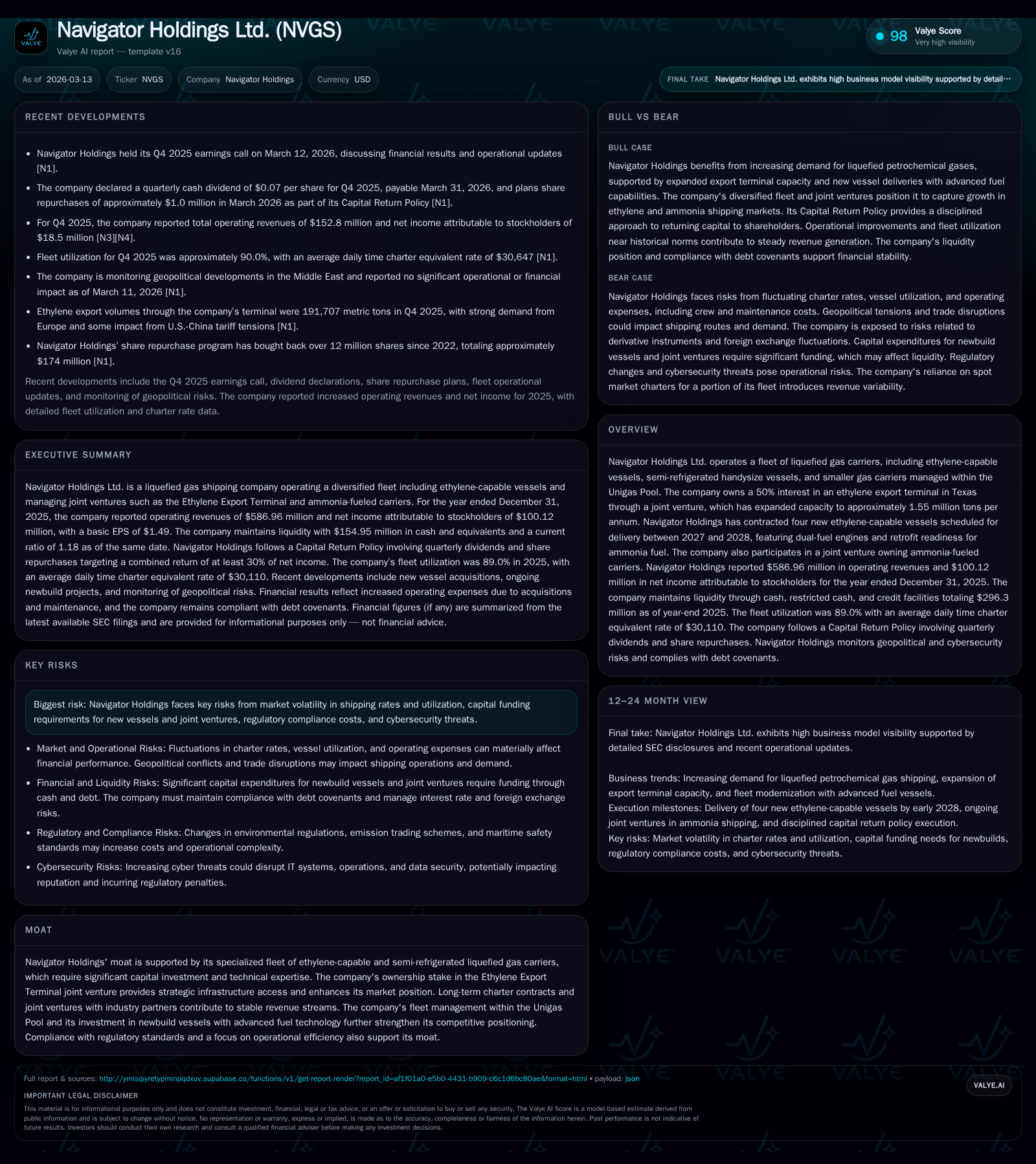
Navigator Holdings Ltd. has demonstrated consistent top-line and profitability growth driven by expansion and specialization of its liquefied gas carrier fleet, including ethylene-capable and semi-refrigerated vessels. The company’s ownership stake in an ethylene export terminal joint venture and investments in ammonia-ready dual-fuel newbuilds underpin its competitive moat and future readiness. Navigator's liquidity position remains robust with diversified financing, supporting capital allocation strategies that balance dividends and repurchases. Key upcoming milestones include the delivery of advanced ethylene vessels in 2027–2028 and monitoring evolving market dynamics and regulatory risks.
Historical Revenue and Profit Momentum Driven by Fleet Enhancement
Navigator Holdings Ltd. has steadily increased its operating scale with marked improvements in profitability over recent years. From FY2022 through FY2025, revenues expanded from approximately $474 million to nearly $587 million, representing a cumulative increase driven primarily by the addition of specialized liquefied gas carriers such as ethylene-capable vessels and semi-refrigerated handysize ships within their fleet [F1]. This +3.6% revenue year-over-year growth from FY2024 to FY2025 further benefitted from higher vessel utilization rates and effective charter contract management.
Operating income exhibited more pronounced gains, surging +15.5% year-over-year to exceed $165 million in FY2025 from the prior year’s $143 million, illustrating improved margin capture possibly due to more favorable time charter equivalent (TCE) rates amid capacity leverage increment [F1]. Net income growth also accelerated (+17% YoY), reaching about $100 million for FY2025—evidencing efficient cost control alongside top-line gains—with an approximate 8.2% return on equity based on reported shareholders’ equity of $1.23 billion at year-end [F1]. Operating cash flow was robust at just over $201 million; however, a slight dip (-4.2%) hinted at timing variance or increased working capital deployed ahead of capital expenditures associated with newbuild investments [F1].
Historical performance (annual)
| FY | Rev ($mm) | Net ($mm) | CFO ($mm) | OpInc ($mm) | Rev YoY | Net YoY |
|---|---|---|---|---|---|---|
| 2025 | 587 | 100 | 202 | 165 | +3.6% | +17.0% |
| 2024 | 567 | 86 | 211 | 143 | +2.9% | +4.0% |
| 2023 | 551 | 82 | 175 | 137 | +16.2% | +53.8% |
| 2022 | 474 | 53 | 130 | 61 |
Source: SEC companyfacts cache [F1].
Capital returns and efficiency (annual)
| FY | Buybacks ($mm) | FCF ($mm) | ROE% |
|---|---|---|---|
| 2025 | 117 | 8.2 | |
| 2024 | 57 | 211 | 7.1 |
| 2023 | 49 | 6.9 | |
| 2022 | 5 | 4.6 |
Source: SEC companyfacts cache [F1].
Note: Capex jump in FY2025 reflects investment in newbuild vessels[F1].
Specialized Vessels and Terminal Ownership as Key Growth Drivers
Navigator's competitive position is anchored by its fleet composition that includes ethylene-capable liquefied gas carriers—a niche segment demanding technical investment—and semi-refrigerated handysize vessels operated via the Unigas Pool, optimizing vessel deployment efficiency and market reach [N1][S1]. These vessel types cater to LNG products requiring precise temperature controls distinct from conventional LPG carriers.
The company holds a significant strategic asset through a substantial ownership interest in an ethylene export terminal joint venture based in Texas, whose throughput capacity was recently expanded to approximately 1.55 million tons per annum [N1][S1]. This infrastructure supports reliable access to growing ethylene export volumes from North America, linking Navigator directly to producer customers with long-term contracted volume commitments that fortify revenue stability beyond spot shipping revenues.
Capital Investment in Dual-Fuel and Ammonia-Ready Vessels Supporting Future Readiness
Navigator Holdings is proactively addressing emerging regulatory pressures on emissions by contracting four new ethylene-capable carriers equipped with dual-fuel engines capable of running on LNG and ready for retrofit conversion to ammonia fuel—the latter being a promising zero-carbon marine fuel alternative receiving increasing industry focus [N1][S3]. These newbuilds are scheduled for delivery between November 2027 and January 2028, reflecting anticipated tightening environmental standards from IMO mandates and customer demand for sustainable logistics partners.
The company also participates in joint ventures owning ammonia-fueled carriers, signaling early engagement with fuel transition technologies which may grant first-mover advantage if ammonia shipping scales commercially.
Liquidity Position and Financing Structure Including Recent Term Loans
As of December 31, 2025, Navigator held total liquidity resources aggregating approximately $296 million comprising $155 million unrestricted cash, nearly $50 million restricted funds related to joint ventures, plus undrawn revolving credit lines totaling over $91 million [F1][S6].
The company maintains several secured term loan facilities amortizing quarterly with balloon repayments at maturity dates extending into the late-2020s and early-2030s periods—demonstrating active liability management aligned with vessel life cycles [S4][S14]. Interest rates generally range around Term SOFR plus margins between approximately +150 bps to +220 bps depending on tenor and lender syndicates including ABN AMRO Bank N.V., Nordea Bank Abp, Credit Agricole Corporate & Investment Bank among others.
A senior secured pre/post-delivery term loan facility totaling about $134 million was arranged in March 2026 specifically financing two new ethylene carriers under construction; this facility bears interest at SOFR +150 bps with five-year tenor post-delivery secured by mortgages on the newbuilds themselves [S3][S14]. This targeted financing underscores confidence in asset quality and projected cash flows upon vessel entry into service.
Capital Allocation: Dividend Policy, Share Repurchases, and Cash Flow Profile
Navigator employs a balanced capital return framework based on quarterly cash dividends supplemented by opportunistic share buybacks aimed at maintaining combined payout levels around approximately 30% of net income per quarter [F1][S5][S22]. For FY2025 dividend payments totaled $0.24 per share—up modestly from $0.20 per share the prior year—with Q3/Q4 payouts set at $0.07 per share reflecting stronger earnings momentum.
Since program inception in early-2022 through March 12, 2026, the company has repurchased over twelve million shares equating to roughly $174 million deployed against outstanding stock at an average price near $14 per share—underscoring shareholder value enhancement intent alongside disciplined capital allocation [F1][S5].
Operating cash flow was strong at about $201 million in FY2025 supporting this allocation while financing meaningful capex primarily tied to vessel acquisitions and drydocking cycles (notably an $85 million surge recorded for FY2025), leaving positive free cash flow estimated above $116 million post-investment expenses [F1].
Forecast Indicators: Newbuild Deliveries and Joint Ventures to Monitor
Key milestones shaping Navigator’s near-term outlook include scheduled deliveries of four advanced ethylene-capable vessels between late calendar years of 2027 through early next decade expected to contribute incremental TCE uplift as these ships enter contracted service rotations; these deliveries are co-financed via secured loans demonstrating prudent funding strategy [N1][S3].
Ramp-up effects from joint ventures—especially those related to ammonia-fueled maritime assets—warrant close tracking given potential influence on earnings mix diversification amid evolving LNG commodity markets.
Market factors such as charter rate volatility remain pertinent uncertainties; while long-term contracts provide revenue visibility some exposure persists to spot market swings affecting TCE yields which analysts should incorporate into scenario analyses going forward [N2][N9].
Operational Efficiency Metrics: Fleet Utilization, Drydocking Strategies, and Charter Contracts
Key performance indicators include ownership days (total days vessels are owned), available days (excluding planned offhire such as drydockings), earning days (days actually earning revenue), alongside calculated fleet utilization ratios representing earning days divided by available days—metrics pivotal for managing seasonal or maintenance-driven downtime impacts on revenue generation capacity [S1][S2].
Drydocking is required every five years until vessel age fifteen then every approximately two-and-a-half years thereafter—a schedule aligned with classification society requirements ensuring vessel certification continuity but necessitating concentrated maintenance capital outlays during mature vessel lifecycle phases.
Long-term charter contracts deliver contractually stable revenue streams mitigating spot market exposure; additionally, the firm’s participation in the Unigas Pool enhances commercial flexibility albeit requiring adept logistical coordination across operators.
Risks from Market Fluctuations, Regulatory Compliance, and Cybersecurity
Navigator faces risks typical for shipping firms including pronounced time charter equivalent (TCE) rate volatility which can compress margins especially given capital-intensive nature of liquefied gas carrier operations; spot market swings remain challenging despite partial hedging from long-term contracts [S1].
Environmental regulatory frameworks are increasingly rigorous—addressing fuel sulfur limits (IMO Tier III), greenhouse gas emissions targets requiring transition toward low or zero-carbon fuels—necessitating continual capital reinvestment for compliance including scrubber installation or retrofits for dual/ammonia fuel configurations which could elevate operating costs or delay revenue generation if retrofits require offhire periods.
Cybersecurity threats targeting operational technology systems present emerging vulnerabilities potentially disrupting scheduling or safety-critical systems onboard vessels or shore-based terminals compelling ongoing investment in digital security protocols [S1].
This analysis synthesizes public filings and news transcripts without investment recommendation.
Disclaimer: This is research-only, informational analysis and not investment advice. It may include AI-generated interpretation and general industry context. Always verify important details using primary sources.

Comments