
ProQR Therapeutics Charts a Transition to RNA Editing with Early-Stage Pipeline Focus
ProQR’s pivot to its proprietary Axiomer RNA editing platform redefines its R&D trajectory amidst mounting losses and strategic collaborations.
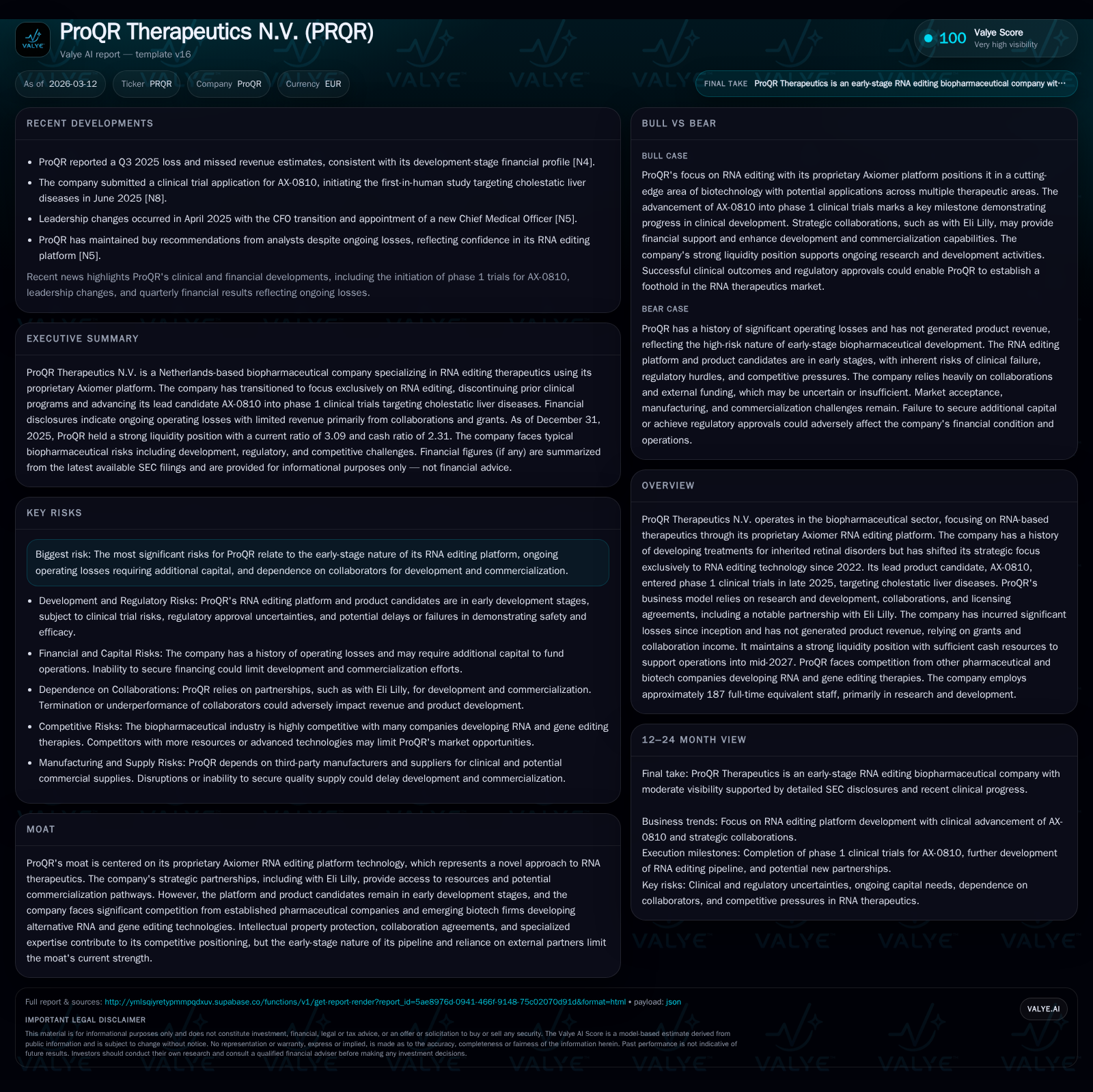
ProQR Therapeutics has shifted from inherited retinal disorder treatments to focusing exclusively on novel RNA editing technology since 2022. The company’s lead candidate, AX-0810, entered Phase 1 trials in late 2025 targeting cholestatic liver diseases, reflecting a pivotal stage in pipeline development. Despite significant historical operating losses and a negative return on equity, ProQR maintains a solid liquidity position to fund operations through mid-2027, supported partly by a key collaboration with Eli Lilly. Key risks remain around early-stage technology challenges, reliance on partnerships, and ongoing capital needs.
From Inherited Retinal Disorders to RNA Editing: Evolution of ProQR’s Growth Drivers
Founded in 2012 with an initial focus on inherited retinal disorders such as Leber Congenital Amaurosis (LCA) and Usher syndrome, ProQR Therapeutics had directed much of its research resources toward developing antisense oligonucleotide therapies like sepofarsen. However, since August 2022, ProQR strategically discontinued clinical development of these retinal candidates, transferring rights for certain programs (e.g., sepofarsen and ultevursen) to Laboratoires Théa by the end of 2023 [S1]. This marked a pronounced pivot away from disease-specific antisense approaches towards leveraging its proprietary Axiomer RNA editing platform—a technology designed to enzymatically modify RNA transcripts to correct genetic mutations.
Such repositioning has fundamentally reshaped the company’s R&D focus and expenditure profile. As of FY2025 year-end, ProQR’s accumulated net losses stood above €467 million [F1], underpinning the heavy upfront investment in platform research rather than product commercialization. Revenue generation efforts have been limited to government grants and collaborative income rather than product sales [S1]. This transition reflects broader biopharma trends favoring platform technologies capable of targeting multiple genetic conditions over single-indication therapeutics.
Financial Recap: Operating Losses and Capital Needs amid Strategic Realignment
Financially, ProQR’s operations continue at a loss-making cadence common for clinical-stage biotech firms investing aggressively in innovative platforms. Net income declined sharply from -€27.8 million in FY2024 to -€42.2 million in FY2025—a 51.9% year-over-year increase in losses [F1]. The operating losses stem primarily from intensive R&D spending associated with advancing the Axiomer platform and initial clinical trials.
Total equity demonstrated volatility over recent years: rising from roughly €41.4 million at the end of FY2023 to €88.6 million at FY2024 before contracting to €49.4 million by FY2025 [F1]. This fluctuation likely mirrors periodic financing rounds balanced against operating burn. The resulting return on equity (ROE) ratio approximates -85.4% for FY2025 reflecting the lack of profitability combined with declining shareholder equity [F1].
Liquidity remains healthy despite ongoing losses; the current ratio measured at approximately 3.09 underscores adequate short-term asset coverage of liabilities [F1]. Nonetheless, continual capital raises will be needed given prolonged operating deficits intrinsic to early clinical development stages and absence of product revenue streams [S1].
Historical performance (annual)
| FY | Net ($mm) | Net YoY |
|---|---|---|
| 2025 | -42 | -51.9% |
| 2024 | -28 | -0.1% |
| 2023 | -28 | +57.3% |
| 2022 | -65 |
Source: SEC companyfacts cache [F1].
Capital returns and efficiency (annual)
| FY | ROE% |
|---|---|
| 2025 | -85.4 |
| 2024 | -31.3 |
| 2023 | -67.0 |
| 2022 | -99.7 |
Source: SEC companyfacts cache [F1].
Progress and Potential: The Lead Candidate AX-0810 and Pipeline Development
Since December 2025, ProQR initiated Phase 1 clinical trials for AX-0810, its first-in-human candidate utilizing the Axiomer platform aimed at treating cholestatic liver diseases by targeting the sodium taurocholate cotransporting polypeptide (NTCP), a critical hepatic transporter implicated in bile acid secretion [N2][S1][S2]. Entering this early clinical stage marks a significant milestone validating the feasibility of RNA editing therapeutics beyond inherited retinal disorders.
Axiomer employs site-directed RNA base editing using engineered enzymes that convert adenosine to inosine within various transcripts contributing to disease pathology. This modality differs from other RNA therapies such as antisense oligonucleotides or mRNA therapeutics by directly correcting mutations at the transcript level without permanent genomic alteration. The NA-Taurocholate Cotransporting Polypeptide (NTCP) targeting reflects an innovative mechanism addressing cholestatic pathologies traditionally lacking effective treatments.
With AX-0810's advancement into safety and dose-escalation studies attendant with Phase 1 designations standard within biotech drug development protocols [S2], success here could establish clinical proof-of-concept for Axiomer’s therapeutic applicability across diverse indications pending further pipeline expansion.
Liquidity Position and Capital Allocation: Managing Cash Runway Through Mid-2027
Despite substantial annual operating losses driven by intense R&D activities affiliated with early-stage recombinant RNA editing technology development [S1], ProQR sustains a strong liquidity position evidenced by a current ratio near 3.09 as of year-end FY2025 [F1]. Current assets totaling approximately €100 million well exceed liabilities close to €32 million [F1], providing operational flexibility.
This financial posture translates into a funding runway projected into mid-2027 under existing expenditure assumptions including ongoing AX-0810 trial costs and further preclinical activities [S17][S18][S25]. Capital allocation concentrates predominantly on research and development expenses with no dividend distributions or share repurchases executed or planned given capital preservation priorities endemic among nascent biotech firms reliant on successive financing rounds until revenue-generating commercialization pathways materialize [S5][S9].
Collaboration Edge: The Role of Eli Lilly Partnership in Advancing the Axiomer Platform
ProQR benefits materially from a strategic collaboration agreement established with Eli Lilly in December 2022 granting Lilly exclusive and non-exclusive rights to exploit aspects of Axiomer's RNA editing intellectual property for select compounds [N2][S1][S14]. This alliance not only brings milestone payments and potential royalty streams contingent upon successful commercialization but also access to Lilly’s extensive drug development expertise and global commercial infrastructure—critical levers for accelerating both scientific validation and market entry.
Co-development synergies reduce capital burden while de-risking translational steps inherent in novel biologic modality pipelines through shared resource utilization. However, dependence on external partners entails risk if collaborators alter their strategic priorities or fail to progress candidate programs promptly which could delay or reduce anticipated revenue inflows from milestone achievements within the partnership framework.
Risks and Uncertainties: Early-Stage Technology Challenges and R&D Investment Reliance
The foremost risks confronting ProQR center on its underlying technology being at an embryonic stage of clinical validation accompanied by extensive operating cash burn necessitating recurring capital raises subject to timing and valuation challenges typical within specialty RNA therapeutic sectors [S4][S6][S26]. Furthermore:
- Patent opposition proceedings are underway particularly in Australia and Europe concerning Axiomer IP which may threaten exclusivity if lost impacting competitive advantage [S20].
- Regulatory barriers remain due to evolving guidelines governing gene-editing modalities implying protracted approval timelines or unforeseen compliance expenses.
- Competitive dynamics intensify as prominent pharma companies deploy alternative RNA-based approaches including CRISPR gene editing or advanced antisense platforms potentially eclipsing Axiomer’s commercial prospects.
- Reliance on collaborative partners like Eli Lilly exposes business continuity risks should negotiations falter or clinical assets underperform reducing future milestone revenues.
- Compliance complexities span multiple jurisdictions’ healthcare laws including anti-kickback statutes and data privacy laws adding operational legal oversight burdens [S6][S7][S8].
Outlook and Key Milestones to Monitor in Clinical and Commercial Expansion
While explicit company guidance is absent regarding revenue timelines or profitability forecasts [N2][S2], critical near-term events warrant attention:
- Readouts from Phase 1 trials of AX-0810 evaluating safety/tolerability will inform dose optimization decisions.
- Initiation of further clinical development phases would signal maturation of pipeline confidence.
- Updates on existing or new collaborations/licensing deals may provide visibility into non-dilutive capital inflows.
- Regulatory submissions supporting investigational new drug applications beyond AX-0810 would broaden pipeline breadth.
Monitoring these milestones can offer insight into progression toward commercialization inflection points amid inherent uncertainties linked to pioneering RNA editing platforms.
Governance Dynamics: Recent Board Changes Reflect Strategic Focus on Innovation
In February 2026 ProQR announced changes in board composition emphasizing appointments of seasoned industry veterans possessing strong pharmaceutical development backgrounds aligning governance structure with scientific innovation imperatives [S3][S1]. Chairmanship transition towards James Shannon M.D.—a figure notable for extensive executive experience at GSK and Novartis—underscores steered oversight through clinical risk landscapes.
This governance recalibration aims to provide robust leadership navigating technological risks while underpinning institutional investor confidence crucial during critical phase transitions within their early-stage pipeline-focused lifecycle.
This analysis synthesizes publicly disclosed SEC filings alongside recent press updates without speculative projections beyond stated factual information. Readers should consider company-specific statements alongside sector context when evaluating prospects related to novel RNA therapeutic development trajectories.
Disclaimer: This is research-only, informational analysis and not investment advice. It may include AI-generated interpretation and general industry context. Always verify important details using primary sources.

Comments