
CION Investment Corp’s Leverage and Credit Challenges Weight on 2025 Performance
The business development company contends with rising non-accruals and tighter asset coverage amid regulatory leverage constraints.
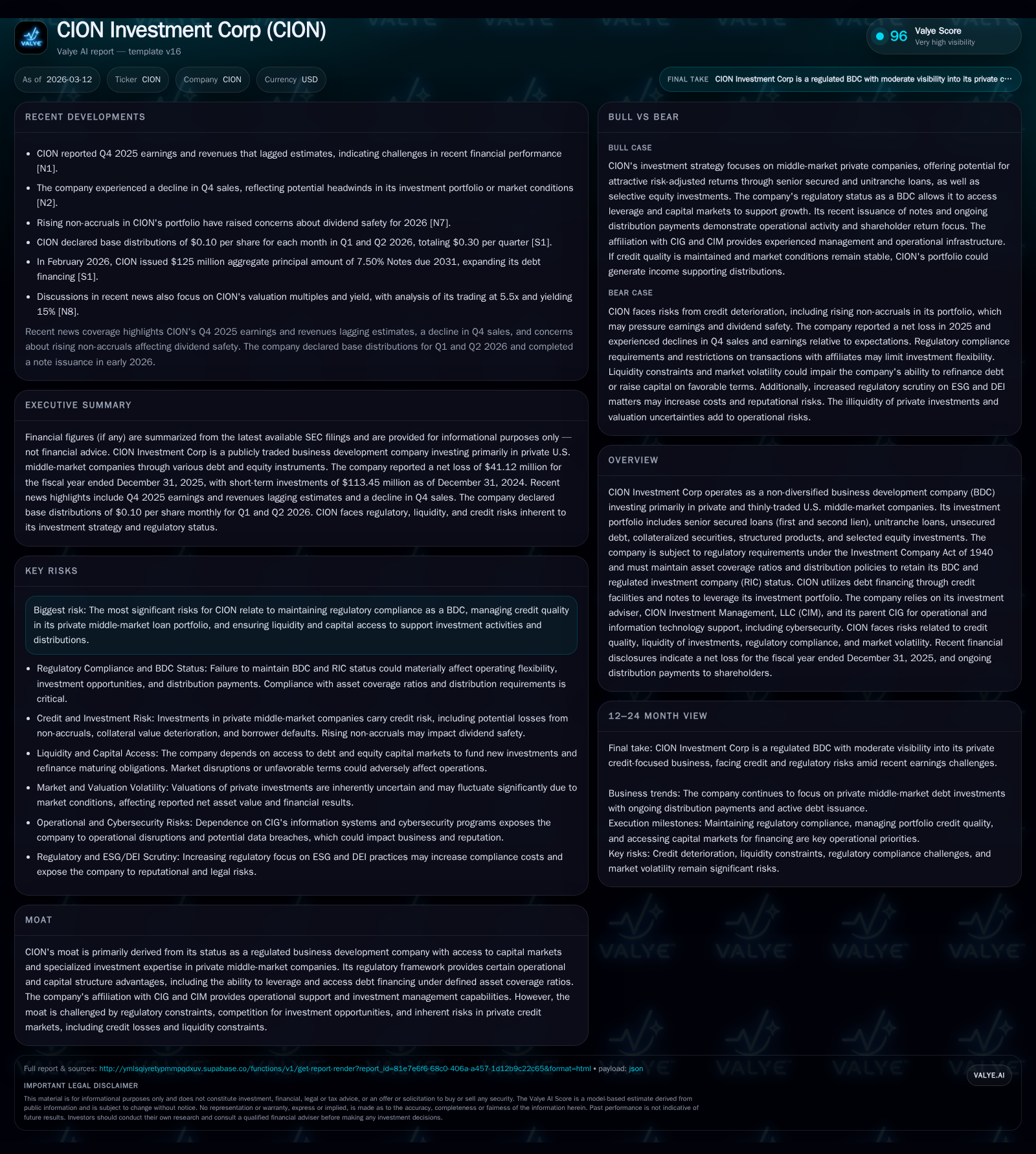
CION Investment Corp, a business development company specializing in middle-market private credit, experienced a sharp reversal to net losses in fiscal 2025 after several years of positive income. The company operates under regulatory leverage limits that permit up to a 150% asset coverage ratio, supporting its capital-intensive investment strategy focused on senior secured, unitranche, and unsecured loans. Rising credit risks and tightening financing conditions have pressured results and dividend sustainability. Going forward, maintaining regulatory compliance and liquidity through capital markets access remain critical to support investments and distributions.
Historical Financial Performance
CION Investment Corp has faced significant fluctuations in financial results over recent years. Net income was $50.14 million in FY2022, $50.99 million in FY2023, then declined sharply to $5.46 million in FY2024 before reversing to a net loss of $41.12 million in FY2025 [F1]. This volatility reflects the credit risk exposure inherent in its middle-market lending focus.
Operating cash flow (CFO) also varied materially: positive at $35.28 million in FY2022, turning negative to -$97.15 million in FY2023, then recovering to $88.19 million in FY2024 before declining again to $76.83 million in FY2025 [F1]. Such swings indicate working capital and investment activity impacts on liquidity.
Equity capital decreased from $883.63 million at the end of FY2022 to $707.63 million at FY2025-end due to cumulative net losses [F1]. Despite earnings volatility, dividends paid remained significant — $66.64 million (FY22), $91.96 million (FY23), $89.48 million (FY24), and $78.02 million (FY25) — underscoring payout pressures [F1]. Share repurchases continued modestly, totaling approximately $17.19 million in FY25 [F1].
Historical performance (annual)
| FY | Net ($mm) | CFO ($mm) | Net YoY |
|---|---|---|---|
| 2025 | -41 | 77 | -853.4% |
| 2024 | 5 | 88 | -89.3% |
| 2023 | 51 | -97 | +1.7% |
| 2022 | 50 | 35 |
Source: SEC companyfacts cache [F1].
Capital returns and efficiency (annual)
| FY | Div ($mm) | Buybacks ($mm) | ROE% |
|---|---|---|---|
| 2025 | 78 | 17 | -5.8 |
| 2024 | 89 | 11 | 0.7 |
| 2023 | 92 | 12 | 5.8 |
| 2022 | 67 | 15 | 5.7 |
Source: SEC companyfacts cache [F1].
The data highlight net income volatility with recent losses emerging; operating cash flow remains positive but declined recently; equity has been reduced by losses; dividends continue at material levels.
Business Model and Regulatory Framework
CION operates as a non-diversified business development company investing primarily in private U.S. middle-market companies through senior secured loans including first and second lien positions, unitranche loans combining senior and subordinated tranches, unsecured debt such as mezzanine instruments or corporate bonds, and select equity stakes [S1]. The illiquid nature of these investments demands careful underwriting but exposes CION to notable credit risk.
Regulatory leverage limits under the Investment Company Act require maintaining asset coverage ratios — recently adjusted from a minimum of 200% down to 150% following shareholder approval effective December 31, 2021 — enabling up to approximately two-to-one debt-to-equity leverage [S1][S16]. This framework provides defined capital buffers but restricts leverage use and investment flexibility.
Affiliated entities such as CIG and CION Investment Management LLC provide investment expertise and operational infrastructure including board-level cybersecurity oversight addressing inherent data security risks [S1].
Credit Risk Profile and Portfolio Composition
Managing credit quality amid economic uncertainty remains a key challenge as middle-market borrowers often have limited financial resources relative to larger corporates [S19][S23]. Rising non-accruals reported recently indicate increasing stressed credits which may threaten dividend sustainability [N10].
Most senior secured loans are collateralized; however, collateral values depend on market conditions affecting recovery prospects upon default [S7][S18]. Intercreditor agreements may limit CION’s influence over enforcement actions where it holds subordinate claims.
Unitranche loans provide blended yields between senior secured and subordinated debt but carry combined risks from both tiers [S7]. Unsecured debt components are subject to higher volatility due to junior ranking.
Prepayments by borrowers can reduce yields if proceeds must be reinvested temporarily at lower rates or held as low-yield short-term instruments [S17]. Selective equity investments accompany debt positions for upside participation but introduce valuation complexities.
Capital Structure and Compliance
CION finances through multiple sources including JPMorgan and UBS credit facilities alongside term loans and publicly traded notes maturing from near-term through longer horizons such as seven-and-a-half percent notes due in 2029 and 2031 [S4][S26]. Covenant compliance mandates maintaining minimum equity levels and asset coverage ratios critical to avoid defaults or forced deleveraging [S4][S10].
As of December 31, 2025, borrowings approximated $1.14 billion producing an asset coverage ratio near 162%, above the regulatory minimum though trending downward from previous years’ levels around 170%-180% [S8][F1]. Declines in portfolio asset values could pressure this ratio risking distribution restrictions or disadvantageous asset sales.
Interest expense is significant given borrowing costs around eight percent or higher impacting net investment income available for distribution [S21]. Rising global interest rates add cost pressure despite hedging efforts which entail execution risk and costs [S9][S17].
Regulations restrict common stock sales below NAV absent board approval aimed at preventing NAV dilution; however, market prices trading below NAV create discount pressures limiting equity raises or prompting dilutive issuances under certain conditions [S16][S24].
Dividend Policy & Capital Returns
Despite earnings volatility culminating in net losses for FY25, CION has maintained substantial dividend payouts consistent with BDC/RIC rules requiring distribution of taxable income annually to avoid corporate-level tax [F1][S1]. Dividends paid totaled $78 million versus operating cash flow of $76 million in FY25 indicating tight cash flow coverage.
The share repurchase program authorizes buying back up to approximately $80 million of shares when trading below NAV intended to support price stability though risking dilution if purchases occur above prevailing NAV per share [S6]. Actual repurchases reached about $17 million during FY25 indicating modest activity relative to dividends paid [F1]. Capital returned favors dividends over buybacks.
Return on equity calculated using latest net income and equity is negative at -5.8%, reflecting poor return efficiency mainly due to recent credit challenges rather than operational issues alone [F1].
Outlook & Risks
Growth prospects depend on disciplined credit risk management while leveraging balance sheet capacity within permitted thresholds amid evolving economic conditions [N9][S16]. Strong origination via CIM provides access to proprietary deal flow though competition among BDCs intensifies with tightening spreads.
Key risks include:
- Credit deterioration raising defaults lowering cash collections impacting distributions.
- Regulatory scrutiny potentially restricting leverage or triggering forced asset sales at unfavorable valuations.
- Macro-economic factors such as inflation volatility or recession depressing borrower repayments.
- Capital markets disruptions impeding refinancing or new funding jeopardizing investment agility.
- Cybersecurity threats posing operational risks despite governance focus [S1].
Recent news highlights investor caution as Q4 results lagged estimates amid margin compression and rising non-accruals raising dividend safety concerns without explicit guidance disclosed recently [N1][N6][N10].
Key Monitorables & Conclusion
Absent explicit forward guidance, important metrics include:
- Quarterly asset coverage ratios vis-à-vis regulatory minima signaling leverage capacity or need for deleveraging.
- Non-accrual loan trends providing early signals on portfolio credit stress.
- Operating cash flow versus dividend payouts clarifying payout sustainability amidst earnings variability.
- Interest rate environment influencing borrowing costs impacting net investment income margins.
- Capital markets receptivity evidenced by issuance activity or covenant amendments confirming liquidity strength.
- Regulatory developments potentially altering leverage rules or reporting requirements affecting operational flexibility.
- Dividend declarations compared with historical patterns reflecting management confidence or caution regarding earnings normalization.
CION operates within a specialized private credit niche characterized by regulatory constraints, concentrated exposures, and leveraged capital structures amplifying both upside potential and downside risks.[F1][S4]
The sharp earnings decline into negative territory during FY25 reflects mounting credit challenges compounded by macroeconomic uncertainty challenging covenant compliance across multiple financings.[N10] While operational cash flows remain positive supporting near-term distributions better than accounting earnings suggest, persistent elevated non-accruals raise concerns about return sustainability.[N10]
The capacity for strategic leveraging offers growth opportunities when prudently managed but significant risks if deteriorating portfolio values force restrictive disposals.[S16]
Close attention should focus on evolving asset coverage ratios alongside portfolio credit trends given their critical implications for dividend policy viability amid tightening BDC regulations.[N9]
Enhanced cybersecurity governance mitigates some operational disruption risks even as geopolitical tensions contribute to broad market volatility affecting capital availability essential for CION’s growth platform.[S1]
This report is prepared solely for informational purposes based on available public disclosures as of March 12, 2026; it does not constitute investment advice.
Disclaimer: This is research-only, informational analysis and not investment advice. It may include AI-generated interpretation and general industry context. Always verify important details using primary sources.

Comments