
Mineralys Therapeutics' Clinical Milestones and Financial Trajectory Toward Hypertension Innovation
Lorundrostat’s late-stage clinical success and FDA NDA acceptance propel Mineralys toward commercialization amid ongoing financial losses.
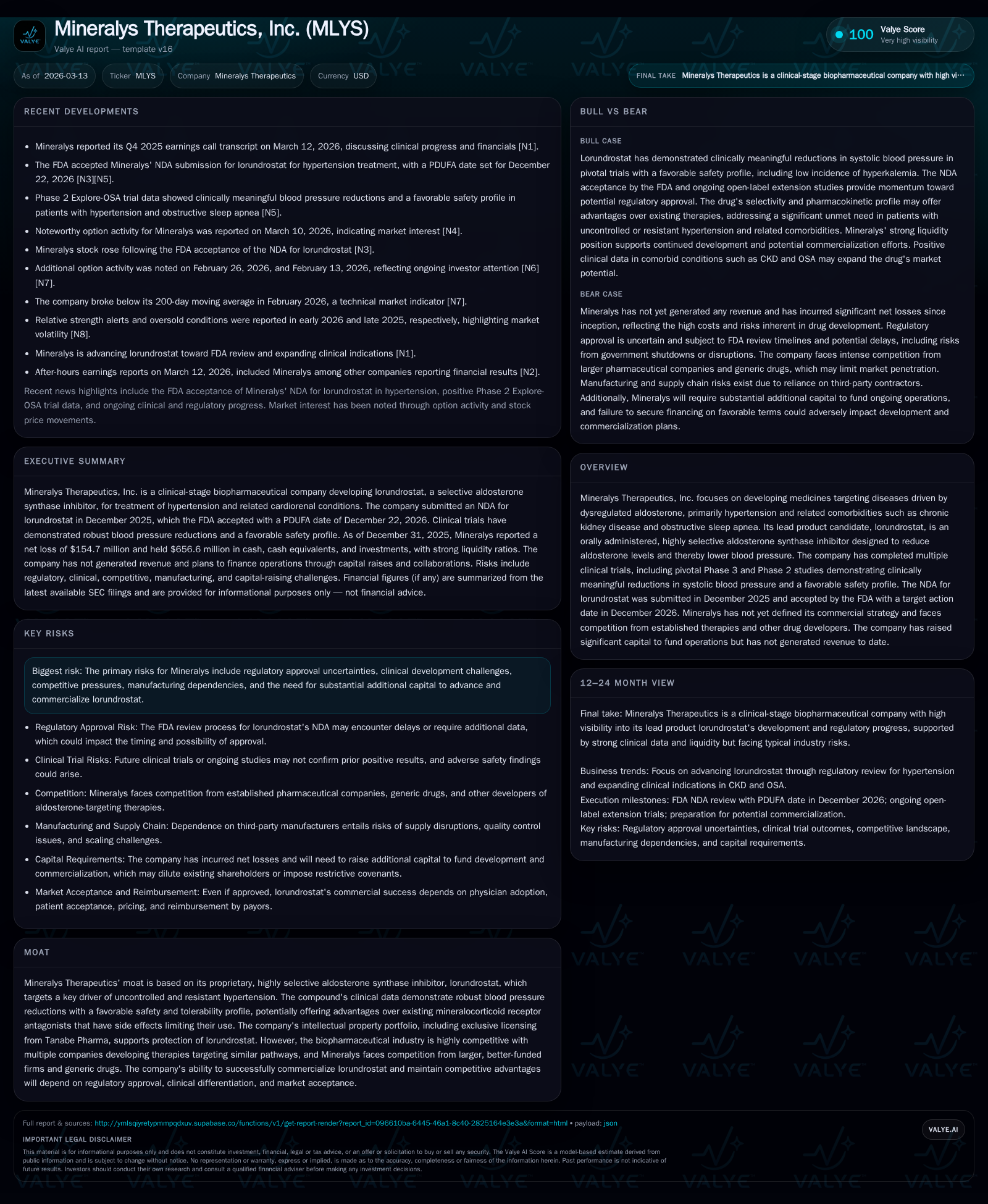
Mineralys Therapeutics has achieved significant clinical validation for lorundrostat, a selective aldosterone synthase inhibitor showing meaningful blood pressure reductions in resistant hypertension. The company’s NDA was accepted by the FDA with a PDUFA date set for December 2026, marking a key regulatory milestone. Despite promising therapeutic data, Mineralys remains loss-making with substantial cash burn as it transitions from development to potential market launch. Continued growth depends on regulatory approval, successful commercialization strategy execution, and expansion into related cardiorenal indications such as CKD and OSA.
Clinical Achievements Driving Growth: Lorundrostat’s Trial Results and Regulatory Progress
Mineralys Therapeutics centers its development efforts around lorundrostat, an orally administered, highly selective aldosterone synthase inhibitor (ASI). This mechanism targets a key driver in approximately 30% of patients suffering from uncontrolled or resistant hypertension (uHTN/rHTN), conditions associated with increased cardiovascular morbidity and mortality [S1].
The company completed multiple clinical trials validating this approach. Foremost among these were the pivotal Phase 3 Launch-HTN trial and the Phase 2 Advance-HTN trial, which together established lorundrostat's robust, durable reductions in systolic blood pressure alongside a well-tolerated safety profile [S1]. These findings gained recognition through presentations at major cardiology conferences and publications in reputable journals like JAMA and NEJM during 2025 [S1].
Beyond hypertension, Mineralys pursued comorbid indications reliant on aldosterone dysregulation pathways. Notably, its Phase 2 Explore-CKD trial showed significant reductions in urinary albumin creatinine ratio (UACR), a surrogate biomarker for kidney disease progression, when administered alongside an SGLT2 inhibitor—a standard therapy for chronic kidney disease [S1]. Further, the recent topline results from the Phase 2 Explore-OSA trial demonstrated clinically meaningful blood pressure reductions in patients with moderate-to-severe obstructive sleep apnea (OSA), another condition linked mechanistically to aldosterone-driven hypertension [N5], [S1].
These clinical successes culminated in the submission of a New Drug Application (NDA) to the FDA in December 2025 for lorundrostat as adjunctive therapy in hypertension [S1]. The FDA accepted this NDA filing and assigned a Prescription Drug User Fee Act (PDUFA) target action date of December 22, 2026 [N3], underscoring a critical regulatory milestone validating both clinical efficacy and development rigour.
Financial Performance Trends and Historical Operating Challenges
Mineralys remains in the pre-commercial stage with no revenue generation to date. Its income statement reflects investments heavy on research and development expenses needed to support its novel drug candidate [F1]. For fiscal year ending December 31, 2025, Mineralys reported an operating loss of approximately $170.6 million and a net loss of $154.7 million [F1]. Although losses narrowed slightly compared to the prior year—operating loss improved by about 11.3% year-over-year—the company continues to face sustained negative cash flows.
Operating cash flow (CFO) remained negative at $142.4 million during FY2025—a modest improvement compared to $166.3 million outflow in FY2024—indicating ongoing cash burn mainly attributable to clinical trials and associated activities [F1]. Capital expenditures have been minimal ($15K in FY2025), consistent with limited fixed asset investments typical of clinical-stage biotech firms predominantly focusing on intangible assets like intellectual property [F1].
The balance sheet depicts strong liquidity supported by $173 million in cash & equivalents as of year-end 2025 alongside current assets totaling approximately $661 million against relatively low current liabilities near $15 million yielding a very healthy current ratio exceeding 43x—a product of recent equity raises rather than operational cash generation [F1], [S10]. Equity surged markedly from $191 million at end-FY2024 to nearly $647 million by end-FY2025 due to multiple public offerings executed during calendar year 2025 that combined raised over half a billion dollars net proceeds [S10].
Nevertheless, residual accumulated deficit stood at roughly $457 million by December 31, reflecting sustained historical operating losses as Mineralys prepares for commercialization [F1]. An approximate return on equity (ROE) calculation using FY2025 net income yields -23.9%, highlighting absence of profitability common for companies transitioning from drug development toward first launches [F1].
Historical performance (annual)
| FY | Net ($mm) | CFO ($mm) | OpInc ($mm) | Capex ($) | Net YoY |
|---|---|---|---|---|---|
| 2025 | -155 | -142 | -171 | 15000 | +13.0% |
| 2024 | -178 | -166 | -192 | 96000 | -147.3% |
| 2023 | -72 | -81 | -85 |
Source: SEC companyfacts cache [F1].
Capital returns and efficiency (annual)
| FY | FCF ($mm) | ROE% |
|---|---|---|
| 2025 | -142 | -23.9 |
| 2024 | -166 | -93.0 |
| 2023 | -29.8 |
Source: SEC companyfacts cache [F1].
Table: Historical Financial Overview (USD millions). Year-over-year % changes reflect improvements though losses persist.
Strategic Prospects for Future Growth in Cardiorenal Therapies
Beyond primary hypertension treatment, Mineralys is strategically exploring adjacent patient populations where dysregulated aldosterone plays pathophysiological roles. The implications for chronic kidney disease are particularly compelling given lorundrostat’s capacity to reduce UACR—an established biomarker correlated with renal injury progression—and improve blood pressure control when combined with existing SGLT2 inhibitors approved for CKD management [S1], [N5].
Similarly, dosing lorundrostat in obese individuals suffering from moderate-to-severe OSA addresses a refractory hypertensive subset characterized by intermittent hypoxia-driven neurohormonal activation; though Explore-OSA did not meet endpoints related to apnea-hypopnea index reduction, blood pressure outcomes were positive—a signal warranting further investigation within this high-risk niche population [N5], [S1].
These extensions reinforce Mineralys’ positioning towards an integrated cardiorenal metabolic disorder franchise potentially elevating market opportunity beyond third-line resistant hypertension therapies into broader multisystem management paradigms.
Regulatory Milestones and Market Entry Expectations: December 2026 PDUFA Date Focus
The FDA’s acceptance of Mineralys’ NDA submission signals readiness for market authorization assessment under standard review timelines culminating on December 22, 2026—the projected PDUFA target date marking potential transition from investigational product status towards commercial availability pending approval [S1], [N3].
While this event is auspicious, inherent uncertainties around final regulator feedback remain significant variables that will shape launch timing and pathway clarity. Further critical strategic developments include defining pricing models, reimbursement negotiations, manufacturing scale-up assurances, supply chain robustness, prescribing guidelines establishment, and sales force deployment—all essential components lacking public detail at present thus constituting watch points during the NDA review period [S1], [N3].
Capital Structure, Cash Flows, and Profitability Headwinds
Mineralys exhibits a capital structure typical of advanced-stage clinical biopharmaceutical entities approaching registration milestones but still distanced from recurrent revenue streams. Recent equity financings substantially bolstered liquidity reserves supporting planned activities through NDA review phases into commercial readiness preparation albeit with heightened burn risks overshadowing near-term profitability prospects.
Operating cash burn remains material ($142M CFO outflow FY2025), while almost negligible capital expenditure expenditure underscores focus on intangible asset development over fixed physical infrastructure investments within this maturation phase [F1], [S10]. Despite positive movement towards operating loss reduction evident in sequential YoY improvements (~11%), leverage on equity expansion dilutes short-term earnings metrics such as ROE which stands deeply negative near -24% illustrating ongoing financing cost burdens relative to nascent earnings capacity [F1].
Therefore capital market engagement or partnerships will likely be requisites pre-or post-launch pending approval outcomes.
Competitive Environment and Market Positioning Risks
The antihypertensive therapeutic landscape is crowded with several classes representing decades-old standards complemented recently by emerging agents targeting mineralocorticoid pathways albeit often limited by side effects constraining their widespread use [S1], [S4]. Lorundrostat’s highly selective ASI profile aims to surpass these limitations through improved tolerability resulting from minimized off-target effects typically seen with mineralocorticoid receptor antagonists.
However, Mineralys faces intense competition from entrenched generic medications widely adopted due to cost-effectiveness alongside competitors advancing similar mechanisms or pipeline programs with larger resource bases favoring scale benefits across regulatory submissions & commercialization capabilities—challenges common among smaller biotech innovators patent-protected solely via licensed proprietary technologies such as licensure from Tanabe Pharma forming part of Mineralys’ IP moat defensive perimeter [S1], [S4].
Success will depend heavily on differentiated clinical profiles translating into payer willingness to reimburse premium pricing amid increasing cost containment pressures affecting access decisions across government programs including Medicare/Medicaid as well as private insurers domestically and internationally (where price controls tighten margins) [S20].
Disclaimer: This is research-only, informational analysis and not investment advice. It may include AI-generated interpretation and general industry context. Always verify important details using primary sources.

Comments