
FORWARD AIR’s Omni Acquisition Spurs Service Diversification Amid Profit Slip
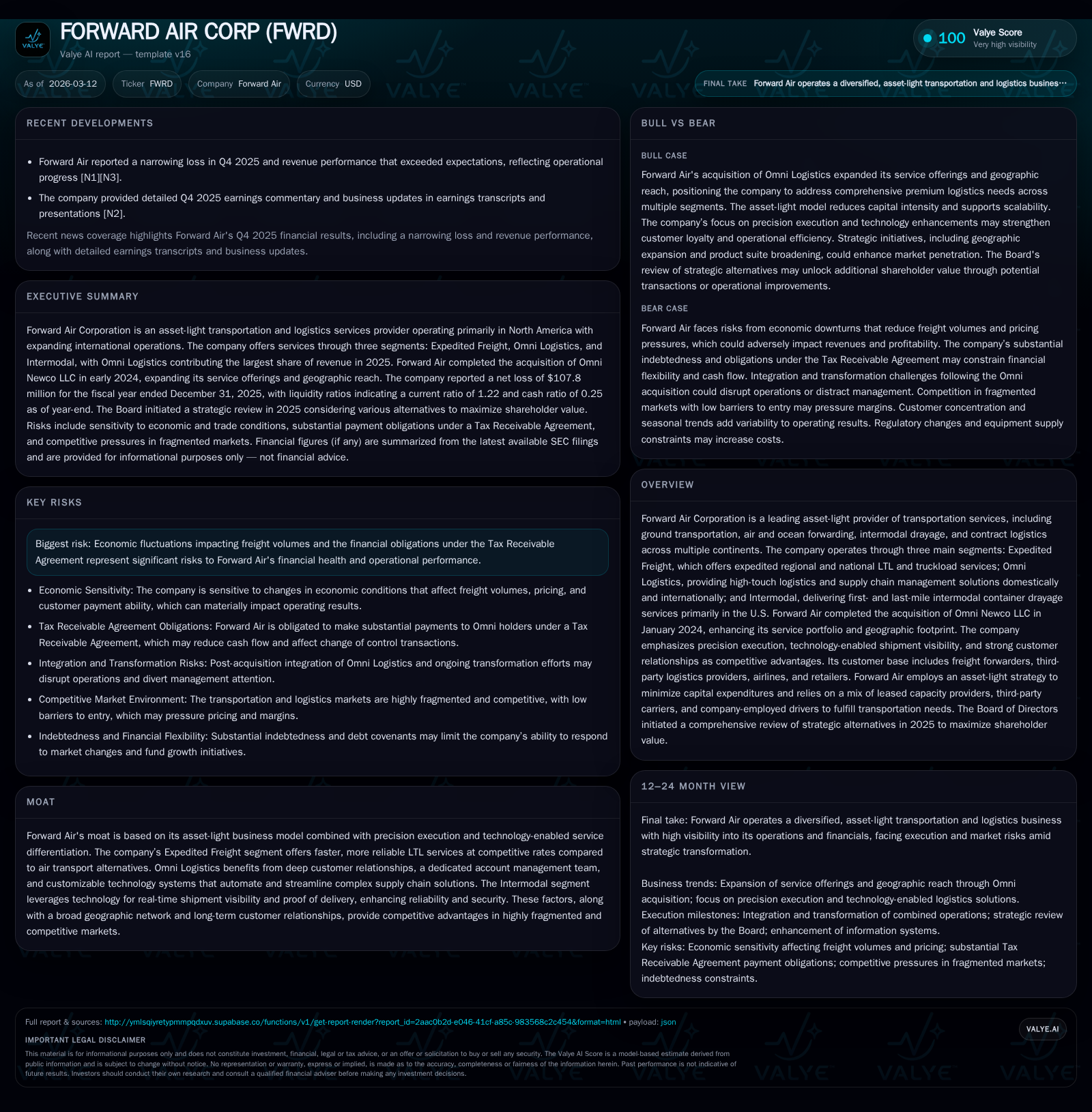
Forward Air integrated Omni Logistics in 2024, significantly reshaping its service mix and geographic reach, yet faced profitability challenges in 2025.
Forward Air Corporation’s strategic acquisition of Omni Newco LLC in early 2024 transformed its revenue composition, with the Omni segment contributing about half of total revenues by 2025. Despite this diversification, the company’s top-line declined year-over-year by over 8%, and it reported a substantial net loss amid economic headwinds and integration costs. Forward Air’s asset-light model and technology-driven service differentiation remain competitive strengths, but freight volume sensitivity and tariff uncertainties pose risks to near-term stability. Capital discipline is evident through reduced capital expenditures and suspended dividends, while liquidity remains adequate but constrained by significant leverage.
Historical Performance Overview
Forward Air’s revenue trajectory reflects both strategic transformation and macroeconomic headwinds. Revenue for fiscal year 2025 declined by approximately 8.2% to $1.19 billion compared to the prior year [F1]. This contraction was driven by softness in freight volumes during economic uncertainties impacting the transportation sector.
Operating income improved markedly to $36 million in FY2025 from a large operating loss of approximately $1.06 billion in FY2024 [F1], indicating operational improvements following the Omni acquisition integration. However, net income remained negative at a loss of $108 million for the year due to non-operating costs including tax receivable agreement payments associated with the acquisition [F1][S19].
Historical performance (annual)
| FY | Net ($mm) | OpInc ($mm) | Capex ($mm) | Net YoY |
|---|---|---|---|---|
| 2025 | -108 | 36 | 29 | -196.0% |
| 2024 | -36 | -1063 | 37 | -135.8% |
| 2023 | 102 | 88 | 31 | -47.3% |
| 2022 | 193 | 266 | 41 |
Source: SEC companyfacts cache [F1].
Capital returns and efficiency (annual)
| FY | Div ($mm) | Buybacks ($mm) | ROE% |
|---|---|---|---|
| 2025 | 0 | 0 | -95.1 |
| 2024 | 0 | 0 | -18.1 |
| 2023 | 25 | 94 | 13.3 |
| 2022 | 26 | 63 | 27.3 |
Source: SEC companyfacts cache [F1].
*Pre-Omni acquisition figures are approximate based on pro forma context.
Impact of Omni Acquisition on Business Mix
The January 25, 2024 acquisition of Omni Newco LLC significantly diversified Forward Air’s service offerings and revenue streams [S11]. By the end of fiscal year 2025, Omni Logistics accounted for roughly half of the company’s consolidated revenues, up from an immaterial contribution before acquisition [S10][S15].
Omni provides asset-light logistics solutions including domestic and international freight forwarding, fulfillment services, customs brokerage, contract warehousing, and value-added services tailored for high-growth sectors such as technology and life sciences [S15]. This expansion positions Forward Air as a multi-modal logistics provider offering bundled ground transportation alongside air/ocean forwarding capabilities.
Economic and Trade Environment Risks
Forward Air remains exposed to cyclical fluctuations in freight demand driven by broader economic conditions impacting customer shipping volumes and industry capacity [S1][S2]. The Expedited Freight segment is particularly sensitive to these dynamics where pricing pressures arise during periods of excess truckload capacity leading carriers to reduce base rates [S18][S25].
Trade tensions involving tariffs between the U.S., China, Canada and other trading partners create uncertainty affecting cross-border shipments vital for Omni’s international forwarding business [S1][S2]. Reciprocal tariff actions have disrupted trade flows impacting transit times and shipment reliability.
Labor shortages within trucking further constrain capacity availability which may limit Forward Air’s ability to meet customer demand efficiently [S18]. These factors combined exert downward pressure on average revenue per pound shipped especially within LTL freight where dimensional weight pricing precision is critical.
Q4 & Full Year Financial Results Highlights
In Q4 2025, Forward Air reported narrowing net losses compared to prior quarters though profitability pressures persisted across segments amid inflationary cost increases for third-party transportation providers and ongoing integration expenses [N1][N7][N2][S3]. The company exceeded revenue estimates driven by robust intermodal activity tied to port volume increases.
Tax-related charges arising from the Tax Receivable Agreement require payments approximating over 80% of certain tax savings generated from the Omni transaction which significantly impact net income independently from core operations [S19].
Segment Operational Insights
- Expedited Freight: Covers expedited regional and national less-than-truckload (LTL) services with emphasis on premium pricing via dimensional weight management across ~96% continental US zip codes. Approximately 40% of consolidated revenue originates here [S16].
- Omni Logistics: Provides customized contract logistics solutions including white glove delivery, supply chain engineering, international freight forwarding mainly focused on Asia-US lanes serving high-value sectors. Accounted for ~50% of revenue by end-2025 [S15][S10].
- Intermodal: Focuses on first- and last-mile container drayage enhanced through GPS-enabled tablets offering real-time shipment tracking and proof-of-delivery signatures—key differentiators against competitors. Represents about 10% of revenues [S14].
Capital Allocation and Liquidity Positioning
At December 31, 2025, Forward Air held approximately $106 million in cash & equivalents with current assets covering current liabilities at a ratio near 1.22 indicating reasonable short-term liquidity [F1][S5]. Operating cash flow was strong at roughly $160 million supporting free cash flow estimated at around $130 million after capital expenditures totaling $29 million—a decrease of about 21% year-over-year reflecting cautious investment amid profit pressures [F1].
Despite positive operating income performance in FY25, net losses due mainly to goodwill impairments related to Omni acquisition and Tax Receivable Agreement obligations drove return on equity into negative territory near -95%, indicative of shareholder equity erosion post-acquisition goodwill write-downs [F1][S19].
Dividend payments were suspended since late 2023 while share repurchases halted following acquisition-related cash demands highlighting capital conservation priorities [F1]. Total indebtedness exceeds $1.7 billion comprised of senior secured notes plus term loans with covenants tightening incrementally throughout calendar year 2026 constraining refinancing flexibility should operating results weaken further [S13][S21].
Outlook & Milestones to Watch
Forward Air plans continued integration efforts targeting system harmonization across segments aiming at scalable sales teams offering bundled ground plus air/ocean solutions alongside geographic expansion into Latin America addressing underpenetrated markets with growth potential [N2][S6][S10].
Key near-term milestones include securing contract renewals within Omni’s major customers who represent a substantial portion of revenues; realizing cost synergies through systems consolidation; improving profitability trends beyond post-acquisition dilution; maintaining compliance with debt covenants amid ongoing margin pressures; plus successful market penetration into Latin America without margin erosion [N2][S3]. Quarterly earnings releases will provide critical visibility into integration progress against evolving economic headwinds including trade policy shifts and trucking capacity constraints.
This analysis is based exclusively on publicly filed data from SEC filings and verified news sources dated through March 12, 2026. It does not constitute investment advice or recommendation but aims to provide an informed overview balancing numeric rigor with sector context pertinent for buy-side evaluation frameworks.
Disclaimer: This is research-only, informational analysis and not investment advice. It may include AI-generated interpretation and general industry context. Always verify important details using primary sources.

Comments