
Eco Wave Power Emerges with Modular Wave Technology and AI-Driven Services
Eco Wave Power advances commercialization with proprietary modular wave energy technology complemented by AI-enabled monitoring and software solutions.
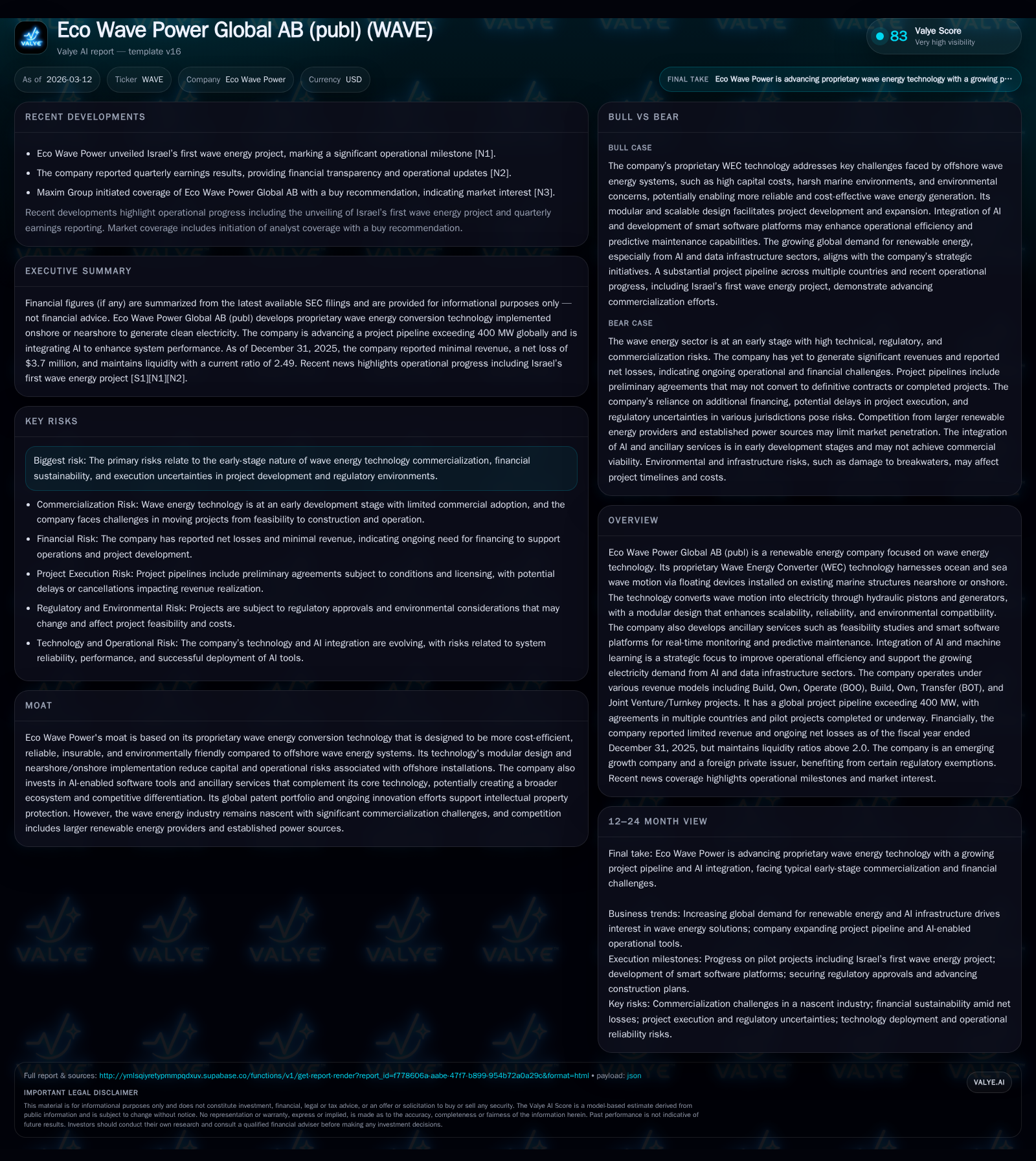
Eco Wave Power Global AB (publ) continues its evolution from nascent-stage R&D and early financial losses towards operational validation, marked by recent record output at its Israeli project. The company's nearshore modular Wave Energy Converter (WEC) technology offers competitive advantages over offshore systems through enhanced reliability, cost efficiencies, and environmental compatibility. Concurrently, Eco Wave is expanding into AI-enhanced software platforms, including the planned WaveGPT intelligence tool for operational optimization. While financial returns remain negative with steep revenue contractions in 2025, liquidity and capital structure maintain runway for ongoing development. Industry risks persist given wave energy's early commercial maturity but the company’s integrated technology and ancillary service approach underscore a differentiated position in renewable ocean energy.
From Concept to Production: Tracking Revenue Trends and Operating Losses
Eco Wave Power Global AB has navigated the notoriously difficult path from concept towards scalable production within the wave energy niche. Founded in Sweden in 2019 through acquisition of its Israeli operating entity established in 2011, Eco Wave’s financial history reflects the volatility typical of emerging energy technologies.
Revenue figures illustrate sharp contraction in recent years: from $306k in 2023 down to an ephemeral $38k in 2025—a steep decline of approximately 77% year-over-year [F1]. Despite this revenue shrinkage, net losses widened markedly to $3.72 million in FY2025 compared to $2.11 million loss in FY2024 (a deterioration of roughly 76.7%) [F1]. Equity deteriorated alongside to $5.49 million by end-2025 from nearly $8.3 million a year prior.
The negative return on equity approximates -68% in FY2025—an anticipated outcome given Eco Wave’s pre-commercial phase emphasizing heavy R&D spend ($0.73 million R&D expense recorded for 2025) alongside limited recurring revenues [F1][S1][S9]. Importantly, the company has not capitalized R&D costs but expensed them fully each year as per IFRS accounting policy.
Historical performance (annual)
| FY | Rev ($) | Net ($mm) | Rev YoY | Net YoY |
|---|---|---|---|---|
| 2025 | 38000 | -4 | -77.4% | -76.7% |
| 2024 | 168000 | -2 | -45.1% | -13.0% |
| 2023 | 306000 | -2 | +1076.9% | +35.7% |
| 2022 | 26000 | -3 |
Source: SEC companyfacts cache [F1].
Capital returns and efficiency (annual)
| FY | ROE% |
|---|---|
| 2025 | -67.9 |
| 2024 | -25.4 |
| 2023 | -23.9 |
| 2022 | -29.4 |
Source: SEC companyfacts cache [F1].
Despite these financial headwinds, the company has pursued deliberate scaling initiatives aimed at transitioning from pilot projects to commercial grid-connected assets.
Proprietary Modular WEC Technology: Competitive Advantages over Offshore Installations
At the core of Eco Wave’s moat lies its proprietary Wave Energy Converter (WEC) technology optimized for nearshore/onshore environments rather than deeper offshore locations that dominate much of the wave energy landscape.
This architecture leverages hydraulic pistons driven by vertical wave motion captured through floating devices anchored onto existing marine structures like breakwaters or piers [S1][S4]. Crucially, this system minimises direct exposure of key conversion units—housing turbines and generators—to corrosive offshore elements. Instead they reside on land-based foundations with only floater assemblies exposed to water.
A built-in storm protection mechanism automatically lifts floaters above dangerously high waves avoiding damage during severe weather events—addressing a critical reliability issue seen with offshore buoy-like competitors that suffer dislodgement or mechanical failure following short-term deployment periods [S4][S24].
Modularity allows Eco Wave’s system to scale from small kilowatt units up to multi-megawatt arrays easily by replication rather than bespoke construction [S16]. This design reduces installation time and costs relative to foundation-dependent offshore systems that require extensive underwater civil engineering works or anchoring.
Capital expenditures are targeted between EUR 1.2 million ($1.3 million) and EUR 1.8 million ($1.9 million) per megawatt installed for commercial-scale projects starting at roughly 20MW capacity [S4][S5]. This positions Eco Wave competitively against other marine renewables—especially when factoring operating leverage gains due to reduced maintenance complexity and improved insurability.
Environmental impact is significantly mitigated since no seabed penetration is required; moreover, integration prospects with solar PV panels have been tested experimentally enhancing hybrid renewable production under one footprint [S16].
Expanding Value through AI-Enabled Operational Software and Ancillary Services
Beyond physical hardware innovation lies Eco Wave’s strategic pivot toward digital intelligence services aimed at monetizing operational efficiency enhancements.
Currently deployed power stations utilize programmable logic controller (PLC)-based industrial control systems that manage real-time operational parameters based on inputs such as wave height sensors and hydraulic pressures [S17]. These PLCs orchestrate floater positioning and energy conversion modes ensuring continuous power generation.
Operational telemetry streams into proprietary cloud-based monitoring platforms enabling time-series analytics of production versus wave conditions alongside anomaly detection thresholds triggering engineering alerts remotely [S17].
To evolve further technological sophistication will come via development of "WaveGPT," an advanced AI-powered intelligence platform under collaboration with Florida Atlantic University designed to synthesize ocean data streams with system performance metrics leveraging machine learning predictive models on GPUs alongside edge computing architectures [S4][S17].
Potential applications include predictive maintenance preempting hydraulic/mechanical faults; dynamic hydraulic system tuning; digital twin simulation aiding design iteration cycles; adaptive control optimizing power output under variable oceanographic conditions [S17].
These technologies remain primarily developmental but signify integral future revenue streams via licensing agreements targeting own deployments as well as third-party wave developers and academic institutions seeking advanced analytical tools within marine renewables ecosystem expansion.
Recent Milestones: Israel Launch and Record Output Achievements
March 2026 marked important operational validation milestones for Eco Wave Power with unveiling of Israel’s first commercial grid-connected wave energy plant located at Jaffa Port—dubbed EWP EDF One project—successfully transmitting electricity into the Israeli national grid under long-term regulatory approvals secured from multiple municipal agencies including Israel Electric Company and port authorities [N1][S20].
Earlier February performance data released demonstrated record electricity output during high-energy sea states featuring approximately three-meter wave heights – a significant testament both to technology robustness under demanding environmental conditions and potential scalability as these wave amplitudes correspond to many global nearshore shorelines [N1][S3].
These reference projects serve not only as data-rich testbeds for advancing WEC designs but also as compelling showcase assets aimed at accelerating contract wins across other jurisdictions where governmental interest towards blue economy energy sources is intensifying.
Assessing Capital Structure, Cash Flow, and Path to Financial Sustainability
Liquidity metrics reveal a cash reserve of approximately $6 million as of December 31st 2025 against current liabilities nearing $2.62 million – yielding a healthy current ratio of about 2.49x indicative of short-term solvency cushions despite ongoing investment burn rates [F1][S20][S21].
Government grants through Israeli Ministry of Energy pioneering programs provide critical non-dilutive financial support particularly earmarked against research expenses treated as forgivable loans contingent on compliance reviews which may mitigate cash flow pressures inherent in capital intensive project development phases [S1].
Operating cash flows remain negative within pre-commercial deployment contexts absent steady revenues derived primarily from feasibility studies or early-stage licensing fees rather than sustained power purchase agreement inflows driving recurring income streams typical once scaled beyond pilot phase [F1].[F1]
Capex levels hover near upper bound estimates for MW installations emphasizing high upfront fixed asset investments typical among Build-Own-Operate models where Eco Wave finances construction upfront expecting long term contracted power sales post commissioning over decades-long power purchase agreements [S4][S8].
No dividends or share repurchases have been declared or made reflecting prudent retention policies prioritizing technology maturation over capital returns amidst uncertain near-term earnings trajectory.
Industry Context: Risks, Emerging Regulatory Landscape, and Competition
Wave energy remains embryonic—and thus risky—from technological maturation through regulatory approval pathways to market acceptance stages globally [S15]. The industry wrestles with challenges unique even among renewables including complex marine environment permitting regimes, wild variability in site-specific resource predictability offshore versus nearshore patterns coupled with cost uncertainties around specialized installations.
Eco Wave benefits from patent protections globally covering its pontoon design facilitating stability improvement while avoiding seabed intrusion aligning with environmental impact minimization directives increasingly mandated alongside accelerating decarbonization policies worldwide [S15][S23].
Competition spans traditional fossil fuel incumbents gaining renewed ESG scrutiny as well as better-funded wind/solar players utilizing more mature technology bases; larger multinational utilities continue cautious consideration versus nascent ocean tech firms requiring long timelines for commercial scale validation before investment thresholds justify accelerated capital allocations[S6].
Insurability—the availability of risk transfer mechanisms enabling lender/investor confidence—is cited specifically as notable advantage stemming from modular nearshore WEC design secure enough that traditionally hard-to-insure offshore infrastructure can rarely replicate due to unpredictably severe exposure[S24]. Nevertheless insurance contracts remain subject to evolving underwriting landscapes influenced by frequency/severity predictions tied directly into climate change trajectories[S24].[F1]
Looking Ahead: Growth Catalysts and Strategic Watch Points
Key acceleration vectors include:
- Movement beyond proof-of-concept into full-build megawatt arrays especially deployments progressing within Taiwan/India pipeline indicating foothold expansions commanded via joint ventures or turnkey sales models[S8];
- Successful licensing/commercial rollout for WPV software segment plus debut release schedule(s) for pioneering "WaveGPT" AI platform essential for unlocking scalable operational insight monetization[S4];
- Timely regulatory approvals particularly site construction consents impacting capex deployment cadence[S21];
- Adoption dynamics within complementary sectors experiencing rising electricity demand spikes such as AI data centers offering emergent niche markets appreciative of decarbonized stable baseload wave power complements[S12];
- Continuous cost optimization efforts lowering CAPEX/MW enhancing competitiveness vis-à-vis other renewables thus affecting long-term margin profiles.
In sum there exists credible momentum visible through technical validation combined with promising digital ecosystem developments positioning Eco Wave Power as an innovator within the global ocean renewable space notwithstanding remaining maturation risks intrinsic to cutting-edge clean energy ventures.
This analysis is prepared solely for informational purposes based on available SEC filings ([F1], [S#]) and verified news reports ([N#]). It does not constitute investment advice or recommendations.
Disclaimer: This is research-only, informational analysis and not investment advice. It may include AI-generated interpretation and general industry context. Always verify important details using primary sources.

Comments