
Growth and Risk Management at CNB Financial After ESSA Bancorp Acquisition
CNB Financial's financial profile in 2025 reflects expansion through acquisition alongside challenges in profitability and risk exposure.
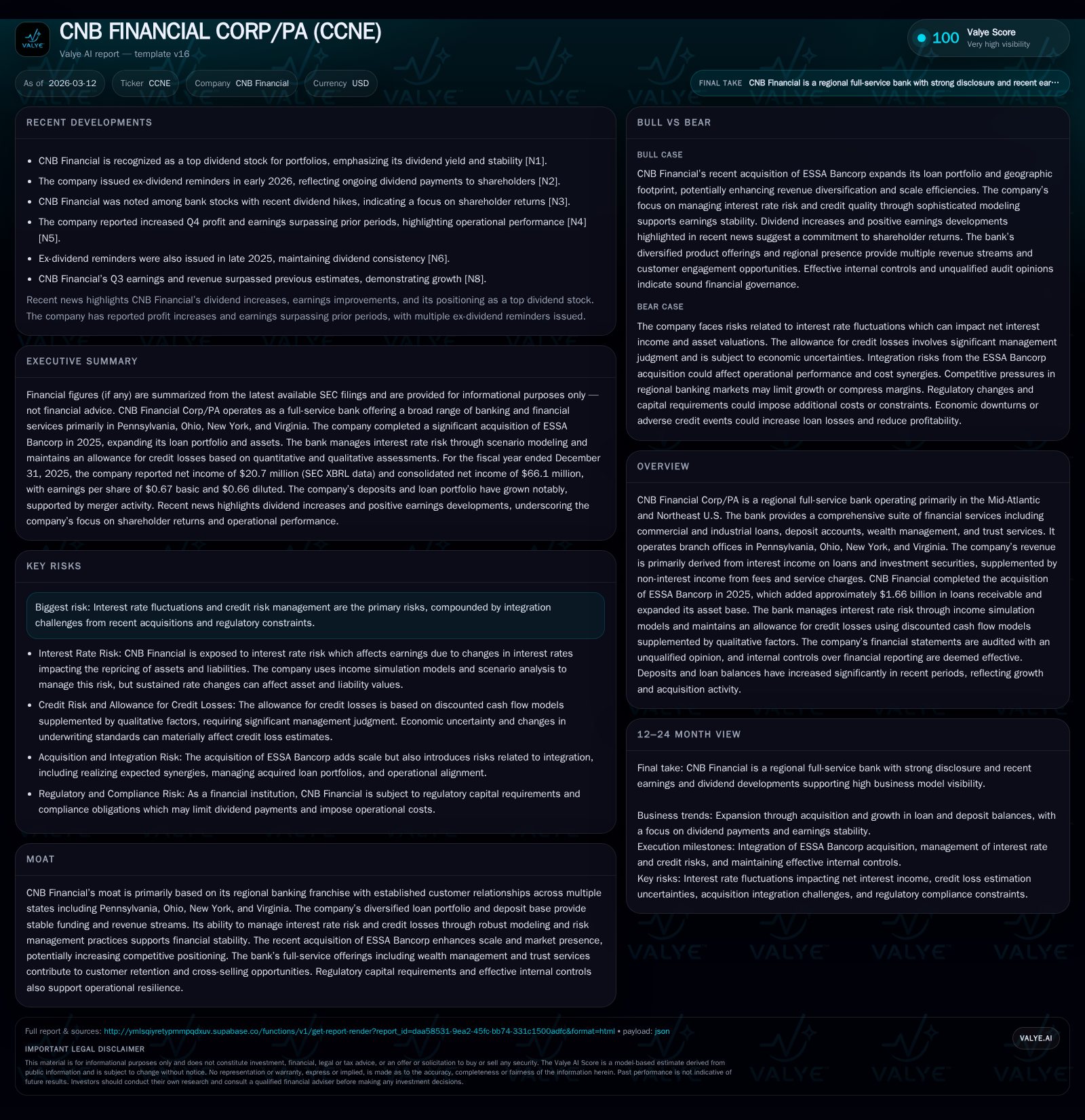
CNB Financial Corp expanded its asset base significantly in 2025 via the ESSA Bancorp acquisition, adding substantial loan volume and growing shareholders' equity materially. Despite this scale increase, net income fell sharply by over 62%, influenced by margin pressures and integration-related expenses. The bank’s net interest margin improved to 3.65%, aided by disciplined interest rate risk management using income simulation models amid volatile rates. Conservative capital allocation continues with stable dividends and controlled capex, supporting a modest return on equity of approximately 2.4%. Key ongoing considerations include credit loss allowances calibrated for acquired portfolios, loan portfolio diversification, and sensitivity of net interest income to interest rate shifts.
Strong Historical Growth Offset by Net Income Decline in 2025
CNB Financial Corp experienced a notable contraction in net income during fiscal year 2025, recording $20.7 million compared to $54.6 million the previous year — a steep drop of approximately 62.1% [F1]. This decline occurred against a backdrop of significant expansion in assets and equity, driven primarily by the acquisition of ESSA Bancorp which contributed new lending volume and deposit base. Meanwhile, operating cash flows showed a moderated decline of around 9.1%, coming in at $64.9 million for the year [F1]. Capital expenditures contracted sharply to $6.3 million from $16.3 million in 2024, indicative of post-merger capital spending normalization [F1]. This divergence between top-line growth metrics and bottom-line profitability suggests increased expenses—likely integration costs—and pressure on net interest margins.
Historical performance (annual)
| FY | Net ($mm) | CFO ($mm) | Capex ($mm) | Net YoY |
|---|---|---|---|---|
| 2025 | 21 | 65 | 6 | -62.1% |
| 2024 | 55 | 72 | 16 | -5.9% |
| 2023 | 58 | 47 | 11 | -8.2% |
| 2022 | 63 | 64 | 12 |
Source: SEC companyfacts cache [F1].
Capital returns and efficiency (annual)
| FY | FCF ($mm) | ROE% |
|---|---|---|
| 2025 | 59 | 2.4 |
| 2024 | 55 | 8.9 |
| 2023 | 36 | 10.2 |
| 2022 | 52 | 11.9 |
Source: SEC companyfacts cache [F1].
In summary, CNB shows a history of steady growth prior to the acquisition year but faces transitional earnings headwinds linked with scaling and margin compression.
ESSA Bancorp Acquisition: Scale Gains Meet Integration Challenges
In early 2025, CNB Financial completed the acquisition of ESSA Bancorp which added approximately $1.66 billion in loans receivable as part of total loan growth to roughly $6.49 billion average loans outstanding [S7][S22]. This strategic move enhanced CNB’s regional footprint across Pennsylvania and neighboring states while augmenting its asset base markedly [N1][N5][S1]. However, the increment brings portfolio integration risk as ESSA’s loan assets required valuation adjustments via discounted cash flow methods accounting for prepayments and credit losses [S12][S22].
Credit deterioration assessments led to identifying Purchased Credit Deteriorated (PCD) loans which are measured differently from originated assets—requiring tailored allowance calculations that factor into provisioning expense [S12][S22]. These complexities likely contributed to short-term profitability constraints as operational focus shifted toward harmonizing systems and underwriting standards.
Moreover, acquisition-related expenses such as increased administrative costs and retention programs amplify near-term cost pressures [S18]. Practitioners will recognize that loan receivables integration demands aligning credit monitoring processes and risk frameworks across legacy portfolios.
Net Interest Margin Dynamics and Interest Rate Risk Management
Despite earnings compression, CNB's net interest margin (NIM) improved to a fully tax-equivalent rate of 3.65% in 2025 up from 3.39% the previous year [S1][F1]. This elevation stems primarily from higher yields on an expanded loan book weighted towards commercial ($1.58 billion at ~6.8%) and mortgage products ($3.73 billion at ~6.17%) bearing attractive coupon rates [S1]. Concurrently, funding costs contained their rise despite deposit mix shifts; total interest-bearing deposit rates dropped from approximately 3.08% to 2.74%, benefiting margin spread [S1].
The bank employs advanced income simulation models integrating assumptions on yield curve dynamics including parallel/non-parallel shifts, rate shocks of +/-300 basis points, embedded option behavior, and deposit repricing sensitivities to quantify impact on future net interest income [S1]. Recent simulations suggest CNB’s balance sheet demonstrates resilience with potential NII gains under moderate rate increases (+200 bps scenario yields ~+1.5%), whereas decreases trigger manageable declines (-100 bps results in roughly -1.8%) [S1]. These scenario analyses enable dynamic repricing strategies mitigating earnings volatility.
Such robust interest rate risk governance aligns with sector best practices emphasizing gap analysis complemented by stochastic modeling to address complex rate volatilities common in a multi-product regional bank context.
Diverse Loan Portfolio as Foundation for Future Revenue Stability
CNB’s portfolio spans commercial loans ($1.58 billion average balance at 6.8% yield), mortgage loans ($3.73 billion at 6.17%), and consumer loans ($127 million at ~11%) as key contributors to interest income [S1]. Each segment reflects distinct credit risks—commercial & industrial loans secured by business assets face underwriting risk based on borrower cash flow sustainability; mortgages hinge on property values plus borrower creditworthiness; consumer loans often carry higher yields compensating for elevated default probabilities.
Credit loss allowances are determined by grouping similar-risk loans into pools evaluated collectively using discounted cash flow models incorporating historical loss experience augmented with qualitative adjustments reflective of current economic conditions [S4][S5][S12][S17]. This thorough methodology covers key portfolio subsets including municipal loans whose repayment depends fundamentally on fiscal budgeting capacity.
The diversified credit exposure mitigates sector concentration risk, with no individual industry exceeding a tenth of total lending maintaining balanced asset quality fundamentals conducive to stable revenue generation.
Dividend Policy and Capital Allocation Reflective of Conservative Discipline
CNB maintained dividend payments consistently through low volatility payout policy; secondary sources note CNB’s dividend appeal owing to reliable distributions supportive of shareholder value despite profit swings [N2][N3][N4]. The company’s payout ratio remains conservative given the low double-digit operating ROEs hovering near roughly ~2.4% as measured against FY2025 equity levels ($872 million) [F1].
Operating cash flows have remained positive ($64.9 million), supporting free cash flow generation even after modest capital expenditures ($6.3 million), highlighting prudent reinvestment post-acquisition phase [F1]. Capital expenditure reductions from prior years signal moderating investment requirements following integration completion.
No substantial share buybacks were reported recently; capital preservation priority likely governs given heightened regulatory scrutiny following expansion activity coupled with market uncertainties.
Future changes to capital return policies may depend on normalization of earnings performance.
Balance Sheet Strength and Credit Loss Allowance Strategies
At December 31, 2025, CNB’s consolidated balance sheet exhibits considerable strength: shareholders’ equity reached $872 million versus $611 million twelve months ago marking a substantial enhancement attributable largely to capital injections linked with acquisitions and earnings retention [F1][S7][S14]. Regulatory capital ratios comfortably exceed mandated thresholds with Tier 1 capital ratios above double digits (approximately 12-14%), underpinning well-capitalized statuses per PCA framework classifications [S14].
Allowance for credit losses increased corresponding with loan growth—to over $67 million from approx $47 million—reflecting both organic portfolio expansion and acquired PCD credits subject to ongoing allowance adjustments informed by pooled risk assessments [S17][S21]. Collateral quality analysis further supports prudent loss recognition practices as municipal and commercial real estate assets underpin substantial portions of the collateralized portfolio segments enhancing recoverability prospects under distress scenarios [S4][S25].
Watching Key Milestones: Loan Growth, Credit Quality, and IRR Sensitivity
Looking ahead, close attention is warranted around several leading indicators shaping CNB’s trajectory:
- Successful operational integration of ESSA Bancorp loan portfolios mitigating adverse effects on earnings stability.
- Evolution of credit loss provisions relative to economic cycles affecting borrower repayment capacity particularly across commercial sectors.
- Net interest income sensitivity metrics under alternative interest rate environments informed through continuous refinement of income simulation models.
- Potential regulatory developments that might recalibrate leverage or liquidity constraints impacting strategic flexibility.
Recent earnings releases noted outperformance relative to estimates in Q4 suggesting nascent recovery momentum but execution risks persist given macro uncertainty surrounding interest rate trajectories and economic activity levels [N1][S1].
This report synthesizes information from CNB Financial Corporation’s SEC filings including the recent annual report (10-K), supported by verified Nasdaq news articles reporting financial results and dividend-related commentary without predictive views or investment recommendations.[F1]
Disclaimer: This is research-only, informational analysis and not investment advice. It may include AI-generated interpretation and general industry context. Always verify important details using primary sources.

Comments