
Septerna Advances SEP-631 with Strong Phase 1 Data and Solid Financial Liquidity
Clinical-stage biopharmaceutical Septerna, Inc. reports encouraging early data for SEP-631 while maintaining robust cash reserves.
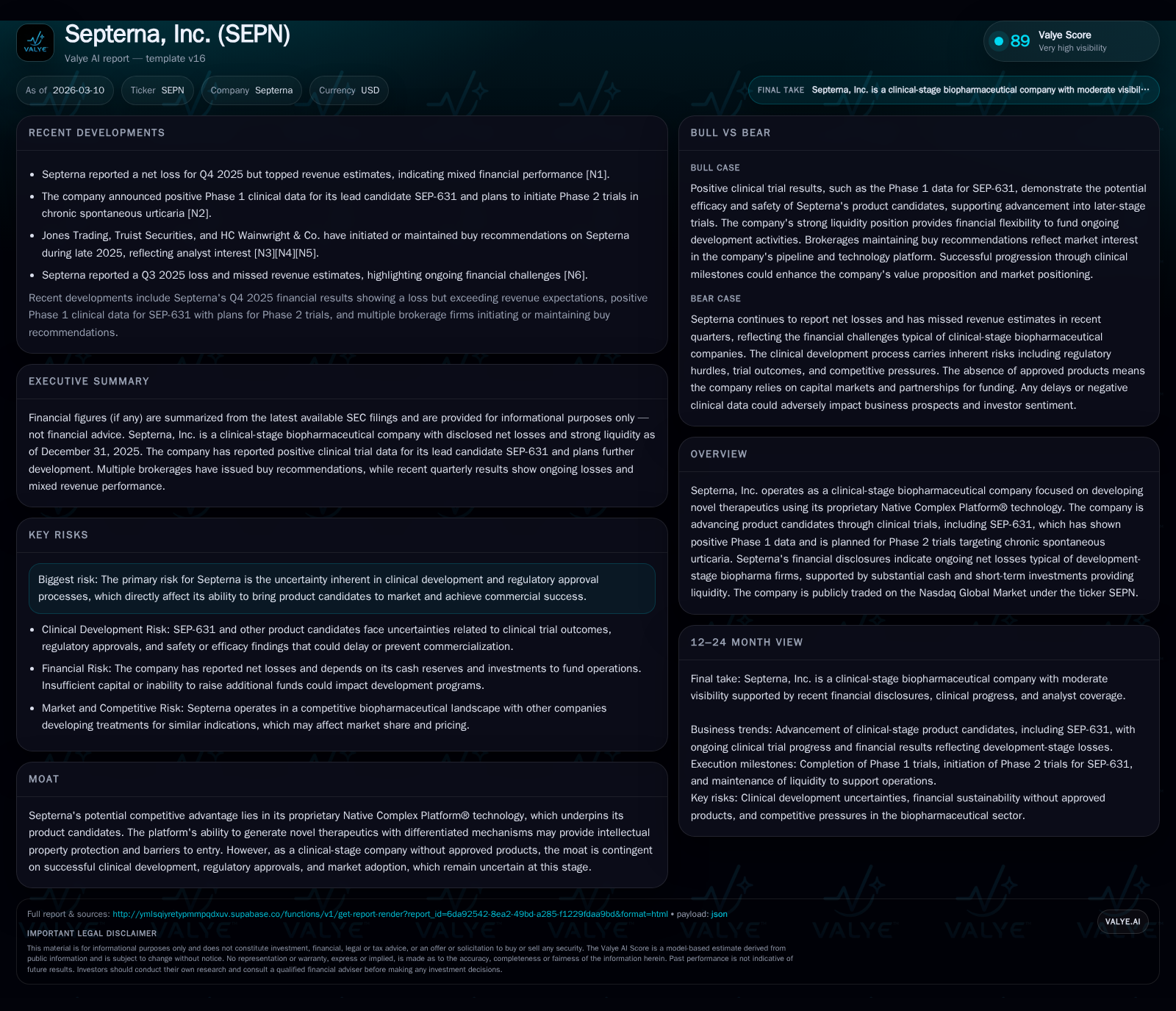
Septerna, Inc. is a clinical-stage biotech focused on developing therapeutics via its proprietary Native Complex Platform®. The company recently announced positive Phase 1 results for SEP-631, targeting mast cell-driven diseases like chronic spontaneous urticaria (CSU), and plans to initiate Phase 2 trials later this year. Despite operating losses consistent with its development stage, Septerna benefits from solid liquidity and improved operating cash flow, supporting ongoing R&D investments. Key risks remain related to clinical and regulatory uncertainties that could impact future commercial viability.
Company Overview
Septerna, Inc. is a clinical-stage biopharmaceutical company developing innovative therapeutics based on its proprietary Native Complex Platform®. This platform is designed to create novel molecules aimed at treating mast cell-driven diseases—a category with a high unmet medical need encompassing conditions such as chronic spontaneous urticaria (CSU), atopic dermatitis, interstitial cystitis, migraine, and asthma [S6][N2].
The company's leading candidate, SEP-631, is an oral negative allosteric modulator (NAM) of the Mas-related G protein-coupled receptor X2 (MRGPRX2), critical in mast cell activation pathways. The therapeutic premise is that SEP-631 can suppress pathological mast cell responses by selectively modulating this receptor.
Historical Financial Performance
As a development-stage biopharma company, Septerna has recorded continuing operating losses typical of companies investing heavily in R&D without yet generating product revenues. Nonetheless, recent financials show some improvement:
Historical performance (annual)
| FY | Net ($mm) | CFO ($mm) | OpInc ($mm) | Capex ($mm) | Net YoY |
|---|---|---|---|---|---|
| 2025 | -49 | 110 | -68 | 1 | +31.9% |
| 2024 | -72 | -67 | -81 | 2 |
Source: SEC companyfacts cache [F1].
Capital returns and efficiency (annual)
| FY | FCF ($mm) | ROE% |
|---|---|---|
| 2025 | 110 | -12.8 |
| 2024 | -70 | -17.1 |
Source: SEC companyfacts cache [F1].
Key observations include the reduction of operating loss by approximately 15.5% year-over-year and a substantial swing in operating cash flow from negative $67.5 million in 2024 to positive $110 million in 2025 [F1]. This swing likely reflects changes in working capital or financing activities rather than operating profitability due to the still-negative net income.
Capital expenditures remained modest relative to operating costs, underscoring the company's focus on drug development rather than fixed asset acquisition or expansion.
Development Pipeline and Future Growth Prospects
The most significant near-term growth catalyst is SEP-631's progression through clinical development. The recent announcement of positive Phase 1 data showed first-in-human evidence of safety and tolerability across dose ranges up to 200 mg once daily as well as strong pharmacodynamic effects measured by suppression of icatibant-induced wheal formation—a validated surrogate for mast cell activation [N2][S20].
SEP-631’s pharmacokinetics support convenient once-daily oral dosing with a half-life approximating 24 hours and no clinically meaningful food effect impacting absorption.
Building on this foundation, Septerna plans to initiate a randomized double-blind placebo-controlled global Phase 2b study targeting moderate-to-severe CSU patients who remain symptomatic despite standard antihistamines during the second half of 2026 after completing long-term preclinical toxicology assessments [N2][S15]. Furthermore, plans include an open-label study addressing chronic inducible urticaria variants like dermatographism.
Beyond urticaria indications, the company is exploring broader applications in mast cell-mediated disorders where MRGPRX2 expression plays pathogenic roles. These exploratory areas include atopic dermatitis and asthma—large markets with unmet needs that could fuel longer-term growth contingent on proving efficacy and safety.
Milestones and Guidance
While explicit financial guidance or detailed timelines beyond the initiation of Phase 2b studies have not been provided publicly, watchers should monitor key events:
- Completion of long-term toxicology studies addressing safety concerns.
- Regulatory submissions for IND amendments supporting Phase 2b initiation.
- Enrollment progress and interim data readouts from CSU trials.
- Updates on pipeline expansion into other mast cell-related conditions.
Given the typical timeline for clinical development phases coupled with regulatory review cycles for novel biologics/small molecules affecting immune pathways, these milestones will significantly influence Septerna's valuation outlook.
Capital Structure and Returns Analysis
The company's capital structure remains straightforward without reported debt financing burdens or leverage amplifying risk [S9][S14]. Cash holdings of roughly $121 million at year-end provide a strong liquidity buffer to fund near-term clinical milestones.
Return metrics such as ROE are approximate given negative net earnings but estimated around -12.8% suggest ongoing losses typical for a firm investing heavily ahead of commercialization [F1]. No dividends or share repurchase programs have been declared or executed so far; capital allocation prioritizes reinvestment into research activities as expected for clinical-stage biotechnology enterprises [S23].
Free cash flow estimation stands positive largely due to the swing in operating cash flow coupled with nominal capital expenditure totaling about $518 thousand for fiscal year ended December 2025 [F1]. This indicates effective cash cost control despite intensive development spending.
Competitive Positioning and Moat Considerations
Septerna's proprietary Native Complex Platform® undergirds its product candidates including SEP-631 by enabling generation of highly selective modulators targeting novel mechanisms like MRGPRX2 NAM activity. If clinically validated through successful pivotal trials and subsequent regulatory approval(s), this could confer meaningful intellectual property protection barriers against competitors replicating such mechanistic approaches [S6][N2]. However, this moat remains prospective given clinical risk factors inherent to early-stage biotech development.
The targeted indications represent sizable segments within allergy/immunology with multiple approved therapies but persistent unmet patient needs for non-antihistamine options that address refractory cases effectively without systemic immunosuppression side effects.
Risks Summary
As outlined comprehensively in Septerna's SEC filings [S4][S5], major risks persist including:
- Failure or delays in clinical development programs leading to impaired timelines or termination.
- Unfavorable safety signals emerging from ongoing toxicology or human trials.
- Inability to secure necessary regulatory approvals or market access.
- Competition from established pharmaceutical players and emerging biotechs tackling overlapping targets.
- Dependence on continued capital markets access absent current product revenue streams.
These cautionary factors underscore the inherent volatility for investors tracking clinical-stage biotechnology ventures such as Septerna.
Summary Observations
Septerna has taken meaningful strides forward leveraging its Native Complex Platform® technology focusing on challenging yet impactful indications driven by mast cell pathobiology. Positive Phase 1 results for SEP-631 mark significant progress validating its approach with a manageable safety profile supportive of oral therapy convenience.
Financially stable with liquidity positioned well ahead of planned Phase 2 initiations enhances operational runway while embracing typical developmental risk profiles intrinsic to biopharma innovation cycles. Critical upcoming milestones throughout 2026 will be pivotal in confirming translational science into therapeutic reality as well as broader pipeline expansion potential.
This case exemplifies the high-risk/high-reward generational biopharma development trajectory where scientific innovation converges with capital stewardship amidst substantial regulatory hurdles ahead.
This document is an analysis based solely on provided data as of early March 2026 and does not constitute investment advice.
Disclaimer: This is research-only, informational analysis and not investment advice. It may include AI-generated interpretation and general industry context. Always verify important details using primary sources.

Comments