
Corbus Pharmaceuticals Advances Oncology and Obesity Pipeline with Clinically Validated Targets but Faces Operating Losses
Clinical-stage development of CRB-701 and CRB-913 underpins Corbus Pharmaceuticals’ growth, balanced by capital reliance and regulatory hurdles.
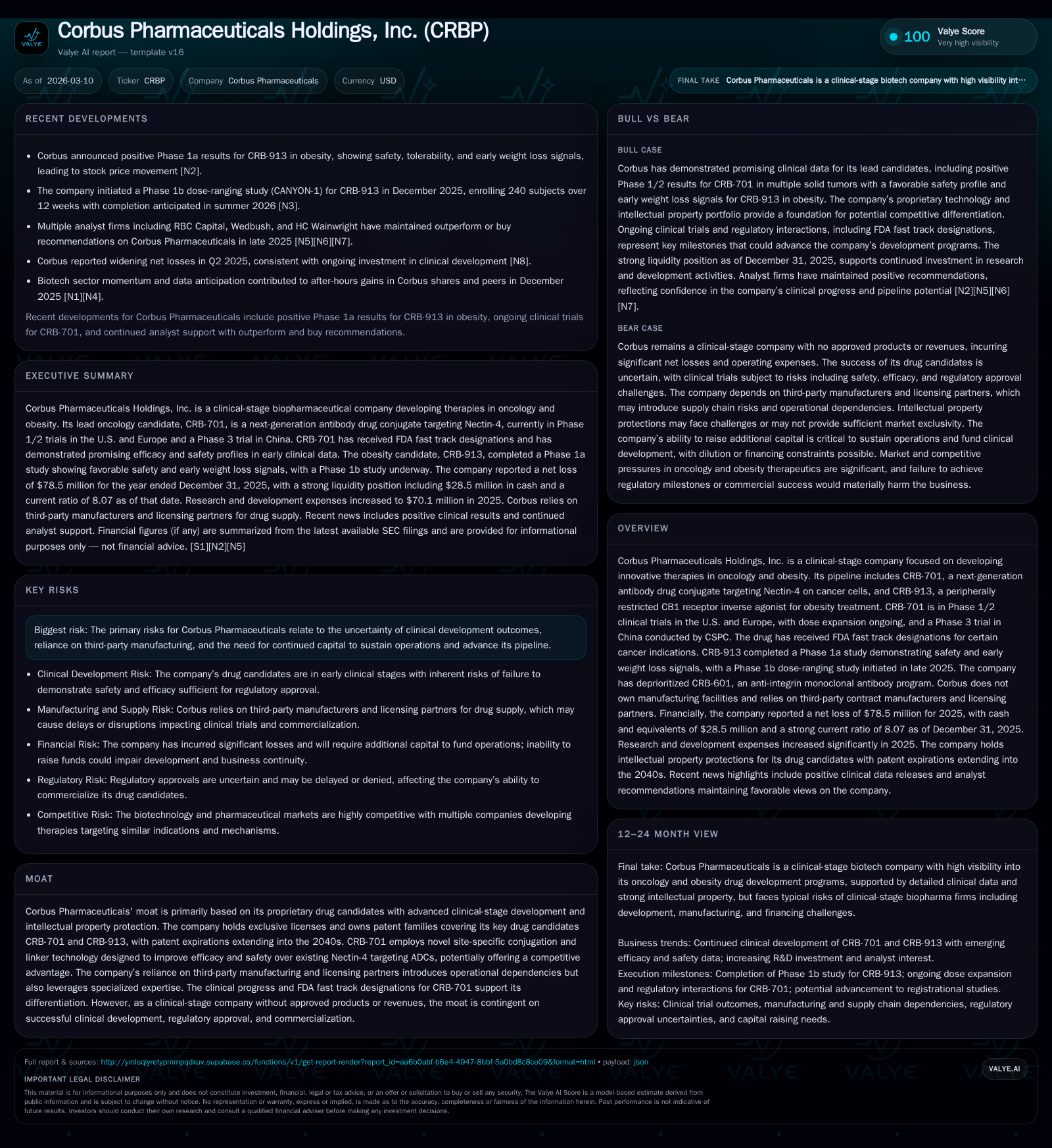
Corbus Pharmaceuticals Holdings, Inc. focuses on innovative therapeutics in oncology and obesity, highlighted by its lead candidates CRB-701 and CRB-913. The company operates without approved products or revenues, relying on third-party manufacturers and licensing partners while incurring significant operating losses driven primarily by research and development activities. Though recent clinical progress and FDA fast track designations signal potential, commercial viability remains contingent on successful trial outcomes and future financing.
Overview of Business Focus
Corbus Pharmaceuticals Holdings, Inc. is a clinical-stage biopharmaceutical company developing therapies for oncology and obesity. Its key pipeline candidates are CRB-701, an antibody drug conjugate targeting Nectin-4 on cancer cells to deliver the cytotoxic payload MMAE; and CRB-913, a peripherally restricted CB1 receptor inverse agonist designed for safe weight loss treatment with minimized central nervous system side effects [S1].
CRB-701 leverages proprietary site-specific conjugation technology to improve upon existing Nectin-4 targeting ADCs such as Pfizer's PADCEV®. It is currently in Phase 1/2 dose expansion in the U.S. and Europe, with a Phase 3 trial ongoing in China under license from CSPC Megalith Biopharmaceutical Co., Ltd. The therapy has received two FDA fast track designations for relapsed or refractory metastatic cervical cancer (December 2024) and recurrent/metastatic head and neck squamous cell carcinoma (September 2025) [S1].
CRB-913 recently completed a Phase 1a study demonstrating safety with early signals of weight loss and initiated a Phase 1b dose-ranging study enrolling around 240 subjects across multiple dosage arms with data expected in mid-2026 [S24].
The anti-integrin monoclonal antibody program CRB-601 has been deprioritized after initial Phase 1 dose escalation studies [S24].
Historical Financial Performance
Corbus operates without approved drugs or significant product revenue; top-line figures reflect minimal historical sales primarily from collaboration fees or early-stage milestone payments, totaling approximately $4.8 million at best reported in FY2018 [F1]. Operating losses have increased sharply aligned with escalating R&D investment to advance clinical trials.
Historical performance (annual)
| FY | Net ($mm) | CFO ($mm) | OpInc ($mm) | Capex ($) | Net YoY |
|---|---|---|---|---|---|
| 2025 | -79 | -64 | -85 | 7000 | -95.3% |
| 2024 | -40 | -42 | -49 | +9.9% | |
| 2023 | -45 | -36 | -45 | 0 | -5.3% |
| 2022 | -42 | -38 | -40 | 13449 |
Source: SEC companyfacts cache [F1].
Capital returns and efficiency (annual)
| FY | FCF ($mm) | ROE% |
|---|---|---|
| 2025 | -64 | -53.2 |
| 2024 | -28.2 | |
| 2023 | -36 | 646.0 |
| 2022 | -38 | -128.4 |
Source: SEC companyfacts cache [F1].
(The lack of revenue beyond early years underscores the clinical-stage nature of the company; rising operating losses largely track increased trial activity.)
Drivers of Past Growth and Spending
The accelerated R&D spend ($70.1 million in 2025 vs $32.2 million in 2024) highlights Corbus’ commitment to advancing CRB-701 phase trials in Western markets and China alongside initiation of later stage studies for CRB-913 [S24]. Clinical supply partnerships—particularly with CSPC for manufacturing—enable progression without heavy capital asset investment [S21]. These investments have not yet translated into revenue growth given regulatory timelines.
Future Growth Prospects
Growth hinges critically on clinical trial outcomes, regulatory approvals, commercialization capabilities, and market adoption of pipeline therapies:
Positive Phase 2/3 results for CRB-701 would enable potential NDA/BLA filings; fast track designations may facilitate expedited review.
Success in the obesity market with CRB-913 depends on demonstrating efficacy combined with safety benefits over competitors like Novo Nordisk.
Expansion beyond Western markets will likely rely on further partnerships or licensing agreements.
However, substantial risks remain including possible trial failures or delays, pricing pressures from healthcare reforms especially within Medicare/Medicaid frameworks, and competition from major pharma ADCs targeting Nectin-4 as well as alternative weight loss therapies [S14], [S21].
Forecasts / Milestones to Watch
Though explicit company guidance is not provided, key near-term milestones include:
Completion of CRB-913 CANYON-1 dose-ranging trial expected mid-year 2026 [S24].
Dose expansion progress and combination arm data from CRB-701 trials ongoing.
Regulatory updates on Phase 3 Chinese cervical cancer study led by CSPC.
Monitoring these readouts will be essential to gauge pipeline viability ahead of possible late-stage development or marketing submissions.
Returns and Capital Allocation
Corbus Pharmaceuticals has no dividend policy nor executed share buybacks, typical for a pre-revenue clinical-stage firm focused on extending its cash runway through equity raises rather than cash returns [S1].
With net losses accelerating ($78.5 million in FY2025) relative to equity ($147.5 million), the approximate return on equity stands negative at about -53% for the period per available data [F1]. Operating cash flow is negative $64.5 million reflecting ongoing cash burn that steadily outpaces minimal capex spend (~$7k), consistent with operating model relying chiefly on outsourced manufacturing rather than fixed assets.
Liquidity measures are reasonably comfortable with a current ratio above eight times (current assets vs liabilities), supported by cash reserves near $28.5 million end-FY2025 but further capital raising will be required to sustain operations beyond upcoming clinical inflection points [F1].
Competitive Positioning and Operational Dependencies
Corbus’ moat derives from proprietary site-specific conjugation linker technology underpinning CRB-701’s improved safety profile compared to established competitors such as PADCEV® that suffer from severe dermatologic toxicities limiting dosing intensity [S21]. Intellectual property protection extends to patents through the mid-2040s securing exclusivity if successfully commercialized.
Operationally the company does not own manufacturing facilities but relies heavily on contract manufacturers including CSPC as well as other cGMP-compliant third parties facilitating both clinical supply chains and prospective commercialization capacity [S21]. This reliance introduces vendor risk but also leverages specialized production expertise common among biotech developers limiting upfront capital expenditure burden.
Regulatory compliance spans US FDA fast track pathways along with EU/U.K adaptations post-Brexit harmonizing approval processes but imposing rigorous quality standards; off-label promotion risks, pricing pressures under evolving healthcare legislation including Medicare Part D discount escalations, fraud & abuse laws all represent ongoing operational challenges , [S13], [S17].
Risk Profile Summary
Major risks encompass uncertain clinical outcomes inherent in drug development weighted against costly trial expenditures; dependency on third-party manufacturing creates supply chain vulnerabilities impacting timely product delivery; necessity for continuous capital access mediated by investor appetite amid biotechnology sector volatility; intellectual property enforcement complexity typical within pharmaceutical innovation ecosystems; competitive pressures from well-funded incumbents employing alternate mechanisms particularly impacting both oncology ADCs and CB1-targeted obesity drugs; reimbursement environment evolving under healthcare reforms influencing future profitability potential [S1], [S21], [S23].
Conclusion
Corbus Pharmaceuticals represents a classic clinical-stage biopharma profile advancing next-generation ADC technology in oncology paired with novel cannabinoid pathway modulation targeting obesity — areas primed for innovation but fraught with development risk and high capital intensity. While recent approvals granting fast track status coupled with expanding clinical pipelines provide catalysts positioning toward eventual proof-of-concept validation, lack of revenues alongside significant operating losses mark the company’s status firmly within speculative developmental stages requiring continued external funding support. Future progress hinges heavily on successful trial completion milestones anticipated through late 2026 alongside navigation of regulatory complexities deepening competitive landscapes both domestically and internationally.
This analysis is intended solely for informational purposes summarizing publicly available financial disclosures and known scientific developments related to Corbus Pharmaceuticals Holdings, Inc., without expressing any investment recommendations or advice.
Disclaimer: This is research-only, informational analysis and not investment advice. It may include AI-generated interpretation and general industry context. Always verify important details using primary sources.

Comments