
Stellus Capital Investment Corp’s Earnings Decline and Leverage Strategy Under Scrutiny
Examining Stellus Capital's recent earnings downturn alongside its high-tech exposure and leverage adjustments reveals tensions in balancing dividend payouts with financial flexibility.
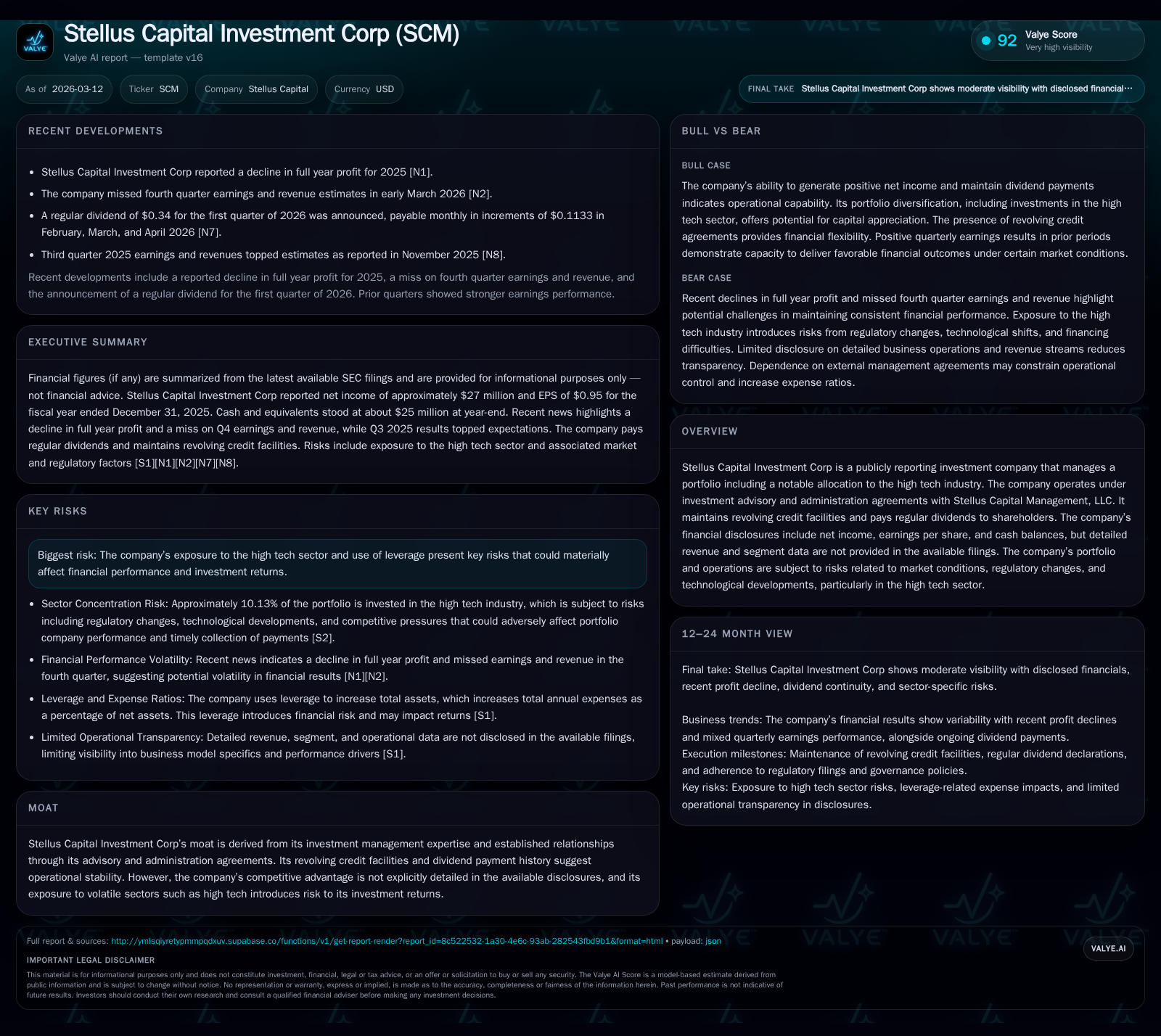
Stellus Capital Investment Corp reported a 41% decline in net income for FY2025 versus FY2024 despite increasing dividends, reflecting pressure on profitability amid stable equity. The company’s roughly 10% portfolio concentration in the high-tech sector exposes it to regulatory and technological risks that may affect returns. In September 2025, Stellus amended its revolving credit facility to increase capacity and extend maturity while lowering margin rates, enhancing liquidity management. Return on equity stands near 7.3%, with capital allocation favoring dividends over repurchases. Investors should watch upcoming earnings reports and credit agreement milestones for insights into operational resilience and portfolio adjustments.
Historical Performance Overview
Stellus Capital Investment Corp reported a significant contraction in net income for fiscal year 2025, falling approximately 41% from $45.8 million in FY2024 to $27.0 million in FY2025, despite maintaining a steady equity base near $371 million [F1]. Operating cash flow remained negative but improved slightly to -$24.4 million compared to -$28.6 million the prior year, underscoring ongoing challenges in cash generation from investment operations.
Historical performance (annual)
| FY | Net ($mm) | CFO ($mm) | Net YoY |
|---|---|---|---|
| 2025 | 27 | -24 | -41.0% |
| 2024 | 46 | -29 | +161.5% |
| 2023 | 18 | -17 | +21.0% |
| 2022 | 14 | -56 |
Source: SEC companyfacts cache [F1].
Capital returns and efficiency (annual)
| FY | Div ($mm) | ROE% |
|---|---|---|
| 2025 | 45 | 7.3 |
| 2024 | 38 | 12.4 |
| 2023 | 36 | 5.5 |
| 2022 | 27 | 5.3 |
Source: SEC companyfacts cache [F1].
Figures are rounded; all amounts in USD millions.
Despite pressure on profitability, Stellus has continued to increase dividend payments annually, with distributions reaching $45.3 million in FY2025 up from $37.6 million in FY2024 [F1].
Exposure and Risks Related to High-Tech Portfolio Concentration
Stellus maintains approximately a 10% portfolio allocation in companies operating within the high-tech sector [S2]. This concentration introduces exposure to risks stemming from rapid technological developments, evolving regulatory landscapes, shifting customer preferences, and competitive financing challenges faced by portfolio companies.
The company identifies regulatory uncertainty and technology disruption as principal risk factors that could materially impact the timely collection of principal and interest payments from high-tech investments [S4][S5]. This sector-specific risk necessitates active management due to potential volatility in asset valuations and cash flow timing.
Leverage Positioning and Liquidity Management
A key element of Stellus’ capital structure strategy involves its revolving credit facility. An amendment effective September 11, 2025 increased the facility's borrowing limit from $315 million to $335 million with an accordion feature expanding potential total commitments to $365 million [S8]. The maturity date was extended through September 11, 2030.
Margin rates on borrowings were reduced: Eurocurrency loans now carry margins between 2.25% and 2.50%, while Alternative Base Rate loans range between 1.25% and 1.50%, with prior credit spread adjustments removed [S8][S9]. These changes improve borrowing cost efficiency amid fluctuating market conditions.
SEC reporting standards require expense ratios be calculated relative to net assets (assets less liabilities), which means leverage inflates these ratios compared with unleveraged peers—highlighting the importance of managing expenses carefully [S1][S20]. Concurrent amendments revised borrowing base calculations and financial covenants to preserve operational flexibility [S9][S10][S11].
Capital Allocation: Dividends Over Buybacks
Stellus’ return on equity for FY2025 approximates 7.3%, calculated as net income divided by equity, reflecting moderate profitability given prevailing market conditions [F1]. Despite declining profits, dividend payments have increased steadily since FY2022.
The company supports shareholder returns via its Dividend Reinvestment Plan allowing shareholders to receive stock instead of cash dividends if they choose [S6][S18]. No share repurchase activity has been disclosed recently, indicating that capital deployment prioritizes sustaining dividends and liquidity buffers over buybacks amid ongoing profit pressures [S6][S21].
Incentive fees payable under advisory agreements remain low at current performance levels but could rise if investment gains improve materially, affecting distributable income available to common shareholders [S1][S6].
Outlook: Key Milestones and Considerations for Investors
Stellus does not provide explicit forward guidance; therefore, upcoming quarterly earnings releases will be important indicators of operational momentum following FY2025 results [N1]. Investor attention should also focus on potential portfolio shifts regarding high-tech exposures or changes in credit facility utilization.
Upcoming anniversaries related to credit agreement amendments may prompt covenant resets or margin renegotiations affecting liquidity costs [N6][S8]. Monitoring participation rates in the dividend reinvestment plan can offer insights into shareholder preferences concerning cash versus stock returns.
Regulatory developments impacting high-tech portfolio companies remain critical risks flagged by management due to their potential impact on repayment performance and asset valuations [S4][S5].
Conclusion
Stellus Capital Investment Corp faces a complex environment balancing concentrated high-tech portfolio risks with leveraged balance sheet dynamics amid declining profitability.
The company’s recent credit facility amendments strengthen liquidity management while negative operating cash flows highlight ongoing challenges converting investment performance into free cash flow.
Rising dividends despite lower earnings reflect commitment to shareholder returns but may constrain reinvestment capacity if adverse market or regulatory conditions persist.
Expense metrics inflated by leverage underscore sensitivity to borrowing costs; risk disclosures emphasize vulnerability to rapid technological change and regulatory shifts affecting portfolio companies.
Investors should closely monitor forthcoming financial disclosures and credit agreement developments as Stellus navigates this challenging landscape.
This analysis synthesizes currently available public filings and news reports without projecting ownership recommendations or price targets. It aims solely at delivering an informed internal perspective on Stellus Capital Investment Corp’s financial condition and strategic positioning based on documented data sources.
Disclaimer: This is research-only, informational analysis and not investment advice. It may include AI-generated interpretation and general industry context. Always verify important details using primary sources.

Comments