
TechTarget's Bold Merger and Financial Recalibration: Charting the Road Ahead
TechTarget's 2025 financial losses coincide with its strategic merger with Informa Tech, presenting integration challenges and recalibrated capital priorities.
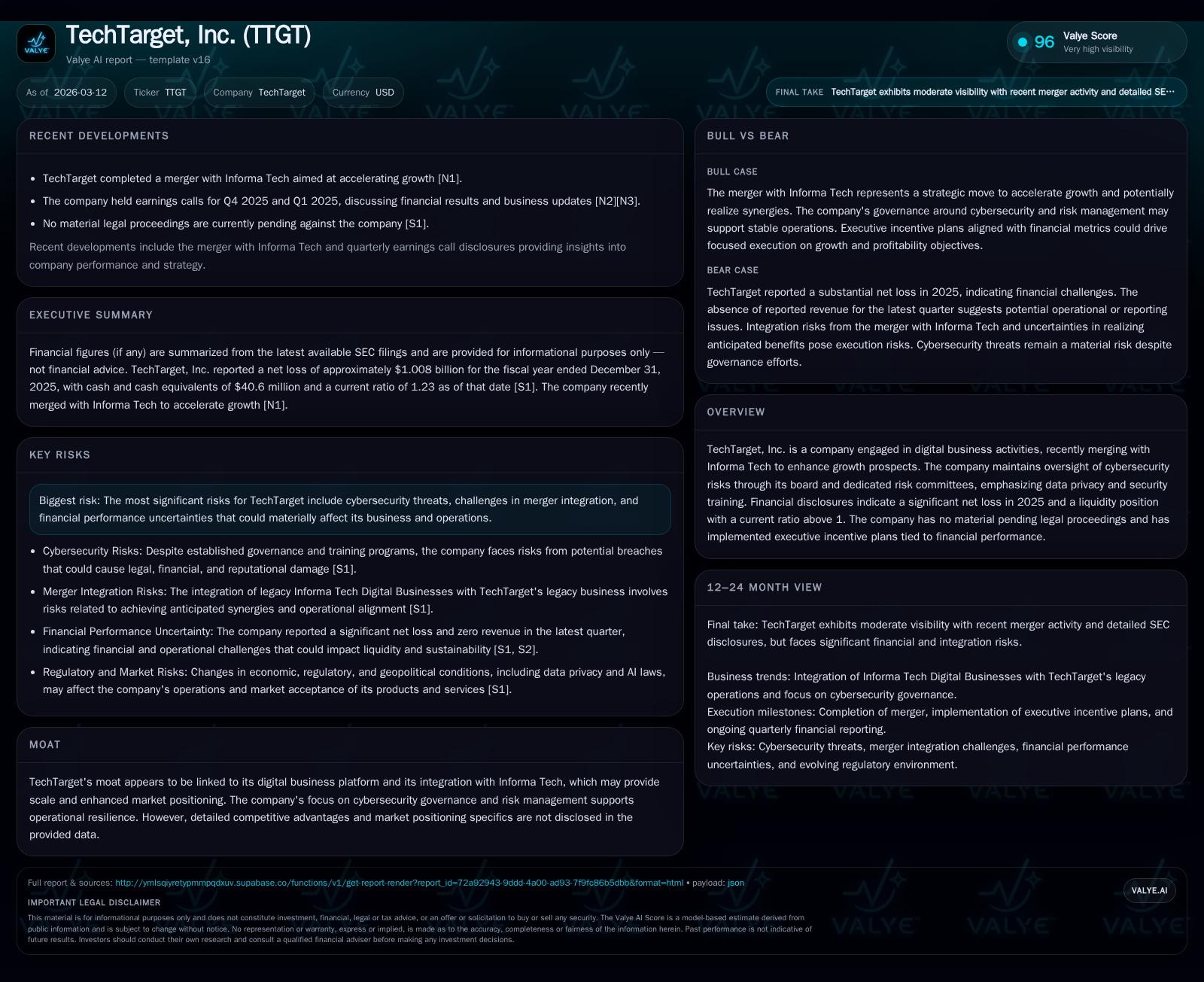
TechTarget, Inc. reported a dramatic deterioration in profitability for fiscal year 2025, with operating and net losses expanding by over 20-fold compared to the prior year. This financial distress is set against the backdrop of its transformative merger with Informa Tech, which aims to consolidate digital platforms and enhance market reach. The company maintains tight cybersecurity governance to mitigate operational risks amid integration complexities. Capital allocation reflects cautious discipline, marked by modest positive cash flow despite losses and no dividend or buyback programs. Going forward, growth prospects hinge on successful synergy realization and monitored integration milestones.
Historic Profitability Challenges and Financial Deterioration in 2025
TechTarget endured a stark financial reversal in fiscal year (FY) 2025 compared to FY2024. Operating income plummeted from a loss of approximately $48 million in 2024 to a massive $1.03 billion deficit in 2025, representing an astonishing negative growth rate of over 2000% [F1]. Net income followed suit, escalating the net loss to approximately $1.01 billion from a comparatively modest loss of $40 million the prior year — a drop exceeding 2400% [F1]. This consequential erosion of operating profitability reflects either substantial restructuring charges or impairment costs largely associated with merger-related activities and integration efforts as indicated by company disclosures [S1]. The approximate return on equity also turned deeply negative at about -170%, emphasizing the impact on shareholder value [F1].
Despite this earnings debacle, operating cash flow (CFO) showed a notable turnaround from negative $65 million in FY2024 to positive $16 million in FY2025 [+125% YoY], indicating managerial focus on operational cash generation amid non-cash losses [F1]. Capital expenditures remained negligible around $387,000 in FY2025 (down roughly 8% YoY), underscoring limited spend beyond essentials [F1]. Meanwhile, shareholders' equity dropped significantly from about $1.57 billion to $595 million reflecting cumulative deficits and balance sheet adjustments post-merger [F1].
Historical performance (annual)
| FY | Net ($mm) | CFO ($mm) | OpInc ($mm) | Capex ($) | Net YoY |
|---|---|---|---|---|---|
| 2025 | -1008 | 16 | -1026 | 387000 | -2438.5% |
| 2024 | -40 | -65 | -48 | 420000 |
Source: SEC companyfacts cache [F1].
Capital returns and efficiency (annual)
| FY | FCF ($mm) | ROE% |
|---|---|---|
| 2025 | 16 | -169.6 |
| 2024 | -65 | -2.5 |
Source: SEC companyfacts cache [F1].
Table: TechTarget Annual Financial Summary FY2024–FY2025 [F1]
Strategic Overview of the Informa Tech Merger and Growth Drivers
TechTarget's recent merger with Informa Tech constitutes a pivotal strategic pivot aimed at leveraging enhanced scale and integrated digital business platforms [N2][S1]. The transaction combines TechTarget’s core digital marketing assets with Informa Tech’s extensive technology media footprint — intended to accelerate revenue growth through cross-selling opportunities and an expanded customer base.
However, company filings underscore that realizing these envisioned synergies is contingent upon complex integration circumstances including unifying legacy IT systems and harmonizing organizational culture across entities [S1]. The management team acknowledges uncertainty regarding expected financial performance post-merger as well as execution risks tied to cost benefits and revenue ramp [S1]. Forward-looking statements caution investors about execution risk inherent in large-scale tech sector mergers where synergy realization often lags initial estimates.
Still, the baseline strategic thesis is that combined platform capabilities will create competitive differentiation through richer customer insights and broadened content offerings — factors crucial for driving growth within tech marketing services sectors.
Cybersecurity Governance: Mitigating Digital Risks Amid Expansion
In parallel with its expanded digital reach following the merger, TechTarget emphasizes meticulous cyber governance frameworks as critical pillars supporting operational resilience [S1][S13]. The board’s audit committee provides continuous oversight on cybersecurity risks aligned with current sector best practices seen among IT platform companies.
A dedicated executive-level risk committee meets periodically addressing global privacy, security compliance trends, resource demands, key projects, and privacy/security metrics reporting directly to audit committees [S1]. The Chief Product & Technology Officer heads the IT Security Team responsible for ensuring company-wide cybersecurity protocols including policy setting, employee training initiatives—for example on phishing awareness and incident response—and deployment of tech-based mitigations [S13]. Importantly, TechTarget’s IT security efforts are tightly integrated with Informa’s CISO teams fostering alignment on strategy, tooling assessments, and coordinated risk management approaches.
Such robust cyber risk controls constitute essential defensive mechanisms amid increasing threats targeting digital publishing platforms involved in data collection and B2B marketing.
Operational Synergies and Integration Hurdles to Watch
While the longer-term potential of the Informa Tech merger centers on synergy realization through platform unification and cost-base optimization [S7], integration risk remains one of the most material near-term obstacles identified by management [S1][S7]. These risks include potential delays or difficulties merging distinct legacy technologies as well as cultural mismatch between historical corporate identities that could slow time-to-benefit.
Experience within similar tech/digital amalgamations suggests that achieving anticipated cost synergies often encounters underestimation—particularly related to aligning sales channels or consolidating product lines without disrupting customer experiences.
Moreover, complexities introduced by dual reporting structures or divergent compliance standards must be carefully managed to avoid inefficiency creep post-close. These factors collectively portend an elongated timeline for capturing merger value despite management's stated ambitions.
Capital Allocation Priorities: Cash Flows, ROE Trends, and Shareholder Returns
Capital discipline appears pronounced at TechTarget amid navigating its large operational losses paired with integration tasks. Despite these earnings challenges, management succeeded in restoring positive operating cash flow totaling approximately $16 million during FY2025 compared to significant outflows previously [F1]. After accounting for minimal capital expenditure needs (~$387K), free cash flow remains modestly positive near $16 million illustrating prudent liquidity stewardship given broader financial pressures.
Conversely, the company reports severely negative return on equity (-170% approx), reflecting both significant net losses and diminished equity base after merger-related impairments [F1]. Notably absent are any announcements regarding dividends or share repurchase authorizations—consistent with prioritizing reinvestment into business scaling initiatives plus ensuring ample liquidity buffers [S16][S22]. Executive incentives have been revamped under new short-term incentive plans linking payoffs more closely to earnings per share targets along with revenue and profit metrics — aligning leadership compensation tightly with performance recovery goals [S18][S23].
In aggregate these capital allocation tendencies emphasize careful balancing between maintaining operational flexibility while steering toward sustainable profitability.
Outlook: Market Expectations and Key Milestones on the Horizon
Recent earnings calls affirm that TechTarget's near-term outlook hinges critically on several integration milestones linked directly to revenue acceleration potential stemming from combined platforms [N1]. Absent explicit numeric guidance for forthcoming periods [N1][S1], key performance indicators investors should monitor include synergy milestone achievements such as consolidated customer acquisition rates, platform unification progress measured by system migration completion percentages, and cost efficiency gains relative to pre-merger levels.
Furthermore, tracking evolving cyber governance metrics remains vital given escalated scale elevates cyber exposure risks requiring ongoing vigilance by executive leadership.
Successful orchestration across these dimensions will underpin whether TechTarget can reverse its recent steep losses trajectory while justifying strategic rationale behind this bold digital merger architecture.
This analysis integrates information drawn strictly from the company's recent SEC filings through Q4/ FY2025 ([F1],[S#]) alongside news transcripts ([N#]). It omits speculation beyond explicit document contents respecting data granularity constraints. All financial figures are denominated in U.S. dollars unless otherwise noted.
Disclaimer: This is research-only, informational analysis and not investment advice. It may include AI-generated interpretation and general industry context. Always verify important details using primary sources.

Comments