
First US Bancshares Faces Earnings Contraction Despite Capital Return Initiatives
After years of growth fueled by loan demand, First US Bancshares encountered profit declines in 2025 while managing regulatory and operational complexities of banking.
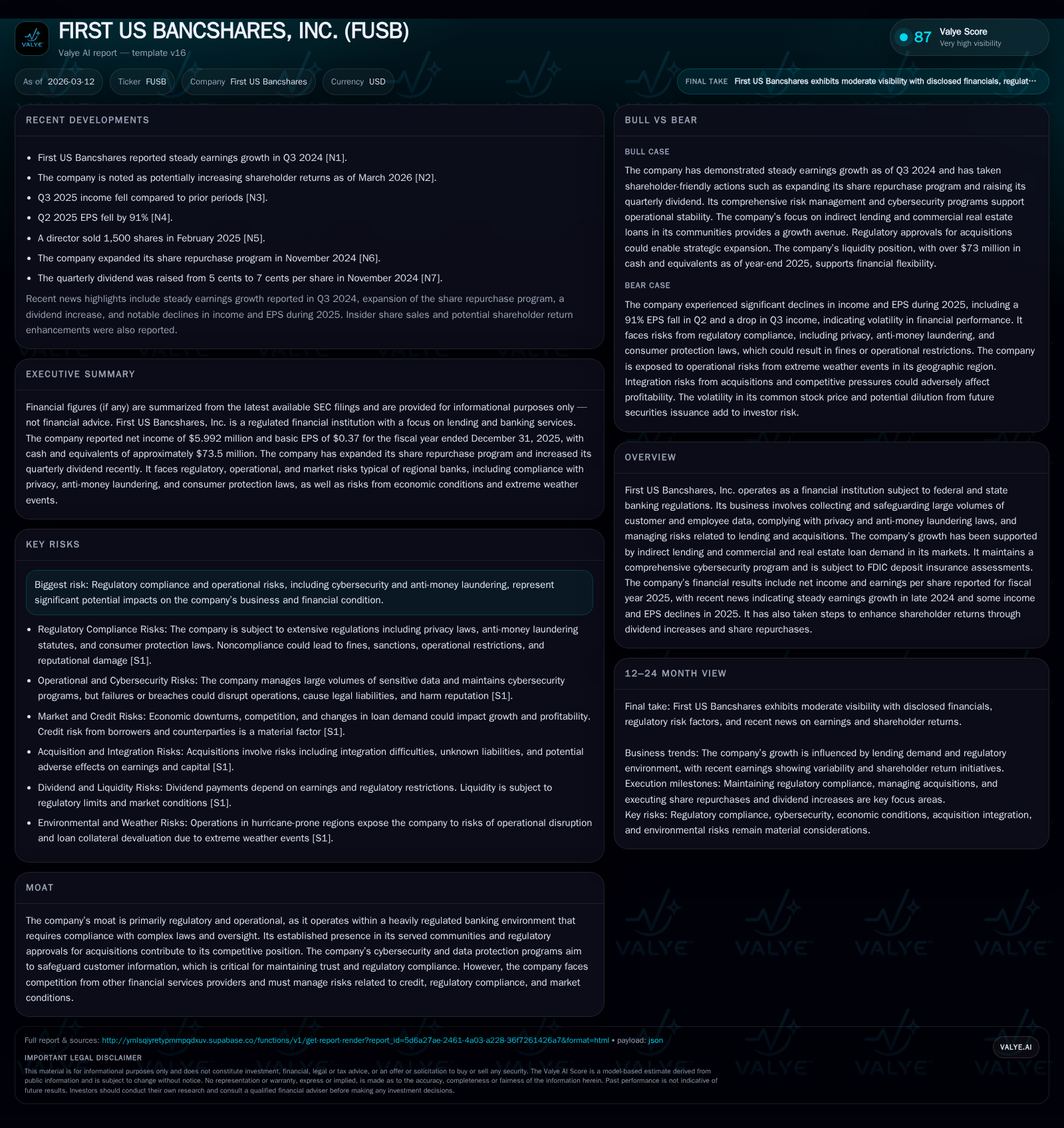
First US Bancshares, Inc. delivered steady earnings growth through 2024 driven by indirect lending and commercial real estate loans but saw a notable net income decline of nearly 27% in 2025. The bank navigated heightened regulatory requirements, including data privacy and anti-money laundering compliance, alongside ongoing cybersecurity vigilance. Its capital allocation strategy included increased dividends and share repurchases, though these returns come against a backdrop of decelerating profitability. Future growth prospects will hinge on successful acquisitions under regulatory constraints, disciplined credit risk management, and sustaining core deposit bases amid competitive pressure.
Historical Performance
First US Bancshares has demonstrated a trajectory of profitable growth through the mid-2020s. Net income increased from $6.86 million in FY2022 to $8.49 million in FY2023 before slightly retreating to $8.17 million in FY2024. However, fiscal year 2025 marked a significant reversal with net income dropping by approximately 26.7% to $5.99 million despite an uptick in operating cash flow (CFO) that rose almost 59% to $12.3 million.
Capital expenditures have grown consistently over the same period — from $1.26 million in FY2022 up to $3.24 million in FY2025 — reflecting investments into infrastructure or technology likely aligned with strategic priorities such as cybersecurity enhancements or branch modernization.
Equity capital expanded steadily from $85.13 million at FY2022 year-end to over $105 million at FY2025 year-end, indicating retained earnings accumulation alongside external capital sources if any.
Dividend payouts rose from $832 thousand in FY2022 to $1.61 million in FY2025 while share repurchases showed fluctuations but maintained an upward trend since FY2023.
Historical performance (annual)
| FY | Net ($mm) | CFO ($mm) | Capex ($mm) | Net YoY |
|---|---|---|---|---|
| 2025 | 6 | 12 | 3 | -26.7% |
| 2024 | 8 | 8 | 2 | -3.7% |
| 2023 | 8 | 13 | 1 | +23.6% |
| 2022 | 7 | 13 | 1 |
Source: SEC companyfacts cache [F1].
Capital returns and efficiency (annual)
| FY | Div ($) | Buybacks ($mm) | FCF ($mm) |
|---|---|---|---|
| 2025 | 1608000 | 2 | 9 |
| 2024 | 1264000 | 2 | 6 |
| 2023 | 1175000 | 1 | 12 |
| 2022 | 832000 | 4 | 11 |
Source: SEC companyfacts cache [F1].
Note: Net Income YoY % calculated as current year vs previous year.
Business Drivers and Operational Context
The company’s expansion has been largely propelled by strong demand in indirect lending avenues—often automobile financing partnerships—and commercial as well as real estate loans in its key regional markets [S1][S17]. This aligns with a typical mid-tier regional bank strategy leveraging community ties.
A significant competitive edge comes from navigating the highly regulated environment effectively—complying with federal privacy laws like the Gramm-Leach-Bliley Act which governs the sharing and safeguarding of nonpublic customer information [S1][S7]. The bank's ability to maintain trust through robust information security initiatives is critical given its operational dependence on handling large volumes of sensitive customer data.
The institution also maintains a comprehensive cybersecurity program involving annual employee training on data handling, simulation exercises for phishing threats, multiple layers of IT controls embedded within technology investments, routine third-party audits, and incident response frameworks designed to limit exposure or consequences of potential cyber incidents [S6][S18].
Regulatory compliance costs have increased due to evolving privacy laws and anti-money laundering statute enforcement risks under statutes such as the Bank Secrecy Act and related USA PATRIOT Act provisions [S4][S9]. Failures here would not only trigger fines but also reputational harm that can erode customer relationships.
Further complexity arises from FDIC deposit insurance assessments that fluctuate based on risk classification—the bank faces potential premium rises especially given systemic stress factors post-financial crises affecting sector-wide resolution costs [S4].
Growth Prospects and Constraints
Future growth may continue along similar lines—leveraging strong indirect lending pipelines combined with steady commercial loan demand—if economic conditions remain favorable within the regions served [S17]. The company intends ongoing acquisition activity aimed at expanding market presence albeit recognizing the integration challenges entailed such as system conversions and cultural assimilation [S10][S13]. These acquisitions require multi-agency regulatory approval including from the Federal Reserve and FDIC which may delay or limit deal momentum.
Loan portfolio quality will require vigilant underwriting standards amid macroeconomic uncertainties impacting borrowers’ repayment capacity or collateral valuations—particularly exposed are real estate loans where localized market softness could manifest [S12][S17]. Moreover, retention and growth of core deposits amidst competition from larger financial institutions or fintech alternatives are essential for funding stability.
Innovation within digital channels might be necessary to sustain customer engagement but involves balancing cybersecurity risks—as third-party vendors increasingly participate in service delivery pipelines [S11][S18].
Forecasts & Milestones To Watch (Analysis)
Explicit consensus or company guidance was not included within filings or public reports; however, upcoming milestones include execution progress on announced acquisitions subject to regulatory consent [N2], continued deployment of technology infrastructure upgrades targeting enhanced customer experience and operational resilience [N2], as well as achievement of performance targets linked to executive compensation plans emphasizing pre-tax income growth and return ratios .
Investors should monitor quarterly results for trends in loan portfolio performance metrics (non-performing loans ratio), net interest margin stability amid interest rate shifts, deposit growth trajectories, plus any changes in regulatory environment impacting capital planning or dividend policies.
Capital Allocation & Returns
Despite profit contractions in FY2025, First US Bancshares increased dividends paid relative to prior years—from $1.26 million in FY2024 up to $1.61 million—and ramped share repurchases from approximately $1.64 million to $1.76 million during the same interval signaling commitment towards shareholder value enhancement within constrained earnings budgets [F1][N2].
The company reported an approximate return on equity (ROE) around 5.7% for FY2025 based on reported net income against equity capital—a moderate return level that has seen fluctuations tied closely to quarterly profitability swings [F1]. Positive free cash flow exceeding $9 million (operating cash flow less capex) provides financial flexibility supporting these distributions without overly pressuring liquidity.
Executive compensation schemes impose alignment mechanisms anchored around consolidated pre-tax income targets, return on average assets (ROAA), return on tangible equity (ROATE), plus net loan growth objectives primarily focused on indirect lending—a structured approach that incentivizes holistic financial discipline balanced with strategic expansion efforts .
Risk Factors Highlighted by Management
The company identifies several material risks: compliance lapses under privacy laws or anti-money laundering statutes could yield substantial penalties or operational restrictions; cybersecurity breaches pose threats beyond financial loss including adverse reputational impacts; FDIC insurance premium increases could pressure cost structures; macroeconomic downturns threaten loan losses especially if underwriting standards slip; competition may erode deposit bases crucial for balance sheet funding; climate-related weather events potentially disrupt operations particularly given geographic concentration near vulnerable Gulf Coast regions; integration difficulties with acquisitions could impair short-term earnings; tax law changes add unpredictability; finally talent retention remains vital for sustaining execution quality at all levels [S4][S9]. These layered risks necessitate ongoing management attention and contingency readiness.
In Summary
First US Bancshares operates within a tightly regulated framework where operational excellence—including data protection—and prudent credit management underpin its business model success thus far in this decade’s mid-stage financial cycle.
While the bank rode robust loan demand waves through late-2024 delivering steady earnings expansion according to recent reporting [N1], fiscal year 2025 introduced headwinds trimming profits materially despite higher operating cash flows facilitating reinvestment and shareholder distributions.
Looking ahead, sustaining momentum depends on deftly marrying acquisition ambitions with organic business development while managing increasing compliance complexity plus competitive pressures on funding costs.
Capital discipline evidenced by rising dividends plus continued share buybacks highlights management’s effort to balance reward delivery against evolving financial trade-offs typical for mid-sized regional banks navigating uncertain macro-financial environments.
Investors should observe upcoming quarterly disclosures for indicators of credit quality shifts or margin compression alongside any signals regarding regulatory developments affecting dividend capacity or acquisition pace.
This report is prepared solely for informational purposes without offering investment advice or recommendations regarding any securities mentioned herein.
Disclaimer: This is research-only, informational analysis and not investment advice. It may include AI-generated interpretation and general industry context. Always verify important details using primary sources.

Comments