
Alpha Tau Medical's Path from Innovation to Global Commercialization of Alpha DaRT®
Reviewing Alpha Tau Medical’s financial trends, proprietary oncology technology, and capital strategy as it advances toward commercialization.
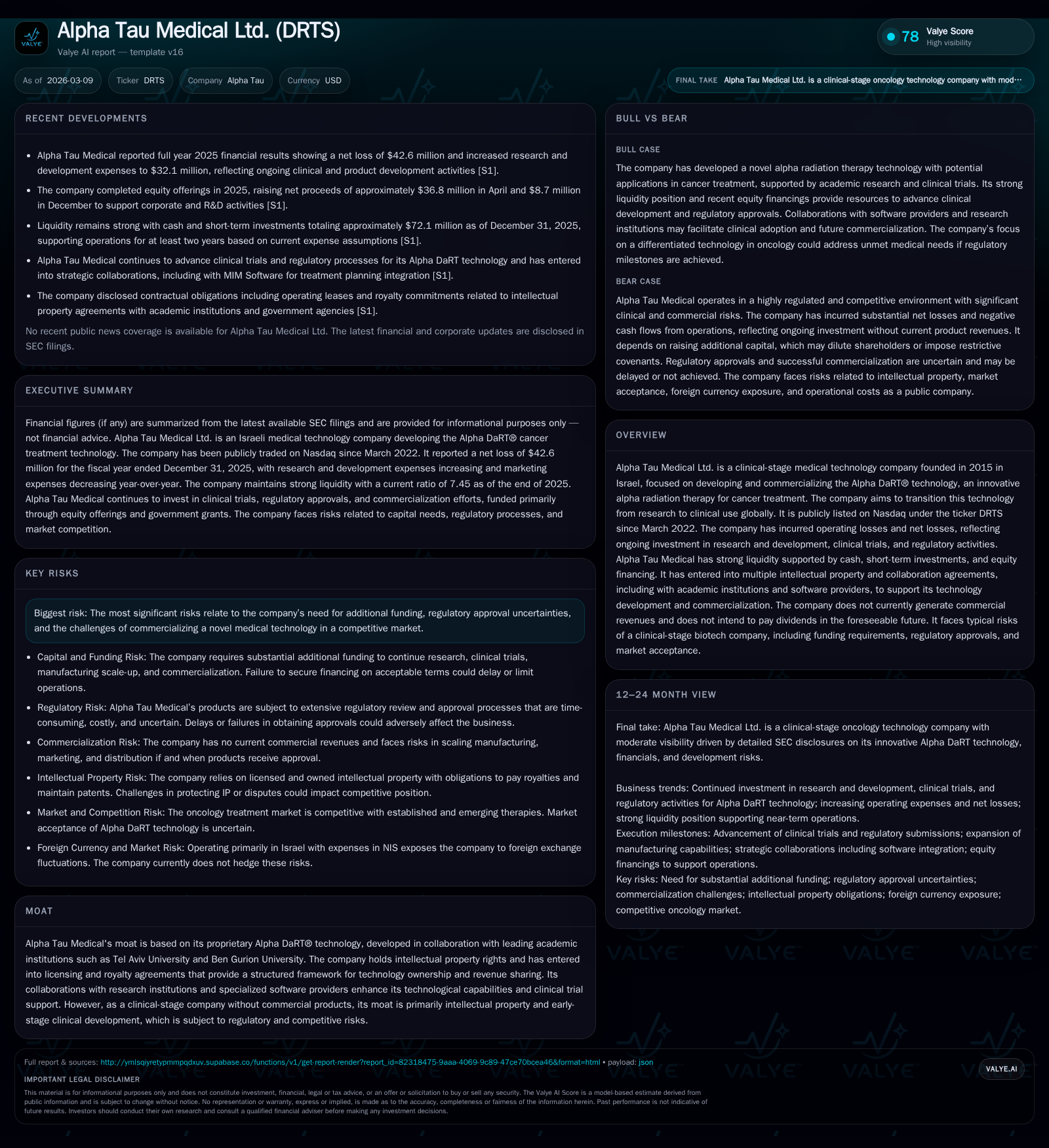
Alpha Tau Medical Ltd., a clinical-stage medtech company founded on proprietary alpha radiation technology, has steadily increased its R&D investment while extending its cash runway through equity raises. The company achieved a key regulatory milestone with marketing approval in Japan for treating unresectable head and neck cancer, marking progress toward global commercialization. Despite continued operating losses and significant cash burn driven by clinical trials and infrastructure expansion, strong intellectual property partnerships and collaborations underpin its strategy as it navigates the pathway from innovative therapy development to market launch.
Innovation Roots: The Alpha DaRT® Technology and Intellectual Property Strength
Alpha Tau Medical originated as a spinout formed by researchers at Tel Aviv University—among them Professor Itzhak Kelson and Professor Yona Keisari—to translate an innovative alpha radiation therapy known as Alpha DaRT® from laboratory research into clinical applications [S20]. This technology delivers alpha-emitting isotopes directly into tumors to provide targeted cancer treatment with potentially improved efficacy and limited systemic toxicity compared to conventional radiotherapy.
The company's intellectual property moat stems from multiple licensing agreements with academic institutions such as Tel Aviv University and Ben Gurion University, securing rights to proprietary formulations and methods related to Alpha DaRT®. These collaborations not only confer ownership but also involve royalty arrangements—such as Ramot at Tel Aviv University which receives a fixed royalty rate of 2.5% on net sales—and continued research partnerships enhancing clinical development [S16], [S17], [S18]. Additional alliances with software providers like MIM Software extend the therapeutic platform’s capabilities through integrated treatment planning systems, facilitating seamless trial implementation and future commercial distribution [S17].
As a clinical-stage firm without commercial products yet, Alpha Tau’s moat principally comprises these IP rights combined with regulatory progression underpinned by collaborative research expertise.
Financial Footprint: Historical Operating Losses and Expense Drivers
Alpha Tau Medical’s financial trajectory reflects typical early-stage medtech dynamics featuring increasing expenditures aligned with clinical advancement milestones. The total operating loss expanded by 17.3% year-over-year to $42.3 million in 2025 from $36.0 million in 2024 [F1], [S1]. This loss acceleration derives predominantly from an 18.7% increase in research and development expenses reaching $32.1 million as the company invested more heavily in personnel costs, raw materials, and outsourced services essential for Phase II/III trials [S1][S5].
Marketing spends notably contracted by 20.8% to $1.9 million reflecting rationalized travel budgets and reduced compensation costs during this pre-commercial stage [S1]. Conversely, general administrative expenses grew by 25.3% to $8.4 million due mainly to elevated share-based compensation alongside augmented legal and investor relations fees consistent with public company compliance demands [S1].
Financial income reversed to a slight expense position driven by unfavorable currency exchanges and diminished returns on deposits, further weighing on bottom-line outcomes [S1].
Historical performance (annual)
| FY | Net ($mm) | CFO ($mm) | OpInc ($mm) | Capex ($mm) | Net YoY |
|---|---|---|---|---|---|
| 2025 | -43 | -27 | -42 | 6 | -34.3% |
| 2024 | -32 | -20 | -36 | 2 | -8.9% |
| 2023 | -29 | -18 | -36 | 6 | +13.6% |
| 2022 | -34 | -24 | -32 | 1 |
Source: SEC companyfacts cache [F1].
Capital returns and efficiency (annual)
| FY | FCF ($mm) | ROE% |
|---|---|---|
| 2025 | -33 | -55.3 |
| 2024 | -22 | -50.7 |
| 2023 | -24 | -34.5 |
| 2022 | -25 | -32.0 |
Source: SEC companyfacts cache [F1].
Table: Key Financial Metrics 2024-2025 (USD thousands) [F1], [S1]
Clinical Advances and Regulatory Breakthroughs: Marketing Approval in Japan
A landmark regulatory achievement arrived in February 2026 when Alpha Tau Medical secured marketing approval from Japan’s Ministry of Health (MHLW) for the use of Alpha DaRT® in unresectable locally advanced or recurrent head and neck cancer—a patient population with significant unmet medical need [S3]. This authorization marks the first country-specific nod enabling commercial deployment.
Although it falls under a pre-market (shonin) approval system requiring continued post-market surveillance studies [S17], this milestone evidences successful translation of preclinical work into recognized safety and efficacy profiles vital for broader geographic expansion plans.
Commercial agreements accompanying this approval include revenue-sharing terms with local partners such as HekaBio K.K., highlighting structured collaboration models for market entry while sharing operational responsibilities [S17].
Scaling Challenges: R&D Intensity, Operating Leverage, and Emerging Growth Status
The company operates under statutes defining it as an emerging growth entity which grants transitional accounting relief yet underscores evolving operational rigor ahead [S6]. Expense escalation—especially in R&D—increases operating leverage pressure; operating cash flow deteriorated nearly 35% YoY to negative $26.7 million representing accelerated investment into ongoing trials alongside ramping up internal capabilities including manufacturing scale-up [F1], [S5], [S10].
Capital expenditures surged by over 170% to $6.1 million reflecting infrastructure investments aimed at enhancing production capacity indispensable for eventual product commercialization [F1], [S5]. Foreign exchange volatility further complicates cost forecasting given exposure primarily denominated in Israeli shekels weighing against U.S.-dollar reporting requirements [S6], imposing financial planning nuances.
Capital Structure and Liquidity Position: Funding History and Cash Runway
The company’s liquidity is bolstered by sizable equity raises totaling upwards of $270 million from inception through late 2025 per SEC reports citing gross proceeds near $225 million mainly from share issuances alongside government grants supporting early-stage research efforts [S1], [S4]. Recent private placements completed at rising share prices netted tens of millions dollars enhancing available liquidity buffers to fund anticipated operating deficits and capital needs through at least two years based on management guidance [S4], [S7].
As of December 31, 2025, current assets stood at roughly $78.3 million versus current liabilities near $10.5 million delivering a strong current ratio around 7.45x signaling favorable near-term solvency [F1]. However, contractually committed lease payments approaching $9.7 million over subsequent years represent ongoing fixed obligations impacting cash forecasts beyond immediate horizons [S15].
Governance of Capital Allocation: Absence of Dividends, Share Issuances Without Buybacks
Shareholders receive no dividend payout reflecting corporate practice common among pre-commercial biotech enterprises prioritizing reinvestment into development programs rather than distributions [S11]. No share repurchase activity has been reported; instead issuance of ordinary shares remains the principal capital procurement route raising potential shareholder dilution over time especially if financing rounds persistently replenish runway amid continuing losses.
Share-based compensation is an increasing component of G&A expenses incentivizing staff retention aligned with growth initiatives though also placing upward pressure on expense base reported under US GAAP provisions requiring fair value accounting approaches detailed in filings [S13].
Commercialization Horizons: Future Milestones and Strategic Collaborations
Looking forward into mid-2026 and beyond, Alpha Tau is advancing multiple pivotal clinical trials including U.S. Phase II registrations targeting recurrent glioblastoma multiforme and cutaneous squamous cell carcinoma while preparing additional regulatory submissions such as FDA pre-market approval modules already filed for certain indications (not detailed here). Further collaborations underpinning these efforts include strategic IR/public relations contracts intended for investor outreach across key territories within the United States, Israel, South Korea complementing product registration momentum [S16],[S18],[S23]. Successful navigation through these milestones will be essential to justify additional capital infusions needed for final commercialization steps.
Risk Architecture: Funding Needs and Regulatory Uncertainties
Risks weigh heavily on Alpha Tau’s near-term outlook driven largely by dependency on securing substantial incremental funding where no committed sources currently exist obligating repeated access to equity markets or partner deals that may dilute ownership or constrain strategic choices [S4],[S14],[S17]. Regulatory review outcomes retain inherent uncertainties given novel modality profiles coupled with heterogeneous global jurisdictional expectations which complicate timelines or induce unforeseen data requests impacting cost structures or approvals [S14],[S20]. Competition among alpha-emitting radiotherapeutics along with broader oncology innovations demands continuous differentiation via trial results credibility supported by robust IP coverage safeguarded through ongoing licensing vigilance with academic licensors — factoring patent life cycles extending up to or beyond fifteen years post-development inception creates both opportunity but also time-sensitive pressures on recoupment potential[S17],[S18].
This analysis synthesizes information extracted exclusively from Alpha Tau Medical Ltd.'s SEC filings including Forms 20-F and 6-K along with company-provided disclosures as referenced herein without extrapolation beyond documented facts or speculation about market behavior or price movements.
Disclaimer: This is research-only, informational analysis and not investment advice. It may include AI-generated interpretation and general industry context. Always verify important details using primary sources.

Comments