
Dianthus Therapeutics Accelerates Autoimmune Pipeline Expansion While Managing Cash Burn and Regulatory Risks
Clinical successes in CIDP and upcoming Phase 3 data in gMG spotlight Dianthus’ innovation amid significant operational losses.
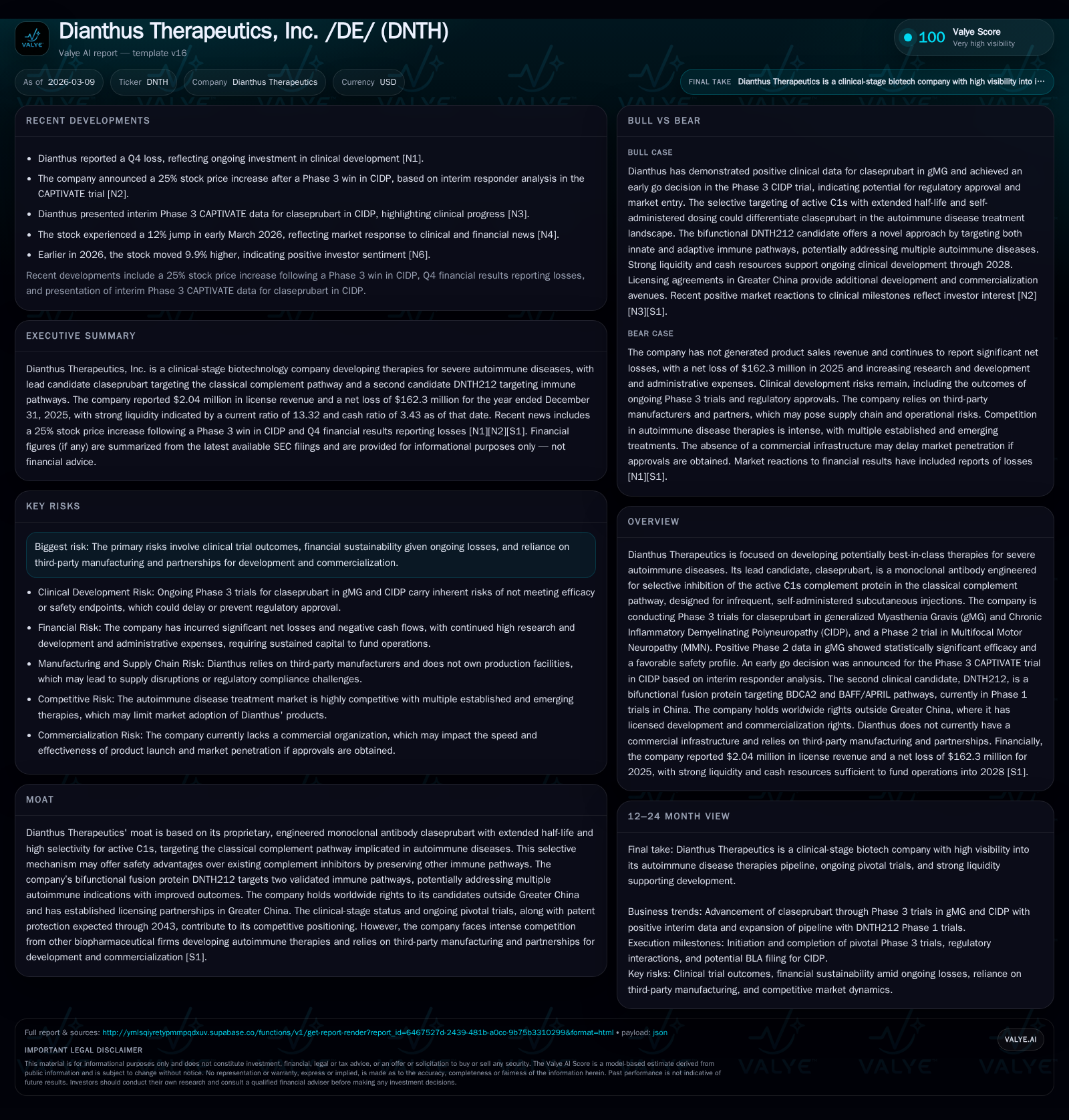
Dianthus Therapeutics is advancing its lead candidate claseprubart through pivotal Phase 3 trials targeting severe autoimmune indications such as CIDP and generalized Myasthenia Gravis (gMG), complemented by early-stage development of its bifunctional DNTH212. Despite promising clinical milestones, including an early go decision in CIDP and strong Phase 2 efficacy in gMG, the company remains pre-commercial with no product sales revenue yet. The firm reported a net loss of $162.3 million in 2025 while maintaining cash reserves to fund operations into 2028. High R&D investments continue to drive negative operating cash flow, underscoring reliance on capital markets or partnerships. Commercialization plans include internal efforts and licensing in Greater China, with manufacturing outsourced to third parties. Regulatory and reimbursement landscapes pose ongoing challenges amid evolving U.S. pricing controls. Patents securing claseprubart extend through at least 2043, supporting a differentiated position in autoimmune therapeutics.
Company Overview and Core Technologies
Dianthus Therapeutics is a clinical-stage biotechnology company focused on developing therapies for severe autoimmune diseases. Its lead candidate, claseprubart, is a monoclonal antibody engineered to selectively inhibit the active form of C1s—a protease in the classical complement pathway implicated in autoimmune pathogenesis. Claseprubart incorporates YTE half-life extension mutations designed to enable less frequent dosing via self-administered subcutaneous injections, improving patient convenience relative to broader complement inhibitors.
This selective inhibition aims to preserve immune function by sparing lectin and alternative complement pathways, potentially reducing infection risks associated with pan-complement blockade. Complementing this, DNTH212 is a bifunctional fusion protein targeting plasmacytoid dendritic cell BDCA2 to suppress Type I interferon production alongside BAFF/APRIL inhibition to modulate B cell function, thus addressing both innate and adaptive immune mechanisms involved in autoimmunity.
Historical Financial Performance
Dianthus remains pre-commercial with no revenue from product sales since inception. Recognized revenues derive mainly from upfront payments, milestone achievements, and cost reimbursements under license agreements.
Historical performance (annual)
| FY | Rev ($mm) | Net ($mm) | CFO ($mm) | OpInc ($mm) | Rev YoY | Net YoY |
|---|---|---|---|---|---|---|
| 2025 | 2 | -162 | -129 | -178 | -67.3% | -91.1% |
| 2024 | 6 | -85 | -78 | -102 | -95.1% | |
| 2023 | -44 | -37 | -48 | +43.0% | ||
| 2022 | -76 | -67 | -81 |
Source: SEC companyfacts cache [F1].
Capital returns and efficiency (annual)
| FY | ROE% |
|---|---|
| 2025 | -32.9 |
| 2024 | -24.1 |
| 2023 | -25.8 |
| 2022 | -72.2 |
Source: SEC companyfacts cache [F1].
The substantial year-over-year increase in operating losses (74.7% from 2024 to 2025) reflects intensified clinical development activities and milestone payments tied to claseprubart and DNTH212 programs [F1][S10][S20]. Research and development expenses nearly doubled to $145.6 million in 2025 due to expanded external clinical costs, manufacturing-related expenses, discovery efforts, and personnel growth [S20][S21]. General and administrative costs also increased notably as infrastructure scaled ahead of potential commercialization [S21].
Operating cash flow remains significantly negative consistent with investment-heavy stages typical for clinical-stage biopharmaceutical companies [F1]. Capital expenditures are minimal given reliance on contract manufacturing organizations rather than owned facilities [F1][S19].
Clinical Pipeline Progress and Growth Drivers
Claseprubart is under evaluation in three mid-to-late stage clinical trials:
- The Phase 3 CAPTIVATE trial in Chronic Inflammatory Demyelinating Polyneuropathy (CIDP), where an early go decision was announced following interim responder analysis in March 2026 [N3][N4].
- A planned Phase 3 registrational trial in generalized Myasthenia Gravis (gMG), expected to initiate mid-2026 after favorable FDA end-of-Phase 2 discussions [S1][N4], with topline results anticipated in the second half of 2028.
- Ongoing Phase 2 evaluation in Multifocal Motor Neuropathy (MMN).
Positive Phase 2 MaGic trial topline data demonstrated statistically significant efficacy coupled with a favorable safety profile, supporting regulatory confidence for further development [S1].
DNTH212 represents an earlier-stage asset designed for broader autoimmune indications by simultaneously modulating innate plasmacytoid dendritic cells and adaptive B cell pathways [S1]. Licensing agreements grant regional exclusivity—such as with Tenacia Biotechnology for Greater China—while Dianthus retains global rights elsewhere [S1][S18][S19]. Milestone payments under these arrangements contribute modestly to current revenues.
Key Milestones & Outlook
While detailed guidance remains limited due to typical confidentiality around pivotal studies, critical upcoming milestones include:
- Interim analyses from ongoing Phase 3 trials—especially CAPTIVATE (CIDP)—to inform regulatory submissions.
- Initiation timing and subsequent data readouts from the planned Phase 3 gMG study.
- Advancement of DNTH212 through preclinical and clinical phases that may diversify pipeline indications.
Monitoring progress on partnership milestones will provide insight into collaborative confidence levels and incremental non-dilutive funding opportunities.
Capital Allocation & Financial Health
As of December 31, 2025, Dianthus reported cash and equivalents of approximately $51 million against current liabilities near $31 million, yielding a robust current ratio exceeding 13x indicative of strong near-term liquidity [F1][S17]. Equity grew substantially reflecting recent capital raises bolstering the balance sheet for continued research investment.
Despite this liquidity cushion extending the operational runway into late 2028 per company disclosures [S10], substantial negative operating cash flow exceeding $129 million during calendar year 2025 underscores dependence on additional capital raises or partnership inflows for sustainability [F1][S22].
No dividends or share repurchases have been declared consistent with prioritizing reinvestment into development over shareholder distributions at this stage [F1]. The net loss relative to equity translates into an approximate negative return on equity near -33%, reflecting developmental investment impact rather than profitability [F1].
Competitive Positioning & Intellectual Property
Dianthus’ proprietary technology hinges on claseprubart's engineered monoclonal antibody selectively targeting active C1s with enhanced Fc domain modifications extending half-life—enabling less frequent dosing compared to historical C1s or broader complement inhibitors such as C5 blockers dominating autoimmune treatment landscapes.
This selectivity may confer safety advantages by preserving lectin and alternative complement pathways thereby reducing infection risk—a meaningful differentiation noted within complement inhibitor classes.
DNTH212’s bifunctional design targets validated immune pathways implicated across multiple autoimmune diseases offering potential efficacy benefits over single-target approaches aligned with precision immunotherapy trends.
Patent protections covering claseprubart extend through at least 2043 providing substantial exclusivity that supports long-term competitive positioning while eventual biosimilar entry risks remain remote within this horizon [S19].
Regulatory Environment & Risks
Key risks include:
- Potential delays or failures in clinical trials necessitating additional costly studies;
- Dependence on third-party contract manufacturers without internal production control;
- Continued substantial cash burn requiring capital raises that may dilute shareholders or impose restrictive covenants if debt-financed;
- Uncertainties surrounding FDA review timelines as well as foreign regulatory approvals impacting market entry timing;
- Payer coverage challenges compounded by evolving U.S. Medicare/Medicaid pricing reforms and international reference pricing affecting reimbursement levels;
- Compliance risks related to healthcare laws governing marketing practices;
- Intense competition within autoimmune biologics space posing commercial viability pressures.
These factors highlight that success depends not only on scientific breakthroughs but also execution capabilities across regulatory, commercial, and financial domains given absence of marketed products currently [S4]-[S9][S12]-[S16].
Commercial Strategy & Manufacturing Model
Dianthus currently lacks an internal commercial organization typical of late-stage biotechs preparing for launch but plans hybrid approaches combining direct efforts with strategic licensing such as its agreement with Tenacia Biotechnology covering Greater China markets while retaining global rights elsewhere [S19]. This approach balances upfront cost control against strategic market optionality.
Manufacturing is fully outsourced relying on contract development and manufacturing organizations (CDMOs) supported by internal expertise overseeing quality assurance rather than owning physical facilities [S19]. While this mitigates capital expenditure needs it introduces operational dependencies inherent to third-party providers.
Outlook & Monitoring Considerations
With pivotal clinical milestones forthcoming—including encouraging interim readouts from CAPTIVATE Phase 3 CIDP trial plus planned initiation of registrational studies for gMG—the company stands at a critical juncture transitioning from R&D-intensive phases toward potential commercialization readiness.
Ongoing assessment of milestone achievements within collaborations will illuminate partner confidence levels alongside incremental non-dilutive financing impact affecting liquidity outlook. Market uptake post-launch will depend heavily on demonstrated safety/efficacy advantages over incumbent therapies coupled with negotiated reimbursement terms shaping realized revenue potential. Subsequent progression of DNTH212 could materially expand therapeutic breadth mitigating binary risk exposure typically seen in single-candidate portfolios.
Disclaimer: This report is based solely on publicly available information as of March 9, 2026, including SEC filings and news releases. It does not constitute investment advice or recommendations regarding securities transactions. Investors should conduct independent due diligence including consultation with professional advisors before making investment decisions.
Disclaimer: This is research-only, informational analysis and not investment advice. It may include AI-generated interpretation and general industry context. Always verify important details using primary sources.

Comments