
Equity Bancshares’ Shifting Profitability and Growth Dynamics in Regional Banking
The company’s recent earnings swings reflect the complex interplay of organic growth, acquisitions, and regulatory capital demands within concentrated regional markets.
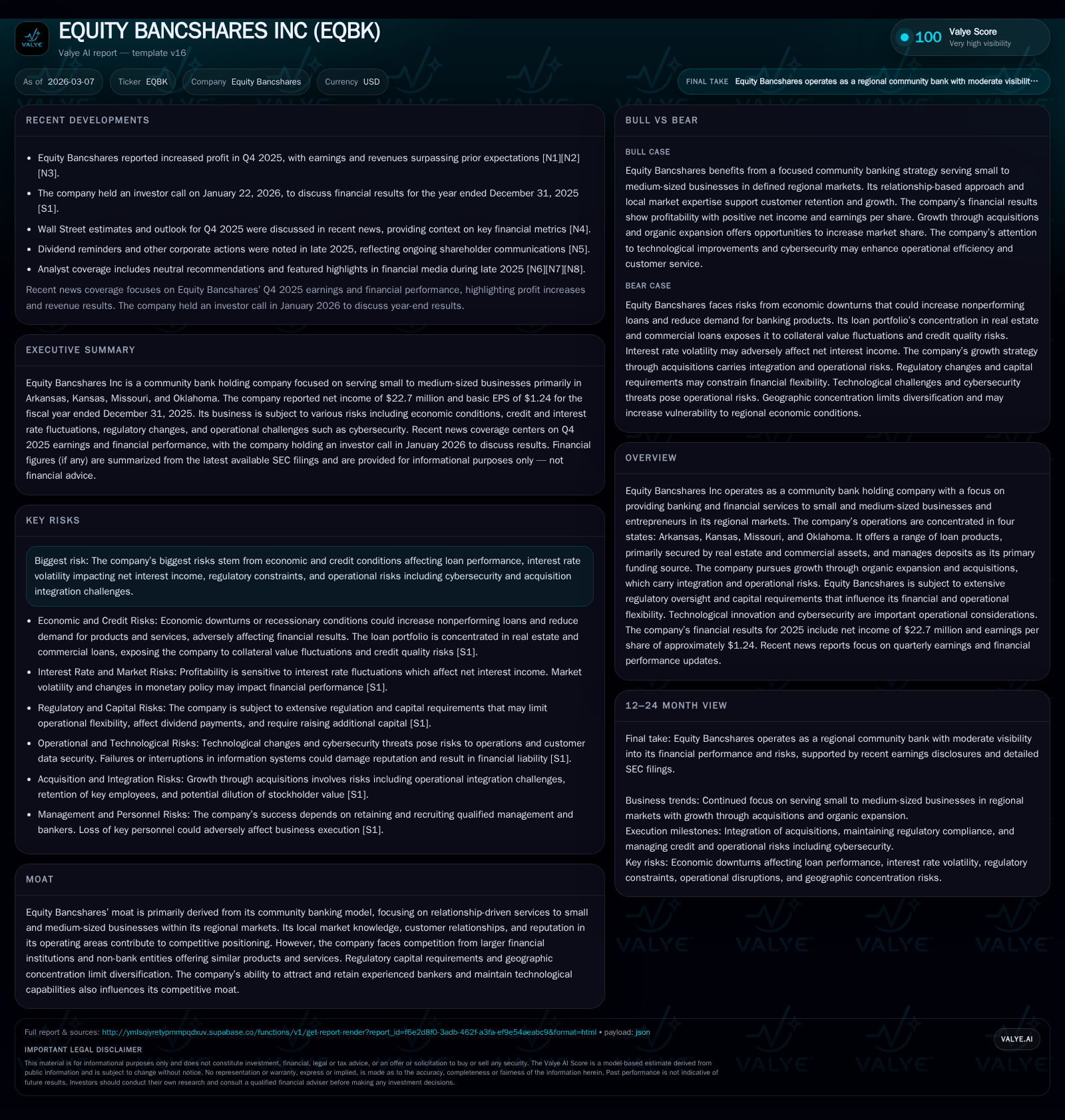
Equity Bancshares Inc has experienced pronounced volatility in net income through 2022–2025, with a sharp pullback in profitability in 2025 contrasted by consistent expansion of its equity base. Rooted in community banking across Arkansas, Kansas, Missouri, and Oklahoma, the firm leverages strong local relationships but faces limits tied to geographic concentration and regulatory capital constraints. Its growth strategy balances cautious organic loan portfolio development against risk-laden acquisitions, while navigating heightened operational and cybersecurity pressures. Looking ahead, managing deposit funding costs, integrating acquisitions smoothly, and adapting to interest rate and credit risks remain pivotal to reviving earnings momentum.
Earnings Volatility: Historical Performance Trends and Key Drivers
Equity Bancshares’ financial results from FY2022 through FY2025 reveal significant swings in profitability amid stable capital accumulation. Net income peaked at $57.7 million in 2022 before plunging to $7.8 million in 2023—an 86.4% drop—then rebounded to $62.6 million in 2024 only to retreat sharply again to $22.7 million in 2025 [F1]. This pronounced cyclicality underscores the sensitivity of the company’s earnings to regional economic fluctuations, credit losses tied primarily to its commercial loan portfolio secured by real estate and other business assets, and acquisition-related expenses.
Operating cash flow similarly contracted over this period from $74.1 million in 2022 to $51.4 million in 2025—a nearly 30% decline—paralleling tighter liquidity conditions and increasing working capital needs [F1]. Capital expenditures swung markedly upward in 2025 to $13.3 million from prior years’ mid-single-digit millions, reflecting investments into technological platforms and physical infrastructure critical for competitive agility.
Meanwhile, total equity climbed steadily from $410 million at end-2022 to over $732 million by the close of FY2025, bolstered by retained earnings despite lower net margins plus measured share buybacks amounting to roughly $14 million in the latest fiscal year [F1]. The resulting return on equity calculated approximately at 3.1% for FY2025 indicates constrained profitability relative to equity levels—a key consideration for future capital efficiency.
Historical performance (annual)
| FY | Net ($mm) | CFO ($mm) | Capex ($mm) | Net YoY |
|---|---|---|---|---|
| 2025 | 23 | 51 | 13 | -63.7% |
| 2024 | 63 | 74 | 8 | +700.7% |
| 2023 | 8 | 77 | 16 | -86.4% |
| 2022 | 58 | 74 | 3 |
Source: SEC companyfacts cache [F1].
Capital returns and efficiency (annual)
| FY | Buybacks ($mm) | FCF ($mm) | ROE% |
|---|---|---|---|
| 2025 | 14 | 38 | 3.1 |
| 2024 | 12 | 65 | 10.6 |
| 2023 | 18 | 61 | 1.7 |
| 2022 | 33 | 71 | 14.1 |
Source: SEC companyfacts cache [F1].
Note: Capital expenditures surged significantly in FY2023 due to targeted technology upgrades before declining moderately in FY2024, then rising again in FY2025 aligned with further digital transformation efforts.
The volatile profit patterns stem largely from the company’s concentrated exposure to small- and medium-sized businesses within its four-state regional banking footprint that are sensitive to macroeconomic shifts affecting credit quality and loan demand [S7]. Additionally, the firm’s asset-sensitive stance exposes profitability to fluctuations in net interest margin governed by prevailing interest rates.
Regional Footprint and Market Positioning: Concentration Risks and Competitive Moat
EQBK’s business is geographically anchored predominantly across Arkansas, Kansas, Missouri, and Oklahoma where it operates primarily as a community bank specializing in relationship-based services for SMEs [S7]. This focus generates a competitive moat derived from deep customer ties, localized market intelligence, and tailored lending products largely secured by real estate or commercial collateral.
However, this regional concentration entails material risks due to exposure to localized economic downturns that can depress loan performance or reduce deposit inflows [S7][S13]. Sector-specific challenges such as real estate market volatility or disruption in agricultural commodity prices also directly impact loan collateral valuations given a significant portion of loans are asset-based.
Competitive dynamics further complicate growth prospects as EQBK faces pressure not only from larger national banks with scale advantages but also fintech firms and non-bank financial intermediaries increasingly encroaching on traditional lending segments via innovative digital platforms [S18]. While EQBK maintains a valued reputation within its communities bolstered by personal service standards, it must continuously invest in technology enhancements to sustain relevance against digitally native competitors.
Growth Outlook: Opportunities and Operational Constraints
Looking forward, Equity Bancshares seeks growth primarily through cautious organic expansion of its loan portfolio supplemented selectively with acquisitions [N1][N2][S1]. Yet this path is bounded by several operational constraints:
- Federal regulations impose lending limits for community banks that limit credit exposure per borrower constraining larger deal origination capacity [S8][S29].
- Maintaining adequate capital ratios under Basel III-like requirements restricts leverage expansion which tempers aggressive portfolio growth.
- Geographic exposures limit economic diversification ameliorating risk but concentrating vulnerabilities if one regional economy contracts [S7].
- Interest rate environments influence net interest margin; tightening rates can boost spreads but heightened volatility adds uncertainty around funding costs.
- Deposit composition changes post-2023 bank failures have introduced investor scrutiny over uninsured deposits—a significant share at ~33% of non-brokered deposit balances—potentially increasing funding cost variability [S24][S9].
Consequently, organic growth depends heavily on deepening penetration within existing markets while balancing risk-weighted asset management prudently against cost of funds pressure.
Strategic Acquisitions and Integration Challenges
Acquisitions serve as a strategic lever for EQBK’s market footprint broadening beyond organic capabilities but carry inherent execution risks [S1][S4]. Acquisition integration demands include IT systems harmonization, assimilation of underwriting standards, retention of acquired customer relationships, cultural alignment among bankers, and regulatory approvals—all bearing on near-term financial outcomes.
Notably, recent disclosures emphasize how acquisition-related disruptions can dilute stockholder value through elevated operating expenses or credit provisioning mismatches arising during transition phases [S4][S13]. Such risks necessitate disciplined vetting of targets plus structured post-merger integration frameworks guided by experienced management teams capable of mitigating operational disconnects swiftly.
Capital Allocation Review: Returns, Dividends, and Share Buybacks
Equity Bancshares demonstrates measured capital stewardship reflected in its allocation choices balancing liquidity preservation with shareholder distributions:
- Return on equity stood at approximately 3.1% based on trailing annual net income of $22.7 million over $732 million equity as of FY2025 end—indicative of cautious leverage deployment coupled with margin pressure [F1].
- Operating cash flow remaining robust relative to capex enabled generation of about $38 million free cash flow supporting reinvestment flexibility [F1].
- Share repurchases reached nearly $14 million for FY2025 compared with smaller outlays prior years documenting consistent buyback activity aimed at offsetting dilution [F1][N3].
- Quarterly dividend declared at $0.18 per share evidences commitment toward regular shareholder returns without overextending payout ratios amid profit variability [(S3)].
Capital deployment remains sensitive to preserving capital buffers required under regulatory stress testing norms imposed on regional banks post-pandemic fallout enhancing resilience but constraining aggressive capital returns [S21]. Refinancing subordinated debts prior maturity dates also factors into liquidity planning.
Risk Environment: Credit, Interest Rate Sensitivities, and Regulatory Oversight
The bank operates within a multifaceted risk landscape shaping performance trajectories:
- Credit risk concentrates around SME borrowers whose repayment capacity is vulnerable to local economic cycles; real estate collateral value fluctuations compound loss severity potential [S1][S9][S10].
- Interest rate sensitivity challenges profitability given asset-liability mismatches typical for community banks managing short-term deposits funding longer-term loans [S1][S26].
- Regulatory environment remains stringent with dual federal-state oversight enforcing capital adequacy norms alongside consumer protection frameworks including Dodd-Frank compliance impacting operational scope [S11][S19].
- Heightened post-2023 examination regimes amplify compliance cost structures especially regarding deposit stability scrutiny following major regional bank failures eroding depositor confidence generally [S9][S24].
- Litigation exposure arises from intellectual property claims related to IT vendors as well as customary financial services disputes potentially leading to material settlements or reputational damage [S4][S22].
Managing these risks necessitates prudent underwriting discipline coupled with robust internal controls plus maintaining responsive compliance infrastructures adaptable to evolving laws.
Technology Adoption and Cybersecurity Imperatives
Technological innovation represents both a strategic necessity and operational challenge for Equity Bancshares [S4][S6]. As a community-oriented institution with comparatively limited resources versus national peers, EQBK invests substantially in upgrading digital platforms enabling enhanced internet/mobile banking services vital for customer retention.
Cybersecurity risks are escalating driven by increased targeting of commercial banking networks alongside expanding remote access solutions offered to clients exposing potential vulnerabilities [S17][S14]. Successful cyber breaches could cause direct financial losses plus cascading reputational harm underlining the importance placed on continuous security improvements funded through recent rises in capex.
The advent of artificial intelligence integration across processes introduces novel legal/regulatory uncertainties adding layers of complexity requiring ongoing investment.
Investor Considerations: Metrics to Watch and Potential Catalysts
Without formal forward-looking guidance available publicly,[N1][N2] investors should focus on several key indicators impacting future valuation:
- Earnings quality trends including normalized credit loss provisions which historically cause profit punctuations.
- Loan portfolio growth rates balanced against yield compression risks reflective of pricing power amidst competitive pressure.
- Deposit stability metrics especially uninsured deposit percentages influencing funding cost volatility.
- Execution progress on the acquisition pipeline accompanied by early integration results impacting margins.
- Operating cash flow momentum relative to capex trends indicating free cash flow availability underpinning dividends/share buybacks sustainability.
- Regulatory developments stemming from federal oversight agencies shifting examination focus which could recalibrate operating expense baselines abruptly.
Monitoring quarterly disclosures for these variables will provide nuanced insight into whether EQBK can regain steadier profit expansion while preserving its distinctive community banking franchise amid mounting external challenges.
This analysis is based solely on information sourced from company filings ([F1], [S#]) and recent news items ([N#]). It does not constitute investment advice or recommendations.
Disclaimer: This is research-only, informational analysis and not investment advice. It may include AI-generated interpretation and general industry context. Always verify important details using primary sources.

Comments