
Tredegar Corp's Turnaround : From Losses to Solid Profitability
Tredegar Corporation reverses years of losses with a strong 2025 profit fueled by operational improvements and strategic capital management.
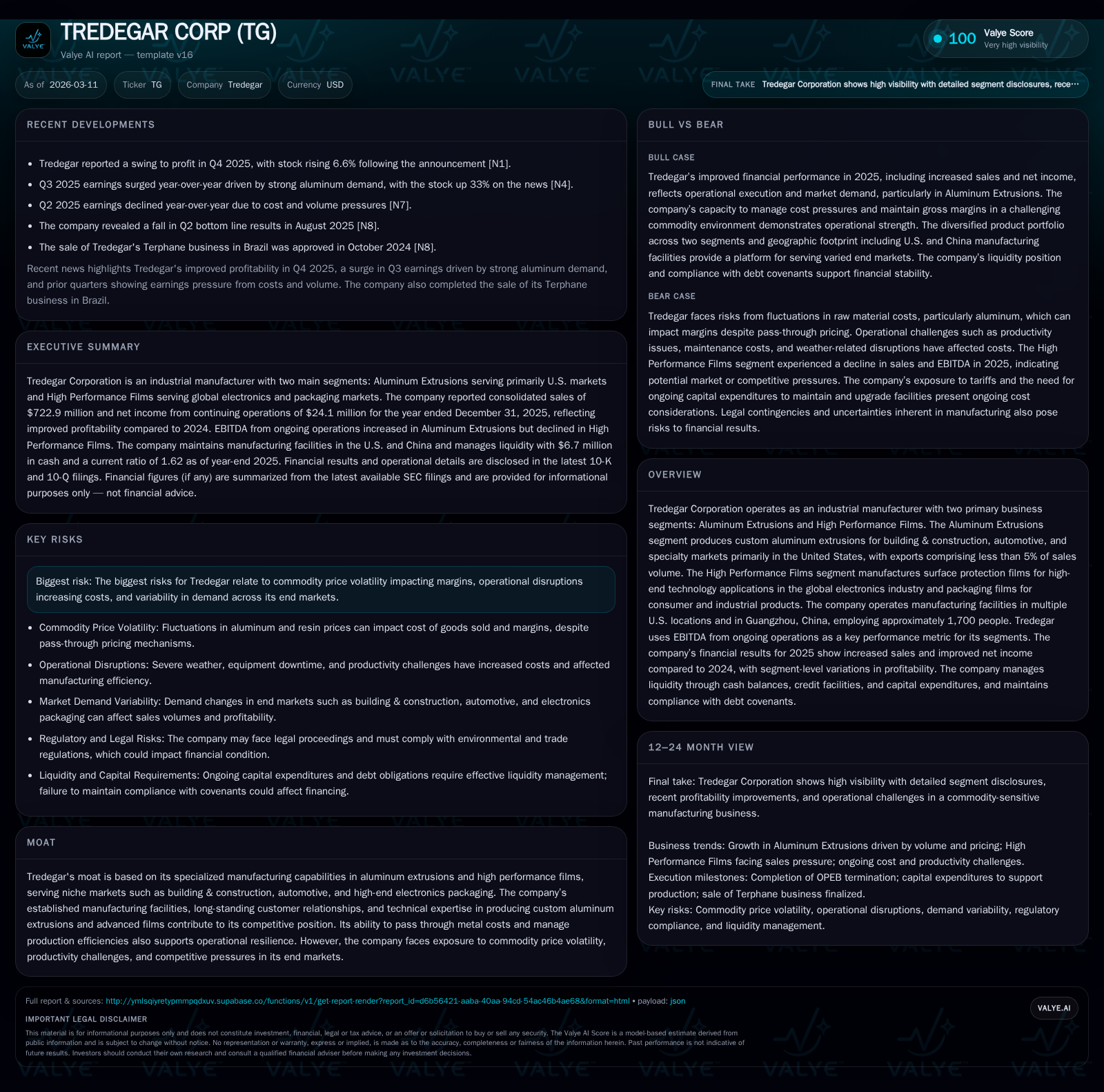
After suffering steep net losses in 2023 and 2024, Tredegar Corporation posted a net income of $33.5 million in 2025, demonstrating a significant financial recovery. This turnaround was supported by increased sales volume, improved operating cash flow, and effective management of commodity cost pass-throughs in its Aluminum Extrusions and High Performance Films segments. The company maintained compliance with debt covenants while suspending dividends and share buybacks to prioritize liquidity and reinvestment. Key near-term indicators for performance focus on segment EBITDA trends and metal price volatility.
Historical Financial Trajectory: Earnings and Cash Flow Rebound
Tredegar Corporation emerged from substantial losses in 2023-24 with a notable rebound in profitability in 2025, marking a pivotal corporate turning point. Net income shifted from a negative $105.9 million in 2023 and a negative $72.7 million in 2024 to a positive $33.5 million in the latest fiscal year — a year-over-year increase exceeding 146% [F1].
This improvement was underscored by strengthened operating cash flow, rising nearly 30% from $25.5 million to approximately $33.0 million over the same period, signaling enhanced operational cash generation capacity aligned with improved earnings quality [F1]. Capital expenditures increased moderately by about 20% to $17.2 million, reflecting measured reinvestment into production capabilities following prior cutbacks [F1]. These factors combined produced approximately $15.7 million of free cash flow (operating cash flow less capex), offering some breathing room for liquidity management amidst recovery.
Return on equity approached an estimated 15.5%, recovering after several years of negative returns wrought by accumulated losses, signaling restored shareholder value creation potential [F1]. The company's equity also expanded alongside earnings improvements, attaining over $216 million by year-end.
Historical performance (annual)
| FY | Net ($mm) | CFO ($mm) | Capex ($mm) | Net YoY |
|---|---|---|---|---|
| 2025 | 33 | 33 | 17 | +146.0% |
| 2024 | -73 | 26 | 14 | +31.4% |
| 2023 | -106 | 24 | 26 | -472.2% |
| 2022 | 28 | -21 | 37 |
Source: SEC companyfacts cache [F1].
Capital returns and efficiency (annual)
| FY | FCF ($mm) | ROE% |
|---|---|---|
| 2025 | 16 | 15.5 |
| 2024 | 11 | -40.2 |
| 2023 | -2 | -68.0 |
| 2022 | -58 | 14.1 |
Source: SEC companyfacts cache [F1].
Note: Exact revenue figures unavailable; focus is on profitability and cash flow metrics per latest filings.
Segment Dynamics: Aluminum Extrusions and High Performance Films Insights
Tredegar operates two primary business segments with distinct market dynamics: Aluminum Extrusions and High Performance Films.
The Aluminum Extrusions segment principally serves building & construction (both residential and nonresidential), automotive, machinery & equipment, electrical applications and distribution markets predominantly within the U.S., exhibiting negligible export exposure (<5%) [S14][S17]. This segment accounted for approximately $599 million of revenue in FY25—a robust increase of about 27% compared to FY24—driven mainly by higher sales volume coupled with successful metal cost pass-through mechanisms [S14][S17]. EBITDA for this segment rose materially to roughly $51.0 million (+23%), highlighting improved operational leverage alongside volume gains and cost control benefits.
In contrast, the High Performance Films segment focuses on manufacturing surface protection films for high-end electronics globally plus packaging films for consumer and industrial uses . In FY25 this segment’s revenues contracted by about 5%, falling to approximately $100 million due to lower volumes primarily in surface protection films and advanced packaging categories [S14][S17]. Correspondingly, EBITDA declined around $3.3 million year-over-year resulting from volume dips partially offset by pricing actions and efficiency gains [S25]. The division retains global manufacturing reach including facilities in the U.S.A.–Pottsville–and Guangzhou–China–supporting near-shoring strategies for Asian electronics clients.
Taken together, the two segments contributed roughly $78 million EBITDA from ongoing operations (Aluminum Extrusions: ~$51M; High Performance Films: ~$27M), underscoring divergent trajectories but overall positive corporate momentum [S17][S25].
Operational Efficiency and Capacity Utilization
Management reports that current manufacturing capacities are adequate to meet prevailing demand levels across both segments; capacity utilization fluctuations tie closely to product mix changes and seasonal demand variations rather than fixed restrictions [S1]. Significant plants include multiple U.S.-based Aluminum Extrusion facilities (e.g., Carthage TN; Clearfield UT leased; Elkhart IN; Newnan GA; Niles MI) alongside High Performance Film operations at Pottsville PA plus Guangzhou China for tolling arrangements servicing Asian markets [S1][S14].
Productivity initiatives targeting labor efficiency improvements offset headwinds such as wage inflation or maintenance costs related partly to tariffs or severe weather events experienced earlier in the year [S15]. These efforts contribute critically to sustaining margins amid an input cost environment prone to raw material price shocks.
Commodity Cost Pass-Through and Margin Management
A key pillar sustaining Tredegar's operational resilience is its ability to incorporate metal cost pass-through provisions within customer contracts primarily under Aluminum Extrusions segment agreements [S15]. Such arrangements mitigate margin compression risks caused by aluminum price volatility.
In practice, Tredegar experienced periods where timing mismatches between raw material cost recognition under LIFO versus FIFO inventory accounting resulted in interim margin effects but overall preserved gross profit through aligned pricing adjustments passed downstream [S15]. For example, in FY25 inventory accounting methods yielded net benefits materially surpassing prior years due to elevated metal price environments.
Meanwhile High Performance Films segment contended with resin cost fluctuations that impacted contribution margins modestly; however variable cost savings programs partly offset these pressures alongside operational efficiencies realized during the year [S15][S25].
Assessing Growth Catalysts and External Challenges
Growth drivers include expanding high-specification aluminum extrusions tailored to automotive lightweighting efforts as well as penetration into nonresidential construction markets exhibiting recovery cycles post-pandemic disruptions [N1]. Additionally technological advancements necessitate premium surface protection films serving global electronics manufacturers where packaging innovation supports incremental volumes over time.
Conversely risks remain substantial: commodity input volatility can quickly erode realized margins if pass-through mechanisms lag demand realignments; demand cyclicality across end markets introduces revenue unpredictability; further operational disruptions arising from weather events or geopolitical uncertainties pose execution risks; regulatory factors may heighten compliance costs especially given environmental remediation contingencies already accrued but subject to future adjustments [S16][N1].
Capital Structure: Debt Facilities, Liquidity, and Covenants
Tredegar maintains access to a senior secured asset-based revolving credit facility with a commitment of $125 million extended through May 2030 following Amendment No.5 finalized mid-2025 [S4][S6]. Collateral encompasses substantially all assets domestically plus shares of key foreign subsidiaries including operations tied to High Performance Films.
As of December 31st, 2025 availability under this facility stood at approximately $87.5 million or 70% of commitment after factoring reduced letters of credit ($3M vs prior ~$12M), indicating ample borrowing headroom relative to current drawdowns ($34.6M outstanding debt) [S4][S6][F1]. Financial covenant compliance is solid with fixed charge coverage ratio exceeding required minimums comfortably (calculated ratio ~9.28), minimizing near-term refinancing risks or lender constraints on liquidity usage [S8].
High Performance Films’ Guangzhou subsidiary arranged an unsecured revolving loan equivalent to approximately $0.5M USD maturing late-2026 on terms tied to Chinese benchmark lending rates minus nominal spread—the balance remains minimal without significant impact on consolidated leverage profiles [S7].
Overall liquidity remains adequate at about $6.7 million cash & equivalents combined with expected operating cash flows sufficing near-term working capital needs alongside scheduled debt obligations for at least the next twelve months per management disclosures [F1]. Any material changes would require managerial intervention but no indications suggest concern presently.
Capital Allocation Strategy: Dividends, Buybacks, and Cash Flow Deployment
Reflecting priorities towards stabilizing financial footing post-loss periods, Tredegar suspended its quarterly dividend program starting Q3’23 after historically consistent payouts dating back decades prior—a prudent move aligning capital conservation with turnaround execution plans[S1][S21].
Despite an active share repurchase authorization allowing up to five million shares acquired at management discretion since early-2008, no repurchases occurred during calendar years 2023 through end-2025 owing likely to cautious capital deployment strategies amidst recovering earnings trajectories but still constrained liquidity considerations[S21]. Board explicitly defers shareholder distributions pending sustainable profitability and covenant status continuity.
Free cash flow generation enables measured incremental reinvestments primarily focusing on capacity enhancement yet balancing between operational maintenance capital expenditure requirements [S19,S22,S24,S27].[This approach manifests in moderate annual capex increases supporting productivity without overextending resources amid cyclical uncertainties.]
Near-term Outlook and Key Performance Indicators
No explicit formal guidance has been issued post-FY25 results announcement which delivered notable Q4 profitability uplifts lifting full year figures positively[N1]., future performance monitoring should prioritize segment EBITDA developments as early signals for durable profitability sustainability given divergent segment growth paths[S2],[N1]. attention toward consistency of metal cost pass-through efficacy amid ongoing aluminum market volatility merits scrutiny as it directly influences realized margins especially within Aluminum Extrusions. order backlog updates or capacity utilization reports if disclosed as industry conditions evolve., any emerging signs of demand softness or raw material supply chain disruptions could herald risk shifts necessitating timely adjustment. investors should keep tabs on key operational metrics balancing growth opportunity against external challenges outlined previously., these operational indicators provide foundational context into Tredegar’s resilience going forward.
This report was prepared exclusively for informational purposes without provision of investment advice or recommendations regarding securities transactions.
Disclaimer: This is research-only, informational analysis and not investment advice. It may include AI-generated interpretation and general industry context. Always verify important details using primary sources.

Comments