
Kamada Ltd Drives Record 2025 Growth Supported by Proprietary Products and Israeli Tax Incentives
Kamada's 2025 results mark a new revenue and profitability high driven by its proprietary pharmaceutical segment and efficient capital allocation underpinned by Israeli government incentives.
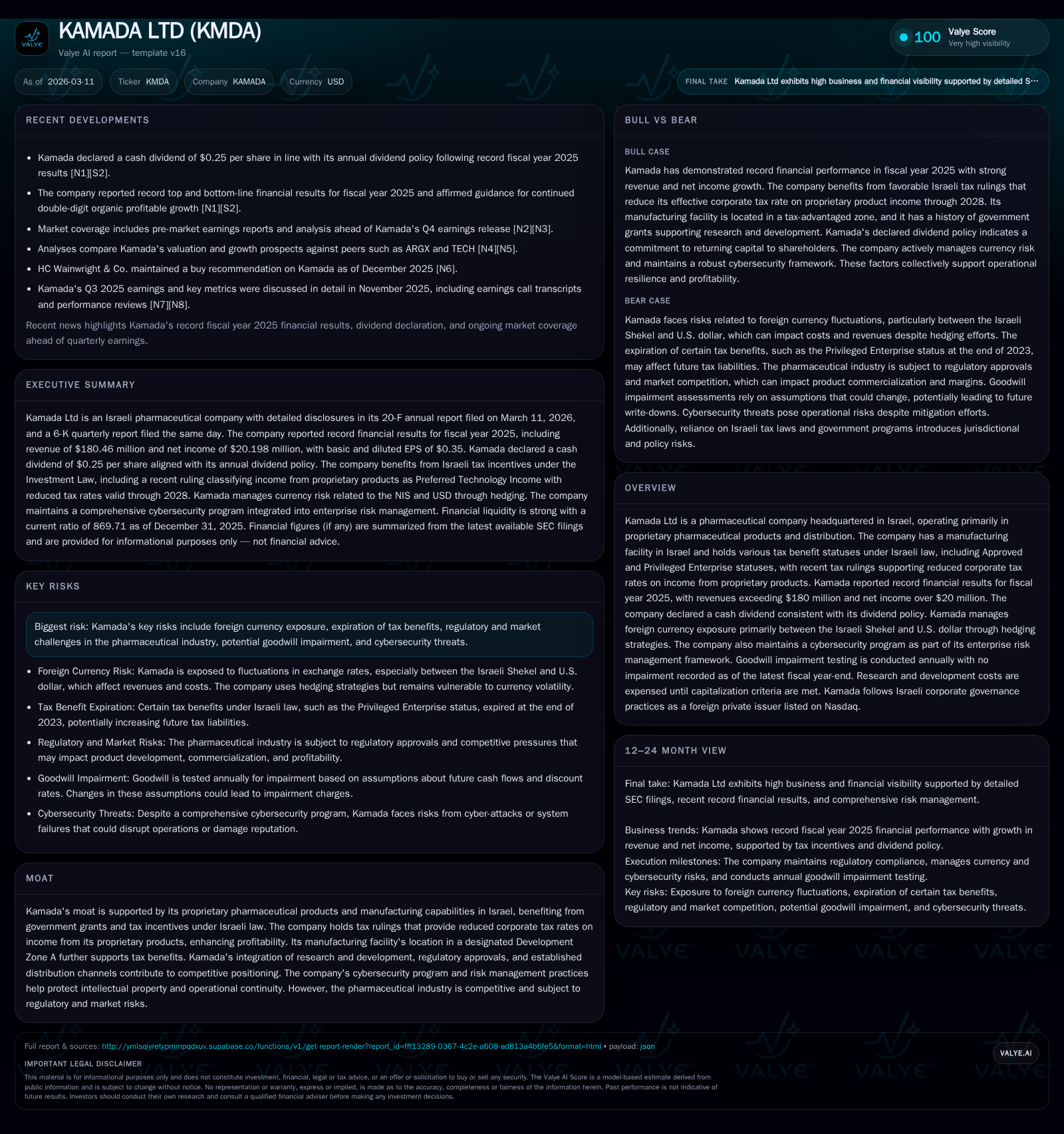
Kamada Ltd reported record fiscal year 2025 results with revenues surpassing $180 million and net income exceeding $20 million, reflecting strong organic growth in proprietary pharmaceuticals. The company benefits from strategic tax rulings and Development Zone status in Israel that enhance its effective tax rate on proprietary product income. Forward growth hinges on continued innovation, regulatory approvals, and global distribution expansion, though foreign currency volatility and expiration of tax benefits pose risks. Kamada maintains a solid capital structure with healthy cash balances, a consistent dividend policy, and no share repurchases during 2025.
Overview and Historical Performance
Kamada Ltd is an Israel-headquartered pharmaceutical entity specializing in proprietary pharmaceutical products alongside distribution activities. The company operates an in-house manufacturing facility strategically located within Israel's Development Zone A, which supports various tax benefits under Israeli law.
The fiscal year ended December 31, 2025, marked a record financial performance for Kamada. Reported revenue reached $180.46 million—up 12.1% from $160.95 million in fiscal 2024—and net income rose markedly by almost 40%, hitting $20.2 million [F1]. This improvement reflects robust organic growth primarily led by the Proprietary Products segment.
Historical performance (annual)
| FY | Rev ($mm) | Net ($mm) | Rev YoY | Net YoY |
|---|---|---|---|---|
| 2025 | 180 | 20 | +12.1% | +39.7% |
| 2024 | 161 | 14 | +12.9% | +74.6% |
| 2023 | 143 | 8 | +10.2% | +456.9% |
| 2022 | 129 | -2 |
Source: SEC companyfacts cache [F1].
Capital returns and efficiency (annual)
| FY | ROE% |
|---|---|
| 2025 | 7.5 |
| 2024 | 5.6 |
| 2023 | 3.4 |
| 2022 | -1.3 |
Source: SEC companyfacts cache [F1].
These results underscore Kamada's ability to expand its market presence while managing cost efficiencies effectively.
Proprietary Products Segment as Growth Driver
Kamada's moat stems primarily from its portfolio of proprietary pharmaceutical products complemented by integrated manufacturing capabilities . Its manufacturing base in Israel coupled with Approved and Privileged Enterprise statuses grants access to reduced corporate tax rates under Israeli law—a structural advantage enhancing net profitability [S1]. The company's Development Zone A classification further supports these favorable incentives.
Goodwill accounting attributes roughly $30.3 million to this segment, which was tested annually for impairment at December 31, 2025; fair value surpassed carrying amount by around 40%, indicating solid intrinsic value expectations [S4][S13].
Investment in research and development remains pivotal for sustainment of pipeline innovation with R&D costs mainly expensed as incurred unless capitalized upon meeting strict feasibility criteria such as technological viability and market potential [S5]. Expansion plans also include scaling manufacturing capacity aligned with expected demand growth and industry trends [S6].
Capital Allocation & Returns
As of December 31, 2025, Kamada held cash and equivalents totaling approximately $75.47 million [F1], providing ample liquidity to fund operations or invest strategically without relying heavily on external financing. The balance sheet reflects prudent management with current assets dwarfing current liabilities—resulting in an exceptionally high current ratio—highlighting near-term solvency strength.
In March 2026, Kamada declared a cash dividend of $0.25 per share consistent with its adopted annual dividend policy signaling a commitment to returning capital to shareholders while balancing reinvestment needs [N1][S2][S7]. There were no share repurchases during the fiscal year ended December 31, 2025 [S16], indicating retention of equity capital for operational resilience or future strategic use.
The company’s approximate return on equity of roughly 7.5% signifies moderate profitability given the sector’s capital intensity [F1]. Free cash flow specifics were not disclosed explicitly but net income growth alongside sound working capital management suggests positive cash generation trends.
Foreign Exchange Exposure & Risk Management
A notable operational risk is currency exchange volatility between the Israeli Shekel (NIS) and U.S. dollar due to the company's revenue base partially denominated in U.S. dollars while incurring expenses in NIS or Euros depending on product sourcing [S8][S11]. For fiscal years ending December 31 from 2023 through 2025 there was significant exchange rate fluctuation culminating in a -12.5% change against USD in 2025 alone impacting reported earnings and asset valuations.
Kamada actively employs hedging strategies via derivatives and forward contracts designed to align payment timing and currency exposures minimizing translation impacts [S11]. Mitigation efforts include matching Euro denominated revenues against Euro expenses within its Distribution segment.
Industry Risks & Cybersecurity Measures
The pharmaceutical sector imposes inherent challenges including regulatory approvals uncertainty, competition pressures, potential loss of patent exclusivity or market pricing constraints . Additionally Kamada acknowledges risks including expiration of its tax incentive statuses which could materially affect effective tax rates going forward [S9].
Cybersecurity forms an integral component of enterprise risk control frameworks due to threats potentially affecting production continuity or intellectual property protection [S17]. Kamada implements layered defenses via firewalls, IDS/IPS systems alongside continuous vulnerability assessments coupled with employee awareness training programs emphasizing threat vigilance.
Future Outlook & Milestones to Watch
Kamada affirmed guidance for continued double-digit organic profitable growth into fiscal year 2026 without issuing detailed numeric targets at this stage [N2][S2]. Key drivers will hinge on:
- Successful progression and regulatory clearance of late-stage proprietary drug candidates;
- Expansion of geographically diverse distribution partnerships enhancing global market penetration;
- Sustained advantage through Israeli governmental incentives contingent upon compliance;
- Managing foreign exchange volatility effectively;
- Maintaining operating leverage benefiting from scalable manufacturing infrastructure.
Monitoring quarterly sales trajectory within the Proprietary Products segment alongside R&D milestones will be critical indicators of sustainable growth momentum.
Corporate Governance & Regulatory Compliance
As a foreign private issuer listed on Nasdaq but domiciled in Israel Kamada follows home country governance practices which do not fully mirror U.S domestic corporate governance requirements [S15]. Shareholder protections thus differ marginally compared to typical U.S.-based listed peers including quorum thresholds during meetings.
Moreover the company complies fully with Israeli Companies Law governance obligations enforced upon publicly listed entities including policies governing director nominations & insider trading practices ensuring transparent oversight mechanisms exist [S15][S20].
Summary
Kamada Ltd’s latest fiscal performance emphasizes reinforcing organic growth underpinned by proprietary pharmaceutical innovations delivered through an Israeli located manufacturing hub benefiting from attractive state-sponsored tax regimes. Profitability has accelerated strongly driven by higher revenues combined with disciplined capital allocation characterized by steady dividends and absence of share buybacks during FY25 despite record earnings levels.
Operational risks relating mainly to forex exposure require continuous monitoring while cybersecurity presents ongoing challenges addressed via mature risk mitigation systems integrated within broader enterprise risk management frameworks.
Future success substantially depends on regulatory outcomes associated with developmental pipelines alongside continuation of beneficial fiscal treatment under Israeli law amidst evolving macroeconomic pressures.
This analysis is based solely on information available as of March 11, 2026 ([F1],,) without any financial or investment advice intended or implied.
Disclaimer: This is research-only, informational analysis and not investment advice. It may include AI-generated interpretation and general industry context. Always verify important details using primary sources.

Comments