
Marvell Technology’s Transition to AI and Photonics Fuels Revenue and Profit Surge
Strategic acquisitions and divestitures reshape Marvell’s semiconductor portfolio amid growing data center demand.
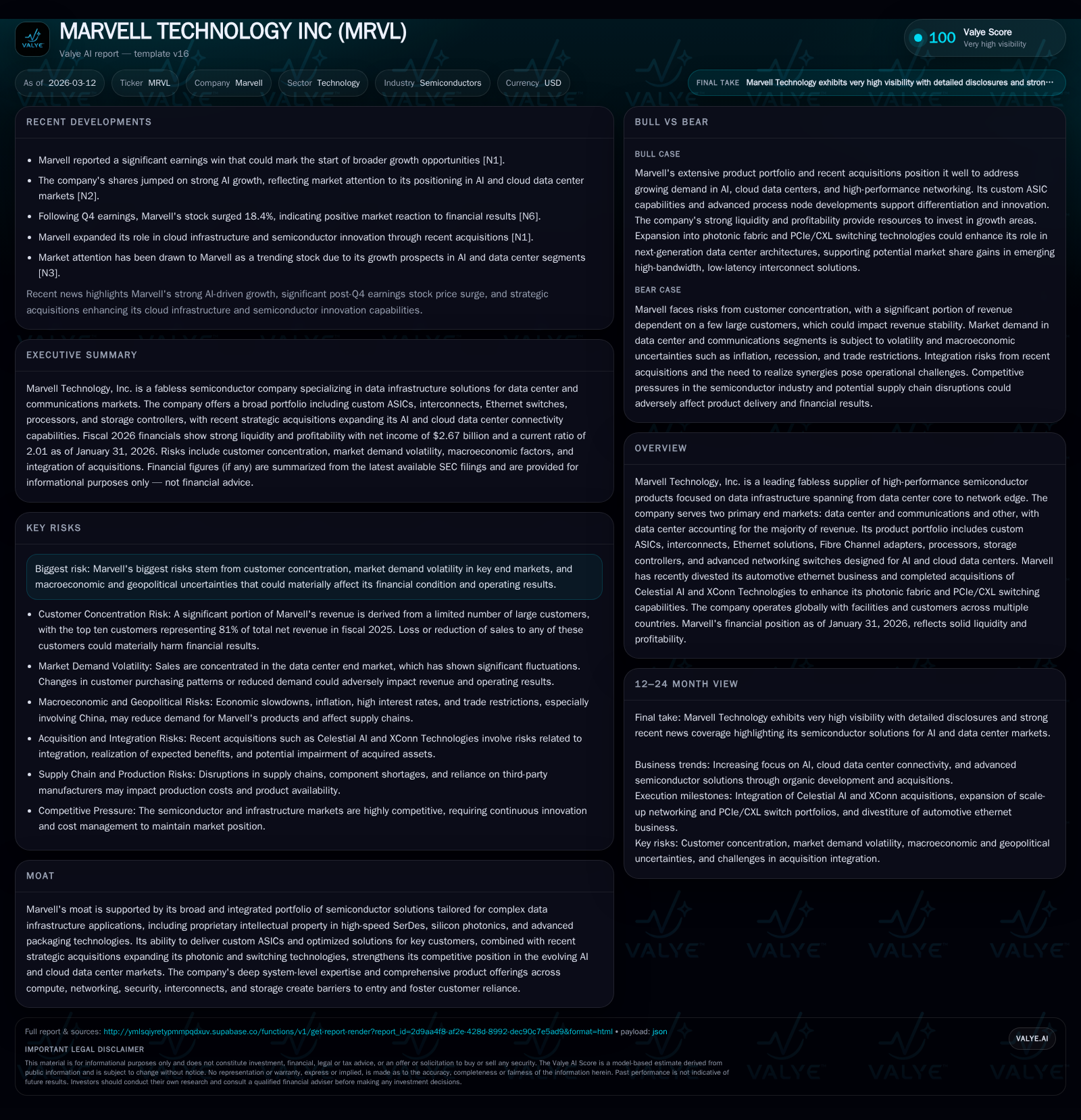
Marvell Technology has demonstrated a strong financial turnaround in fiscal 2026, driven primarily by growth in its data center segment and strategic portfolio realignment. Divesting its automotive ethernet business while acquiring Celestial AI and XConn Technologies bolsters its photonic fabric and PCIe/CXL switching capabilities, aligning with evolving AI and cloud infrastructure needs. Despite concentration risks and macroeconomic headwinds, the company’s expanding semiconductor solutions for complex data infrastructure supported significant revenue and profit gains in FY2026.
Historical Performance and Financial Trends
Marvell Technology reversed a multi-year profitability slump with fiscal 2026 results that demonstrated considerable top-line growth alongside a dramatic jump in operating income. Total net revenues rose to approximately $8.19 billion for the twelve months ended January 31, 2026, up from $5.77 billion in FY2025 — representing a nearly 42% year-over-year increase driven primarily by expansion in its data center business segment which accounted for roughly three quarters (74%) of revenue during FY2026 [F1][S10].
Operating income swung sharply positive to $1.32 billion from negative operating results in the prior two years (-$720 million in FY2025 and -$568 million in FY2024), underscoring an improvement measured not just by scale but also enhanced product mix and cost control measures [F1]. Net income similarly turned positive reaching $2.67 billion for FY2026, boosted by a pre-tax gain totaling approximately $1.8 billion recorded on the August 2025 sale of the automotive ethernet business to Infineon Technologies AG [S1][S7]. This divestiture reshaped Marvell's portfolio focus while providing financial flexibility.
Operating cash flow has shown steady growth over recent years, hitting $1.75 billion in FY2026 (+4.1% YoY), facilitating increased capital expenditures of $354 million invested mainly toward innovation and capacity enhancements [F1]. The company returned capital aggressively through shareholder distributions with dividends around $205 million annually coupled with buybacks scaling up markedly to over $2 billion in FY2026 compared to just $725 million the prior year, reflecting confidence supported by cash generation [F1].
Historical performance (annual)
| FY | Net ($bn) | CFO ($mm) | OpInc ($mm) | Capex ($mm) | Net YoY |
|---|---|---|---|---|---|
| 2026 | 2.7 | 1751 | 1323 | 354 | +401.7% |
| 2025 | -0.9 | 1681 | -720 | 285 | +5.2% |
| 2024 | -0.9 | 1371 | -568 | 336 | -470.9% |
| 2023 | -0.2 | 1289 | 238 | 206 |
Source: SEC companyfacts cache [F1].
Capital returns and efficiency (annual)
| FY | Div ($mm) | Buybacks ($bn) | FCF ($mm) |
|---|---|---|---|
| 2026 | 205 | 2.0 | 1396 |
| 2025 | 208 | 0.7 | 1397 |
| 2024 | 207 | 0.1 | 1034 |
| 2023 | 204 | 0.1 | 1083 |
Source: SEC companyfacts cache [F1].
Revenue reflects consolidated results; growth rates compare current fiscal year against prior.
Business Model Evolution and Product Portfolio
Marvell operates as a fabless semiconductor supplier focused on data infrastructure spanning data center cores through network edges [S7][S10]. Its portfolio integrates analog, mixed-signal, digital processing components alongside proprietary firmware to serve compute, networking, security, interconnects, and storage applications.
The company emphasizes custom ASICs tailored for specific customer requirements that deliver system-level differentiation suited for next-generation AI models and cloud workloads [S7][S10]. It offers Ethernet solutions, Fibre Channel adapters, processors, storage controllers, and is expanding into emerging scale-up AI interconnect technologies with Ultra Accelerator Link TM switches [S7][N1].
Post-fiscal year-end acquisitions include Celestial AI with Photonic Fabric TM technology designed for optical interconnect acceleration at scale, enhancing bandwidth-density-power efficiency; and XConn Technologies Holdings providing advanced PCIe and CXL switching silicon that augments Marvell's switch portfolio toward heterogeneous compute architectures [S1][S3]. These moves strengthen Marvell's position in silicon photonics and advanced switching fabrics crucial for high-performance AI workloads.
Milestones and Expectations
Key milestones include the successful integration of Celestial AI's photonic technology into scalable commercial products aimed at next-generation AI data centers [N1][N5]. The ramp-up of XConn's PCIe/CXL switch platforms is expected to enhance Marvell's leadership in scale-up switching solutions tailored for demanding AI workloads [N3][N9].
Looking forward, growth prospects hinge on expanding market penetration within accelerating AI/cloud infrastructure segments driven by global digitization trends, hyperscale data center investments, and adoption of cutting-edge technologies like silicon photonics [N1][N5][S22].
Risks persist around customer concentration—with two customers contributing more than 20% of total revenue and the top ten accounting for over 80%—and macroeconomic uncertainties including inflationary pressures, geopolitical trade restrictions especially involving China that could impact demand or supply chains [S4][S6][S24]. Competitive pressures from established semiconductor firms with greater resources as well as hyperscale operators developing internal silicon solutions also represent challenges to sustained design wins [S6][S22].
Returns and Capital Allocation
Marvell achieved an approximate return on equity near 18.7% reflecting its profitability recovery after several years of losses prior to fiscal year ended January 31 2026 [F1]. Liquidity remains strong with cash & equivalents totaling approximately $2.64 billion and a current ratio above twofold as of January 31 2026 supporting operational flexibility [F1][S15].
Capital deployment prioritized shareholder returns through significant share repurchases totaling about $2.04 billion alongside dividends near $205 million annually [F1]. Capital expenditures increased modestly to support innovation initiatives aligned with growth strategies.
The company maintains an undrawn revolving credit facility capped at $1.5 billion providing financial optionality without immediate debt burdens [S15][S17].
Competitive Positioning and Risks
Marvell's competitive advantages derive from its extensive intellectual property portfolio including high-speed SerDes technologies essential for high-bandwidth interconnects along with proprietary packaging innovations [S16]. Its growing expertise in silicon photonics further differentiates it within the semiconductor industry.
Challenges include intense competition from large global semiconductor firms often possessing fabrication capabilities offering vertical integration advantages; industry consolidation altering supplier landscapes; evolving customer strategies favoring internal silicon development potentially limiting addressable markets; regulatory uncertainties especially export controls impacting sales into China; pricing pressures amid inflationary input cost increases; supply chain constraints; plus ongoing intellectual property litigation risks common within the sector [S16][S20][S21][S27][S28][S8][S9].
Summary Considerations Moving Forward
Key indicators to monitor include quarterly revenue trends by end market emphasizing traction in AI-specific products; margin stability amidst product mix shifts; progress on post-acquisition integration particularly regarding photonic/PCIe-CXL solutions; cash flow sustainability balanced against acquisition-related spending; customer design win announcements among hyperscalers; macroeconomic factors affecting capital expenditure appetite; plus regulatory developments shaping trade access.
Overall, Marvell presents as a company successfully reshaping its portfolio towards fast-growing high-performance computing niches while delivering improved financial outcomes supported by strategic foresight encompassing emerging technologies such as silicon photonics.
This analysis is based on publicly available company filings covering fiscal periods up to January 31 2026 including the Form 10-K filed March 11 2026 as well as relevant news sources cited herein emitting no investment advice or recommendations but intended solely for informational purposes.
Disclaimer: This is research-only, informational analysis and not investment advice. It may include AI-generated interpretation and general industry context. Always verify important details using primary sources.

Comments