
Vista Gold Corp's Mt Todd Project: From Feasibility Milestones to Funding Challenges
Vista Gold's transition from feasibility completion to project development underscores critical financial dynamics and strategic funding imperatives.
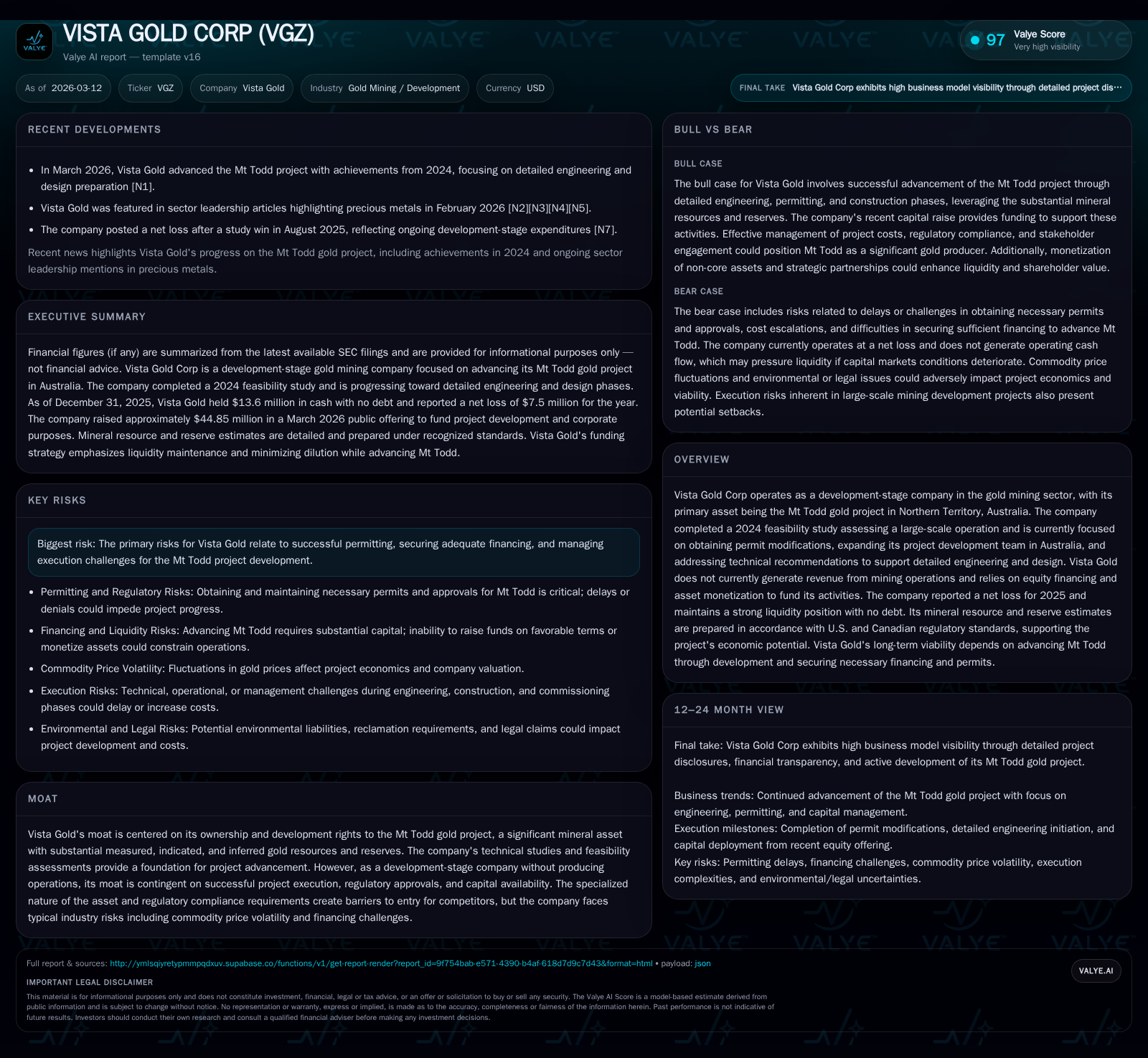
Vista Gold Corp remains a pure development-stage gold company focused solely on its Mt Todd project, which registered significant technical progress with a 2024 feasibility study finalized. Despite no mining revenue, the company recorded a 2025 net loss of $7.5M driven by elevated exploration and feasibility expenses, yet sustains strong liquidity supported by a recent $44.85M equity raise. The pathway toward detailed engineering in 2027 depends heavily on securing permit modifications and managing execution risks amid volatile commodity markets and capital demands. While short-term cash flow trends show increased outflows tied to study expenditures, ongoing capital allocation emphasizes prudent balancing of dilution risk and project advancement.
Historical Financial Profile and Operational Overview
Since acquiring its flagship Mt Todd gold project in Northern Territory, Australia in 2006, Vista Gold Corp has consistently operated as a development-stage entity without commercial mining revenue [S1], [F1]. The company reported no revenues between FY2015 and FY2025 per financial data [F1]. A notable swing is observed in net income wherein Vista generated $11.25M net income in FY2024 largely due to a one-time gain on granting royalty interests totaling roughly $16.9M recognized that year [S1], whereas FY2025 posted a net loss of $7.5M predominantly arising from increased exploration activities and feasibility study expenses without offsetting economic gains [S1], [F1]. Operating loss deepened to approximately $9.3M in FY2025 from an operating profit of $10.5M in FY2024 (reflecting the royalty gain inclusion) [F1].
The cash position contracted moderately from $17M at end-2024 to $13.6M at end-2025 while maintaining zero debt levels – reinforcing the company's low leverage but reliance on equity funding [F1], [S4]. Working capital declined commensurately reflecting ongoing expenditures related to advancing Mt Todd development [F1]. Exploration, evaluation, and holding costs rose sharply to $5.6M in FY2025 compared to $3.5M prior year — underlining intensifying technical efforts [S1]. Corporate administration costs were stable around $3.6M annually with non-cash stock compensation constituting nearly half a million USD each year [S1]. This expenditure profile establishes a foundation where operational losses primarily represent investments into property rights preservation, regulatory compliance, and preparatory activities rather than recurring operational deficits.
Historical performance (annual)
| FY | Net ($mm) | CFO ($mm) | OpInc ($mm) | Capex ($) | Net YoY |
|---|---|---|---|---|---|
| 2025 | -7 | -7 | -9 | 592000 | -166.7% |
| 2024 | 11 | -6 | 11 | 344000 | +270.8% |
| 2023 | -7 | -6 | 51000 | -33.5% | |
| 2022 | -5 | -7 | 5000 |
Source: SEC companyfacts cache [F1].
Capital returns and efficiency (annual)
| FY | FCF ($mm) | ROE% |
|---|---|---|
| 2025 | -7 | -49.6 |
| 2024 | -6 | 62.8 |
| 2023 | -6 | -133.0 |
| 2022 | -7 | -49.2 |
Source: SEC companyfacts cache [F1].
Data reflects absence of mining revenue; stark swings driven by royalty gains/losses and capitalization policies [F1].
Progression of Mt Todd Project Development and Feasibility Study Updates
In July 2025, Vista completed an updated S-K 1300 technical report alongside a NI 43-101 companion report for the Mt Todd project based on a rigorous feasibility study conducted throughout 2024 [S1], [N1]. This new feasibility study assessed increasing the scale significantly to a nominal throughput capacity of approximately 50 ktonnes per day or nearly 17.75 million tonnes annually—marking a strategic pivot from previous smaller-scale assessments [N1], [S1].
The rigor applied under U.S. SEC Regulation S-K Item 1300 combined with Canadian NI 43-101 standards strengthens Vista's position by providing regulatory-compliant mineral reserve estimates critical for raising capital and negotiating permits [S1]. Deliverables from this FS include detailed metallurgical testing results refining grind size assumptions and recovery projections which form vital inputs for next-phase engineering design.
Following the FS conclusion, management is directing focus towards establishing the groundwork for detailed engineering targeted for initiation in early calendar year 2027. This marks progression beyond conceptual studies into systematic design engineering necessary before construction mobilization can begin [N1], [S1].
Navigating Regulatory Approvals and Permit Modifications
Crucial bridgework remains securing permit modifications aligned with the updated parameters defined by the FS outcome which reflect expanded throughput rates and environmental safeguards mandated by Northern Territory authorities [N1], [S1]. Vista reports active engagement with Australian consultants, regulators including Department of Industry, Tourism & Trade (DITT), local stakeholders plus Indigenous groups as part of their compliance strategy integral to permitting success.
Some modification applications have already been submitted with others scheduled imminently alongside supporting programs such as environmental baseline studies which commenced following FS completion [N1]. Approval timelines are conservatively anticipated during calendar year 2027 coincident with planned detailed engineering start—highlighting synchronized gating between regulatory and technical milestones typical of large-scale gold project developments [N1], [S1].
Such regulatory complexity underscores Vista’s moat as it imposes barriers to entry given geographic specificity coupled with evolving environmental governance protocols affecting site expansion plans.
Capital Raising, Liquidity Position, and Financing Strategy
Funding requirements underpinning near-term development are being met via proactive equity issuances complemented by ongoing monetization of non-core assets including royalties over U.S., Canadian properties plus sale of legacy mill equipment marketed through third parties [S4],[S5],[N1].
Most notably on March 9th, 2026—the company closed an underwritten public offering generating gross proceeds of approximately $44.85 million at ~$2.50 per share before fees yielding net proceeds approximating $41.9 million intended explicitly for advancing exploration/development workflows at Mt Todd along with corporate uses including working capital enhancement [S1],[S4],[S26].
This sizable liquidity injection follows incremental receipts from an at-the-market equity program during FY2025 amounting to net proceeds around $4.3 million plus residual royalty inflows totaling approximately $17 million booked mostly in earlier years but positioning liquidity conservatively forward-looking into FY2026 beyond baseline commitments [S4],[S5],[F1].
Maintaining zero debt distinguishes Vista amid sector peers often leveraging aggressively since no major recurring revenues exist; thus equity issuance dilutes shareholders but preserves flexibility essential during permitting phases where covenant burdens can hinder agility [S4],[N1].
Analyzing Financial and Operating Cash Flow Trends
Vista's operating cash flow outlays expanded modestly by about 15% year-over-year reaching negative $6.6 million by December 31, 2025—costs elevated due partly to treatment of the FS expenditures as operating expenses rather than capitalization as had been done previously for drilling campaigns that shifted mostly into investing cash flows in fiscal year prior [F1],[S6],[S11].
Capital expenditures also increased materially by roughly +72% rising to nearly $592K largely reflecting plant additions such as installation of an enhanced evaporation system improving site infrastructure robustness ahead of major construction activities anticipated post-detailed engineering phase [F1],[S6],[N1].
Furthermore, capitalization policies distinguish drilling related directly to proven/probable mineral reserves that get capitalized while exploration drilling continues expensed causing variability in cash flow classification impacting free cash flow analysis which remains negative near -$7.2 million after accounting for capex implying continued reliance on financing until positive operating leverage emerges at production ramp-up stages downstream [F1],[S6],[S11].
Outlook on Project Execution Timeline and Milestones
Vista Gold projects sequential milestones starting with securing permit modifications targeted for approval within calendar year ending late-2027 followed immediately by commencement of detailed engineering & design phases scheduled early that year marking transition toward physical construction readiness requiring approximately 27 months’ duration encompassing plant erection through commissioning leading into commercial production onset likely no earlier than late-2029 or early-2030 assuming no delays emerge from permitting or financing bottlenecks [N1],[S1].
Key developments warrant close monitoring include regulator feedback speed post-application filings; corporate capability expansions within Australian headquarters augmenting local management depth poised for construction oversight; metallurgical testing validation outcomes confirming grind size/recovery assumptions embedded within FS; plus securing supplementary financing should capital demands exceed current plan scope—all pivotal factors conditioning timely delivery against sector-average timelines commonly challenged by logistic or environmental constraints peculiar to Northern Australia jurisdictional contexts.
Risks Pertaining to Project Execution, Commodity Price Volatility, and Financing
Vista’s risks remain archetypical yet distinctly amplified due to sole reliance on one asset—Mt Todd—mandating flawless regulatory navigation amidst stringent environmental laws increasingly emphasizing indigenous land impact mitigation elevating geopolitical permitting risks within Northern Territory jurisdictional fabric compounded by recent penalties paid related to sacred sites infringements in minor past drilling suggesting reputational sensitivity exists if compliance missteps reoccur [S12],[N1].
Financing risk surfaces given ongoing need for equity infusions absent operating cash generation necessitating continual shareholder dilution while commodity price volatility influences projected project net present values translating gold bullion price shifts directly into margins challenging internal return projections embedded within capital budgeting frameworks driving strategic decisions whether to proceed or pause based on precious metal market cycles plus input cost inflation exposures typical across mining supply chains since macroeconomic uncertainty can delay bids or increase required contingency funding.
Execution complexities include scaling processing equipment aligned exactly with FS assumptions whilst ensuring schedule adherence over multi-year horizon saddled by labor market tightness unique to remote locations alongside subcontractor dependencies introducing potential cost overruns or time slippage jeopardizing value realization timing across shareholders’ investment horizon thereby underscoring need for meticulous project controls deployed comprehensively upfront mitigating common project overruns documented across medium-to-large gold developments globally.
Implications of Capital Deployment on Shareholder Returns
Today's financial snapshot reveals zero revenue generation producing no direct margin contribution thus ROE registers negatively at about -50% given persistent net losses relative to book equity approximating $15 million—reflecting typical pre-operating stage balance sheets dominated by capitalized mineral properties awaiting conversion into producing assets generating earnings streams eventually repaying invested shareholder capital over decades-long project lives consistent with gold industry norms subject to geological subtraction rates versus reserve conversion cycles witnessed broadly across peer mid-tier producers globally [F1],[S19].
Further compounding shareholder return constraints is absence of dividends or share repurchases matched logically with an early-stage growth profile mandating retention of all excess cash flows toward sustaining exploration/feasibility/development priorities while careful communication addressing dilution risk from frequent financings becomes vital signaling management’s intent aligning investor patience expectations appropriately against uncertain timing until production commencement unlocks operating free cash flows thereby enabling future distributions potentially contingent on successful mine ramp-ups coupled with stable market fundamentals fostering reinvestment capacity.
This analysis synthesizes publicly available financial statements and disclosures provided by Vista Gold Corp through SEC filings and recent news releases as of March 12th, 2026. It is intended solely for informational purposes without providing investment advice or recommendations. Readers should consider seeking independent professional guidance when evaluating any company's securities or financial prospects.
Disclaimer: This is research-only, informational analysis and not investment advice. It may include AI-generated interpretation and general industry context. Always verify important details using primary sources.

Comments