
LCNB CORP’s Capital Allocation and Risk Management in a Transforming Financial Landscape
LCNB CORP’s financial statements reveal a complex interaction between acquisition-fueled intangibles, cash flow dynamics, and capital deployment strategies in 2025.
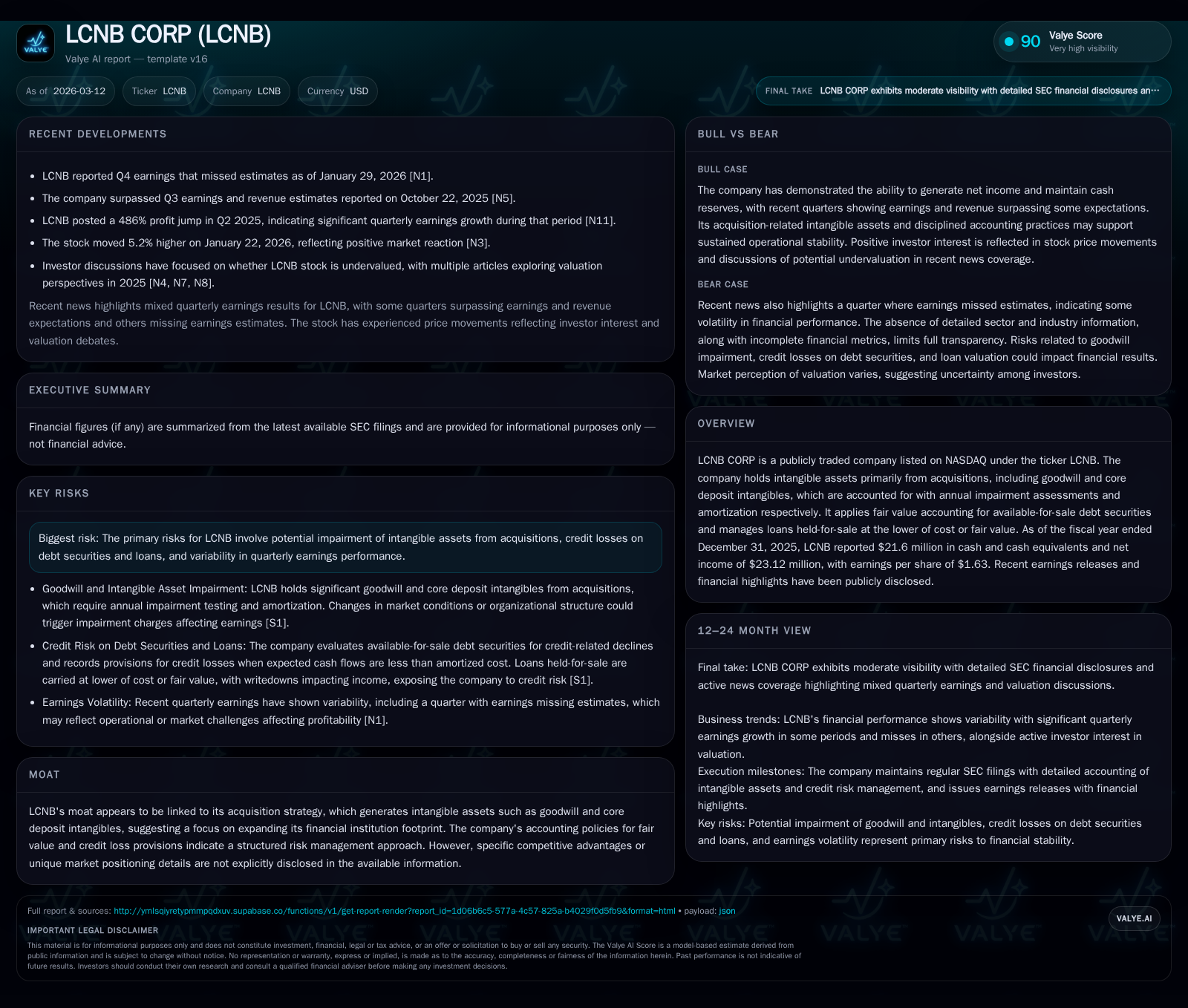
LCNB CORP posted a significant 71.4% increase in net income for fiscal 2025, reaching $23.12 million despite subdued top-line revenue and a steep decline in operating cash flow. This earnings surge is closely tied to acquisition-related intangible asset accounting, including goodwill and core deposit intangibles subject to amortization and impairment tests. The company's disciplined approach to fair value measurements on debt securities and loans held-for-sale adds volatility but reflects a conservative risk posture. Capital allocation exhibits steady dividend payouts with a shift away from buybacks, supported by strong free cash flow generation and an approximate 8.4% return on equity. Emerging risks center on potential impairments of intangible assets and credit losses amid market fluctuations. Analysts should monitor intangible asset health metrics, loan sale trends, and cash flow consistency for insight into future earnings quality.
A Leap in Profitability: Dissecting LCNB’s Net Income Growth in 2025
LCNB CORP exhibited a startling upturn in net income for the fiscal year ending December 31, 2025, reporting $23.12 million compared with $13.49 million the prior year—a year-over-year increase exceeding 70% [F1]. This jump stands out notably against virtually stagnant revenue levels; no material top-line growth is documented since available data shows consistent revenues around $6.45 million from prior years [F1], indicating that bottom-line expansion stems less from operational scaling than from margin improvements or accounting effects related to acquisitions.
One plausible explanation resides within acquisition-related accounting treatments, detailed further below, which can introduce significant non-cash components elevating reported earnings without parallel cash inflows. Operating cash flow (CFO), conversely, plunged by over 60% from about $93 million in FY2024 to $34.4 million in FY2025 [F1], underscoring this disconnect between reported profitability and cash realization.
The company’s quarterly earnings release in January 2026 confirmed these dynamics but also highlighted some reader caution as fourth-quarter results missed analyst estimates [N1], reflecting intrinsic volatility possibly linked to fair value adjustments or loan sale valuations.
Acquisition Assets Under the Microscope: Goodwill and Core Deposit Intangibles
LCNB’s financial profile is shaped profoundly by its acquisition strategy that drives concentrations of intangible assets comprising goodwill and core deposit intangibles [S1][S5]. At acquisition dates, all assets and liabilities are assigned fair values through approaches such as discounted cash flow analyses or market comparables—sometimes relying on management’s internal valuations or external valuation specialists when appropriate [S1].
Goodwill represents the purchase price excess over assigned fair values; this intangible is subject to annual impairment testing at minimum and more frequent assessments should 'triggering events' arise—such as adverse economic shifts or operational restructurings—which could mandate write-downs hitting earnings directly [S1][S5]. Core deposit intangibles carry straight-line amortization over their estimated life spans but similarly require management to consider whether impairment indicators warrant revising useful lives or carrying amounts downward.
This reliance on judgment-laden estimates embeds risk into reported earnings quality: an impairment loss could abruptly erode reserves or inflate reported expenses if market conditions deteriorate.
Fair Value Accounting and Credit Risk: Impact on LCNB's Securities Portfolio
LCNB classifies certain debt securities as available-for-sale (AFS), valuing them at fair market prices with unrealized gains and losses flowing through other comprehensive income (OCI), net of tax [S1][S4][S5]. However, when securities' market values decline below amortized cost basis, the firm evaluates intent to sell or necessity of disposal before cost recovery; if either criterion applies, an immediate write-down through net income occurs.
Absent intent/requirement-to-sell indications, management probes whether the drop stems from credit events—considering severity of decline versus amortized cost, credit rating downgrades by recognized agencies, and issuer-specific adverse conditions [S4]. Present value calculations of expected cash flows support measurement of impairment allowances affecting the allowance for credit losses accounts.
This methodological rigor ensures rapid identification of credit deterioration but elevates quarter-to-quarter earnings volatility since provisions may fluctuate markedly based on evolving market perceptions.
Liquidity and Capital Structure: Navigating Debt and Cash Holdings
At fiscal year-end 2025, LCNB maintained a robust liquidity position with roughly $21.6 million in cash and cash equivalents [F1], reflecting healthy buffers for operating needs. Capital structure disclosures affirm compliance with applicable regulatory standards governing lending ratios and equity cushion requirements without signaling excessive leverage or liquidity strain [S4][S6].
The firm’s balance sheet reflects an equity base approaching $274 million by end-2025 [F1], supporting solvency amidst operational variability. No notable issuance of debt instruments nor material shifts in capital obligations emerge from filings during this period.
Loans Held-for-Sale: Strategies Affecting Non-Interest Income Volatility
Loans classified as held-for-sale (LHFS) relate predominantly to residential mortgages destined for secondary markets alongside other loans management plans actively to divest [S1][S4]. These loans carry at the lower-of-cost-or-fair-value on an aggregate basis by loan category.
Any initial writedown realized upon transfer reduces loan charge-offs immediately; subsequent reductions feed into non-interest income income lines while appreciation over cost basis remains unrecognized until final sale completion [S1]. Such accounting treatment produces sensitivity of non-interest revenues to secondary market pricing fluctuations—a common challenge for banks managing loan sale inventories—as realized gains/losses contribute materially yet variably each period.
This approach aligns with sector practices emphasizing cautious recognition policies that mitigate premature profit booking but introduce quarter-specific non-operating income volatility.
Track Record of Capital Allocation: Dividends, Buybacks, and Reinforcement of Equity
LCNB’s capital return profile evidences consistent dividend payouts growing modestly to approximately $12.47 million in FY2025 from prior years ($12.2M in FY2024) [F1], signaling stable commitment toward shareholder distributions.
Share repurchases have notably waned post-2023 levels ($3.33 million) after historically elevated levels (e.g., $23.66 million buybacks in FY2022) suggesting a strategic shift away from aggressive share buybacks toward internal equity fortification amidst market uncertainties [F1][S22].
Operating CFO exceeding capex substantially (FY2025 CFO $34.4M versus capex near $959K) yields abundant free cash flow ($33.4M), underpinning claimed dividend sustainability alongside internal reinvestment capacities [F1]. Furthermore, approximate ROE calculated at about 8.4% conforms with industry norms for mid-sized community banking institutions balancing growth ambitions against prudent risk appetites.
Emerging Risks from Impairments and Market Variability
A salient risk theme revolves around potential goodwill impairments tied to future macroeconomic upheavals or structural organizational changes that might trigger accelerated write-downs damaging reported results [S7][N1]. Similarly, credit losses arising from tightening allowances on debt securities or loans could pressure profitability given ongoing inflationary headwinds influencing borrower stress [S8].
Recent quarterly earnings disclosures reflect heightened performance swings attributable partly to these valuation methodologies alongside operational execution variances underscoring inherent volatility embedded within bank financial statements influenced by fair value accounting rules [N1].
What Comes Next: Metrics and Milestones to Monitor for LCNB
While explicit forward guidance is unavailable in filings or news releases [N1][S3], investors should focus on several key indicators under analysis:
- Trends reconciling operating CFO relative to net income capturing profit quality shifts post-acquisition activities;
- Impairment test outcomes communicated annually for goodwill/core deposits plus any mid-year triggering event updates;
- Movements within allowance for credit losses derived from securities portfolio reviews;
- LHFS balances alongside pricing realities impacting non-interest income reliability;
- Dividend policy continuity vis-à-vis free cash flow generation;
- Quarterly earnings variance patterns amid volatile credit markets. By integrating these metrics nuancedly within fundamental frameworks expect enhanced clarity on LCNB’s trajectory amid ongoing economic transformations.
Historical performance (annual)
| FY | Net ($mm) | CFO ($mm) | Capex ($mm) | Net YoY |
|---|---|---|---|---|
| 2025 | 23 | 34 | 1 | +71.4% |
| 2024 | 13 | 93 | 4 | +6.8% |
| 2023 | 13 | 21 | 3 | -42.9% |
| 2022 | 22 | 25 | 1 |
Source: SEC companyfacts cache [F1].
Capital returns and efficiency (annual)
| FY | Div ($mm) | Buybacks ($mm) | FCF ($mm) |
|---|---|---|---|
| 2025 | 12 | 33 | |
| 2024 | 12 | 89 | |
| 2023 | 10 | 3 | 18 |
| 2022 | 9 | 24 | 24 |
Source: SEC companyfacts cache [F1]. Table reflects selected financial metrics; revenue figures not disclosed explicitly beyond historical level.
Disclaimer: This report provides factual analysis strictly based upon disclosed financial information as of March 2026 without investment recommendations or speculative forecasts.
Disclaimer: This is research-only, informational analysis and not investment advice. It may include AI-generated interpretation and general industry context. Always verify important details using primary sources.

Comments