
CID Holdco’s Patented AI-Driven Asset Tracking Poised for Industrial Expansion
CID Holdco leverages patented RFID and AI technologies to drive growth across diverse industrial sectors despite significant financial and operational headwinds.
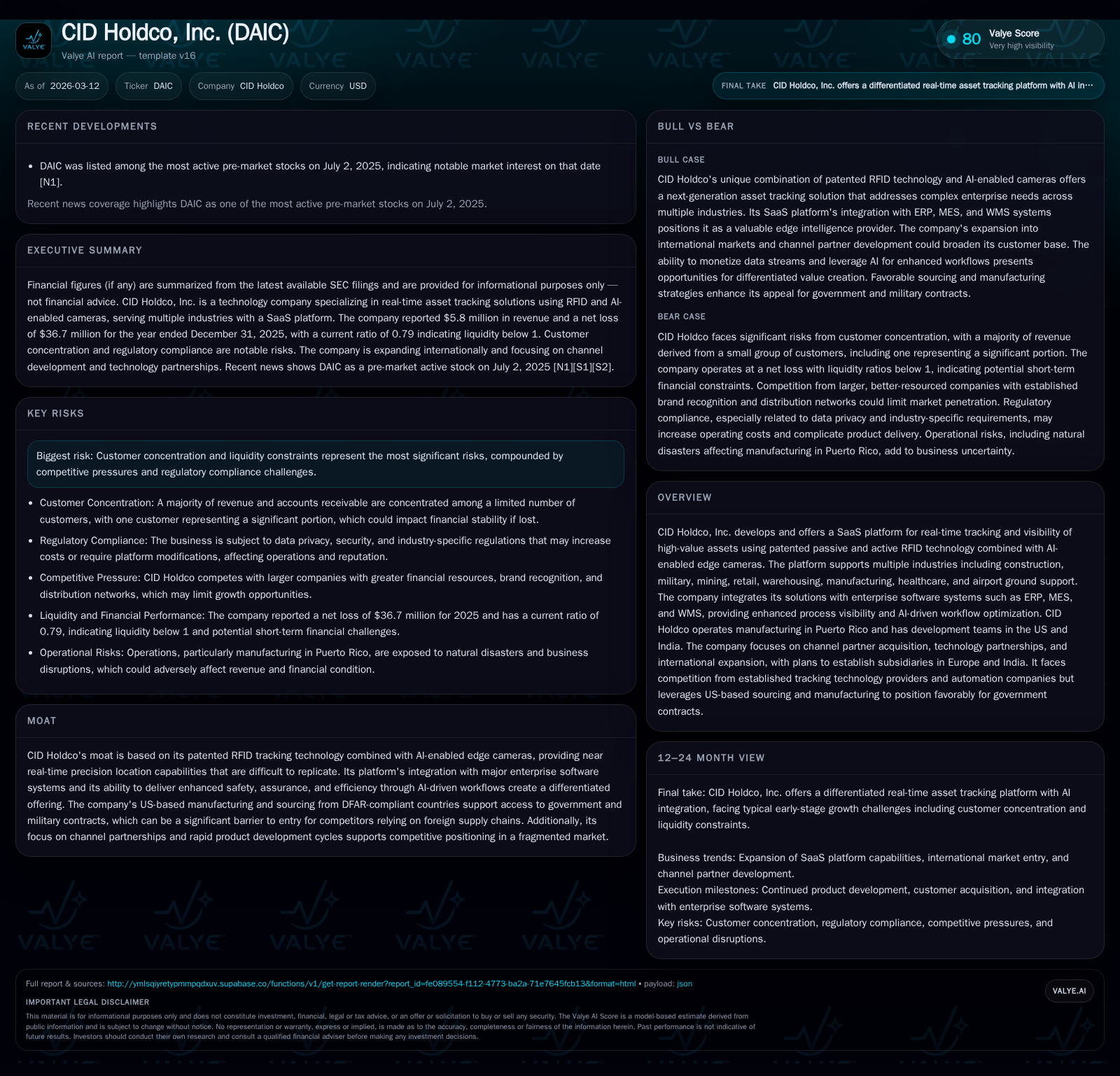
CID Holdco, a SaaS provider specializing in real-time tracking of high-value assets through proprietary passive and active RFID technology combined with AI-powered edge cameras, has demonstrated remarkable revenue growth largely driven by hardware sales. However, operating losses remain substantial amid cash flow constraints and liquidity challenges. The company’s competitive advantage lies in its patented technology, US-based manufacturing compliant with DFAR standards, and strong integration into enterprise systems. Expansion strategies emphasize channel partner networks and international footprint growth while risks include customer concentration, regulatory compliance, and internal control weaknesses.
Evolution of CID Holdco’s Growth: Historical Revenue Momentum vs. Rising Losses
CID Holdco’s fiscal 2025 marked an extraordinary revenue increase driven primarily by hardware sales that serve as the entry point for subscription SaaS platform adoption. Reported revenue grew over 3,200% year-over-year to approximately $5.8 million from under $180 thousand in 2024 [F1]. This surge reflects successful penetration into multiple end markets requiring asset visibility solutions—including construction, military, mining, retail, warehousing, and manufacturing sectors [S1][S5].
However, such growth has come at the cost of rising operating expenses outpacing top-line results. Operating loss widened significantly to just over $10.4 million in 2025 compared to prior year negative but smaller magnitude operating income [F1]. Net losses ballooned further to roughly $36.7 million attributable largely to non-cash charges such as fair value adjustments on SAFE notes plus operational expenditures [F1][S19]. As a result of heavy investment phase scale-up dynamics typical of emerging SaaS technology firms combining hardware components, CID exhibits a deeply negative return on equity roughly estimated at -15,333%, reflecting accumulated deficits more than 15 times shareholder equity value [F1].
Cash flow performance remains challenging; free cash flow was negative close to $13.9 million due mainly to operating cash outflows and ongoing capital expenditures focused on software development and machinery procurement needed for proprietary hardware production (detailed below) [F1][S21]. Working capital position is also strained with a current ratio dipping below unity at 0.79 indicating liabilities exceed readily available assets by approximately $1.7 million—highlighting liquidity constraints warranting proactive capital management strategies [F1][S7].
Historical performance (annual)
| FY |
|---|
| 2025 |
Source: SEC companyfacts cache [F1].
Note: Financials reflect annual periods ended December 31; revenue growth calculated from prior fiscal year.
Technological Differentiators Powering Industry Applications and Market Expansion
At the heart of CID Holdco’s offering is its patented combination of passive and active RFID tracking methodologies augmented by AI-powered edge camera systems—collectively enabling near real-time precision location capabilities seldom matched in the industrial IoT arena [S1]. This hybrid approach extends tracking accuracy into challenging environments where traditional GPS or barcode scanning falls short—critical for sectors like military logistics subject to stringent security standards or volatile mining sites.
The platform’s architecture supports seamless integration with widely-used enterprise systems including ERP (Enterprise Resource Planning), MES (Manufacturing Execution Systems), and WMS (Warehouse Management Systems). This interoperability allows customers not only to visualize asset flows but also to embed intelligent workflow automation within their existing digital infrastructures—delivering measurable efficiency gains and enhanced process safety assurances [S5].
Unlike competitors reliant upon foreign supply chains—particularly China or Taiwan-based sources—CID’s strategy includes manufacturing physical components at its Puerto Rico facility via Dot Works subsidiary while sourcing exclusively from Defense Federal Acquisition Regulation Supplement (DFAR) compliant countries. This positioning addresses critical security compliance requirements facilitating access to US government contracts often closed off to firms lacking such sourcing transparency or capability—a formidable barrier reducing threat from entrenched rivals like Zebra Technologies or other AutoID market incumbents focusing mainly on software or general hardware peripherals made overseas [S4][S6][S22].
Pathways and Barriers: Customer Acquisition, Channel Strategy, and International Growth
Growth plans revolve around expanding the footprint through rapid identification and onboarding of channel partners globally—leveraging the attractiveness of the patented technology coupled with an appealing commercial model that emphasizes subscription scalability complemented by high service standards including training support [S5][S12]. The company pursues a "channel-first" go-to-market approach designed for fast penetration across fragmented verticals.
CID aims not only at winning new logos but also deepening penetration within existing accounts by increasing enrolled assets across multiple divisions or locations within customers—a classic land-and-expand approach that maximizes lifespan value per client [S6]. Technology partnerships underpin this expansion as well; use of COTS (commercial off-the-shelf) devices permits ease of integration and co-selling with complementary system providers boosting referral opportunities.
Internationally, strategic moves include establishing sales subsidiaries targeting Europe—with Southern Germany or Northern Switzerland earmarked for early presence—and India planned as an offshore engineering hub aligned with emerging sales growth there planned for fiscal year 2026 onward. Notably the platform is engineered from inception for compatibility with international standards simplifying regulatory hurdles for global deployment [S5][S6].
Despite these forward-looking pathways substantial risks remain: customer concentration is material with revenue heavily reliant on a few significant clients which can impact billing stability if any one defaults or shifts priorities; competitors boast superior scale resources creating pressure on pricing models; also ongoing macroeconomic uncertainties could impair purchasing decisions within target sectors hampering contract ramp-ups [S4][S10].
Financial Health and Capital Allocation: Analyzing Liquidity, Cash Flows, and Returns
CID Holdco continues facing acute liquidity pressures that threaten operational continuity without new capital inflows or structural cost reductions. As of year-end 2025 current ratio stands at roughly 0.79 evidencing insufficient short-term current assets relative to liabilities [$6.4M vs $8.1M] underscoring working capital deficit concerns prominent for investors monitoring solvency metrics closely [F1]. Negative free cash flows near $13.9 million reflect that cash used in operations plus investment activities outstrip funding generated internally—characteristic of early-stage businesses emphasizing development over profitability currently [F1][S19].Capital expenditures involve tooling for manufacturing hardware tags specific to CID’s unique RFID system alongside internal-use software development augmenting platform offerings.[/footnote]
Furthermore significant net losses ($36.7 million) predominantly arise from operating costs compounded by accounting recognition related to SAFE agreements conversions impacting balance sheet equity valuation dynamics creating high volatility in reported earnings measures [F1]. No dividends or repurchase programs have been initiated consistent with reinvestment mode.Free cash flow definition here uses operating cash flow less capital expenditures consistent with GAAP reporting.[/footnote]
Funding sources have included multiple PIPE investments totaling near $10.8 million contemporaneously with business combination closing alongside bridge loans bearing amortization obligations pushing financing costs higher than ideal. Recent senior secured convertible loan agreements add limited breathing room but impose covenant restrictions constraining operational flexibility if liquidity thresholds are breached thereby increasing refinancing risk profiles considerably if market conditions deteriorate further [S7][S18].Loan facility monthly amortization linked partly to equity line drawdowns can cause execution challenges during trading downturns.[/footnote]
Collectively these financial levers stress urgent need either for improved revenue scales moving cash flow positive or securing alternative financing either via equity issuance—which would dilute existing shareholders—or structured debt.
Competitive Positioning within Industrial IoT Asset Tracking Ecosystem
The broader asset visibility market comprises fragmented vendors ranging from specialized software developers serving niche verticals to large conglomerates offering bundled solutions inclusive of tracking services integrated into enterprise resource bundles. CID’s key defense is its intellectual property owning patents covering both RFID tag designs and AI-powered edge computing enabling accuracy hard to replicate cheaply[/analysis]. Moreover its commitment to manufacture domestically in Puerto Rico combined with sourcing from DFAR-compliant suppliers uniquely aligns it for sensitive government/military accounts where buyer mandates demand secure provenance—a strong moat unaddressed by competitors heavily reliant on Asian OEMs who face geopolitical risk exclusions particularly among US federal agencies.
Nonetheless competition persists from larger firms capable of deploying aggressive pricing backed by marketing budgets far surpassing CID’s resources forcing continuous innovation imperative while shoring up strategic channel alliances. This oligopolistic dynamic requires balancing differentiated technological features against commoditization pressures.[/analysis]
Corporate Governance and Risk Management Against Regulatory and Operational Threats
CID acknowledges identified material weaknesses in internal control over financial reporting reflecting limited public company operating experience presenting governance improvement urgency.Material weaknesses implicate risk of misstated financial statements necessitating remediation efforts prioritized by management.[/footnote] Combined with cybersecurity threats common across IoT enterprises—including system failures or breaches risking reputational damage—and complex compliance frameworks around trade controls (EAR), export restrictions particularly affecting encryption-capable SaaS products incorporating AI modules plus privacy regulations like GDPR enforcement introduces multifaceted challenges constraining smooth contract executions especially in global deals involving defense-related components or dual use technologies [S1][S9][S14][S23]. Failure to comply can lead to severe penalties including contract terminations or debarments potentially halting portions of business temporarily putting further strain on liquidity as well as investor confidence. [/analysis] Legal contingencies also arise given active litigation involving major stakeholders alleging breaches related to employee agreements possibly diverting management attention although no currently material financial impact is disclosed beyond settlement-related expenses borne.
Future Milestones to Watch: Profitability, Scaling, and Market Penetration
While the company offers no official explicit forecast guidance publicly available at this juncture monitoring upcoming milestones will be crucial:
- Revenue progression surpassing the current run-rate of ~$5.8 million signaling sustainable traction beyond initial client wins;
- Quarterly operating expense moderation leading toward positive EBITDA territory;
- Successful establishment of European sales subsidiary in Germany/Switzerland region enabling local client acquisition amid regulatory complexities;
- Indian subsidiary ramp supporting product development velocity while optimizing labor arbitrage benefits;
- Rate of channel partner recruitment supporting scalable market access;
- Progress toward resolving internal control issues enhancing audit opinions strengthening investor relations credibility;
- Cash burn tapering aligned with either improved collections or fresh financing events mitigating going concern doubts raised by auditors.
These inflection points collectively define whether CID transitions from capital-intensive scale-up phase toward robust commercial sustainability balancing innovation leadership with disciplined financial stewardship.
Disclaimer: This analysis does not constitute investment advice or recommendations but serves purely informational purposes based on publicly available data as of March 12, 2026.
Disclaimer: This is research-only, informational analysis and not investment advice. It may include AI-generated interpretation and general industry context. Always verify important details using primary sources.

Comments