
Katapult Holdings Advances Gross Originations and Revenue Despite Liquidity Challenges
The company’s proprietary lease-to-own technology fuels 18% revenue growth, offset by liquidity risks and pending mergers.
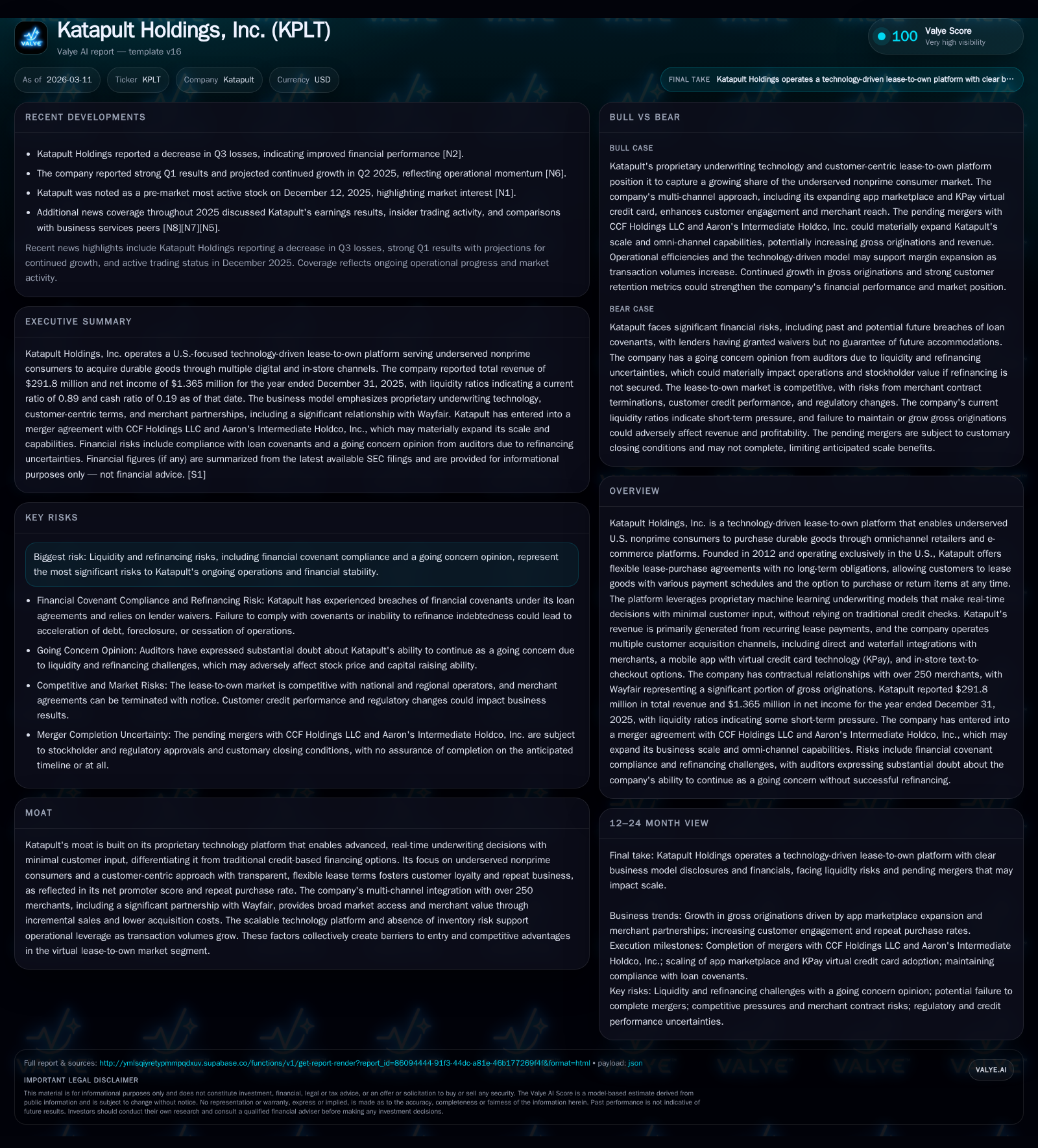
Katapult Holdings, Inc. is a U.S.-focused lease-to-own platform serving underserved nonprime consumers through technology-driven underwriting and flexible payment options. In 2025, it grew gross originations by 17.3% and revenue by 18%, aided by expanding merchant relationships and its KPay app. However, the company continues to face significant liquidity and refinancing risks, with substantial indebtedness and restrictive loan covenants leading to going concern doubts. A pending merger with CCFI and Aaron’s aims to expand the platform's footprint but introduces ownership dilution and execution risks.
Business Overview
Katapult Holdings, Inc. operates a technology-enabled lease-to-own (LTO) platform focused exclusively on underserved U.S. nonprime consumers who often lack access to traditional credit financing for durable goods purchases [S1][S12]. Founded in 2012 and headquartered in Plano, Texas, the company integrates with omnichannel retailers and e-commerce platforms to facilitate flexible lease-purchase agreements that feature transparent terms without late fees or long-term obligations [S12].
Central to Katapult's value proposition is its proprietary machine learning underwriting platform that approves customers rapidly (within five seconds on average) using minimal input fields and does not rely on traditional credit checks. This platform powers both the front-end customer experience as well as real-time risk decisioning on the back end [S14]. Customers benefit from tailored payment plans with options for early buyouts or returns at any time.
Historical Growth and Performance
Katapult has experienced consistent growth in revenue and transaction volume over recent years despite operating losses. Key financials for fiscal years ended December 31 are summarized below:
Historical performance (annual)
| FY | Rev ($mm) | Net ($mm) | CFO ($mm) | OpInc ($mm) | Rev YoY | Net YoY |
|---|---|---|---|---|---|---|
| 2025 | 292 | 1 | -12 | -1 | +18.0% | +105.3% |
| 2024 | 247 | -26 | -33 | -8 | +11.6% | +29.3% |
| 2023 | 222 | -37 | -17 | -19 | +4.5% | +3.2% |
| 2022 | 212 | -38 | -21 | -25 |
Source: SEC companyfacts cache [F1].
Capital returns and efficiency (annual)
| FY | FCF ($mm) | ROE% |
|---|---|---|
| 2025 | -12 | -3.6 |
| 2024 | -33 | 55.4 |
| 2023 | -17 | 131.0 |
| 2022 | -21 | -531.3 |
Source: SEC companyfacts cache [F1].
The company's growth trajectory is primarily driven by expanding gross originations, which represent the retail value of merchandise leases initiated each period but not yet recognized as revenue due to accounting standards [S1]. Gross originations increased approximately 17% year-over-year to $278 million in 2025 from $237 million in 2024 [S20]. These originations convert into revenue over an average eight-month lease term.
A major contributor was the expansion of Katapult's KPay mobile application launched in late Q3 2022, accounting for about 42% of gross originations in full-year 2025 versus roughly one-third the prior year [S20]. Meanwhile, origination concentration from Wayfair decreased from over one-third of gross originations in 2024 to about one-quarter in 2025, indicating broadening merchant diversification [S20][S24].
Despite top-line gains, operating results reflect investments in technology development, customer acquisition—including underwriting expenses—and litigation-related charges [S9][S17]. Operating loss narrowed substantially to approximately half a million negative dollars from over eight million negative dollars the prior year, signaling improving operating leverage alongside scale [F1].
Net income swung into positive territory at $1.365 million for full-year 2025 versus a net loss exceeding $25 million last year due mainly to better revenue realization and controlled expense growth [F1]. However, operating cash flow remains negative (-$11.9 million), indicating ongoing cash consumption related to working capital or collection cycles typical of lease-based models [F1].
Capital expenditures remain low relative to overall spending given Katapult’s asset-light model; Capex totaled only $34 thousand in FY25 compared to $54 thousand the prior year [F1].
Future Growth Prospects
Katapult operates within an estimated $50-$60 billion total addressable virtual LTO market that remains fragmented with largely regional or local competitors [S12]. With less than one percent market share based on recent gross origination run rates, there is significant room for scaling within this underserved segment [S12].
Key growth drivers include:
- Expansion of merchant network: Onboarding additional direct integration merchants while strengthening existing partnerships such as Shopify, BigCommerce, WooCommerce alongside legacy heavyweight Wayfair reduces concentration risk and increases addressable customers [S24].
- Product innovation leveraging proprietary technology: Continued development of data-driven underwriting algorithms and enhancements to digital experiences through KPay offer customer acquisition tailwinds [S14][S11].
- Strategic mergers: Pending mergers approved December 2025 with CCFI and Aaron’s are expected to create a combined omni-channel leader providing broader financial solutions targeting nonprime consumers; completion anticipated Q2 calendar year 2026 subject to regulatory approvals [S1].
- Operating leverage potential: As transaction volumes grow on Katapult's cloud-based infrastructure devoid of inventory risk, incremental revenues can translate into expanded operating margins given largely fixed cost base characteristics [S11].
Challenges include:
- Merchant contract termination risk: Existing key partnerships such as Wayfair can be terminated on short notice; loss could impact volume meaningfully given current concentration levels [S24][S15].
- Algorithmic risk: Changes in consumer behavior or macroeconomic shifts could reduce model predictive power for creditworthiness assessments risking portfolio performance or tightened approvals [S15].
- Competitive pressure: The competitive landscape includes traditional finance sources plus emerging fintech entrants offering installment payments or buy-now-pay-later options targeting overlapping customer bases [S18][S24].
- Regulatory environment: Extensive state/federal regulations affecting rental-purchase transaction compliance impose costs and legal risk uncertainties that may curtail operational flexibility or increase expenses [S21][S22][S26].
Milestones and Outlook
While explicit company guidance is limited, investors should monitor:
- Completion timing of mergers with CCFI/Aaron's expected mid-2026 which will materially alter capital structure and market position; timing delays or deal modifications pose execution risks [S1].
- Loan covenant compliance regarding minimum trailing three-month net originations and liquidity thresholds requiring lender waivers due to recurring breaches through late-2025; failure may accelerate debt repayment demands [S4][S8][S10][S16].
- Sustained gross originations growth above mid-teens percent annually is crucial given deferred lease revenue recognition patterns post-origination [S1][F1].
- Customer retention metrics such as repeat purchase rate (~64%) and net promoter score (46), robust among nonprime peers, should be maintained as indicators of brand loyalty underpinning sustainable unit economics [S14].
Returns and Capital Allocation
Katapult’s return on equity remains negative at approximately -3.6%, reflecting accumulated losses eroding shareholder equity reported at negative $38 million by end FY25 versus positive equity around $7 million in FY22 before losses intensified starting FY23 onward [F1].
The company does not currently pay dividends nor has disclosed stock repurchases amid ongoing liquidity constraints.
Operating cash flow remains negative (-$11.9 million annually) after nominal capex expenses; this underscores dependence on external financing until positive free cash flow generation is achieved [F1].
Liquidity Position and Financial Risks
Liquidity constraints are critical for Katapult:
- The company’s revolving loan agreement includes restrictive covenants requiring minimum trailing three-month net originations above thresholds alongside maintaining weekly liquidity minimums no lower than $5 million unrestricted cash equivalents.
- Several covenant breaches occurred repeatedly during July through December 2025 requiring lender waivers for continued borrowing capacity.
- Failure to obtain further waivers or satisfy covenants could trigger default accelerating all obligations immediately due senior lenders with rights to foreclose collateral securing substantially all assets.
- Auditors issued a going concern opinion citing substantial doubt about ability to continue operations beyond twelve months absent successful refinancing or restructuring coinciding with maturing indebtedness due December-end calendar year next round [S16][F1].
- Restrictive affirmative/negative covenants limit incurring new debt plus restrict dividends or asset sales constraining strategic flexibility; combined with high leverage evidenced by current liabilities exceeding current assets leading to sub-unity current ratio (~0.89), liability management is paramount moving forward [F1][S4][S10][S15].
Competitive Moat Analysis
Katapult's moat stems from:
- Proprietary data science underwriting models efficiently approving high-risk nonprime consumers without traditional credit scoring dependencies;
- Seamless digital-first experience including branded KPay virtual card mechanism facilitating consumer convenience plus retailer integration across channels;
- Established partnerships securing significant gross originations led by Wayfair plus marketplace expansions via Shopify et al.;
- Transparent customer-friendly leasing terms promoting trust evidenced by industry-leading net promoter score near +46 with repeat usage rate around two-thirds indicating strong retention.
Key Risks Review
Principal risks include:
- Liquidity & refinancing: Persistent loan covenant breaches necessitate lender goodwill—withdrawal could force rapid deleveraging or insolvency jeopardizing operations continuity [S4][S8][S16];
- Concentration risk: Heavy reliance on Wayfair exposes volume volatility risk if contract loss occurs given competitor offerings enabling consumer migration off-platform [S24];
- Regulatory scrutiny: Strict federal/state laws regulating rental-purchase transactions impose fines/legal exposure augmented by trends toward more stringent legislation elevating compliance costs or product modifications impacting profitability flexibilities [S21];
- Intellectual property litigation: Ongoing disputes potentially divert resources though not currently recognized as probable loss contingencies implying unresolved contingent liabilities material if adverse outcome emerges long term [S23];
- Market competition: Entrenched players offering alternate credit products including BNPL disruptors present evolving challenges necessitating continual tech innovation maintaining differentiation critical amid commoditization threats.
Summary Perspective
Katapult Holdings exemplifies a digitally native fintech approach bridging large U.S. nonprime consumer demand gaps for durable goods access via flexible lease-to-own pathways integrated across established omnichannel merchants. The company delivered improving financial metrics including near break-even operating profile coupled with return to net profitability supported by meaningful top-line growth driven notably by proprietary KPay digital reach. However substantial liquidity pressures stemming from restrictive loan covenants compounded by upcoming debt maturities remain critical near-term issues demanding successful capital restructuring; failures could imperil viability. Pending transformative merger with CCFI/Aaron’s slated for Q2 ’26 presents scale economies but also ownership dilution complexities warranting close monitoring. Overall Katapult operates within a sizeable addressable market ripe for scalable growth provided it navigates competitive regulatory financial headwinds inherent servicing higher credit risk populations through innovative leasing alternatives.
Disclaimer: This analysis describes historical performance, business model features, risks disclosed by Katapult Holdings, Inc., and publicly available information as of March 11, 2026 without investment advice.
Disclaimer: This is research-only, informational analysis and not investment advice. It may include AI-generated interpretation and general industry context. Always verify important details using primary sources.

Comments