
Omada Health Advances Virtual Care with Multi-Condition Platform and Strong Retention
The company leverages its integrated platform and evidence-backed programs to sustain member engagement while addressing profitability and regulatory challenges.
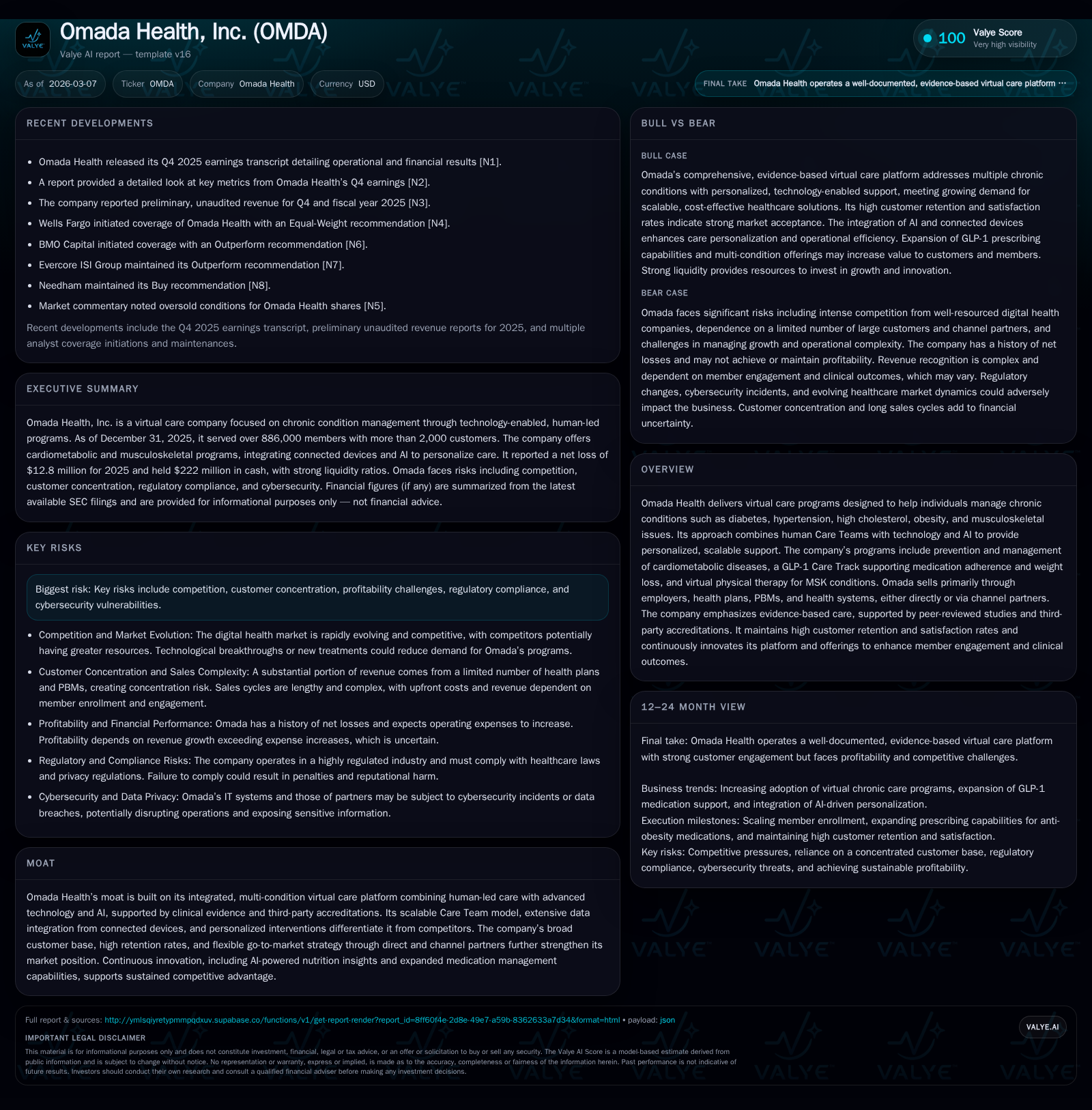
Omada Health has demonstrated strong historical growth in member enrollments, supported by its technology-enabled, human-centered virtual care approach. Its multi-condition platform, combining personalized Care Teams with AI-driven insights, underlies high retention rates and clinical relevance. Despite meaningful top-line expansion, the company continues to face profitability headwinds as it invests in scaling operations and innovation. Regulatory compliance and evolving healthcare policies remain critical risks as Omada pursues sustainable capital deployment and long-term value creation.
Growth Trajectory: From Rapid Enrollment Growth to Business Scale-Up
Since inception, Omada Health has rapidly scaled its member base through evidence-based virtual care solutions targeting chronic conditions. By December 31, 2025, total members enrolled reached over 886,000 across more than 2,000 customers [S1][S4]. This represents an accumulation of nearly two million individuals who have participated in at least one program since launch. Member enrollment is measured by billing activity within the prior twelve months.
The growth curve reflects robust demand for digital therapeutics addressing cardiometabolic conditions (diabetes, hypertension, cholesterol management), obesity interventions including GLP-1 medication adherence tracks, as well as musculoskeletal (MSK) virtual physical therapy [S4]. While the chronic care market itself is nascent and rapidly evolving with competitive entrants, Omada's ability to attract a large membership quickly speaks to early market validation.
Table 1 below summarizes key annual financials illustrating operating leverage stress points amid growth efforts.
Historical performance (annual)
| FY |
|---|
| 2025 |
Source: SEC companyfacts cache [F1].
Operating income and net losses have narrowed year-over-year; free cash flow improved driven by higher cash from operations exceeding capital expenditures [F1].
Drivers Behind Member Engagement and Program Retention
Omada’s ability to maintain high member engagement validates its differentiated care delivery. The hallmark is the "Compassionate Intelligence" model—a synergy of proactive human-led Care Teams combined with AI-powered tools that tailor interventions dynamically based on individual health data streams [S1][S4]. This model cultivates trust and responsiveness that scale digitally.
Key drivers include:
- Data integration from connected health devices allowing real-time feedback on vitals such as weight or glucose levels.
- Personalized coaching messaging and interaction through the mobile app enabling omnichannel support.
- Multi-condition platform design accommodating comorbid patients seamlessly under one provider.
Retention metrics for cardiometabolic programs are demonstrative: over 55% remain actively engaged at month twelve and more than half persist through month twenty-four [S4]. Engagement is defined through actions like logging into the app or recording relevant clinical metrics during the respective month.
Such sustained participation not only reinforces clinical outcomes but also strengthens contractual relationships through proven cost-offset effects benefiting payers.
Product Depth: Multi-Condition Platform and Innovation Roadmap
Omada's portfolio extends well beyond lifestyle coaching to encompass complex chronic disease management modalities:
- Cardiometabolic prevention/management addressing diabetes risk reduction.
- GLP-1 Care Tracks aimed at optimizing medication adherence aligned with obesity treatment protocols.
- Virtual physical therapy programs tackling MSK diagnoses remotely through licensed therapists collaborating under professional service agreements [S4][S11][S25].
The platform incorporates evolving AI capabilities such as nutritional insights driven by machine learning analytics—enabling diet personalization responsive to member behavior patterns [N1]. This layer of technologically enabled clinical decision support encapsulates the "Compassionate Intelligence" ethos by marrying empathy-driven care with data science precision.
Market Access Strategy: Customers, Channels, and Competitive Positioning
Omada’s go-to-market model embraces a business-to-business-to-consumer (B2B2C) framework targeting diverse channels: self-insured employers seeking cost containment; fully insured health plans; pharmacy benefit managers (PBMs); and integrated health systems assuming financial risk [S4]. The strategy harmonizes different contracting flows—direct sales allow customer-specific customization while channel partnerships facilitate broader reseller reach with streamlined onboarding.
The strength of these relationships is affirmed by a three-year average customer retention rate exceeding 90%, accompanied by implementation and ongoing customer success satisfaction rates both north of 90% [S4]. Such metrics reflect not only service reliability but also alignment with payer value propositions emphasizing sustained clinical improvement.
Importantly within digital therapeutics sector vernacular is the governance structure around channel partners who resell Omada’s programs—these entities drive enrollment volumes but require consistent oversight to maintain quality standards congruent with Omada’s evidence-based branding.
Financial Overview: Profitability Headwinds Amid Investment Phase
Reviewing Omada’s financial profile reveals ongoing net losses approximating $12.8 million for fiscal year ending December 2025 despite progress narrowing operating deficits [F1][N1][N2]. The revenue line detail is not disclosed but implied solid growth underpins positive cash flow generation.
Operating income improved year-over-year by roughly 11%, reflecting efficiency gains alongside scale benefits. Free cash flow remains positive ($16.9 million), underscoring effective working capital management amidst continued capex investment primarily allocated toward platform enhancements and program development [F1].
Return on equity stands at approximately -5.6%, consistent with an expansion stage firm prioritizing scalability over near-term profitability [F1]. This profile typifies digital health companies balancing rapid program adoption against upfront clinical validation costs.
Capital Allocation and Cash Flow Analysis
Omada closes FY2025 with a robust liquidity position marked by $222 million in cash and equivalents coupled with a current ratio of about 3.6x indicating strong short-term financial flexibility [F1].
Cash from operations significantly exceeded capital expenditures ($19.3M vs $2.6M), resulting in positive free cash flow signifying self-sustainability improvements notwithstanding continued investments in innovation pipelines.
No dividends or share repurchases were reported; capital allocation appears focused on reinvesting into R&D activities—particularly AI advancements—and expanding multi-condition program coverage rather than returning capital currently [F1][N1].
Navigating Regulatory and Market Risks in Digital Therapeutics
Omada operates within a complex regulatory environment shaped by healthcare laws including anti-kickback statutes; patient privacy regulations such as HIPAA; extensive fraud-and-abuse frameworks like the False Claims Act that hold providers accountable for compliance violations [S5][S6][S10].
Additional regulation affecting virtual care spans licensing restrictions differing state by state concerning telehealth delivery models especially for physical therapy services managed via affiliated professional entities [S11][S25]. Frequent legal reinterpretation increases monitoring burdens.
Potential FDA oversight looms over AI-infused software applications where shifting definitions might reclassify products as medical devices requiring rigorous clearance processes potentially elevating costs or delaying launches [S6][S9][S15].
Cybersecurity vulnerabilities linked to sensitive personal health information pose reputational and operational risks amplified given increasing federal scrutiny under FTC consumer protection enforcement initiatives encompassing data protection claims [S16].
Competitive intensity from incumbents armed with greater resources demands relentless innovation to defend market share while payer relationships’ variability adds volatility to revenue visibility given external policy uncertainties including drug pricing reforms affecting PBMs or health plans [S12][S18].
Key Metrics to Monitor: Member Growth, Retention, and Financial Inflection Points
Looking ahead requires tracking several metrics indicative of Omada’s progression towards durable profitability:
- Sustained or growing member engagement rates beyond two years verify long-term platform stickiness necessary for lifetime value realization.
- Improvements in contribution margins signal operational leverage balancing escalating scale against fixed program costs.
- Expansion within existing customer bases reflects cross-selling efficacy enabled by multi-condition platform breadth.
- New program launches adapted swiftly within regulatory confines demonstrate agility amid tightening policy landscapes.
Together these measures offer clarity on whether Omada’s integrated human-plus-AI Care Team model can convert its evidenced clinical efficacy into consistent financial returns while scaling competitively across an increasingly dynamic digital therapeutics market.
This analysis synthesizes available numeric data from company filings alongside contextual business disclosures without projecting unreported metrics or forward-looking guidance absent explicit statements. It aims to furnish investment professionals a grounded understanding of Omada Health’s business evolution balancing innovation-driven growth ambitions against industry-specific regulatory demands and capital deployment considerations.
Disclaimer: This is research-only, informational analysis and not investment advice. It may include AI-generated interpretation and general industry context. Always verify important details using primary sources.

Comments