
SAB Biotherapeutics’ Platform Science Advances Against Autoimmune Type 1 Diabetes
SAB Biotherapeutics leverages its proprietary transchromosomic cattle platform to pioneer disease-modifying therapies addressing autoimmune type 1 diabetes.
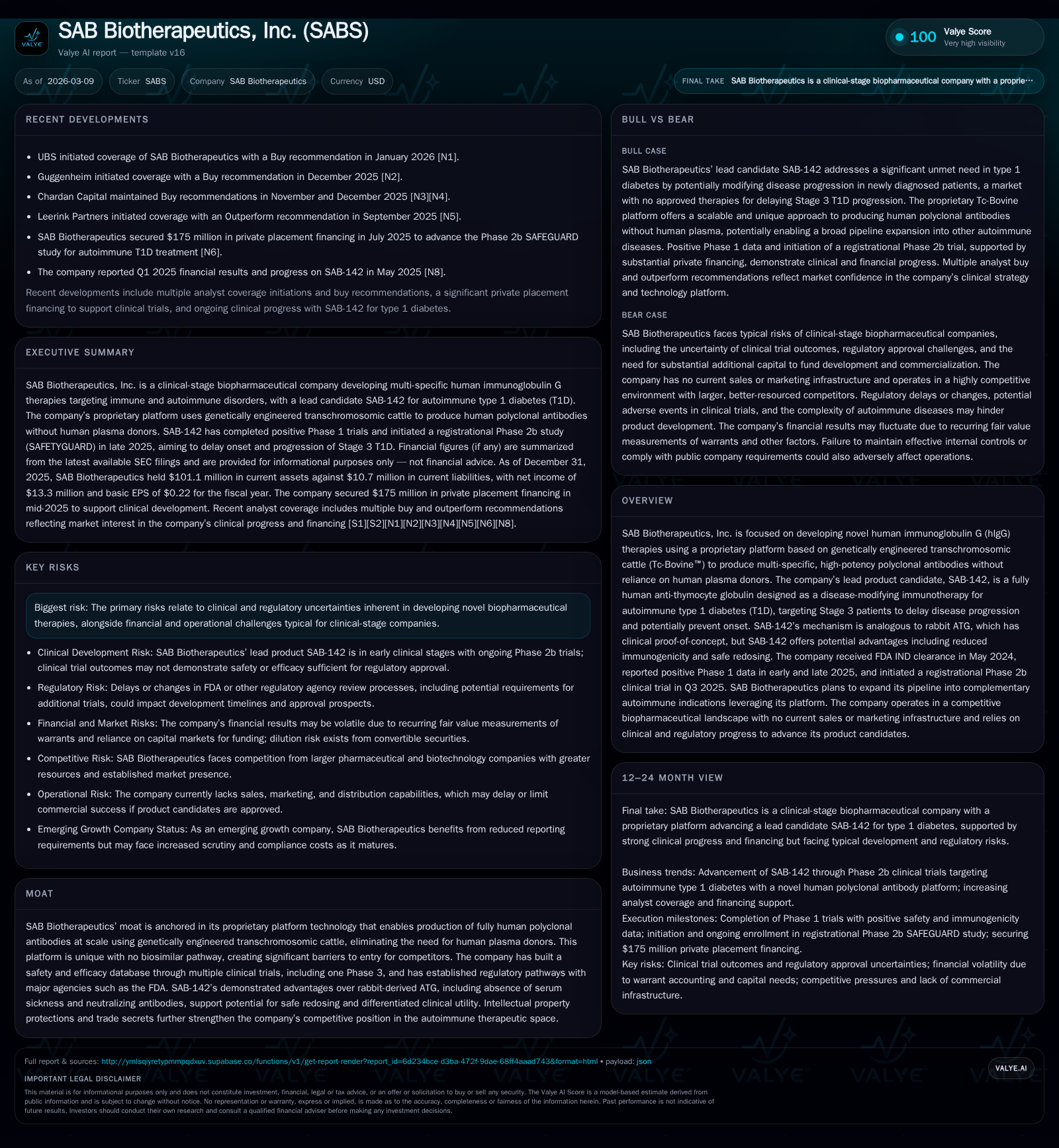
SAB Biotherapeutics, Inc. develops human polyclonal antibodies using genetically engineered transchromosomic cattle, enabling scalable production without human plasma donors. Its lead candidate, SAB-142, targets autoimmune stage 3 type 1 diabetes with promising Phase 1 data and an ongoing registrational Phase 2b trial. Despite increasing operating losses due to R&D investment, the company reported a net income turnaround in 2025 influenced by accounting factors amidst continued negative operating cash flow. A strong cash position and regulatory milestones underlie the company’s potential, balanced by clinical and regulatory risks inherent to novel biologics development.
Genesis of Clinical Growth: The Role of Proprietary Tc-Bovine™ Platform
SAB Biotherapeutics’ foundation rests on its proprietary transchromosomic cattle technology (Tc-Bovine™), which represents a paradigm shift in human immunoglobulin production. By genetically engineering cattle to carry human immunoglobulin gene loci, SAB produces multi-specific, high-potency human polyclonal antibodies (hIgG) at scale without relying on human plasma donors [S1][F1]. This stands apart from conventional antibody sourcing methods, which often depend on limited plasma availability or animal-derived products such as rabbit-derived anti-thymocyte globulin (rATG).
The Tc-Bovine platform creates a significant moat: no biosimilar pathway exists for these complex polyclonal antibody mixtures, and substantial intellectual property protections underpin the engineering process [S1]. Moreover, SAB’s hIgG candidates are designed to reduce immunogenicity compared with rATG, notably minimizing risks like serum sickness and neutralizing antibody formation that hinder repeat dosing. This capability is crucial for chronic or redosable therapies, especially relevant for autoimmune diseases where long-term immune modulation may be required.
Clinically validated mechanisms paralleling rATG’s action provide proof-of-concept while offering differentiated safety profiles [S1]. These advantages allow SAB not only to reproduce established immunomodulatory effects but also potentially to extend therapeutic utility through safer redosing and improved tolerability.
From Preclinical Promise to Phase 2b: SAB-142’s Development Milestones
SAB’s lead candidate SAB-142 epitomizes its platform capabilities — a fully human anti-thymocyte globulin formulated as an immunotherapy targeting autoimmune type 1 diabetes (T1D). Unlike symptomatic treatments, SAB-142 aims to delay progression or possibly prevent onset of Stage 3 T1D by modulating the pathogenic T-cell attack on pancreatic beta cells [S1].
Following FDA investigational new drug (IND) clearance in May 2024, SAB reported positive early and late Phase 1 clinical data throughout 2025 demonstrating safety and mechanistic activity consistent with the expected multi-specific immunomodulation [S1]. These results facilitated initiation of a registrational Phase 2b trial aiming to establish efficacy endpoints necessary for eventual marketing approval.
Importantly, SAB-142’s mechanism reflects a multi-antigen targeting profile capable of binding several immune cell epitopes simultaneously—a hallmark advantage of polyclonal over monoclonal antibodies that may better navigate the complexity of autoimmune pathophysiology. This therapeutic approach is particularly promising given the chronic inflammatory milieu characteristic of T1D [S1].
Financial Performance: Persistent Operating Losses Amid Expanding R&D Commitment
Financially, SAB Biotherapeutics remains a clinical-stage biotech with no meaningful revenues reported—only $85K half-year revenue ending June 2023—with operating losses deepening annually as R&D investments expand [F1]. Operating income declined from -$28.9M in FY2022 to -$38.1M in FY2023 (-31% YoY), worsening further to -$42.9M in FY2024 (-13% YoY), and finally reaching -$48.9M in FY2025 (-14% YoY). This trend underscores sustained operational spending centered on advancing clinical trials and platform development without offsetting commercial sales.
Notably, net income showed a reversal: from -$18.7M net loss in FY2022 through larger losses in FY2023 (-$42.2M) and FY2024 (-$34.1M), turning positive to +$13.3M in FY2025—a year-over-year increase exceeding 138%. This atypical pattern signals non-operating income or accounting adjustments rather than operational profitability; it merits cautious interpretation given the persistent negative operating cash flow (-$44.8M in FY2025) reflecting ongoing burn [F1].
Historical Financial Performance Summary
Historical performance (annual)
| FY | Net ($mm) | CFO ($mm) | OpInc ($mm) | Capex ($mm) | Net YoY |
|---|---|---|---|---|---|
| 2025 | 13 | -45 | -49 | 1 | +138.9% |
| 2024 | -34 | -34 | -43 | 0 | +19.2% |
| 2023 | -42 | -25 | -38 | 0 | -125.1% |
| 2022 | -19 | -23 | -29 | 2 |
Source: SEC companyfacts cache [F1].
Capital returns and efficiency (annual)
| FY | FCF ($mm) | ROE% |
|---|---|---|
| 2025 | -46 | 8.8 |
| 2024 | -35 | -131.3 |
| 2023 | -25 | -73.6 |
| 2022 | -26 | -60.3 |
Source: SEC companyfacts cache [F1].
Balancing Act: Cash Flows and Capital Allocation
At December 31, 2025 cash & equivalents totaled approximately $10.5 million with current assets around $101 million against current liabilities near $10.7 million—yielding a strong current ratio near 9.46 indicative of solid short-term liquidity [F1]. Capital expenditures remain modest relative to operating costs but increased significantly by about 177% from ~$0.34 million in FY2024 to ~$0.93 million in FY2025 reflecting infrastructure investments aligned with clinical scaling [F1].
Operating cash flow deteriorated further by over 30% year-over-year to nearly -$45 million amid intensifying research efforts without offsetting commercial revenues [F1]. Equity surged markedly from about $26 million at end-FY2024 to approximately $151 million at end-FY2025 reflecting significant capital raises supporting operations and pipeline development [F1][S2].
The company has neither declared dividends nor initiated share repurchases consistent with typical early-stage biopharmaceutical capital allocation focused on reinvestment into R&D programs [F1]. However, the presence of Series B Preferred Stock conversion rights registered for resale effective September 30, 2025 introduces potential dilution risk that investors should monitor closely [S2].
Regulatory Landscape and Risk Factors Shaping Growth Potential
SAB faces complex regulatory pathways involving both FDA approval processes for biological drug candidates and New Animal Drug Applications related to genetic modification of production cattle—a dual hurdle uncommon among biologics developers [S1][S4]. Delays or failures could materially impact timelines.
Further risks include enrollment challenges typical of autoimmune clinical trials; uncertainties regarding demonstration of sustained safety/efficacy; manufacturing scale-up complexities under cGMP standards; and compliance with extensive healthcare fraud/abuse laws affecting commercialization strategy . While currently free from material litigation [S14], future claims remain possible given industry risks.
Market acceptance will hinge on reimbursement dynamics shaped by government payors such as Medicare/Medicaid alongside private insurers increasingly demanding robust cost-effectiveness evidence post-approval [S11][S18]. Advertising restrictions limit off-label promotion potentially impacting initial uptake rates [S17].
Outlook: Clinical Readouts and Commercial Viability Ahead
Upcoming milestones center on SAB-142 including registrational Phase 2b trial results assessing disease-modifying efficacy in Stage 3 T1D patients alongside safety/tolerability data critical for differentiating from rabbit ATG analogs.
Regulatory interactions around IND phases and future Biologics License Application submissions will be key determinants for U.S. approval prospects with potential global expansion opportunities given broad autoimmune indications.
Financial monitoring remains essential as the company balances aggressive pipeline advancement against capital needs typical for pre-revenue biopharma firms.
The platform's capacity for multi-specific antibody generation beyond T1D could unlock additional growth avenues contingent on validation through clinical success.
This analysis is based solely on publicly available information up to March 9, 2026 without extrapolation beyond cited SEC filings and financial data.[F1][S1][S2]
Disclaimer: This is research-only, informational analysis and not investment advice. It may include AI-generated interpretation and general industry context. Always verify important details using primary sources.

Comments