
Creative Media & Community Trust Navigates Portfolio Renovations and Capital Rebalancing Amid Profitability Challenges
CMCT’s focused portfolio and strategic capital moves reflect efforts to stabilize operations and strengthen liquidity amid renovation investments and market headwinds.
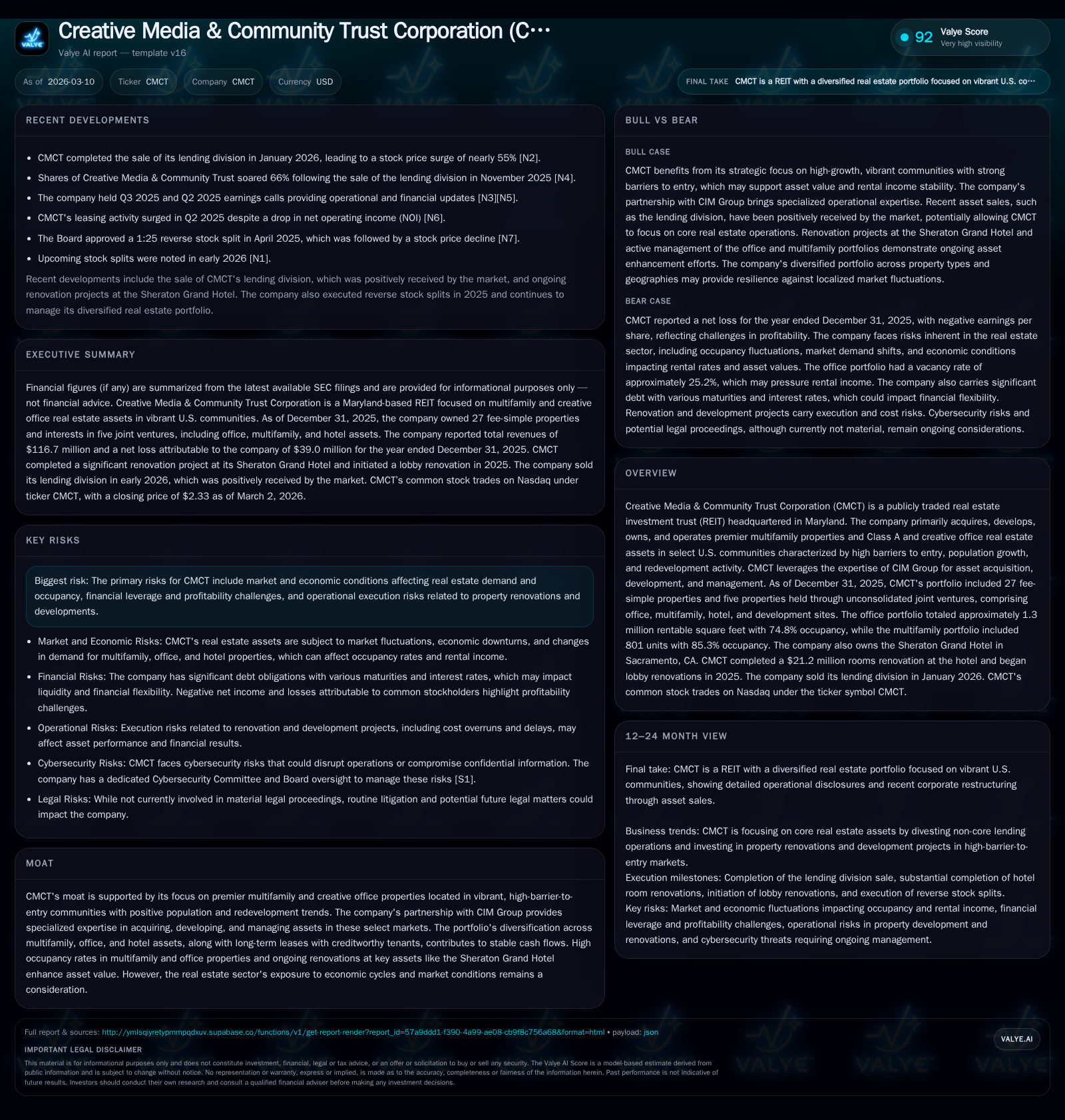
Creative Media & Community Trust Corporation (CMCT) holds a selective portfolio of multifamily, office, hotel, and development properties primarily in high-barrier U.S. markets under CIM Group's management. Despite solid occupancy rates in multifamily (85.3%) and office (74.8%) segments, the company faced a 6.3% revenue decline to $116.7 million in 2025 and a net loss of $39.0 million, with operating cash flow contracting sharply to $5.8 million. Capital allocation priorities include debt reduction through refinancing and repayment activities, preferred stock redemptions via common stock issuances, and suspension of common dividends in 2025 to preserve liquidity. Ongoing hotel renovations and portfolio repositioning are key operational focuses as the company manages financial leverage within lender covenants while addressing market cyclicality risks.
Company Overview and Portfolio Composition
Creative Media & Community Trust Corporation (CMCT) is a publicly traded real estate investment trust headquartered in Maryland that owns, develops, and operates multifamily residential, office, hotel, and development properties across select U.S. markets exhibiting strong population growth and barriers to entry [S1]. The company leverages CIM Group's expertise in urban land assembly and property management.
As of December 31, 2025, CMCT held a portfolio of 27 fee-simple properties alongside five unconsolidated joint ventures encompassing office buildings, multifamily units, hotels, and development sites [S1]. The office segment includes roughly 1.3 million rentable square feet with an occupancy rate near 74.8%, while the multifamily segment consists of approximately 801 units with occupancy around 85.3% as of year-end [S1]. Key assets include the Sheraton Grand Hotel in Sacramento undergoing significant renovations targeting rooms and lobby areas [S5][S17].
Historical Financial Performance
CMCT's revenues declined by approximately 6.3% from $124.5 million in FY2024 to $116.7 million in FY2025 [F1]. Net losses deepened to $39.0 million in FY2025 compared with a loss of $25.2 million the previous year, reflecting ongoing profitability challenges [F1]. Operating cash flow contracted sharply by about two-thirds to $5.8 million from $17 million year-over-year during increased expenses associated with renovation projects [F1].
Historical performance (annual)
| FY | Rev ($mm) | Net ($mm) | CFO ($mm) | Rev YoY | Net YoY |
|---|---|---|---|---|---|
| 2025 | 117 | -39 | 6 | -6.3% | -54.9% |
| 2024 | 125 | -25 | 17 | +4.4% | +48.1% |
| 2023 | 119 | -48 | 12 | +17.0% | -919.3% |
| 2022 | 102 | 6 | 32 |
Source: SEC companyfacts cache [F1].
Capital returns and efficiency (annual)
| FY | Div ($mm) | Buybacks ($mm) | ROE% |
|---|---|---|---|
| 2025 | 0 | -14.7 | |
| 2024 | 6 | -8.3 | |
| 2023 | 8 | 0 | -12.9 |
| 2022 | 8 | 5 | 1.6 |
Source: SEC companyfacts cache [F1].
Revenue year-over-year changes calculated directly from reported figures; net income volatility reflects impairment charges or operational pressures.
Strategic Growth Drivers and Constraints
CMCT targets growth through selective investments in high-barrier U.S markets supported by demographic trends [S1]. The partnership with CIM Group provides specialized capabilities for complex property acquisitions and urban redevelopment.
Key growth drivers include:
- Completion of substantial renovations at flagship properties such as the Sheraton Grand Hotel aimed at enhancing asset value.
- Stable occupancy levels supporting steady rental income particularly within the multifamily segment.
- Reduced financial leverage enabling opportunistic acquisitions or capital expenditures.
Constraints impacting growth:
- Sensitivity of commercial real estate demand to economic cycles especially affecting office space utilization.
- Concentration risks given California-centric asset base.
- Execution risks related to timing and cost control on renovation projects which influence near-term cash flows.
- Debt covenant requirements mandating minimum fixed charge coverage ratios (recently adjusted upwards post-December quarters) limiting flexibility [S8][S21].
Debt Profile and Liquidity Management
CMCT has actively restructured its debt profile to lower borrowing costs and extend maturities [S6][S14]. The company fully repaid its prior $56 million term loan and $150 million revolving credit facility by April 2025 using proceeds from mortgage financings secured by office and hotel properties [S6]. In January 2026, CMCT extinguished a remaining $10.5 million lending division revolver balance following the sale of its lending subsidiary First Western SBLC LLC [S14][S20].
As of December 31, 2025, consolidated mortgages payable totaled approximately $474 million net including fixed-rate ($268M) and variable-rate ($209M) components secured by real estate collateral [S12][F1]. Junior subordinated notes outstanding were about $27 million bearing interest reset quarterly based on SOFR plus spread with maturity in March 2035 [S14].
Liquidity comprised roughly $15 million in cash plus restricted cash totaling about $22 million at year-end supporting ongoing capital expenditures primarily for renovations [F1][S24]. Financial covenants require maintaining leverage limits not exceeding approximately a total leverage ratio of 2.50:1 as well as fixed charge coverage ratios ranging from about one times up to recent minimums around 1.15 times post-December quarters [S8][S21].
Capital Allocation: Dividends, Buybacks & Preferred Stock Redemptions
Dividend payments on common stock were suspended during FY2025 reflecting cautious liquidity management amid operating losses [F1][S13][S16]. Historically, annual common dividends ranged between approximately $6–7 million but were zeroed out last fiscal year.
Preferred stock redemption programs have involved exchanging preferred shares for newly issued common shares rather than cash payments thereby reducing cash dividend obligations but diluting equity [S13][S16][F1]. Planned redemptions announced for early calendar year periods indicate continued reduction of preferred stock liabilities [S17]. There were no share repurchases reported during recent fiscal years indicating capital prioritization toward debt repayment rather than buybacks [F1].
Operational Risks and Compliance Considerations
CMCT faces typical real estate risks including interest rate fluctuations affecting refinancing costs; tenant demand variability sensitive to economic cycles; labor cost inflation impacting construction projects; regulatory changes influencing property taxation or zoning; as well as cybersecurity risk oversight provided through CIM Group’s cybersecurity committee structure consistent with SEC regulations effective since mid-2023 [S1]. No material cybersecurity incidents affecting financial results have been disclosed.
Outlook Considerations
Absent explicit forward guidance beyond March '26 filings ([N1],[S3]), key factors to monitor include:
- Successful completion and lease-up following major hotel renovations.
- Occupancy stability particularly in office segments amid hybrid work trends.
- Maintaining compliance with financial covenants ensuring access to financing facilities.
- Dividend policy signaling reflecting confidence or continued conservatism regarding distributions.
- Market conditions influencing asset valuations or capital availability across core geographies.
Recent corporate actions including asset sales paired with curtailed equity offerings suggest a focus on financial consolidation over expansion positioning CMCT cautiously amid evolving market conditions.
This analysis is based solely on publicly available SEC filings through early March '26 without offering investment advice or forecasts beyond documented facts supported by cited sources.
Disclaimer: This is research-only, informational analysis and not investment advice. It may include AI-generated interpretation and general industry context. Always verify important details using primary sources.

Comments