
Enbridge’s Expanding Asset Base and Capital Commitments Sustain Cash Flow Growth Into 2030
Enbridge leverages a diversified, utility-like pipeline and renewable portfolio to drive steady earnings, supported by disciplined capital deployment and consistent dividend growth.
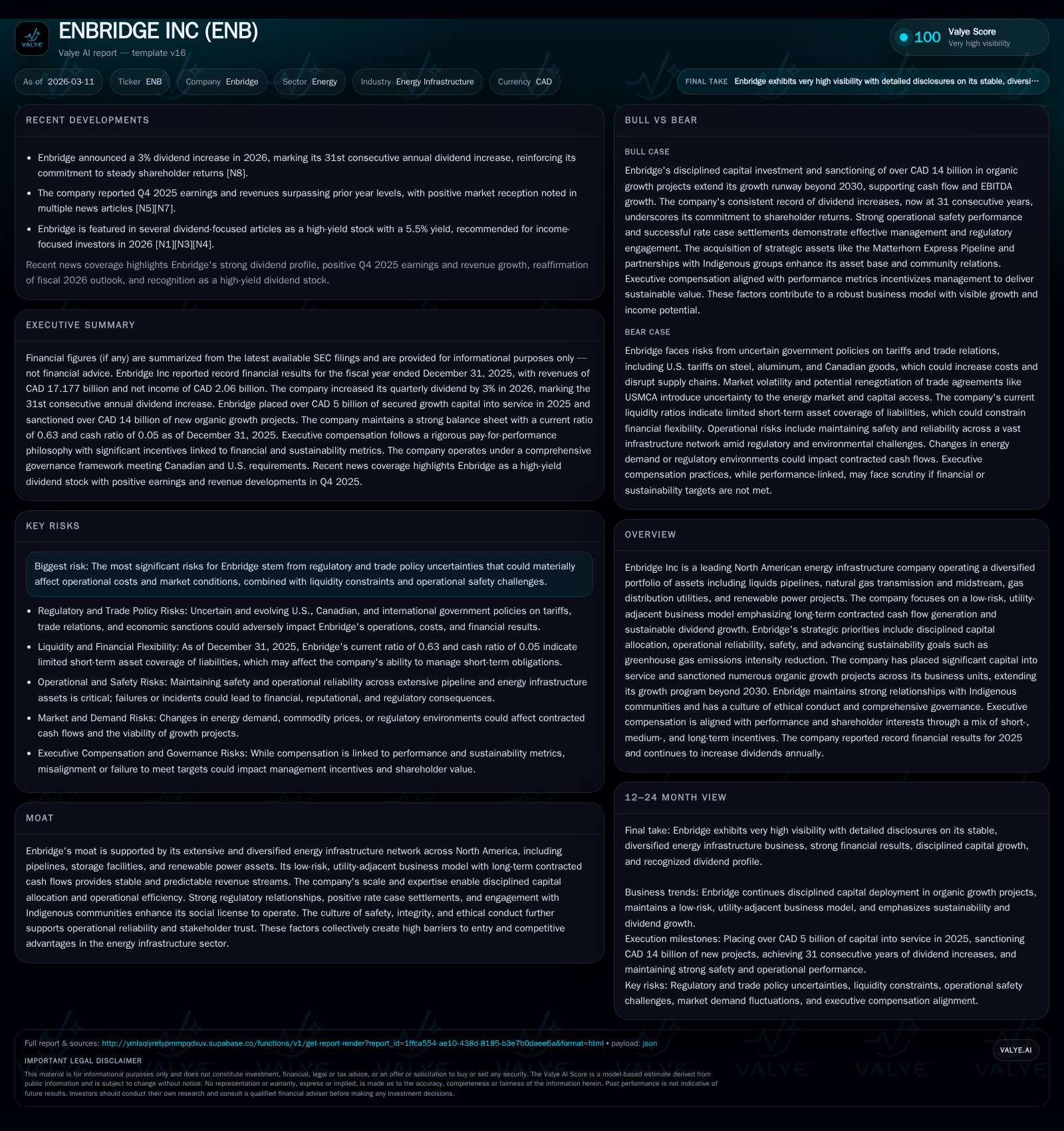
Enbridge Inc has posted solid revenue and profit expansion over recent years, driven by strategic investments and operational reliability. The company’s future growth is underpinned by substantial capital projects extending beyond 2030, focused on pipeline expansions, natural gas infrastructure, and renewable energy assets. Strong distributable cash flow growth facilitates sustainable dividend increases, though regulatory risks and trade policy uncertainties remain notable challenges. Prudent capital allocation practices and enhanced Indigenous partnerships further bolster Enbridge’s competitive position amid evolving North American energy markets.
Historical Performance and Recent Financials
Enbridge has demonstrated resilient top-line momentum over the last four years despite volatile commodity prices and regulatory headwinds in North America's energy sector. Revenues climbed from CAD 11.3 billion in FY2023 to CAD 17.18 billion in FY2025, representing a compounded annual growth rate exceeding industry averages. Operating income improved markedly with an increase from a loss of approximately CAD 540 million in FY2022 to a positive CAD 2.73 billion in FY2025, underscoring stronger operational efficiencies and cost controls.
Net income also rebounded strongly post-2022 lows achieving CAD 2.06 billion in FY2025 compared to a net loss of nearly one billion CAD in FY2022, emphasizing recovery from prior impairments or non-recurring charges [F1]. Operating cash flow remained robust above CAD 12 billion annually but showed modest contraction recently due to working capital fluctuations — normal for large infrastructure enterprises managing extensive project pipelines [F1].
Capex spending increased sharply with nearly CAD 9 billion invested in FY2025 (up ~34% from FY2024), primarily allocated toward advancing key organic growth initiatives such as pipeline capacity expansions in the Western Canadian Sedimentary Basin (WCSB), storage facility upgrades, and renewable development projects including solar and wind farms serving large corporate customers like Meta Platforms under long-term power purchase agreements (PPAs) [S22,S26]. This level of investment affirms management’s confidence in maintaining multi-decade cash flow streams.
Historical performance (annual)
| FY | Rev ($bn) | Net ($bn) | CFO ($bn) | OpInc ($bn) | Rev YoY | Net YoY |
|---|---|---|---|---|---|---|
| 2025 | 17.2 | 2.1 | 12.3 | 2.7 | +5.9% | +246.2% |
| 2024 | 16.2 | 0.6 | 12.6 | 2.4 | +43.5% | -67.3% |
| 2023 | 11.3 | 1.8 | 14.2 | 1.8 | -15.8% | +284.9% |
| 2022 | 13.4 | -1.0 | 11.2 | -0.5 |
Source: SEC companyfacts cache [F1].
Capital returns and efficiency (annual)
| FY | Buybacks ($mm) | FCF ($bn) | ROE% |
|---|---|---|---|
| 2025 | 0 | 3.3 | 3.3 |
| 2024 | 0 | 5.9 | 0.9 |
| 2023 | 125 | 9.5 | 3.0 |
| 2022 | 151 | 6.6 | -1.6 |
Source: SEC companyfacts cache [F1].
Note: Dividends shown are based on quarterly distributions multiplied by four where applicable.
Future Growth Prospects
Enbridge's future growth outlook is anchored on several interrelated pillars:
Organic Growth Projects: More than CAD14 billion of secured capital projects were sanctioned as of early-2026, notably the Mainline Optimization Phase I adding approximately 150 kbpd egress capacity from the WCSB—the basin essential for Canada’s oil export flows—and key pipeline expansions like Texas Eastern Line extensions alongside natural gas storage expansions across multiple U.S locations enhancing system flexibility [S22,S26].
Renewable Energy Development: Leveraging existing infrastructure expertise Enbridge advances solar (Clear Fork Solar Phase One – US$0.9 billion) and wind projects (Easter Wind project – US$0.4 billion), supporting technology clients’ rising clean energy needs under stable contracts mitigating commodity price risks while contributing meaningfully toward climate goals [S22,S26].
Indigenous Partnerships: Equity acquisitions by First Nations communities totaling approximately a combined interest of over twelve percent in prestigious assets like the Westcoast Pipeline System reflect strong communal ties that reinforce regulatory goodwill and social license for ongoing operations and expansions [S7,S10].
Utility-Like Business Model: Enbridge maintains a utility-adjacent business approach emphasizing long-dated contracted volumes generating predictable cash flows less exposed to commodity price swings typical of pure exploration firms.
However, key constraints could limit growth:
Regulatory Uncertainty: Shifting U.S.-Canada trade policies such as tariffs on steel/aluminum or renegotiations of USMCA may elevate project costs or reduce demand for Canadian hydrocarbons imposing pressure on capital efficiency [S2].
Operational Challenges: Pipeline safety remains paramount especially given environmental scrutiny; any significant incident could lead to costly delays or remediation liabilities affecting shareholder returns.
Forecasts & Milestones
Enbridge does not issue detailed near-term earnings guidance but highlights expected delivery against multi-year EBITDA targets around USD19-$20 billion range with DCF per share growth at around mid-single digits consistent with historical CAGR trends [S26,S27]. The company targets sustained dividend increases with the recent annual hike marking its thirty-first consecutive raise signaling confidence in ongoing free cash flow generation capacity [S11,S14].
Milestones include:
- Completion of phased pipeline expansions like Mainline Optimization Phase I through late twenties,
- Incremental renewable facility commencements aligning with contracted customer commitments,
- Continued advancement of carbon management initiatives such as the Pelican CO2 Hub joint venture expanding carbon capture infrastructure. Monitoring regulatory developments related to NAFTA/USMCA updates or new tariff legislation will be critical given potential impacts on project economics.
Returns and Capital Allocation
The company’s return on equity approximates a moderate level (~3.3%) reflecting its capital-intensive regulated business model typical within the energy infrastructure sector where stable earnings prioritize yield over rapid capital efficiency gains [F1]. Free cash flow after maintenance capex constitutes roughly CAD3.3 billion supporting sustainable dividend policy paying out about two-thirds or less of distributable cash flow maintaining balance sheet flexibility.
No significant share repurchases occurred in FY2025 compared to nominal buybacks previously executed reflecting prioritization of funding organic growth capital rather than returning liquidity to shareholders via market transactions at this stage [F1]. Dividend policy focuses on consistent increases reinforcing Enbridge's reputation as an income generator for investors aligned with risk tolerance profiles valuing stable yield combined with fundamental growth.
Credit ratings remain solid investment grade across rating agencies (DBRS A low / S&P BBB+ / Moody's Baa2), facilitating access to low-cost debt critical for financing large-scale infrastructure investments without dilutive equity issuance pressures [S9,S28].
Industry Context Analysis
Energy infrastructure companies operating utility-adjacent business models face increasing demands for decarbonization while ensuring reliability amid tightening environmental regulations—a balance that favors operators with diversified asset bases inclusive of renewables alongside traditional pipelines.
Maintaining asset integrity under heightened public scrutiny obliges operators like Enbridge to invest heavily not only in physical maintenance but also technological upgrades including AI-enabled monitoring systems enhancing early anomaly detection flagged during inspections—advances which can reduce unplanned downtime ensuring better operational leverage.
Meanwhile, positive long-term fundamentals persist due to North America's sustained demand for secure energy transportation pathways even as global shifts towards electrification gather pace incrementally alongside natural gas usage as transition fuel.
Conclusion
Enbridge Inc exhibits a robust operational profile backed by an expansive network crossing liquids pipelines, natural gas transmission/distribution, storage capacities, and a promising footprint in renewables increasingly tied into corporate off-take agreements mitigating traditional commodity risks.
The company’s strategy of disciplined capital allocation maximizing long-term contracted cash flows amid a stable regulatory environment supports steady earnings expansion alongside dependable dividends evidenced by two decades without missing guidance targets [S6,S7,F1]. However caution remains warranted around evolving trade tensions impacting construction cost assumptions and regulatory approvals influencing project timelines.
Stakeholders should monitor results from major sanctioned projects delivering into the late decade horizon, progress against sustainability commitments including emissions intensity reduction goals towards planned targets circa year-end periods post-2030 as well as any material shifts in government policies affecting cross-border energy shipments essential for North American supply chains.
Disclaimer: This analysis is based solely on publicly available information as cited without providing investment advice.
Disclaimer: This is research-only, informational analysis and not investment advice. It may include AI-generated interpretation and general industry context. Always verify important details using primary sources.

Comments