
Heritage Commerce Corp's Resilient Growth and Capital Strategy in 2025
Heritage Commerce demonstrated solid financial recovery in 2025 while managing capital prudently amid a pending merger and intense regional competition.
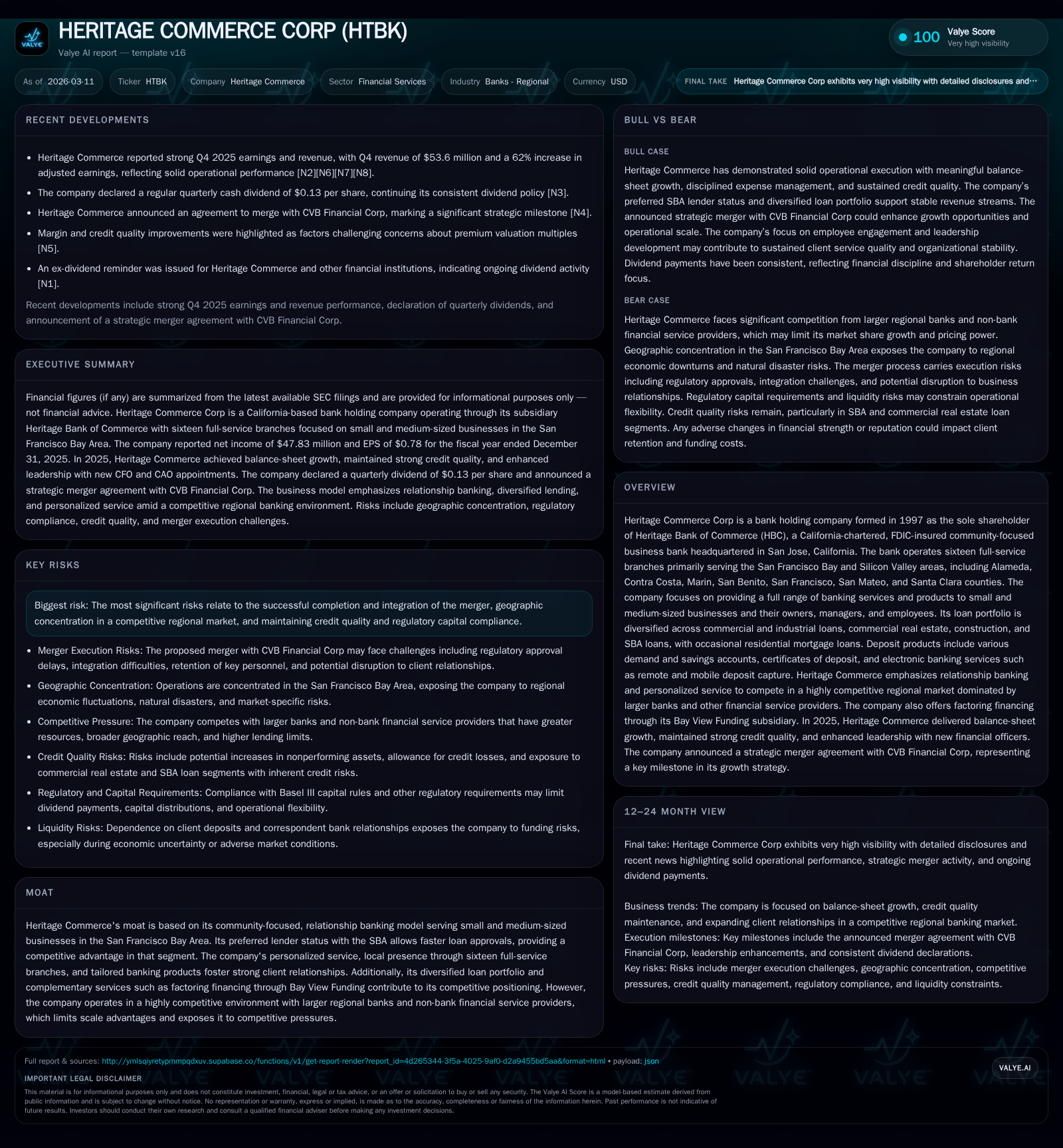
In 2025, Heritage Commerce Corp rebounded from prior years' profitability declines, achieving an 18% net income increase supported by steady loan origination from its San Francisco Bay Area branches. The company's diversified loan portfolio and preferred SBA lender status underpinned consistent credit quality despite competitive pressures from larger institutions. Strategic management hires and board succession strengthened corporate governance as the bank advances its pending merger with CVBF, which presents potential scale benefits but also integration risks. Capital allocation remained focused on dividends and leveraging improved operating cash flows while capex was sharply curtailed, positioning Heritage for disciplined growth in a consolidating banking market.
Steady Financial Performance Amid a Competitive Bay Area Banking Scene
Historical performance (annual)
| FY | Net ($mm) | CFO ($mm) | Capex ($) | Net YoY |
|---|---|---|---|---|
| 2025 | 48 | 62 | 377000 | +18.0% |
| 2024 | 41 | 39 | 1624000 | -37.1% |
| 2023 | 64 | 73 | 1671000 | -3.2% |
| 2022 | 67 | 70 | 783000 |
Source: SEC companyfacts cache [F1].
Capital returns and efficiency (annual)
| FY | Div ($mm) | FCF ($mm) | ROE% |
|---|---|---|---|
| 2025 | 32 | 61 | 6.8 |
| 2024 | 32 | 37 | 5.9 |
| 2023 | 32 | 71 | 9.6 |
| 2022 | 31 | 69 | 10.5 |
Source: SEC companyfacts cache [F1].
Heritage Commerce Corp experienced a notable rebound in its earnings profile during fiscal year 2025, reporting net income of $47.83 million—an 18% increase over the prior year’s $40.53 million [F1]. This follows a period of decline through FY2023-24 when net income had fallen from $66.46 million in FY2022 to $40.53 million in FY2024. The turnaround was driven primarily by disciplined loan origination concentrated through the company’s network of sixteen full-service branches deeply embedded in high-growth counties such as Santa Clara, San Francisco, and Alameda within the San Francisco Bay Area [S1], [S4]. While this regional focus supports robust small- and medium-sized business borrower engagement characteristic of Silicon Valley's economic demographics, it also places Heritage within an intensely competitive landscape dominated by several multi-billion-dollar banks holding approximately 69.58% of total deposit market share across its geographic footprint [S4]. As of mid-2025, Heritage ranked fourteenth among deposit holders with a modest 0.74% share, signaling ongoing pressure on pricing and client acquisition.
Loan Portfolio Diversification Driving Consistent Credit Quality
A cornerstone supporting Heritage’s resilient credit profile is its diversified loan portfolio spread across commercial and industrial loans, commercial real estate (CRE), construction and land development financing, Small Business Administration (SBA) loans, along with select residential mortgage lending [S1]. This mix enables risk mitigation against sector-specific downturns. Regulatory filings highlight that despite incremental growth in CRE exposures—measured at 319% of risk-based capital as of December 31, 2025 versus 311% the prior year—the company has sustained low nonperforming assets and net charge-offs throughout the fiscal year [S1], consistent with effective credit risk management practices including adequate loan loss reserves. Notably, Heritage's preferred lender status with the SBA accelerates loan approval times providing distinct competitive differentiation that enhances client retention particularly in segments underserved by larger banks [S19]. However, regulatory scrutiny remains elevated on CRE concentrations and construction-to-permanent loans due to their higher inherent credit risk given sensitivities to property valuation fluctuations and development cycle risks [S6].
Strategic Leadership Changes and Corporate Governance Renewal
Complementing operational stability is Heritage’s strategic renewal at the executive leadership level amid transformative corporate actions. In 2025, the company appointed Seth Fonti as Chief Financial Officer bringing over two decades of global banking experience, alongside Jeannie Tam as Chief Accounting Officer with deep expertise in financial operations transformation within financial services [S1]. Additionally, Board governance transitioned smoothly with the Vice Chair assuming Chair responsibilities in May and a new independent director joining later that summer to ensure continuity against the backdrop of the company's pending merger [S1]. These moves signal focused stewardship intended to balance day-to-day management rigor with the complexities inherent in integrating CVBF post-merger.
Evaluating Heritage’s Capital Allocation: Dividends, Equity, and Cash Flow Trends
Despite a recent trough in profitability earlier this decade, Heritage has maintained a steady stream of shareholder returns with roughly stable annual dividends paid each year near $31.9 million through FY2025 [F1]. This discipline contrasts favorably against variable earnings cycles common among regional banks. Notably, operating cash flow surged by more than 58% year-over-year to $61.68 million driven by improved core earnings quality and expense efficiency measures [F1]. Concomitantly, capital expenditures were curtailed significantly—from about $1.62 million in FY2024 down to only $377 thousand in FY2025—reflecting restrained reinvestment commensurate with its branch-centric business model but supplemented by ongoing digital capabilities investments via online banking offerings [S1]. The company’s equity base grew moderately reaching $708.57 million at year-end reflecting retained earnings accumulation [F1]. These factors culminate in an approximate return on equity (ROE) near 6.8%, indicating moderate profitability against its capital deployment scale.
The Proposed Merger with CVBF: Growth Catalyst or Integration Risk?
Announced recently as a strategic milestone for expansion beyond organic growth limits constrained by geographic concentration and competitive pressures, Heritage’s merger agreement with CVBF represents an opportunity to achieve greater economies of scale critical for sustaining competitive viability [S1], [N1]. The combined entity can plausibly expand lending limits beyond current constraints tied to regulatory caps at Heritage’s scale while broadening product offerings. However, publicly disclosed risk factors underscore common merger vulnerabilities encompassing potential difficulties or delays in obtaining regulatory approvals; costs exceeding estimates; key personnel retention challenges; possible shareholder dilution effects reducing existing investor control; disruption to existing client relationships; and litigation risks associated with merger proceedings that could hinder execution timelines or outcomes [S1], [S16]. These considerations weigh heavily as Heritage navigates integration planning amid a highly regulated financial environment.
Navigating Regional Market Concentration and Regulatory Pressures
Heritage’s exclusive footprint within California's Greater San Francisco Bay Area imbues it with both strengths tied to local knowledge and personalized service appeal as well as significant concentration risks described extensively by management [S1], [S4]. Regulators have noted that CRE lending concentrations above 300% of capital spark elevated supervisory scrutiny; Heritage exceeds this at roughly 319%, mandating rigorous internal risk controls to avoid growth restrictions such as limitations on branching or mergers imposed by authorities [S6], [S17]. In parallel, intensified competition from large regional and national players boasting broader product suites puts pressure on net interest margins and deposit costs while technological innovation lowers barriers for fintech entrants eroding traditional community bank market share [S19], [S4], [F1]. Regulatory complexity further extends into consumer protection laws specific to California adding compliance cost burdens that can disproportionately affect mid-sized institutions like Heritage versus larger peers or less regulated competitors.
Metrics That Matter: ROE, Operating Cash Flows, and Investment Efficiency
Quantitative analysis shows improvement metrics signposting operational leverage gains; net income rose by an emphatic 18% year-over-year reaching $47.83 million while operating cash flow expanded even more sharply by over 58%, highlighting enhanced cash generation amid tight expense controls noted internally [F1]. Capital expenditure reductions nearly seventy-seven percent reduced cash outflows enabling free cash flow generation estimated around $61.3 million—an ample buffer supporting dividend payments totaling $31.9 million while permitting reinvestment or debt servicing if needed [F1]. The approximate ROE at just under 7% is below peak historical levels but reasonable given current large equity base size relative to earnings base expansion pace. Efficiency improvements appear linked to digital channel augmentation coupled with sustained physical branch utilization which remains core to local marketing effectiveness.
Future Prospects and Watchpoints for Investors
Looking ahead, Heritage Commerce’s near-term trajectory depends critically on successful completion of its transaction with CVBF including satisfying all regulatory conditions without material delay or cost overruns—events that could unsettle markets or impair operational momentum [N1], [S3]. Maintaining credit underwriting discipline post-merger will be essential as combined entities integrate loan portfolios subject to differing underwriting standards or regional economic exposures. Investors should closely monitor nonperforming asset trends alongside regulatory updates related to CRE exposure thresholds since heightened scrutiny might curtail expansion plans or limit dividend flexibility if capital buffers erode unexpectedly. Additionally, changes in branch strategy adapting for evolving customer preferences toward electronic banking represent both a challenge and potential efficiency lever.
This analysis synthesizes publicly filed reports alongside market intelligence without extending investment recommendations or forecasts beyond documented facts. Readers should consider these findings within their broader due diligence framework given evolving macroeconomic conditions impacting regional banks generally.
Disclaimer: This is research-only, informational analysis and not investment advice. It may include AI-generated interpretation and general industry context. Always verify important details using primary sources.

Comments