
ACCO BRANDS Corp: Profit Recovery Despite Revenue Decline and Operational Pressures
In 2025, ACCO BRANDS Corp reversed prior operating losses with disciplined cost management and supply chain flexibility, despite an 8.5% revenue decline.
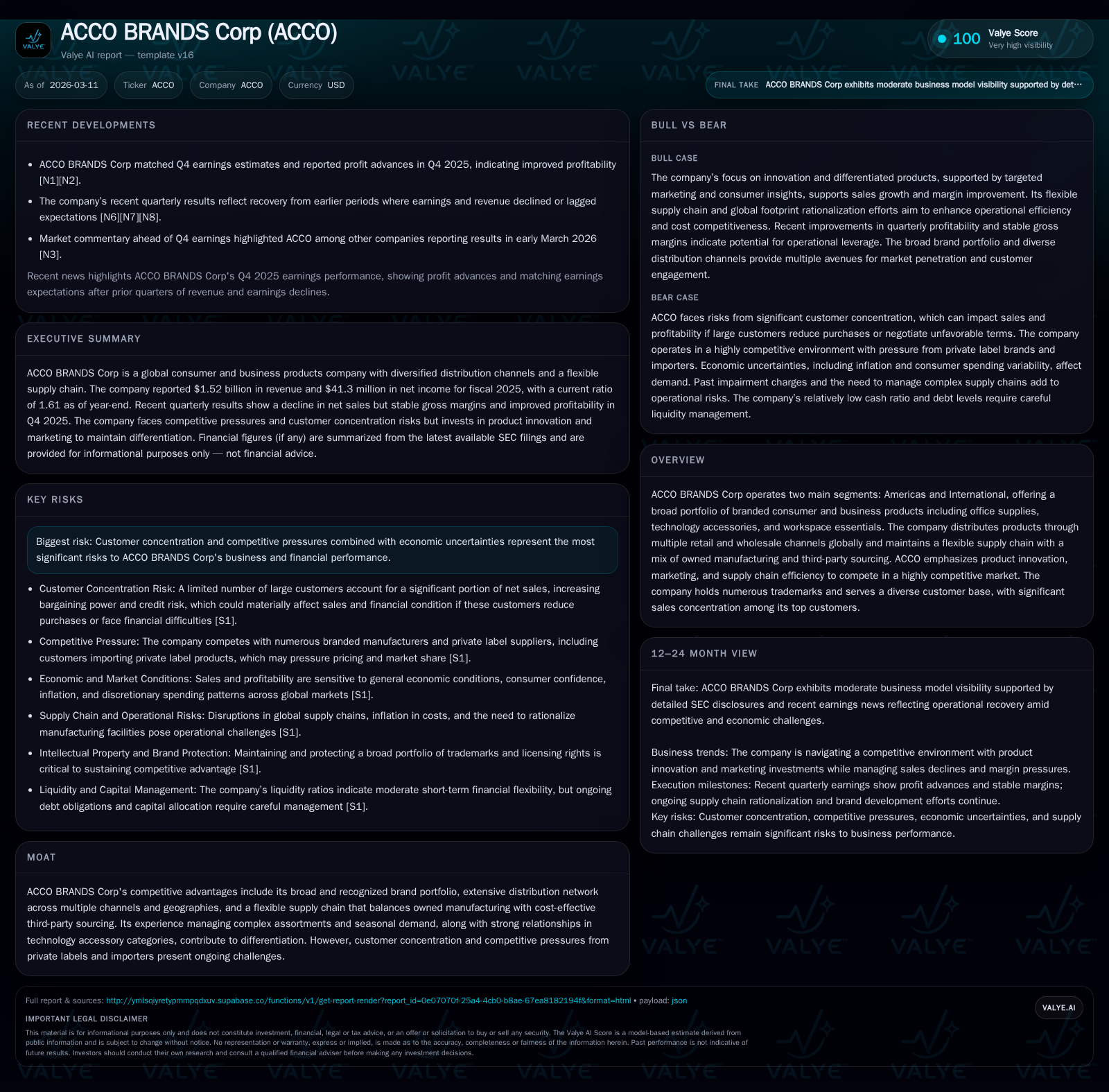
For fiscal year 2025, ACCO BRANDS Corp reported $1.52 billion in revenue, down 8.5% year-over-year, while operating income rebounded sharply to $92.3 million from a loss of $37 million in 2024 [F1],[S2]. This improvement was driven by gross margin stability, reduced intangible amortization, and controlled selling, general and administrative expenses amid a competitive market and concentrated customer base [S22],[S15]. The company’s supply chain blends approximately 40% owned manufacturing with 60% third-party sourcing primarily from Asia, supporting operational agility [S1]. Capital allocation focused on share repurchases of $15.1 million and moderate capital expenditures, maintaining a return on equity near 6.2% [F1],[S6]. Key risks include customer concentration, foreign exchange exposure, and economic uncertainties impacting discretionary spending [S15],[N5]. Future growth depends on product innovation success and managing seasonal demand across diverse global channels [N1],[N2].
Historical Performance Overview
ACCO BRANDS Corp’s financial results for fiscal years 2023 through 2025 show declining revenues alongside a significant rebound in profitability. Revenue decreased from $1.83 billion in FY2023 to $1.66 billion in FY2024 and further declined by 8.5% to $1.52 billion in FY2025 [F1]. Despite this top-line contraction, operating income recovered from a loss of $37 million in FY2024 to a positive $92.3 million in FY2025—reflecting a strong turnaround in operating margins from negative to approximately 6% [F1],[S2].
Segment performance mirrored these trends with the Americas segment reporting approximately $894 million in sales for FY2025 compared with nearly $1 billion the prior year; the International segment also experienced declines consistent with overall revenue pressures [S4],[S12]. This geographic spread exposes the company to regional economic fluctuations and currency risks.
Historical performance (annual)
| FY | Rev ($mm) | Net ($mm) | CFO ($mm) | OpInc ($mm) | Rev YoY | Net YoY |
|---|---|---|---|---|---|---|
| 2025 | 1525 | 41 | 69 | 92 | -8.5% | +140.6% |
| 2024 | 1666 | -102 | 148 | -37 | -9.1% | -366.1% |
| 2023 | 1833 | -22 | 129 | 45 | -5.9% | -65.2% |
| 2022 | 1948 | -13 | 78 | 35 |
Source: SEC companyfacts cache [F1].
Capital returns and efficiency (annual)
| FY | Buybacks ($mm) | ROE% |
|---|---|---|
| 2025 | 15 | 6.2 |
| 2024 | 15 | -16.8 |
| 2023 | 0 | -2.8 |
| 2022 | 19 | -1.6 |
Source: SEC companyfacts cache [F1].
Note: Capex data for FY2025 is not available; share repurchases resumed after no buybacks in FY2023.
Drivers of Profitability Recovery
The return to profitability was largely driven by tight control over selling, general and administrative expenses which decreased by roughly 11-12%, reflecting disciplined overhead management and elimination of impairment charges that had negatively impacted prior periods [F1],[S2]. Reduced intangible amortization further supported earnings recovery.
Improved unit economics benefited from prudent promotional spending adjustments and selective pricing strategies mitigating inflationary pressures on cost of goods sold [S22]. The absence of restructuring charges or goodwill impairments common in earlier years also contributed positively.
These factors collectively demonstrate ACCO’s ability to adapt cost structures effectively within its complex product assortment characterized by seasonality typical of office supply markets.
Supply Chain Strategy Supporting Cost Efficiency
Approximately 40% of ACCO’s products are manufactured internally within global facilities close to key markets—primarily serving the Americas segment—while about 60% are sourced externally from lower-cost suppliers predominantly located in Asia [S1]. This hybrid model balances fixed capacity utilization with variable sourcing flexibility essential for managing seasonal demand without excessive capital investment.
Ongoing facility rationalization aims to enhance operational efficiency through consolidation under global optimization initiatives [S1]. Investment focus remains on internal research & development complemented by partnerships with technology providers targeting product adjacencies such as gaming accessories and ergonomic tools designed to expand margins despite pricing competition from private labels [S19].
Strong licensing relationships also support competitiveness within technology accessory categories.
Channel Diversification Amid Customer Concentration Risks
ACCO distributes through multiple channels including mass retailers, e-commerce platforms, warehouse clubs, contract stationers, specialty technology stores, and direct sales globally providing resilience but complicating inventory management due to varying lead times across regions [S1],[S4],[S10].
However, revenue concentration among a limited number of large customers poses negotiation challenges given their significant bargaining power as well as credit risk exposure if liquidity issues arise among these partners [S15],[N5]. The rise of private label competitors within these channels further intensifies margin pressures.
Maintaining favorable shelf space terms and inventory replenishment policies remains critical for sustaining profitability.
Capital Allocation Focused on Share Repurchases and Modest Investments
The company repurchased shares worth approximately $15 million annually over recent fiscal years following a pause in prior periods reflecting disciplined capital deployment aligned with covenant restrictions under debt agreements [F1],[S6],[S11]. There have been no recent dividend declarations.
Capital expenditures have generally been modest relative to earnings capacity—historically around $17–21 million pre-2025—and are oriented toward supply chain efficiency rather than expansionary growth projects [F1]. Approximately return on equity stood near 6.2%, indicating improved profitability but room for enhanced capital productivity remains given competitive pressures on margins.
Operating cash flow declined significantly (-53%) year-over-year mainly due to working capital changes associated with slower sales; nonetheless free cash flow remained positive at about $51 million after estimated capex outlays—indicating continued liquidity sufficiency though less robust than prior years [F1].
Key Risks & Uncertainties
Significant reliance on a small group of large customers increases vulnerability to margin compression and payment delays impacting cash flows [S15],[N5]. Foreign currency exchange rate volatility affects international revenues despite hedging strategies focused on major currencies including Euro, British Pound, Brazilian Real among others [S15].
Ongoing legal matters related primarily to intellectual property rights present some uncertainty although management currently does not anticipate material adverse impacts barring unexpected developments [S16],[S23]. Inflationary pressures on raw materials or labor costs remain potential headwinds.
Outlook Considerations: Innovation & Demand Management
Future performance will depend heavily on execution of its product innovation pipeline targeting evolving consumer preferences especially within gaming accessories and technology-enhanced office products referenced by corporate marketing efforts leveraging digital analytics platforms [N1],[N2],[S1].
Effective management of seasonal demand cycles amidst complex multi-category assortments will require fine-tuned inventory velocity controls across diverse channels to avoid stock imbalances that can erode margins or increase holding costs.
Monitoring cash flow trends closely—particularly working capital components—will be essential given CFO variability amid competitive pricing pressures [F1]. Upcoming quarterly earnings releases should provide insights into execution risks shaped by global macroeconomic conditions affecting discretionary spending patterns.
This analysis integrates ACCO BRANDS Corp’s latest SEC filings and recent news coverage along with publicly disclosed financial data without extrapolation or forecast beyond documented information.
Disclaimer: This is research-only, informational analysis and not investment advice. It may include AI-generated interpretation and general industry context. Always verify important details using primary sources.

Comments