
MediciNova Inc’s Strategic Path Through Drug Development and Capital Challenges
MediciNova pursues a dual-pipeline biopharmaceutical strategy while managing persistent losses and liquidity amid ongoing clinical development.
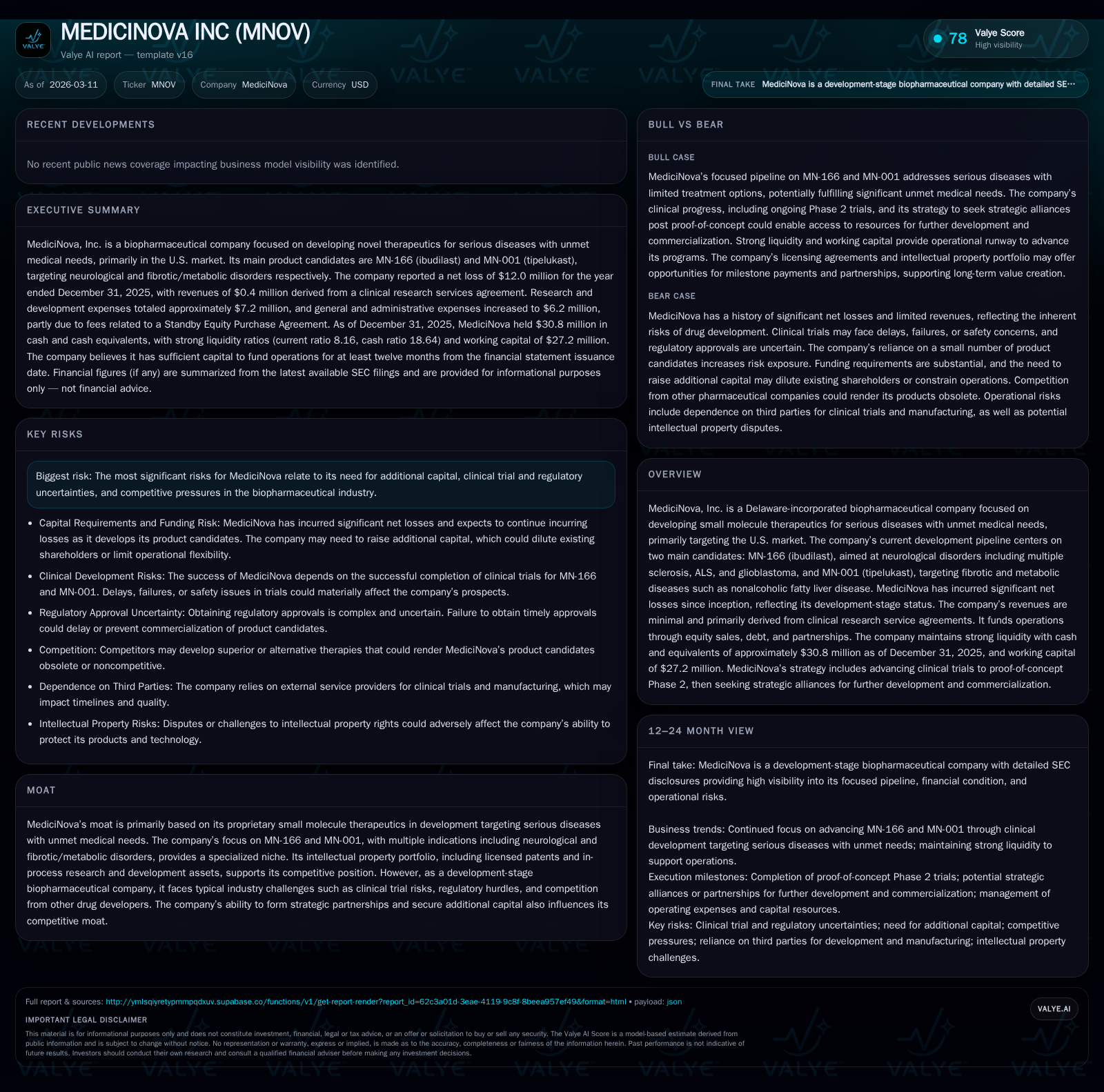
MediciNova, a Delaware-incorporated development-stage biopharma company, focuses on two proprietary small molecule candidates—MN-166 targeting neurological disorders and MN-001 addressing fibrotic/metabolic diseases. Despite minimal revenues primarily from clinical research services, it has sustained net losses exceeding $12 million in 2025, driven by intensive R&D expenditures. The company maintains robust liquidity with over $30 million in cash equivalents but relies heavily on equity financing to fund operations. Future growth hinges on the successful completion of Phase 2 trials and strategic partnerships to advance late-stage development and commercialization efforts. Risks remain significant due to capital needs, regulatory hurdles, and competitive pressures inherent in the biopharma sector.
From Early R&D to Persistent Net Losses: Historical Performance Review
MediciNova presents a financial trajectory emblematic of an early-stage biopharmaceutical enterprise committed to advancing novel therapies through clinical development. Historical reported revenues have remained relatively flat over the past decade, marked by approximately $6 million in annual revenue since 2013 [F1]. These revenues derive predominantly from clinical research service agreements rather than product sales, underscoring the company’s pre-commercial status.
Operating income has consistently been negative, reflecting escalating investments in research and development initiatives centered on its lead drug candidates. For fiscal year ended December 31, 2025, MediciNova reported an operating loss of $13.3 million—a marginal increase from $12.7 million in 2024—while net losses reached nearly $12 million in 2025 compared to approximately $11 million in the prior year [F1]. This progression corresponds with intensifying R&D activity as the company advances its pipeline programs.
Operating cash flows have remained negative but show slight improvement; the company used approximately $9.8 million in operating activities in 2025 versus $10.6 million in 2024 [F1]. Capital expenditures are minimal relative to operational spend—only a few thousand dollars annually—indicating that MediciNova’s cost structure is weighted heavily toward trial expenses and intangible asset development rather than fixed asset investment.
Historical performance (annual)
| FY | Net ($mm) | CFO ($mm) | OpInc ($mm) | Capex ($) | Net YoY |
|---|---|---|---|---|---|
| 2025 | -12 | -10 | -13 | 2899 | -8.6% |
| 2024 | -11 | -11 | -13 | 895 | -28.9% |
| 2023 | -9 | -7 | -10 | 21299 | +39.1% |
| 2022 | -14 | -13 | -15 | 5010 |
Source: SEC companyfacts cache [F1].
Capital returns and efficiency (annual)
| FY | FCF ($mm) | ROE% |
|---|---|---|
| 2025 | -10 | -28.9 |
| 2024 | -11 | -21.0 |
| 2023 | -7 | -13.7 |
| 2022 | -13 | -20.0 |
Source: SEC companyfacts cache [F1].
Figures compiled from SEC filings [F1], showing sustained revenue stagnation alongside increasing net losses driven by R&D intensification.
Pipeline Focus: MN-166 and MN-001 Targeted Therapeutics
At the core of MediciNova’s strategic focus lie two proprietary small molecule therapeutics poised to address serious unmet medical needs within niche therapeutic areas:
MN-166 (ibudilast): Pursued as a treatment for progressive neurological disorders including multiple sclerosis (MS), amyotrophic lateral sclerosis (ALS), chemotherapy-induced peripheral neuropathy, degenerative cervical myelopathy (DCM), glioblastoma multiforme (GBM), and prevention of acute respiratory distress syndrome (ARDS). Clinical evaluation is principally at proof-of-concept Phase 2 stages [S1], leveraging MN-166's presumed anti-inflammatory mechanisms to modulate neurodegenerative disease pathways.
MN-001 (tipelukast): Focuses on fibrotic and metabolic indications such as nonalcoholic fatty liver disease (NAFLD) and hypertriglyceridemia. Development progress also includes early-to-mid-phase clinical trials designed to establish safety and efficacy benchmarks necessary for subsequent late-stage investment decisions [S1].
Both candidate drugs exemplify MediciNova’s commitment to addressing complex chronic conditions currently under-served by approved therapies. Success metrics hinge on demonstration of clinically meaningful endpoints in randomized controlled trials coupled with regulatory clearance processes targeting U.S.-based markets [S1].
Financial Health Analysis: Liquidity, Capital Structure and Operating Cash Flows
Despite persistent operational deficits, MediciNova’s balance sheet exhibits considerable liquidity strength that underpins ongoing R&D activities through at least a one-year horizon post-reporting date [S4][S5][F1]. Cash and cash equivalents total approximately $30.8 million as of December 31, 2025 [F1], representing a current ratio of about 8.16 when juxtaposed with current liabilities near $3.8 million [F1]. Such metrics underscore a solid short-term financial position characteristic of prudent liquidity management.
Liabilities are primarily current accounts payable and accrued liabilities associated with clinical trial accruals—a significant non-cash component recognized by management due to ongoing expenditure obligations with contract organizations [S20]. Lease liabilities related to office premises contribute marginally to long-term obligations but reflect standard commitments reflective of normal operational scale [S19].
Negative operating cash flow continues due to significant outlays on external contract research organizations (CROs), manufacturing arrangements for test compounds, personnel costs, patent filings, and other pre-commercial investments [S23][F1]. Although operating cash outflows slightly decreased year-over-year—from roughly $10.6 million in 2024 to $9.8 million in 2025—it remains a fundamental challenge to balance burn rate against available capital reserves.
Strategic Financing Maneuvers: Evaluating Equity Raises and Capital Allocation
Funding operations largely depends on equity issuance programs aimed at extending operational runway amid absence of meaningful commercial revenue streams. In July 2025, MediciNova entered into a Standby Equity Purchase Agreement (SEPA) with Yorkville Advisors permitting sales up to $30 million worth of common stock over a three-year horizon subject to restrictions safeguarding shareholder interests around ownership concentration levels [S6][S12].
The SEPA arrangement provides a flexible ‘at-the-market’ selling mechanism whereby shares may be issued incrementally based on financing needs while accounting for price considerations linked to trading activity [S6]. The company incurred certain fees totaling approximately $0.4 million related to this agreement during fiscal year 2025 [S16], reflecting typical costs for such capital raising structures.
An earlier At-The-Market Issuance Agreement with B. Riley Securities was terminated effective March 2026 following no equity sold under that facility during recent periods [S21]. No dividends or share repurchase programs exist at this stage given the necessity to conserve capital strictly for developmental activities rather than shareholder returns [S21][F1].
Assessing Growth Potential Against Clinical and Regulatory Risks
Prospective growth drivers rely heavily on successful outcomes from ongoing Phase 2 trials for MN-166 and MN-001 alongside subsequent regulatory submissions including Investigational New Drug (IND) applications progressing toward potential New Drug Applications (NDAs) upon positive results [S1][S13]. The specialized neurodegenerative disease space targeted by MN-166 represents high unmet need but is fraught with historically high attrition rates attributable to complex pathophysiology and stringent FDA evaluation criteria.
Similarly, MN-001's focus on NAFLD addresses an increasingly recognized chronic condition lacking effective therapeutic options; yet competition from larger pharmaceutical entities deploying advanced fibrosis therapeutics remains a palpable headwind [S1][S13].
Strategic collaborations or licensing deals post proof-of-concept data represent vital inflection points by unlocking additional resources or market access that may help offset prolonged development timelines or funding shortages [S1]. Nonetheless, capital acquisition must continue if ambitious multi-indication trials expand or if acquisition/in-licensing activities occur—as both scenarios heighten cash consumption risks considerably.
Operational Leverage and R&D Intensity Driving Expense Trajectory
Research & Development expenditures accounted for approximately $7.2 million annually during both years ended December 31, 2025 and 2024—relatively stable but shifting internally by increased spending on MN-166 pharmacokinetic and DCM studies balanced against lower manufacturing costs elsewhere [S25][S23].
These outlays encompass external costs paid to CROs conducting clinical trials as well as contract manufacturers producing active pharmaceutical ingredients tied directly to trial protocols [S23]. Additional internal expenses cover staff compensation dedicated full-time towards development projects alongside facility depreciation linked primarily to office spaces housing R&D teams staffing activities strategically focused on drug candidate advancement.
Patent-related expenses approximated $0.4 million yearly during these periods representing continual IP protection efforts vital for maintaining exclusivity windows critical for future commercialization success [S10].
Forecast Horizons: Upcoming Milestones to Monitor
Explicit guidance is limited; however, key upcoming events expected include interim analyses or full completion of Phase 2 clinical trials assessing MN-166 efficacy across several neurological indications as well as similar investigational steps advancing MN-001 trials targeting fibrotic/metabolic pathways [S1][N1—not available]
Post-trial conclusions will likely activate corporate strategic initiatives aiming toward partnering discussions or licensing negotiations intended to de-risk commercialization phases through collaborative R&D synergy or out-license arrangements beyond US borders—a conventional approach within specialized small molecule biotech companies seeking pathway acceleration while mitigating excessive capital reliance.
Investors should track announcements regarding patient enrollment completions, data readouts from interim analyses focusing on safety/efficacy endpoints common in neurodegenerative disease trial designs (e.g., change from baseline functional scores), plus any pipeline updates informing shifts in prioritization amidst multiple simultaneous indications.
Valuation Considerations Amid Biopharma Development Uncertainties
From an analytical perspective grounded solely on reported figures without speculation on market pricing or valuation multiples, MediciNova’s approximate return-on-equity equates to around -29%, stemming from persistent net losses relative to equity base accumulated through prior financings [F1]. This negative ROE highlights structural challenges typical among early phase biopharma entities transitioning towards clinical validation stages yet insufficient revenue generation.
Capital efficiency remains paramount given continued operational burn partially offset by partnership potential gains post proof-of-concept milestones but still subject to binary risks inherent in trial failures or regulatory delays impacting future funding access or share price performance.
Such factors dictate conservative valuation approaches emphasizing scenario-driven outcomes dependent principally on pipeline clinical progress efficacy combined with successful execution of strategic financing maneuvers supporting sustainability during these pivotal years ahead.
This analysis relies exclusively on company-reported financial statements and SEC filings as of March 11, 2026 ([F1], [S1]–[S29]). No investment recommendations are provided herein.
Disclaimer: This is research-only, informational analysis and not investment advice. It may include AI-generated interpretation and general industry context. Always verify important details using primary sources.

Comments