
Westrock Coffee Co's Vertical Integration and Traceability Drive Innovation but Profitability Remains Under Pressure
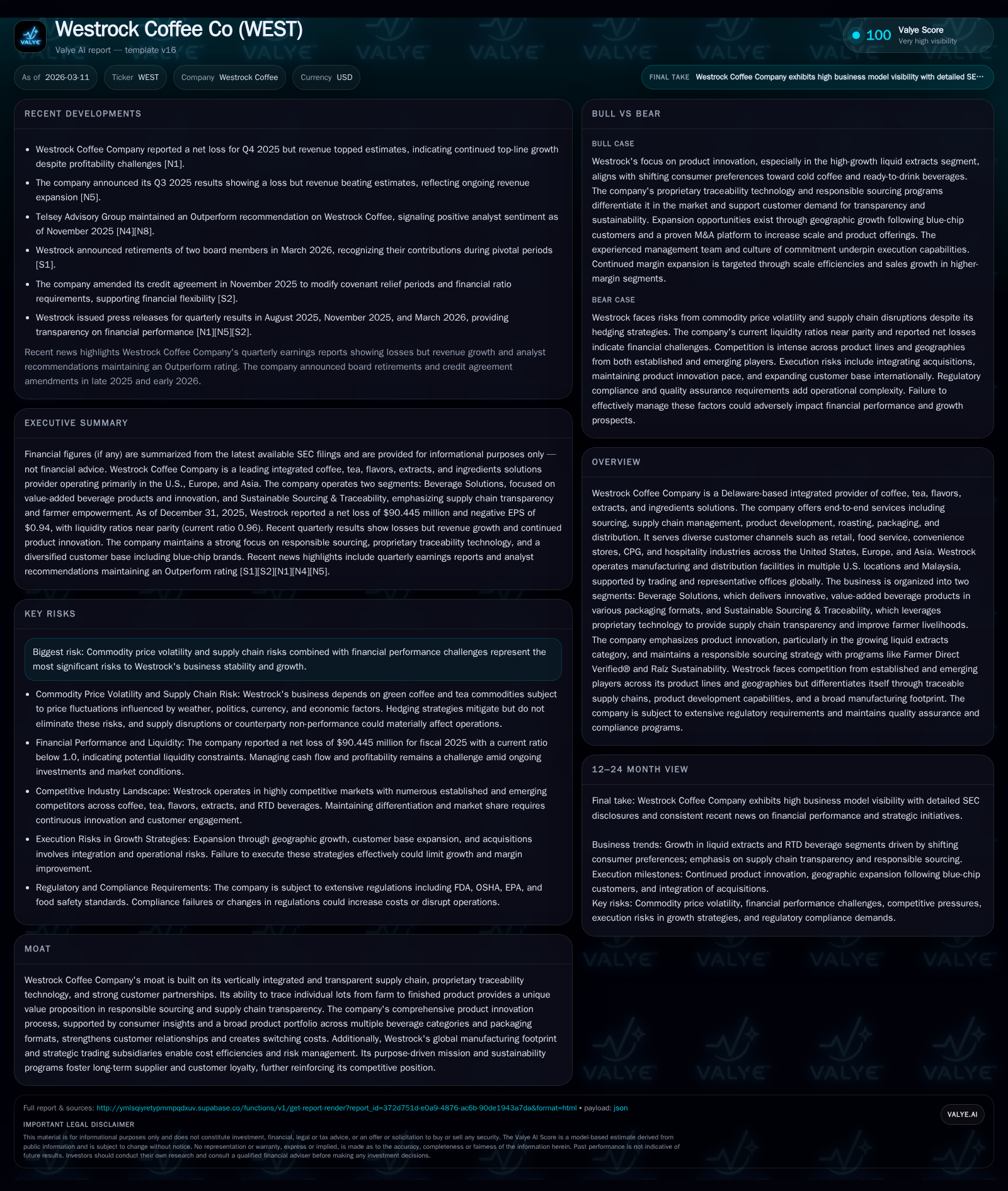
Westrock Coffee Company leverages a vertically integrated supply chain and proprietary traceability to deliver beverage solutions, yet financial challenges persist amid commodity volatility and operational costs.
Westrock Coffee Company (ticker: WEST) operates as a differentiated coffee, tea, and beverage solutions provider with a strong emphasis on sustainable sourcing and supply chain transparency. It has achieved steady revenue growth supported by innovation in liquid extracts and RTD beverages, though profitability remains negative with operating losses continuing through FY2025. The company’s future growth hinges on expanding its customer base, geographic reach, and product innovation while managing commodity price fluctuations and capital expenditures. Capital allocation reflects investment in facilities with limited free cash flow generation, no dividends, and constrained buybacks amid ongoing losses.
Company Overview
Westrock Coffee Company (WEST) is an integrated beverage solutions provider that covers coffee, tea, flavors, extracts, and ingredients. Distinguishing itself through vertical integration, it manages activities from raw material sourcing—often directly engaging with smallholder farmers—to roasting, packaging, and distribution. Westrock services diverse channels such as retail, food service, convenience stores, CPG brands, and hospitality industries globally. It operates manufacturing plants primarily in the U.S. (Arkansas and North Carolina) and Malaysia, complemented by trading and representative offices spanning the UK, Latin America, Africa, and Asia [S1][S4][S9].
Its business divides into two segments:
- Beverage Solutions: A value-added portfolio including branded/private label coffee products in various formats—bags, single-serve pods, RTD bottles/cans—and extract-based ingredients used by customers to produce cold brew or RTD beverages.
- Sustainable Sourcing & Traceability (SS&T): Engages in forward sales of green coffee commodities enhanced by proprietary traceability technology that offers supply transparency from farm to finished product [S1][S4][S7].
Historical Performance
Westrock has experienced top-line growth amid significant operational challenges manifesting as persistent losses.
Historical performance (annual)
| FY | Net ($mm) | CFO ($mm) | OpInc ($mm) | Capex ($mm) | Net YoY |
|---|---|---|---|---|---|
| 2025 | -90 | -19 | -45 | 89 | -12.6% |
| 2024 | -80 | -13 | -49 | 160 | -132.2% |
| 2023 | -35 | -64 | -20 | 165 | +37.3% |
| 2022 | -55 | -57 | 9 | 63 |
Source: SEC companyfacts cache [F1].
Capital returns and efficiency (annual)
| FY | FCF ($mm) | ROE% |
|---|---|---|
| 2025 | -108 | 4841.8 |
| 2024 | -173 | -82.4 |
| 2023 | -229 | -30.4 |
| 2022 | -120 | -595.4 |
Source: SEC companyfacts cache [F1].
Operating income improved by approximately 7.5% year-over-year in 2025 but remains negative [F1].
Net losses widened in fiscal year 2025 compared to the prior year reflecting ongoing cost pressures despite revenue beats reported [N1]. Operating cash flow remains negative at approximately -$19 million indicating continued liquidity challenges [F1]. Capital expenditures decreased sharply year-over-year as major investments transition toward steady-state operations [F1]. Equity turned slightly negative by year-end reflecting accumulated losses overtaking shareholder capital [F1].
Growth Drivers and Strategic Initiatives
Vertical Integration & Sustainability Focus
Westrock leverages full control over its supply chain via proprietary traceability technology enabling farm-to-cup transparency—a competitive advantage valued by sustainability-conscious customers [S15][S17]. Its Raíz Sustainability program supports environmentally responsible farming practices while improving farmer livelihoods through premiums and training [S17]. This integration supports product quality consistency and mitigates supply risks amid volatile global commodity markets.
Innovation in Beverage Solutions
Consumer trends favor premium offerings such as cold brew coffee, liquid extracts, RTD beverages, and iced teas—categories where Westrock sees significant opportunity [S10]. These higher-margin products align with shifting Millennial/Gen Z preferences for convenience and novelty.
Westrock’s multi-format packaging capabilities combined with consumer insights-driven blend customization foster long-term client partnerships that create switching barriers [S6][S9]. The company plans to continue expanding its product platforms through focused R&D investment targeting these growth areas.
Geographic Expansion & Channel Penetration
While Westrock serves a majority of its customers’ U.S.-based locations fully, it identifies substantial international growth potential given lower penetration among existing global clients [S4]. The company aims to "follow its customers" into new geographic markets leveraging existing infrastructure.
Diversification across retail, food service, convenience stores, travel centers, CPGs, non-commercial accounts, and hospitality provides balance against shifts between at-home and away-from-home consumption patterns [S4][S13].
M&A Pipeline & Operational Scalability
Westrock maintains a pipeline of accretive acquisitions designed to accelerate growth while capturing synergies via expanded customer base, product portfolio, and geographic reach [S4]. Its vertically integrated infrastructure supports scalable production aiming to improve cost efficiencies through fixed cost leverage.
Financial Outlook & Risks to Monitor
The company has not issued formal public guidance beyond recent quarterly disclosures but strategic milestones include scaling liquid extracts growth while improving gross margins via operational leverage [N1][S3][S4]. Key metrics to monitor include revenue acceleration driven by innovation adoption; progression toward positive operating income; improvements in free cash flow as capital intensity declines; and compliance with debt covenants under amended credit agreements extending through late 2026 with gradually tightening leverage ratios [S21][S22].
Material risks include:
- Commodity price volatility impacting raw material costs despite hedging strategies [S6][S14],
- Potential supply chain disruptions due to geopolitical or environmental factors,
- Continued operating losses that erode equity base threatening liquidity,
- Counterparty risks within hedging arrangements,
- Regulatory compliance costs under FDA Good Manufacturing Practices and environmental standards requiring ongoing management attention [S14].
Capital Allocation & Returns
Westrock generated negative free cash flow estimated at approximately -$108 million for FY2025 (operating cash flow minus capital expenditures), reflecting ongoing operational losses combined with substantial investment spending [F1]. The company currently does not pay dividends nor engage in share repurchases amid the need to preserve liquidity [S26][S27].
Leverage remains elevated; however covenant relief provisions are effective until October 2026 or earlier upon election allowing maximum secured net leverage ratios of up to 5.50x expected for the end of 2025 with step-down targets thereafter [S21][S22]. Interest coverage requirements have also been temporarily relaxed during this period.
Return on equity is negative given cumulative net losses exceed shareholder equity (-4842% approximate based on latest annual figures), underscoring the priority of restoring profitability before pursuing shareholder returns seriously [F1].
Sector Context & Competitive Positioning
Westrock competes within a fragmented market alongside established coffee/tea suppliers such as Keurig Dr Pepper Inc., Massimo Zanetti Beverage Group; flavor houses like Givaudan SA; ingredient providers including Kerry Foodservice; plus emerging RTD manufacturers [S8].
Its brand-behind-the-brand model positions Westrock as a critical partner delivering operational excellence combined with consumer-driven innovation supporting customers' product pipelines—fostering client stickiness despite competitors’ scale advantages.
Additionally, sustainability-linked transparency via Farmer Direct Verified® traceability programs addresses growing consumer demand for ethical sourcing practices—a differentiator versus some legacy competitors.
Recent Developments & Management Changes
In March 2026 Westrock reported Q4 results showing narrowing losses but sustained revenue strength indicative of resilient volume amidst cost pressures [N1]. Board retirements were noted without operational impact implications [S26][S27]. Management highlights measured expansion focused on liquid extracts driven by data-informed product development cycles aligned with high-margin potential [N1][S10].
Summary Table: Key Metrics
| Metric | FY2022 | FY2023 | FY2024 | FY2025 |
|---|---|---|---|---|
| Operating Income | $8.68 M | -$20.43 M | -$49.12 M | -$45.46 M |
| Net Income | -$55.19 M | -$34.58 M | -$80.30 M | -$90.44 M |
| Operating Cash Flow | -$56.63 M | -$64.06 M | -$13.24 M | -$19.01 M |
| Capital Expenditures | $63.26 M | $164.61 M | $159.63 M | $88.80 M |
| Equity | $9.27 M | $113.74 M | $97.48 M | -$1.87 M |
This overview highlights the ongoing challenge of balancing growth investments against persistent unprofitability.
Disclaimer: This analysis is for informational purposes only; it does not constitute investment advice or recommendations regarding securities of Westrock Coffee Company or any other entity.
Disclaimer: This is research-only, informational analysis and not investment advice. It may include AI-generated interpretation and general industry context. Always verify important details using primary sources.

Comments