
LifeMD Emerges as a Vertically Integrated Telehealth Leader with Surging Subscription Revenue
LifeMD's 2025 financial rebound and platform expansion spotlight its growing influence in virtual specialty care supported by a subscription-based telehealth ecosystem.
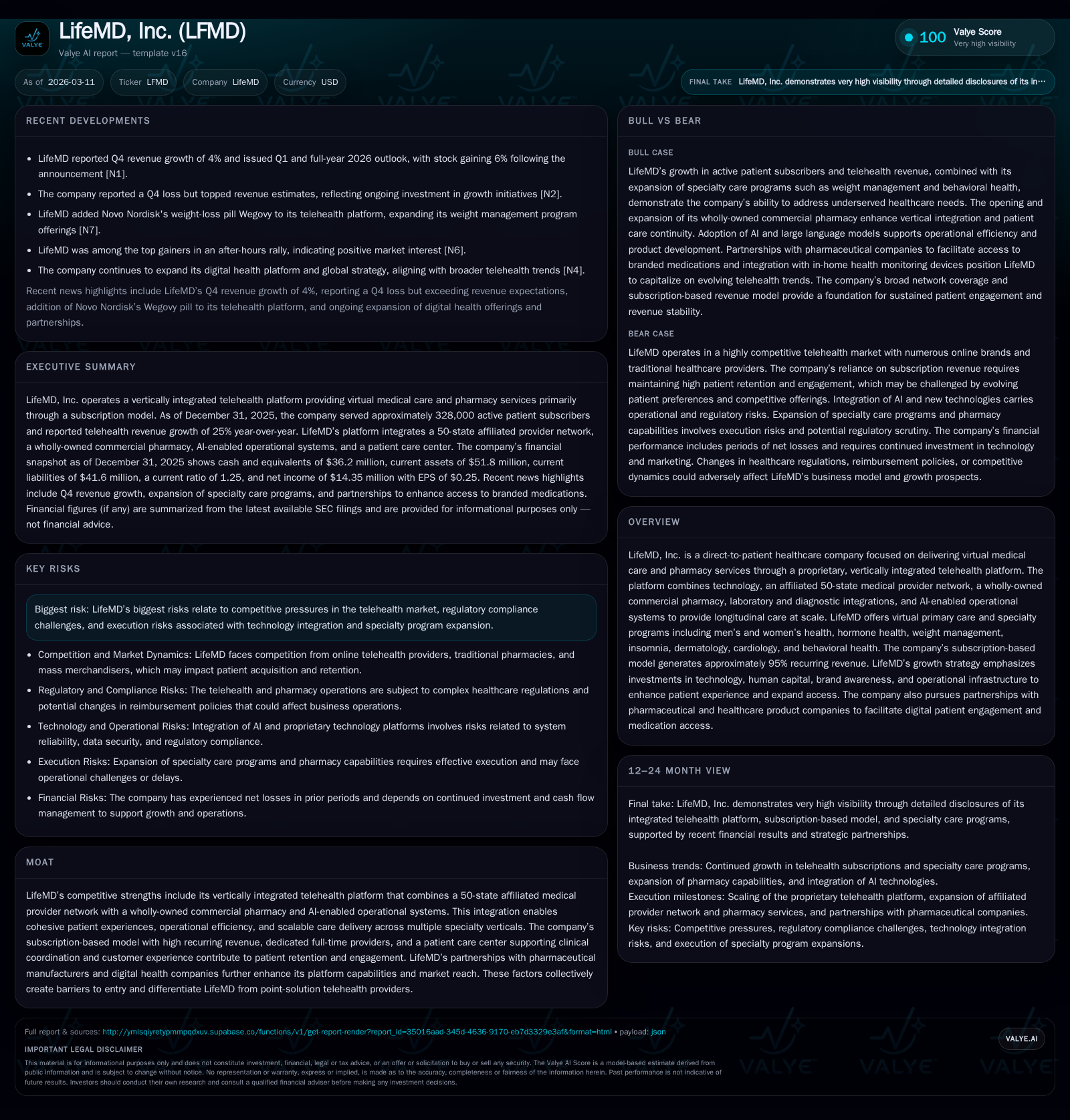
LifeMD made a pronounced financial turnaround in 2025, moving from steep losses in prior years to posting a positive net income of $14.4 million, driven mainly by nearly 50% revenue growth and a subscription model providing about 95% recurring revenue. The company’s vertically integrated telehealth platform combines a nationwide provider network, proprietary pharmacy, and AI-enabled operational systems, differentiating it in an increasingly crowded market. Expansion into private insurance and Medicare coverage alongside ongoing capital discipline demonstrates LifeMD’s intention to leverage platform synergies while navigating litigation and competitive risks.
A Transformation Trend: From Operating Losses to Positive Net Income
LifeMD exhibited a remarkable financial progression through the fiscal year ending December 31, 2025. After consecutive years of substantial operating deficits—operating income stood at -$16.1 million in 2024—the company shrank its operating loss by nearly half to approximately -$7.7 million despite sustaining robust investment activities [F1]. This operating leverage translated into a definitive bottom-line turnaround with net income swinging from a sharply negative -$18.9 million in 2024 to positive earnings of $14.4 million in 2025—a staggering improvement of over 176% year-on-year [F1].
Revenue performance serves as the cornerstone of this turnaround narrative. LifeMD realized a nearly 50% surge in top-line revenue for FY25 relative to FY24, climbing to roughly $192 million [F1]. This growth was underpinned primarily by expanded patient subscriptions coupled with increasing monetization across broader specialty care channels.
Despite the net income gains, operating cash flow narrowed from $17.5 million to $8.3 million year-over-year, suggesting capital-intensive investments alongside normalized working capital swings as the platform scaled [F1][S11]. Capital expenditures moderately increased by approximately 25%, reflecting ongoing commitments toward technological infrastructure enhancements [F1][S15].
Historical performance (annual)
| FY | Net ($mm) | CFO ($mm) | OpInc ($mm) | Capex ($) | Net YoY |
|---|---|---|---|---|---|
| 2025 | 14 | 8 | -8 | 1870668 | +176.0% |
| 2024 | -19 | 18 | -16 | 1490857 | +8.3% |
| 2023 | -21 | 9 | -14 | 203814 | +54.8% |
| 2022 | -46 | -23 | -43 | 366633 |
Source: SEC companyfacts cache [F1].
Capital returns and efficiency (annual)
| FY | Div ($mm) | FCF ($mm) | ROE% |
|---|---|---|---|
| 2025 | 3 | 6 | 62.0 |
| 2024 | 3 | 16 | 344.2 |
| 2023 | 3 | 9 | -587.6 |
| 2022 | 3 | -23 | 399.6 |
Source: SEC companyfacts cache [F1].
All dollar values in millions USD; YoY figures reflect most recent periods reported.
Leveraging a Vertically Integrated Platform Across Specialty Care Verticals
LifeMD distinguishes itself through a fully integrated telehealth infrastructure that fuses clinical services with pharmacy fulfillment and diagnostics within a unified digital ecosystem [S1]. The hallmark of this integration is an affiliated medical provider network authorized across all U.S. states, layered atop proprietary technology facilitating virtual care delivery.
Unlike many point-solution telehealth operators focusing narrowly on episodic visits or single-disease management, LifeMD emphasizes longitudinal care scalability across multiple specialty verticals including men's sexual health, women's hormonal therapy, weight management, sleep disorders (insomnia), dermatology, cardiology, and behavioral health treatment programs [S1]. This breadth enables comprehensive chronic condition management using an AI-enabled operations backbone that streamlines appointment scheduling, clinical coordination, patient monitoring, and pharmacy fulfillment.
The vertically integrated platform enhances clinical cohesion—patients experience seamless transitions between diagnosis and medication fulfillment via the company's wholly owned commercial pharmacy network complemented by nationwide laboratory integrations supporting remote testing regimes [S1]. This synergy facilitates superior patient retention driven by continuous engagement supported by dedicated full-time providers operating within an optimized patient care center environment.
The Subscription Engine: Recurring Revenue and Patient Engagement Dynamics
Central to LifeMD’s business model is the high-margin subscription revenue engine which accounts for approximately 95% of total company revenues—a stark illustration of dependable recurring revenue underpinning business stability and valuation visibility [F1][S1]. As of December-end 2025, roughly 328,000 active subscribers engaged with LifeMD’s suite of service offerings covering broad healthcare needs spanning primary care through an array of specialty telemedicine programs [S1].
This subscription-centric model fuels sustained engagement and allows for data-driven personalization across patient cohorts—a key advantage complementing digital outreach via aggressive marketing efforts which surged selling expenses by about $16 million (23%) in FY25 reflecting investment in subscriber acquisition and retention initiatives [S15].
The structural stickiness stems from provider continuity paired with integrated pharmacy services that facilitate medication adherence—onboarding full-time clinicians rather than contract-based practitioners strengthens therapeutic relationships shaping durable lifetime value per subscriber.
Growth Accelerants and Regulatory Milestones Shaping Future Prospects
Among pivotal catalysts revolutionizing LifeMD's growth trajectory was the June 2024 rollout accepting private health insurance for virtual primary care including weight management treatments for medically qualified patients initially available selectively but slated for expansion nationwide [S1]. This strategic milestone optimizes payer mix beyond out-of-pocket patients enabling broader market penetration.
Equally transformative was the April 2025 extension to accept Medicare Part B reimbursement covering qualifying services initially for over 21 million beneficiaries across approximately half U.S states; subsequent infrastructure build-out now supports near-national reach across forty-nine states enhancing accessibility among older demographics traditionally underserved by telehealth platforms [S1][N2].
The legislation known as the One Big Beautiful Bill Act (OBBBA), enacted July 2025 further enhances telehealth's reimbursement environment permitting high-deductible plan holders tax-advantaged pre-deductible access to virtual care effective January 2025 onwards—this regulatory reform reduces financial friction heightening demand elasticity for telemedicine encounters incentivized by employer-backed plans leveraging Health Savings Accounts (HSAs) [S1].
Looking ahead, LifeMD plans continued enrollments with additional private payors aiming for ubiquitous insurance coverage nationwide thereby positioning the firm favorably within evolving reimbursement paradigms that prioritize preventative virtual care delivery models [N2].
Financial Discipline: Capital Structure, Cash Flow Improvement, and Return Metrics
LifeMD’s balance sheet strengthened considerably throughout FY25 highlighted by complete repayment of its $14 million Avenue Facility credit facility by August reducing leverage risk fully leaving zero indebtedness as of year-end while preserving ample liquidity evidenced by $36.8 million cash reserves on December 31, 2025 [F1][S4][S5].
The establishment of a secured revolving credit facility up to $30 million with Citizens Bank early January reflects forward-looking preparedness for corporate development or opportunistic acquisitions without overleveraging or diluting equity holders prematurely [S24][S25].
Equity rose notably during FY25 closing at nearly $23.2 million versus negative equity positions during prior periods showing recapitalization success combined with profitability gains that improved ROE significantly estimated near an impressive ~62% when computed as net income against average equity base [F1].
Cash flow dynamics showed mixed signals; although operating cash flows decreased from historically elevated levels due mainly to reinvestment cycles along with working capital normalization—they remained positive at approximately $8.3 million versus prior year’s stronger but less sustainable peak above $17 million illustrating operational resiliency post loss recovery phase [F1][S11]. Capital expenditures increased moderately reflecting sustained investment focus most materially on platform development and software amortization totaling around $1.9 million for the year ending December underscoring progressive technology architecture enhancement strategy aligned with longer-term growth objectives [F1][S15].
Meanwhile sustained annual dividend payouts set at $3.1 million since before FY22 demonstrate steadfast commitment to shareholder returns complemented by modest buybacks totaling $270K underscoring balanced capital stewardship blending yield provision with reinvestment into growth ventures securely anchored by improving fundamentals [F1][S23].
Risks and Litigation: Managing Competitive Intensity and Regulatory Compliance
LifeMD confronts intense competition inherent within the sprawling telehealth marketplace where numerous players vie aggressively via pricing innovations or niche specialties threatening erosion of subscriber market shares necessitating continuous innovation both clinically and technologically to maintain differentiation as a vertically integrated player distinct from point-solution entrants [S7][N4][N5].
Execution risks loom regarding sophisticated technology integration challenges linked especially with expansion into diverse specialty verticals each requiring customized clinical workflows raising system complexity subject potentially to operational disruptions or suboptimal user experiences impairing retention metrics if poorly managed.
Compounding these execution uncertainties are legal proceedings commencing late-2025 involving securities class action claims alleging misleading statements alongside related shareholder derivative lawsuits targeting alleged mismanagement claims causing distraction risks among senior management who must allocate resources toward defense activities concurrently managing operational growth demands—a motion to dismiss is slated early Q2-26 signaling litigation remains unsettled but non-trivial exposure warrants ongoing monitoring given possible material adverse business impacts if unsuccessful outcomes arise [S7][S9].[N1]
Regulatory landscapes also remain fluid especially as evolving telehealth reimbursement rules across public/private payors require iterative compliance adaptation notably around prescription drug dispensing regulations intersecting pharmacy licensing plus evolving data privacy norms given telemedicine's high reliance on protected health information exchange complexifying governance burdens regularly disclosed as salient risk drivers within annual filings sensitizing investors toward layered compliance vigilance requirements going forward [S12].[N2]
What to Watch: Strategic Partnerships, Medicare Expansion, and Platform Scaling
Critical upcoming milestones entail LifeMD's ability to capitalize on new alliances forged recently with pharmaceutical manufacturers plus digital health enterprises intended to enrich therapeutic offerings while extending brand reach likely expanding patient funnels thereby incrementally scaling subscription base beyond current ~328K active users boosting ARPU profiles if bundled services gain traction effectively expanding lifetime customer valuations funded through subscription fees sustaining recurrent revenue streams supported by progressively enhanced AI-enabled clinical coordination frameworks fostering operational efficiencies accelerating scalable growth economy effects fundamentally vital amid competitive pricing pressures compelling ongoing margin optimization endeavors [N2].[S1]
Medicare program expansions extending geographically beyond initial partial state footprints will be key barometers especially tracking enrollment trends among elder population subsets whose chronic disease prevalence provides rich opportunity sets for longitudinal virtual specialty interventions rendering monitoring Medicare Part B penetration rates meaningful forward indicators influencing steady-state subscriber compositions driving valuation uplift potentials intersecting macro healthcare utilization shifts intensified post-pandemic accelerating digitized outpatient care adoption trends broadly recognized industry-wide.[N2]
Equally important is quarterly revenue progression analysis following Q4 earnings releases revealing sustainability patterns behind subscription growth rates offering insights into sales/marketing efficiency balances vis-à-vis retention effectiveness quantitatively anchoring future earnings forecasts analytically forming groundwork upon which corporate guidance narratives may eventually be formalized absent today signaling heightened attentiveness warranted.[N1]
Disclaimer: This analysis is prepared solely for informational purposes based on publicly available filings and news sources; it does not constitute investment advice or recommendations.
Disclaimer: This is research-only, informational analysis and not investment advice. It may include AI-generated interpretation and general industry context. Always verify important details using primary sources.

Comments