
Oracle Corp’s Surge in Cloud and AI Investments Drives Record Earnings
Oracle's aggressive cloud infrastructure and AI investments fuel robust financial performance while balancing capital structure risks.
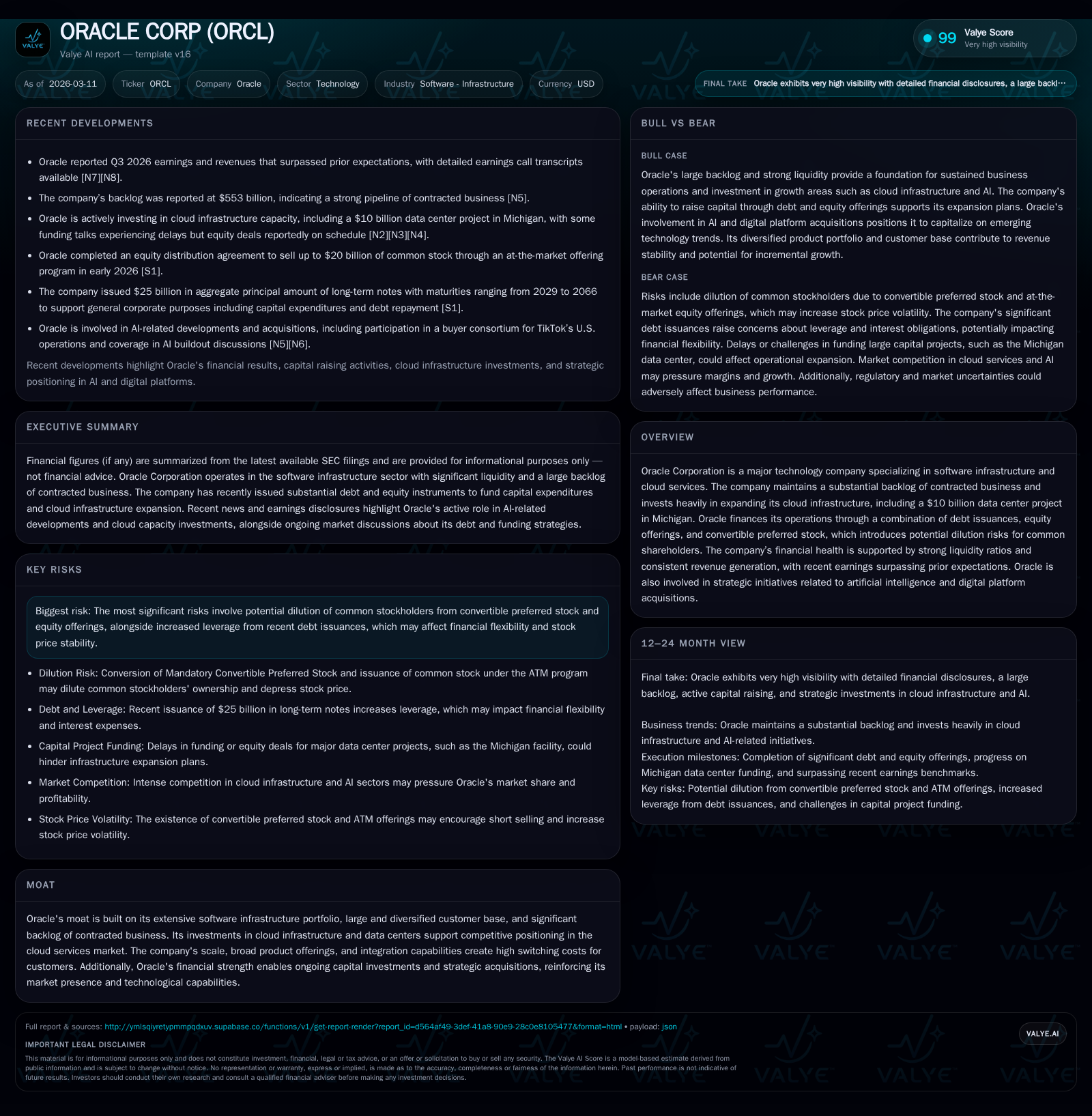
Oracle Corporation demonstrated significant revenue and profit growth through fiscal 2025, driven largely by cloud subscription expansion and efficient scaling of software infrastructure. The company committed to an ambitious $50 billion capital expenditure plan to expand its cloud footprint and deepen AI capabilities, supported by a record $553 billion backlog that ensures sustained revenue visibility. Despite strong operating cash flow, massive capex spending led to slight negative free cash flow recently, compounded by heightened leverage and convertible preferred stock issuance that introduces dilution risks. Oracle’s strategic focus on integrating AI within its platform ecosystem and scaling global data centers positions it for continued competitive advantage amid capital allocation challenges.
Robust Revenue and Profit Growth: The Numbers Behind Oracle’s Momentum
Oracle's financial trajectory through fiscal years 2022 to 2025 showcases a decade-defining ramp in both revenue and profitability. Revenue climbed from $42.4 billion in FY2022 to $57.4 billion by FY2025, marking an approximate compound annual growth rate of over 8%, powered predominantly by expanding cloud subscription sales embedded within the broader software infrastructure services [F1]. This top-line momentum paralleled meaningful operational efficiencies, as operating income surged from $10.9 billion to nearly $17.7 billion over the same period—a leap reflecting both volume gains and enhanced margin ratios amid growing scale.
Net income illustrated even sharper growth rippling beyond operating profits, lifting from $6.7 billion in FY2022 up to $12.4 billion in FY2025, an increase near 19% year-over-year last reported [F1]. These figures underscore Oracle's adeptness at monetizing its transition toward recurring cloud revenue streams while managing costs effectively.
Operating cash flow also trended favorably, nearly doubling from below $10 billion in FY2022 up to over $20 billion in FY2025—indicative of strong cash conversion from core operations [F1]. This liquidity buildup sets the foundation for Oracle’s aggressive reinvestment strategies.
Historical performance (annual)
| FY | Rev ($bn) | Net ($bn) | CFO ($bn) | OpInc ($bn) | Rev YoY | Net YoY |
|---|---|---|---|---|---|---|
| 2025 | 57.4 | 12.4 | 20.8 | 17.7 | +8.4% | +18.9% |
| 2024 | 53.0 | 10.5 | 18.7 | 15.4 | +6.0% | +23.1% |
| 2023 | 50.0 | 8.5 | 17.2 | 13.1 | +17.7% | +26.6% |
| 2022 | 42.4 | 6.7 | 9.5 | 10.9 |
Source: SEC companyfacts cache [F1].
Capital returns and efficiency (annual)
| FY | Div ($bn) | Buybacks ($bn) | FCF ($bn) |
|---|---|---|---|
| 2025 | 4.7 | 0.6 | -0.4 |
| 2024 | 4.4 | 1.2 | 11.8 |
| 2023 | 3.7 | 1.3 | 8.5 |
| 2022 | 3.5 | 16.2 | 5.0 |
Source: SEC companyfacts cache [F1].
Note: Capital expenditures include heavy investments focused on cloud expansion.
Investment Surge: Expanding the Cloud Footprint and AI Commitments
Oracle has ramped capital expenditures sharply—more than tripling Capex to $21.2 billion in FY2025 from under $7 billion the prior year—a capital intensity rarely seen in the software infrastructure space outside hyperscalers [F1],[N8]. This expenditure influx supports aggressive development across a global network of data centers reinforcing the company's competitive moat through superior cloud availability and redundancy.
The Michigan data center project alone commands approximately a $10 billion investment—a flagship endeavor signaling Oracle’s ambitions to scale hyperscale cloud operations coupled with proprietary hardware optimizations . This facility not only adds capacity but serves as a hub for integrating next-generation artificial intelligence capabilities housed within Oracle's software stack.
Furthermore, management has spotlighted strategic initiatives embedding artificial intelligence throughout Oracle’s platform offerings, intending to differentiate its cloud database services and enterprise applications with predictive analytics and autonomous operation features ,[N1]. This transition aligns with sector-wide trends where AI-enabled infrastructure increasingly drives customer lock-in via advanced machine learning services layered atop standard compute resources.
The combination of expansive physical infrastructure build-out paired with deep AI capability development positions Oracle uniquely vs pure-play SaaS or cloud providers reliant solely on third-party data centers.
A $553 Billion Backlog: Implications for Sustained Revenue Visibility
Oracle reported an unprecedented backlog of contracted business amounting to approximately $553 billion as of early calendar year 2026 [N10]. This backlog represents committed future revenues from multi-year contracts primarily tied to cloud subscriptions, support renewals, and license arrangements that are yet to be fully recognized.
Such a vast backlog acts as a considerable revenue cushion insulating Oracle against short-term market perturbations while fostering client retention owing to substantial switching costs embedded within complex software ecosystems . From a risk mitigation perspective, this contracted revenue stream enhances predictability for investors and enables disciplined long-term planning around capacity expansions.
Moreover, this backlog emphasizes Oracle’s entrenched position across diversified sectors including finance, healthcare, government, and manufacturing —where deep software customization plus integrated platform dependencies solidify customer relationships beyond simple price competition [N10].
Capital Structure: Navigating Debt, Convertible Preferred Stock, and Dilution Risks
Oracle’s aggressive investment posture is financed through a mixture of newly issued debt instruments aggregating approximately $25 billion raised in early February 2026—with maturities extending as far out as mid-century—and recent equity capital raises including a sizable mandatory convertible preferred stock offering valued near $10 billion [S6],[S7],[S8],[S16],.
This layering elevates leverage ratios significantly above historical norms seen within the company; however, liquidity remains robust given the substantial cash balance exceeding $38 billion as of February-end quarter close [F1]. The maturity profile stretches far into the future mitigating immediate refinancing risks but increases fixed-charge burden over time.
Convertible preferred stocks carry defined dividend obligations at a rate of approximately 6.5%, accruing dividends payable quarterly with options for payment in shares or cash [S16],[S17]. The eventual conversion planned circa January/February of calendar year 2029 will introduce dilution risk for common shareholders by issuing between roughly five hundred to six hundred shares per preferred share converted [S2],[S4],[S20].
Alongside an At-The-Market (ATM) offering program potentially allowing for ongoing common stock issuances up to aggregate proceeds of about $20 billion parallel dilution concerns [S10],[S11],[S14], these factors might create volatility pressures on the common stock price exacerbated by speculative short-selling tied to conversion anticipation [S2],[S4].
In summary, while debt terms appear manageable given Oracle’s strong operational cash flows and liquid asset holdings, capital structure complexity notably injects risks related to shareholder dilution and increased financial leverage that should be closely monitored.
Cash Flows and Capital Return: Evaluating Dividends, Buybacks, and Cash Conversion
Operating cash flow steadily improved from $9.5 billion in FY2022 up to over $20 billion most recently—a testament to effective cash generation aligned with earning growth [F1]. However, capex outlays ballooning past $21 billion reduced free cash flow into slightly negative territory by about -$394 million last fiscal year, reflecting Oracle's priority toward heavy reinvestment over immediate cash return optimization.
Despite this resource allocation tilt toward growth capex projects like multi-billion-dollar cloud expansions [N8], Oracle maintained consistent dividend payments expanding incrementally each year—from around $3.46 billion in dividends paid during FY2022 up to roughly $4.74 billion most recently—demonstrating commitment toward rewarding shareholders amid investment cycles [F1],[S10],[S11],[S16],[S17].
Conversely, share repurchase programs witnessed marked contraction compared with earlier periods; FY2025 buybacks totaled approximately $600 million versus multiples higher just two years prior—an expected outcome given corporate priorities shifted toward funding Capex demands and servicing elevated debt levels [F1].
Noteworthy is that return on equity remains strong at approximately 60.8%, indicating very efficient use of net assets driven by high net income relative to equity base which itself grew markedly due to equity issuances offsetting past negative retained earnings balances [F1].
The interplay between solid operating cash flow generation balanced against soaring capex needs defines current capital return strategy: steady dividends persist while buybacks are more restrained pending normalization of free cash flow post-investment phase.
Strategic Outlook: What to Watch as Oracle Advances Its Tech Ecosystem
Post-quarter earnings calls highlight management focus on leveraging key digital platform acquisitions enhancing AI tooling capabilities further embedding autonomous operational features into database and application clouds ([N1], , [N9]). The push towards enabling hybrid multicloud environments combined with AI-infused analytics emerges as a priority catering both existing customers upgrading legacy implementations alongside new enterprise adopters seeking intelligent automation benefits.
Cloud footprint scaling continues unabated supported by rapid infrastructural CAPEX commitments indicated above plus incremental regional data centers designed not only for raw compute capacity but also proximity-driven latency-sensitive deployments—a factor increasingly relevant in real-world AI inference workloads ([N8], ).
Absent explicit forward guidance beyond general commentary ([N1]), observers should monitor metrics such as incremental revenue recognition against backlog roll-forward figures alongside evolving margins reflecting scaling efficiencies on expanded infrastructure platforms.
Additionally, developments around AI bottlenecks such as data throughput constraints or specialized hardware acceleration deployments could act as catalyst/detractor scenarios dependent on execution success ([N6], analysis).
Risk Profile: Managing Leverage, Dilution, and Market Volatility
Oracle's risk factors prominently feature dilution risk stemming from mandatory convertible preferred stock conversion mechanics coupled with common stock issuances under ATM programs that might depress share pricing or provoke volatility spikes ([S2], [S4], [S20]). Increased leverage linked directly with recent bond offerings adds pressure on financial flexibility especially if unexpected downturns affect operating performance or interest rate environments tighten financing conditions further ([S6], [S7], [S8]).
Investors face inherent uncertainty around timing/extent of convertible conversions which can coincide unfavorably with market dynamics triggering arbitrage or hedging activity incentivized via preferential stock rights ([S2]). Moreover, dividend preference rankings subordinate common stock dividends until accrued preferred payments are fully settled curtail distribution policy flexibility ([S4]).
Ongoing regulatory/litigation developments mentioned elsewhere ([S12]) also represent latent risks though main concern remains structural complexity introduced via recent financing decisions requiring vigilant monitoring.
Conclusion: Oracle’s Balance of Growth Ambition and Financial Discipline
Oracle Corporation epitomizes a mature technology giant aggressively transforming itself through heavy investments into cloud infrastructure build-outs totaling tens of billions alongside pioneering artificial intelligence integration at the platform level—moves substantiated by solid historical financial growth data paired with robust contract backlog commitments ensuring long-term revenue visibility.
Simultaneously, these strategic initiatives demand elevated capital deployment financed through layered debt issuances complemented by innovative but complex convertible preferred stock instruments imposing notable dilution threats for equity holders alongside rising leverage impacting balance sheet dynamics.
Cash flows reflect this tension—operational strength underpins sustainability while negative free cash flow indicates a deliberate reinvestment phase prioritizing future returns over immediate capital returns where dividends remain steady but buybacks prudently curtailed.
Ultimately, Oracle navigates its evolution maintaining market moat advantages originating from scale economies combined with integrated applications plus infrastructure leading customers into seamless hybrid cloud/AI environments—all supported financially by prudent oversight over increasingly sophisticated capital structuring challenges.
This analysis is based solely on publicly available information as cited without providing investment advice or forecasts beyond verified company disclosures.
Disclaimer: This is research-only, informational analysis and not investment advice. It may include AI-generated interpretation and general industry context. Always verify important details using primary sources.

Comments