
ICL Group's Cost Advantage and Diversified Portfolio Shape Growth Amid Operational Risks
ICL Group leverages unique mineral assets and global operations to drive revenue growth, balancing expansion with operational and geopolitical challenges.
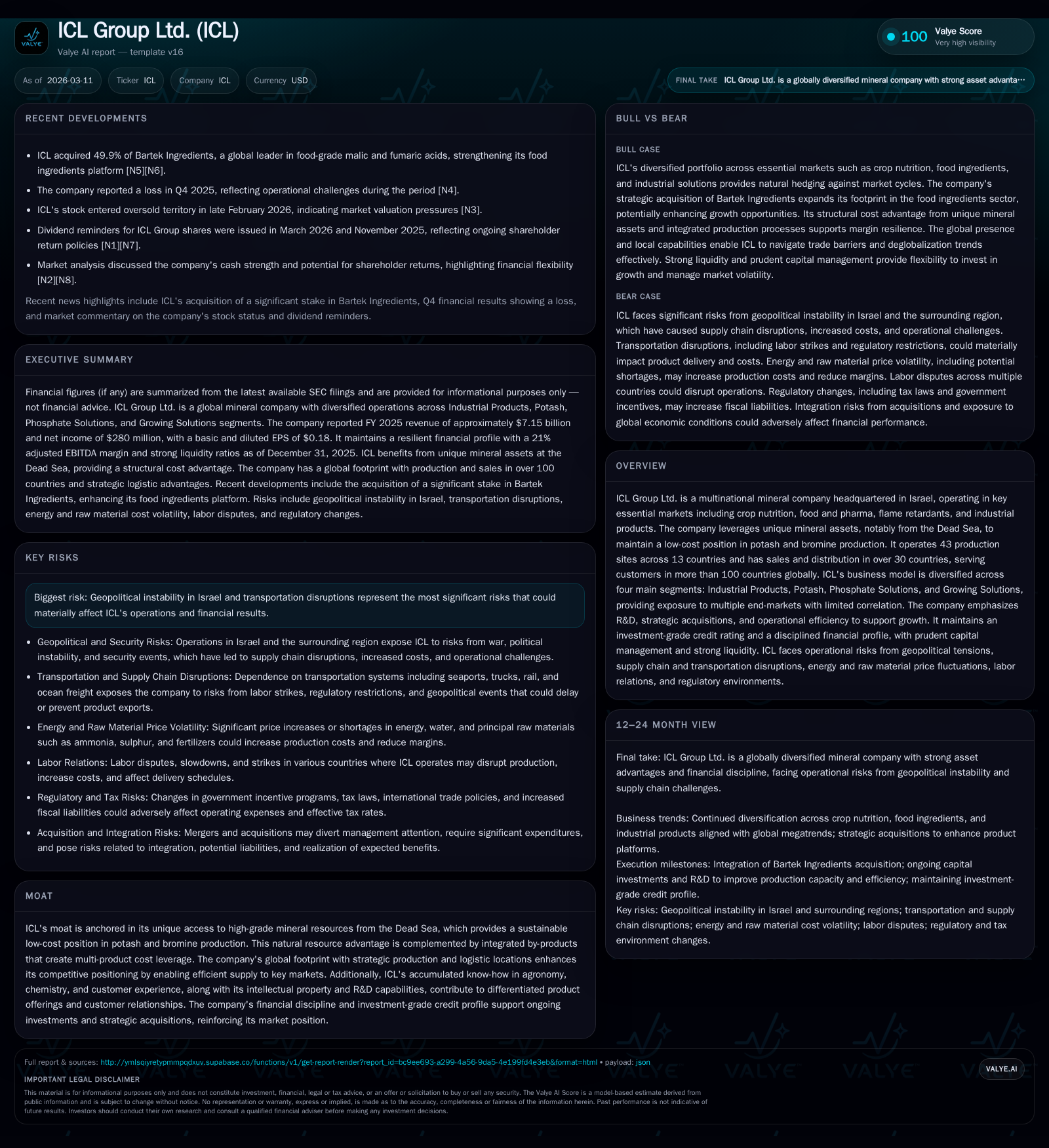
ICL Group Ltd. stands out for its sustainable low-cost production anchored in exclusive Dead Sea mineral resources, supporting a diversified business model spanning crop nutrition, industrial products, food ingredients, and flame retardants. After top-line recovery driven by portfolio and operational efficiencies post-2023, net income has softened due to margin pressures and operational disruptions. The company’s disciplined capital allocation includes dividends aligned with adjusted profits while managing debt conservatively with investment-grade ratings. Key risks remain tied to geopolitical instability in Israel and transportation logistics critical for bulk product shipments.
Company Background and Competitive Position
ICL Group Ltd. is a multinational specialty minerals company headquartered in Israel with operations spanning the globe across 43 production sites in 13 countries, servicing customers in over 100 countries [S1][S9][N2]. The company's diversified segments—Industrial Products, Potash, Phosphate Solutions, and Growing Solutions—provide exposure to varied end-markets including agriculture, food & pharma, flame retardants, and industrial chemicals.
A fundamental competitive advantage lies in ICL’s unique access to high-grade mineral resources from the Dead Sea. This geographic exclusivity enables the company to maintain a sustainably low-cost position especially in potash and bromine production—a significant moat reinforced by integrated by-products that allow multi-product cost leverage [S26]. This resource backbone supports resilient margins even during cyclicality affecting fertilizer markets.
Complementing this natural advantage is ICL’s global footprint paired with strategically located production facilities at key shipping hubs—including dedicated seaport facilities in Israel, Spain, and the UK—ensuring supply chain efficiency to critical markets [S9][S1]. The company’s accumulated know-how in agronomy and chemistry further differentiates its offerings through intellectual property and ongoing R&D investments.
Historical Financial Performance
Following peak revenues of around $10 billion in FY2022, fueled partly by elevated fertilizer prices linked to global supply constraints during that period, ICL experienced a notable dip to approximately $7.5 billion in FY2023 as markets normalized [F1]. The easing commodity cycle pressured both top line and profitability metrics. However, FY2024 saw stabilization at $6.8 billion followed by modest growth (+4.6%) to $7.15 billion in FY2025 [F1].
Net income trends reflected a sharper contraction; from an exceptional $2.22 billion profit in FY2022 dropping to $687 million in FY2023, then sequentially declining further to $464 million (FY2024) and $280 million (FY2025) attributable to margin compression and higher operating costs [F1]. This profit decline juxtaposed against revenue growth highlights escalating cost pressures likely from energy expenses, input inflation, and operational disruptions including transport issues reported [S1][S9].
Historical performance (annual)
| FY | Rev ($bn) | Net ($bn) | Rev YoY | Net YoY |
|---|---|---|---|---|
| 2025 | 7.2 | 0.3 | +4.6% | -39.7% |
| 2024 | 6.8 | 0.5 | -9.2% | -32.5% |
| 2023 | 7.5 | 0.7 | -24.8% | -69.0% |
| 2022 | 10.0 | 2.2 |
Source: SEC companyfacts cache [F1].
Capital returns and efficiency (annual)
| FY | Div ($mm) | ROE% |
|---|---|---|
| 2025 | 288 | 4.5 |
| 2024 | 308 | 7.8 |
| 2023 | 489 | 11.4 |
| 2022 | 1166 | 38.8 |
Source: SEC companyfacts cache [F1].
Despite pressures on earnings, equity grew steadily owing to retained earnings accumulation alongside disciplined capital management: equity rose from approximately $5.7 billion at end-2022 to $6.24 billion at end-2025 [F1]. This implies an approximate ROE of around 4.5% for FY2025—modest given industry cyclicality but reflective of current margin headwinds [F1].
Operational Drivers and Segment Analysis
Operationally, ICL benefits significantly from its vertically integrated business model anchored on its mineral extraction capabilities at the Dead Sea while expanding value-added offerings via R&D-driven product development [S8]. The Potash segment remains vital but subject to cyclical fertilizer demand impacted by agricultural commodity prices and weather-driven planting decisions globally [S12]. Similarly, Phosphate Solutions are influenced by regulatory considerations related to food safety additives.
The Industrial Products segment includes flame retardants whose demand is tied closely to construction activity and regulated applications across diverse sectors [S12]. Growing Solutions taps into crop nutrition leveraging agronomic expertise which helps mitigate risks associated with pure commodity exposure.
Geographically, China (20% sales), Brazil (19%), USA (~17%), combined with Europe and other emerging markets constitute principal revenue hubs illustrating broad market diversification [S20]. However regional currency fluctuations notably affect competitiveness given the euro’s appreciation versus USD undermining European price positioning vis-à-vis non-euro competitors [S17].
Operational challenges noted include dependence on transportation logistics centered on seaports where labor strikes or geopolitical events could delay exports materially affecting sales momentum [S9]. Additionally, energy supply disruptions pose risks especially for energy-intensive magnesium production requiring continuous power availability [S17]. ICL actively manages these through investments in alternative energy sources and crisis readiness plans integrating AI/automation technologies like drones for mine inspections improving safety efficacy [S1].
Capital Allocation Strategy
ICL maintains a conservative financial profile supported by an investment grade BBB- rating from S&P and Fitch with stable outlooks underscoring sound credit discipline despite volatility [S14][S21]. Total gross debt stood near $2.53 billion as of end-2025 with careful maturity staggering including sustainability-linked revolving credit facilities allowing flexibility while incentivizing ESG performance metrics [S14][S21].
Capital expenditures hover below double-digit percentages of revenue (~7-10%) reflecting focused investments aimed at efficiency improvements rather than aggressive capacity expansions amid cyclical market environments [F1][S8][S16]. Free cash flow generation remains solid with margins typically above 20% per internal presentations supporting dividends and debt reduction efforts [F1][S16].
Dividend policy targets payout up to half of adjusted annual net profit; the most recent dividend totaled approximately $288 million indicating steady shareholder remuneration capability aligned with profitability levels [F1][S6][S10]. Although share buybacks are permissible under Board discretion, recent disclosures emphasize dividend stability as primary capital return method given growth investments [S6].
Future Prospects and Strategic Outlook
Growth prospects revolve around leveraging core mineral assets while expanding through targeted acquisitions such as the January 2026 stake acquisition of Bartek Ingredients—a move enhancing ICL’s presence in functional food ingredients markets benefiting from growing consumer preferences for clean-label food additives [S13]. Continued operational advances focus on process automation coupled with R&D pipelines driving new product introductions across all segments.
However success hinges critically on renewing the upcoming concession at the Dead Sea post-2030 securing long-term extraction rights vital to maintaining cost advantages [N2][S2]. Geopolitical stability around Israel remains the paramount risk influencing both extraction operations and export logistics highlighted extensively as systemic vulnerabilities [S1][S9]. Intensifying data privacy regulations across jurisdictions also necessitate ongoing investments to ensure compliance mitigating risk of penalties or reputational harm linked to cybersecurity incidents or information breaches [S22][S23].
Energy price volatility remains an uncontrollable external pressure impacting unit economics despite mitigation efforts via alternative fuels usage capabilities [S17]. Agricultural end-market cyclicality tied to weather patterns adds demand-side uncertainty particularly impacting sales volumes within Potash and Phosphate segments year-on-year [S12].
What To Watch
Absent explicit forward guidance beyond dividend declarations at present filings, monitoring several milestones will be key:
- Progression on Dead Sea mineral extraction concession renewal negotiations before expiry around 2030.
- Execution outcomes from recent acquisitions (e.g., Bartek Ingredients) integration effectiveness.
- Quarterly results evidencing margin stabilization or erosion amid cost inflation trajectory.
- Developments around geopolitical tensions impacting transport routes or Israeli site operations.
- Evolution of energy pricing affecting production cost base.
- Updates on capital expenditures reflective of efficiency projects vs capacity additions.
- Credit rating agency reviews factoring changes in leverage or profitability outlooks.
Conclusion
ICL Group Ltd.'s strategic moat grounded on uniquely accessible Dead Sea minerals underpins its leadership position among global specialty minerals producers offering broad exposure across multiple industrial applications including essential agricultural nutrients amid evolving global challenges. While returning revenue growth after commodity downturns demonstrates resilience supported by diversification strategies involving R&D innovation plus selective acquisitions enhance future optionality.
However profit margin softness over recent years signals pressure points chiefly linked to external cost factors alongside operational complexities accentuated by geopolitical uncertainties inherent in key locations such as Israel which also impinge transportation reliability for largely bulk cargo dependent sales flows.
Financial discipline remains strong featuring prudent liquidity management aligned with moderate capex spend enabling consistent dividend payouts without excessive leverage build-up preserving investment-grade credit standing—a vital pillar supporting long-term competitiveness when coupled with continuous innovation agenda shaping differentiated product offerings.
Investors should prudently assess developments around geopolitical risk management outcomes alongside concession renewals which form critical pillars towards sustaining the foundational low-cost competitive advantage intrinsic to ICL's value proposition.
This analysis is based solely on publicly available information from company filings dated up to March 11, 2026 ([F1], [S#]) and referenced news sources ([N#]). It is intended for informational purposes only without any investment advice or recommendation regarding securities of ICL Group Ltd.
Disclaimer: This is research-only, informational analysis and not investment advice. It may include AI-generated interpretation and general industry context. Always verify important details using primary sources.

Comments