
LaFayette Acquisition Corp.: Unlocking Value in the Post-IPO SPAC Landscape
An in-depth review of LaFayette Acquisition Corp.'s foundational strengths and structural challenges as a newly public SPAC.
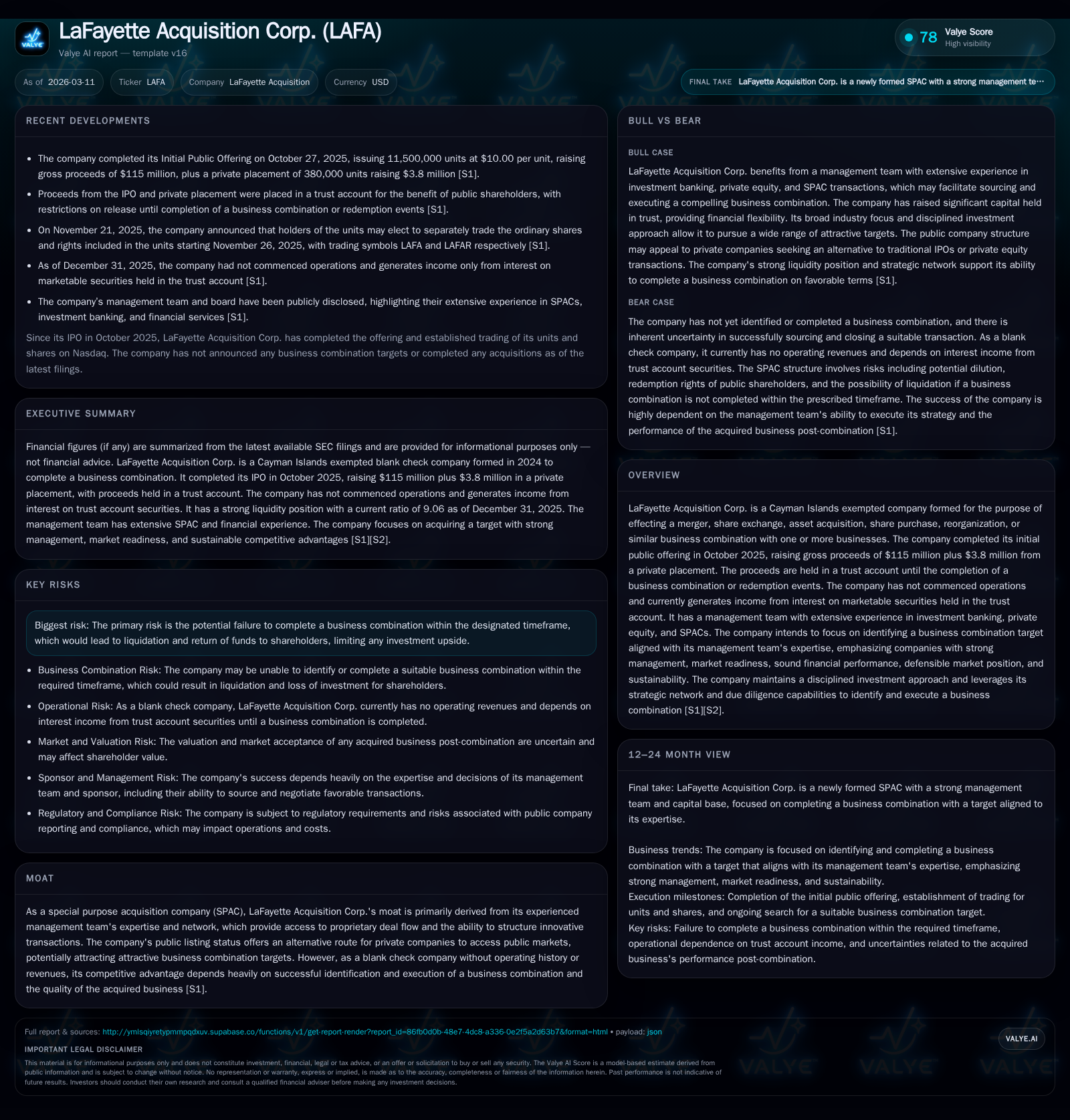
LaFayette Acquisition Corp. successfully completed its October 2025 IPO, raising $115 million gross plus $3.8 million from a private placement, with proceeds held in a trust account to preserve shareholder value prior to completing a business combination. The company has not generated operating revenues but earns interest income on trust assets against modest administrative expenses. Its experienced management team leverages investment banking and private equity backgrounds to source acquisition opportunities across industries and geographies. Key risks include completing a qualifying business combination within the mandated timeframe and managing redemption rights that could impact capital deployment. Upcoming milestones focus on target identification and transaction execution, positioning LaFayette as a moderate-risk SPAC with potential for value creation contingent on effective deal-making.
From Formation to IPO: Capital Raised and Early Financial Positioning
LaFayette Acquisition Corp., incorporated in June 2024 as a Cayman Islands exempted company, completed its initial public offering (IPO) on October 27, 2025. The IPO sold 11.5 million units at $10 each, including full exercise of a 1.5 million unit over-allotment option, generating gross proceeds of $115 million. Concurrently, the company sold 380,000 private placement units at $10 per unit for $3.8 million to the Sponsor and EarlyBirdCapital (EBC) [S1].
Historical performance (annual)
| FY |
|---|
| 2025 |
Source: SEC companyfacts cache [F1].
Transaction costs amounted to approximately $6.73 million, including cash underwriting fees ($2.3 million) and deferred underwriting fees ($4.025 million) [S1]. Net proceeds were placed into a trust account for the benefit of public shareholders with Continental Stock Transfer & Trust Company as trustee [S1][S9], preserving capital pending completion of a business combination or redemption events.
The company has not engaged in operations or generated revenues since inception aside from organizational activities preceding the IPO. For the year ended December 31, 2025, LaFayette reported net income of $554,273 derived entirely from interest income of $779,876 earned on marketable securities held in the trust account, offset by general administrative costs of $225,603 related to compliance and due diligence expenses [S1][F1].
Liquidity remains strong with current assets totaling $904,252 against current liabilities of $99,850 as of December 31, 2025—resulting in a current ratio exceeding 9x—reflecting available cash outside the trust for operational needs [F1]. This profile is typical for blank-check companies prior to target acquisition.
Management Expertise as Strategic Advantage
LaFayette’s management team combines deep experience across investment banking, private equity, private credit markets, and SPAC transactions—key competencies for sourcing attractive acquisition targets and structuring complex deals [S1].
This expertise is expected to provide access to proprietary deal flow opportunities beyond those available to less experienced sponsors. The company aims to target businesses with enterprise values between $500 million and $1.5 billion exhibiting positive cash flows and sustainable competitive advantages consistent with its strategic criteria [S25][S18].
Success depends heavily on identifying an appropriate target within the limited timeframe.
Financial Overview: Trust Account Stability and Operating Expense Profile
The primary financial strength lies in the approximately $115 million principal secured in the trust account plus accrued interest generated from short-term marketable securities investments designed to preserve principal while earning yield [S9][F1]. Upfront underwriting fees have been partially deferred but represent significant initial costs absorbed at IPO closing [S17][S20].
Outside the trust account, cash totaled approximately $813,817 at year-end 2025 to fund working capital needs such as legal fees, accounting costs, ongoing due diligence on potential targets, monthly administrative fees ($10k), and officer compensation agreements [S5][S12][S13]. No borrowings under working capital loans were outstanding at year-end; however, up to $1.5 million may be loaned by Sponsor parties if required and converted into units post-combination at IPO pricing—aligning sponsor interests without dilutive impact prior to deal completion [S8][S16].
Operating expenses remain low but recurring as typical for shell entities preparing for transactional activity. The absence of revenue is standard prior to business combinations.
Key Risks: Deadlines, Redemption Rights, and Market Considerations
A critical risk factor is completing an initial business combination within 18 months from IPO closing (deadline October 27, 2027). Failure triggers mandatory liquidation with pro-rata return of funds to shareholders—preserving principal but foregoing potential acquisition upside [S1][S9]. Extensions require shareholder approval.
Public shares are subject to redemption rights allowing holders to tender shares during merger votes or elect redemption via tender offers near $10 per share plus accrued interest [S22][S7]. Accounting standards under ASC Topic 480 classify these redeemable shares outside permanent equity as temporary equity. This mechanism protects investors’ capital but constrains deployable funds since redemptions must be funded from cash or proceeds excluding sponsor contributions.
Market valuation adjustments for "public rights" issued alongside ordinary shares reflect uncertainties about successful deal execution probabilities and expected post-announcement price volatility—factors influencing investor sentiment towards LAFA units [S3].
Outlook for Business Combination: Flexibility Within Defined Criteria
LaFayette pursues flexibility across industries and geographies but emphasizes leveraging management expertise to target companies demonstrating predictable revenue growth and defensible market positions within an enterprise value range of approximately half-billion to mid-billion dollars [S25][S18]. This focus aims to mitigate valuation risks while accessing scalable growth opportunities benefiting from public listing advantages such as enhanced capital access and management incentive structures.
No announced candidates or preliminary transaction agreements have been disclosed so far; thus stakeholders should monitor progress relative to critical deadlines such as initial announcement windows typically occurring between six to twelve months post-IPO based on general SPAC market norms.
Capital Allocation Strategy: Sponsor Loans and Cost Management
Sponsor support includes offering-related advances structured under covenants allowing conversion into units paralleling private placement terms upon successful business combination closure—supporting working capital sufficiency while aligning sponsor interests financially with public shareholder returns post-deal consummation [S5][S8][F1].
Upfront underwriting fees reduce net IPO proceeds materially (~7% plus other costs), customary yet impactful given limited operating activity requiring strict control over administrative spending until combination execution enables revenue generation downstream [S1][S16].[F1]
No dividends or share repurchases are planned before business combination completion; cash preservation remains paramount until transaction finalization permits broader strategic investments or expansion by acquired entities forming combined operations.
Monitoring Ahead: Milestones and Market Reaction Triggers
Though no direct forecasts or timelines beyond regulatory filings exist,[N/A] monitoring key indicators is essential:
- Announcements identifying prospective business combination targets,
- Commencement of shareholder approval voting processes,
- Redemption election periods coinciding with merger disclosures,
- Extension requests reflecting timing pressures,
- Market price movements around these milestones signaling confidence levels. These factors align with typical SPAC lifecycle stages determining whether investor capital unlocks growth upside or reverts via liquidation.
Conclusion: Evaluating LaFayette’s Acquisition Potential
LaFayette Acquisition Corp. presents as a well-capitalized blank-check vehicle led by experienced management targeting moderate-sized acquisition opportunities favored by current public market conditions. Its conservative early operational stance reflects prudent cash stewardship amid structural constraints inherent in SPAC frameworks—namely time-bound deal closures coupled with redeemable share mechanics limiting flexibility.
Value creation depends decisively on management’s ability to identify fundamentally sound targets aligned with sustainability criteria while capturing public listing benefits for long-term growth acceleration.
Investors should consider upside potential balanced against dilution risks via redemption events pending announcement and closure outcomes.
This analysis is based solely on publicly available SEC filings dated through March 11, 2026.
Disclaimer: This is research-only, informational analysis and not investment advice. It may include AI-generated interpretation and general industry context. Always verify important details using primary sources.

Comments