
UR-ENERGY INC’s Struggles and Strategic Outlook Amid U.S. Uranium Market Dynamics
A comprehensive analysis of Ur-Energy's financial volatility, exploration-stage limitations, and capital deployment amid shifting uranium sector conditions in the U.S.
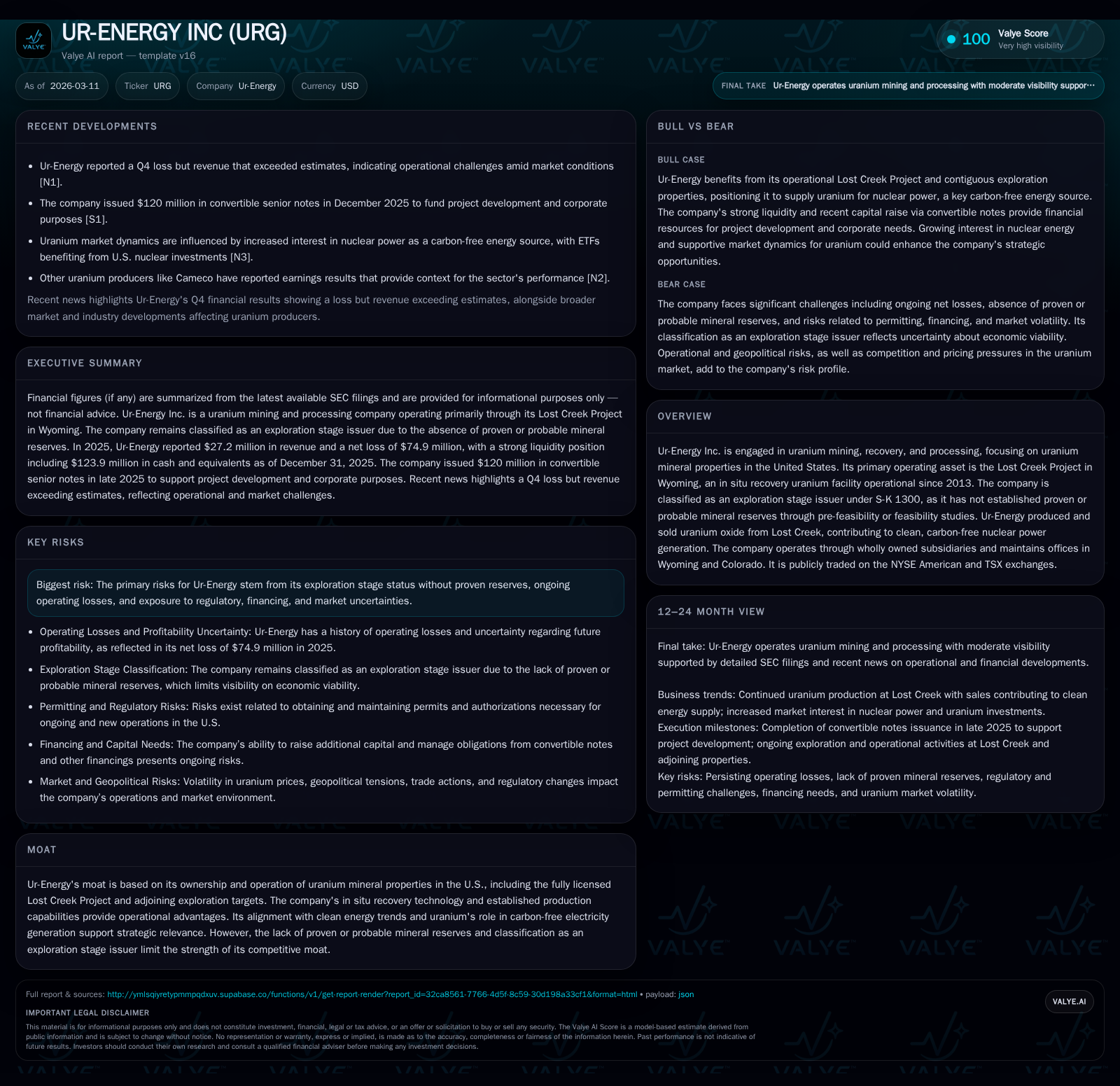
Ur-Energy Inc., operating primarily from its Lost Creek Project with in situ recovery technology, demonstrates significant revenue volatility and widening operational losses through fiscal 2025. Despite increasing capital expenditures aimed at growth initiatives, the company's classification as an exploration stage issuer without proven mineral reserves constrains its growth potential and complicates financing options. Absent formal earnings guidance, investors should monitor uranium prices, production metrics, and permitting outcomes closely. The company's strong liquidity position contrasts with persistent negative free cash flow and absence of dividends or buybacks. Regulatory and market risks inherent to U.S. uranium mining further amplify uncertainty around Ur-Energy’s strategic trajectory.
Historical Revenue and Operational Performance from 2022 to 2025
Ur-Energy Inc.'s recent financial trajectory reveals pronounced volatility highlighted by shrinking revenues and escalating losses through the fiscal year ending December 31, 2025 [F1]. Revenue rose sharply from a nominal $19,000 in FY2022 to $17.7 million in FY2023 but then surged to $33.7 million in FY2024 before retreating nearly 19.3% to $27.2 million in FY2025. This decline coincides with an approximate 10% increase in operating losses from -$63.1 million in FY2024 to -$69.4 million in FY2025.
Net income mirrors this deterioration, plunging about 40.8% year-over-year to -$74.9 million in FY2025 following gains in prior years [F1]. Intriguingly, operating cash flow (CFO) exhibits improvement with a roughly 40% reduction in outflows from -$71.9 million in FY2024 to -$43.1 million despite mounting losses, possibly reflecting tighter working capital management or operational efficiencies.
Capital expenditures expanded aggressively by over 160% to $23.6 million in FY2025 after holding under $9 million the prior year, signaling intensified growth investments despite flagging earnings [F1]. This divergence between capex scale-up during revenue softness underscores heightened strategic urgency but also heightens near-term financial strain.
This financial pattern—widening net losses paired with surging capex and improved but still negative CFO—illustrates a company investing heavily for future capacity while grappling with profitability pressures during volatile commodity cycle phases.
Historical performance (annual)
| FY | Rev ($mm) | Net ($mm) | CFO ($mm) | OpInc ($mm) | Rev YoY | Net YoY |
|---|---|---|---|---|---|---|
| 2025 | 27 | -75 | -43 | -69 | -19.3% | -40.8% |
| 2024 | 34 | -53 | -72 | -63 | +90.7% | -73.5% |
| 2023 | 18 | -31 | -17 | -31 | +92947.4% | -78.9% |
| 2022 | 0 | -17 | -18 | -20 |
Source: SEC companyfacts cache [F1].
Capital returns and efficiency (annual)
| FY | FCF ($mm) | ROE% |
|---|---|---|
| 2025 | -67 | -96.7 |
| 2024 | -81 | -40.1 |
| 2023 | -19 | -40.9 |
| 2022 | -27.4 |
Source: SEC companyfacts cache [F1].
Exploration Stage Status and Its Impact on Growth Potential
Despite continuous uranium recovery since launching Lost Creek operations in 2013 via its wholly owned subsidiaries [S1], Ur-Energy remains regulated as an "exploration stage issuer" under SEC S-K 1300 standards owing to its failure to establish proven or probable mineral reserves through pre-feasibility or feasibility studies [S1][S27]. This classification reflects significant geological uncertainty around economically extractable reserves.
The absence of these reserves restricts the company's ability to clearly define mine life economics or secure traditional project financing structures due to heightened risk perceptions [S3]. Moreover, regulatory risk factors linked exclusively to exploration-stage entities—including permit renewals and construction authorizations—compound uncertainties affecting operational scalability.
For investors or analysts assessing growth prospects at Ur-Energy [S27], this exploration-stage status signals caution; reserve certification is a fundamental milestone needed before substantive production scale-up can be confidently forecasted or secured through capital markets.
Market Positioning Through Lost Creek and In Situ Recovery Technology
Ur-Energy's core asset is the Lost Creek Project located in Wyoming—an operational fully licensed uranium facility leveraging advanced in situ recovery (ISR) technology since initial plant startup [S1][F1]. ISR enables uranium extraction by circulating chemical solutions underground without full-scale mining excavation—offering lower environmental disturbance and favorable cost structures compared to conventional open-pit or underground mining methods.
Given nuclear power's role supplying roughly half of U.S carbon-free electricity [S20], Lost Creek supports clean energy imperatives by producing triuranium octoxide (U₃O₈), a primary nuclear fuel component enabling carbon-free power generation [S20]. The project also includes adjoining exploration properties contiguous with Lost Creek that serve as supplemental resource targets enhancing long-term potential footprint [S20].
This technological approach coupled with substantial drill data underpinning mineral resource estimates positions Ur-Energy competitively within a niche U.S.-based ISR uranium producer cohort—a sector alignment potentially advantaged amid growing climate-driven nuclear demand narratives.
Financial Forecast Signals and What To Monitor Post Q4 2025 Results
As reported on March 10th, 2026 [N1], Ur-Energy posted a quarterly loss yet exceeded revenue expectations for Q4—pointing at continued top-line pressure but possible operational efficiencies or contract fulfillment gains against forecasts.
Absent explicit forward-looking guidance from filings [N1][S2], key performance indicators warranting scrutiny include:
- Uranium spot price trends influencing contract pricing realizations.
- Production volumes and recovery rates at Lost Creek measuring ramp-up execution.
- Capital expenditure pacing relative to budgets indicating project development discipline.
- Regulatory milestones on license renewals or new project authorizations signaling operational continuity. These metrics will crucially inform any trajectory shifts that could mitigate financial losses or justify further investment rounds.
Capital Allocation Review: Cash Reserves and Absence of Dividends or Buybacks
Ur-Energy concluded fiscal 2025 with approximately $124 million in cash and equivalents alongside a current ratio near a robust 5.44 times current liabilities—highlighting ample short-term liquidity buffers [F1][S4]. Equity totaled about $77.5 million at year-end but fell from prior levels due primarily to accumulated net losses eroding book value.
The surge in capex ($23.6M) outweighing cash flow from operations (-$43M) results in significantly negative free cash flow approximating -$66.7M for the year—a reflection of aggressive capital deployment into growth projects despite persistent earnings deficits [F1][S4]. Stock-based compensation expenses outlined in filings add another layer of non-cash considerations impacting overall profitability metrics [S4].
Notably absent are dividends or share repurchase programs; instead Ur-Energy prioritizes retaining liquidity for operational funding and expansion efforts amid volatile sector economics [S4]. This capital allocation approach aligns with typical profiles of smaller-scale miners focused on conserving runway until reserve certification or uranium price environments improve sufficiently.
Sector Challenges: Regulatory Complexity and Funding Risks
Operating within the U.S uranium mining sector entails navigating complex regulatory landscapes including licensing renewals under bodies such as the U.S Nuclear Regulatory Commission as well as state-level authorities governing environmental compliance [S3][S13][S18]. Ur-Energy’s smaller scale exacerbates exposure to these procedural bottlenecks compared with larger peers like Cameco whose recent earnings beat was partly buoyed by scale efficiency [N2].
Funding remains challenging because exploration stage issuers lack proven reserves required for typical bankable feasibility studies limiting access to low-cost debt—for Ur-Energy convertible notes financing introduces added leverage and covenant risks [S15][S26]. Uranium commodity price volatility also drives sales contract uncertainty given fluctuating spot contract benchmarks impact revenue realizations unpredictably [S18][N2]. These compound risks necessitate vigilant monitoring of geopolitical developments influencing trade policies given nuclear fuel supply chains’ sensitivity amid global tensions [S13][S18].
Investor Takeaways: Balancing Strategic Position Against Financial Realities
Ur-Energy stands at an inflection point where its position as a licensed domestic ISR uranium producer aligns strategically within increasing demands for carbon-free energy sources amidst climate imperatives [N1][F1][S1]. Yet this market relevance clashes against persistent operational losses compounded by its classification as an exploration stage issuer lacking proven reserves—a factor restraining full investor confidence and scalability potential.
The company’s robust liquidity cushions provide temporary runway enabling sustained capex investment aimed at unlocking incremental resource value while avoiding pressure for dividends or buybacks consistent with growth-stage priorities. However uncertainty around regulatory approvals coupled with fluctuating uranium prices accentuates execution risk.
From an analytical standpoint it is prudent to track operational milestones on production ramp-up efficiency; response of cost structures embodied in ISR technology benefits; progress towards resource reserve certification; along with broader market sentiment shaped by uranium pricing dynamics—each offering proxy signals charting if Ur-Energy can bridge its strategic potential toward more sustainable profitability.
This report is based solely on publicly available information cited herein including SEC filings and credible news sources as of early March 2026. No forward-looking investment recommendations are expressed or implied herein.
Disclaimer: This is research-only, informational analysis and not investment advice. It may include AI-generated interpretation and general industry context. Always verify important details using primary sources.

Comments