
Barnes & Noble Education's Strategic Rebound: Reversing Long-Term Trends with Innovative Campus Solutions
Barnes & Noble Education leverages integrated physical and digital bookstore networks alongside innovative affordable access programs to stabilize revenues.
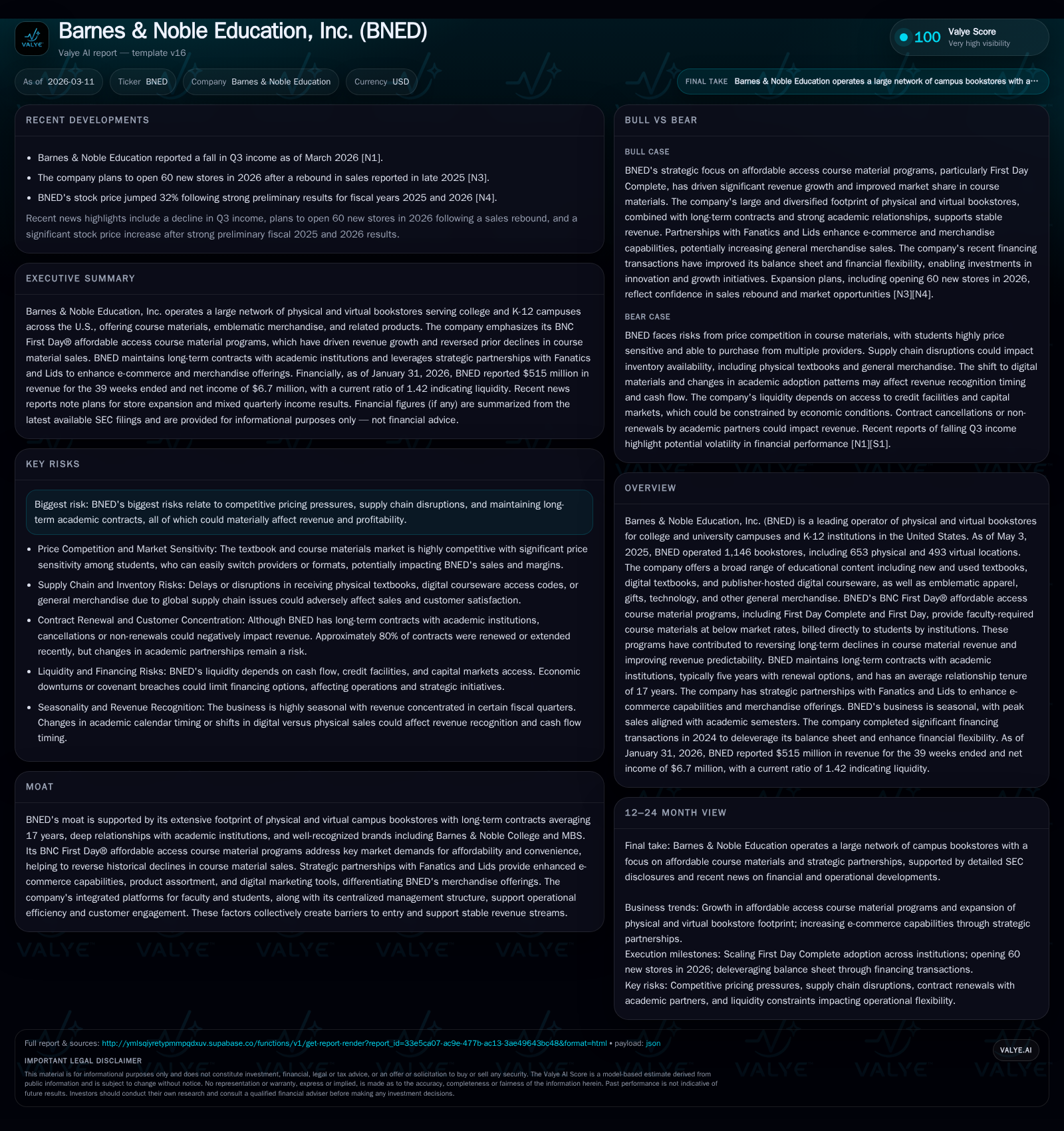
Barnes & Noble Education, Inc. (BNED) operates a nationwide network of physical and virtual campus bookstores supported by long-term contracts averaging 17 years. After several years of operating losses, the company achieved meaningful revenue growth of 19.4% in fiscal 2025, driven largely by expansion of its BNC First Day® affordable access course material programs and digital initiatives. Despite improvement to operating income, net losses persist due to restructuring and liquidity pressures. Going forward, BNED emphasizes scaling its First Day Complete program and enhancing e-commerce capabilities through partnerships with Fanatics and Lids while carefully managing capital allocation amid negative free cash flow. Key risks include pricing pressures, supply chain challenges, and contract renewals that remain critical to sustaining its moat.
Historical Trajectory: Recovery from Multi-Year Operating Losses
Barnes & Noble Education has traversed a challenging financial path over the past several fiscal years before making substantive operational progress highlighted in fiscal 2025. Revenue for FY2025 reached approximately $282 million, marking a robust 19.4% increase compared to FY2024's $236 million [F1]. This rebound was especially notable given prior stagnation and declines linked to shifts in textbook consumption trends.
Operating income swung positively to $16 million from a loss of $22 million the previous year, underscoring early success of strategic initiatives designed to improve profitability [F1]. However, net income remained negative at -$23 million, reflecting lingering headwinds including restructuring costs and non-cash impairment charges disclosed in regulatory filings [S1]. These seasonally influenced factors underscore the still evolving nature of BNED’s turnaround.
Despite operational advances reflected at the EBITDA level, persistent net losses translate into an approximate -8.5% return on equity for FY2025 when juxtaposed against shareholders’ equity of $272 million at year-end [F1]. This dynamic signals a cautious improvement trajectory shadowed by profitability challenges that will require monitoring.
Core Growth Drivers: Contracts, Course Material Innovations, and Expanded Footprint
BNED’s competitive moat rests firmly on a broad physical and virtual bookstore footprint comprising 1,146 locations nationwide as of May 3, 2025 — split between 653 physical stores primarily on college campuses and 493 virtual stores servicing both higher education and K-12 institutions [S5]. This expansive network benefits from long-term academic contracts averaging roughly 17 years in duration [S18], providing stability uncommon in retail.
Central to BNED’s recent growth acceleration are its BNC First Day® affordable access course material programs — First Day Complete and First Day — which offer faculty-required course materials bundled at below-market rates with direct institutional billing [S6][S11]. This model has successfully mitigated decades-long declines in courseware sales by driving higher unit volumes through convenience and affordability innovations. Adoption momentum for First Day Complete expanded notably during FY2025 with continued scaling anticipated [N1][S11].
Complementing course materials revenue are general merchandise sales enhanced via strategic partnerships with Fanatics Retail Group Fulfillment LLC and Fanatics Lids College Inc., collectively termed the F/L Relationship [S11][S26]. These partnerships enable BNED to leverage leading e-commerce technology platforms alongside updated product assortments targeting collegiate fanship demographics.
Additionally, BNED operates a sophisticated wholesale distribution infrastructure supporting used textbook inventory exceeding approximately 235,000 unique titles along with consignment rental programs managed for major publishers such as McGraw-Hill Education and Pearson Education [S4][S15]. Such integrated hardware/software solutions further entrench BNED’s supply chain management advantages.
Financial Performance Snapshot: Improving Operating Income but Persisting Net Losses
The following table summarizes key financial metrics illustrating BNED’s recent trajectory over four fiscal years ending May:
Historical performance (annual)
| FY | Rev ($mm) | Net ($mm) | CFO ($mm) | OpInc ($mm) | Rev YoY | Net YoY |
|---|---|---|---|---|---|---|
| 2025 | 282 | -23 | -85 | 16 | +19.4% | +15.9% |
| 2024 | 236 | -27 | -5 | -22 | -2.4% | +40.8% |
| 2023 | 242 | -46 | 92 | -66 | -84.2% | |
| 2022 | 1531 | 2 | -67 |
Source: SEC companyfacts cache [F1].
Capital returns and efficiency (annual)
| FY | Buybacks ($mm) | FCF ($mm) | ROE% |
|---|---|---|---|
| 2025 | 0 | -98 | -8.5 |
| 2024 | 0 | -19 | -38.8 |
| 2023 | 1 | 67 | -35.4 |
| 2022 | 2 | -41 |
Source: SEC companyfacts cache [F1].
While operating income has rebounded sharply into positive territory after successive years of losses—reflecting operational leverage from improved course material mix—the net loss position persists largely due to restructuring expenses, impairment charges, interest expense approximating $10 million per quarter, and working capital fluctuations impacting cash flows as outlined in SEC disclosures [S1][N1]. The significant deterioration in operating cash flow from +$92 million in FY2023 to -$85 million in FY2025 signals continuing liquidity strain even as top-line growth resumes.
Buybacks remain virtually negligible at a reported $5K for FY2025 reflecting conservative capital stewardship given cash constraints [F1]. No dividend distributions are documented indicating retained earnings continue priority towards business stabilization.
Outlook and Growth Catalysts: Scaling First Day Complete and E-Commerce Enhancements
Looking ahead into fiscal 2026, BNED underscores accelerating adoption of First Day Complete as its primary growth engine [N1][S11]. Continued expansion across new academic institutions aims to broaden penetration of bundled course material offerings that improve predictability while enhancing student affordability — critical given heightened price sensitivity within educational content markets.
Simultaneously, BNED plans further enhancements to its e-commerce platforms leveraging Fanatics’ technology stack encompassing advanced digital marketing tools coupled with expanded product assortment via the F/L Relationship [S11]. This omni-channel capability aims to deepen customer engagement beyond textbooks into emblematic merchandise linked to athletics and alumni identities.
Absent explicit formal guidance disclosed publicly or within filings, investors should monitor new contract wins or extensions along with student adoption rates for First Day product tiers as key execution milestones. Notably, retention rates on virtual bookstore agreements have been strong historically (~88%) but competitive pressures remain present around upcoming negotiations [S18][S21]. Together these dynamics situate BNED at a critical inflection point balancing scale with operational complexity.
Capital Deployment: Conservative Buybacks, Negative Free Cash Flow, and Investment Priorities
BNED’s most recent fiscal data confirm disciplined but cautious capital allocation amid ongoing liquidity challenges. With capital expenditures declining slightly year-over-year (~$13M vs $14M prior year) reflecting targeted reinvestment in IT infrastructure and store improvements consistent with omnichannel priorities [F1], the company has minimized discretionary spending.
Free cash flow turned sharply negative near -$98M driven by deep operating cash flow deficiencies overshadowing moderate capex outlays [F1]. Concurrently BNED has sought temporary consent waivers related to credit agreement covenants evidencing persistence of financing constraints albeit currently managed within lender agreements [S1].
No dividends are noted reflecting preference for internal capital preservation rather than shareholder distributions during this recovery phase. Meanwhile minimal share repurchases underscore prioritization of liquidity buffers over buyback-driven returns given unresolved net losses.
Risks to Monitor: Pricing Pressures, Supply Chains, and Contract Renewals
BNED explicitly cites several risk factors intrinsic to its operating model - foremost among these is intense competitive pricing pressure across course material segments where students easily shift between providers given abundance of alternative sources including direct publisher rentals or open market e-commerce platforms [S22]. Such dynamics could compress margins further even as affordable access models drive volume gains.
Supply chain risks also persist given dependence on timely receipt of physical textbooks and digital access codes from publishers which are critical inputs for BNC First Day® program fulfillment before term commencements each semester [S9][S21]. Disruptions here can materially impair revenue recognition as well as customer satisfaction.
Finally maintaining long-term academic contracts—typically five-year terms with renewal options but cancellable upon notice—remains crucial; approximately 80% renewal rates over past recent years support stability but competition from peers like Follett Corporation poses ongoing threat notably for virtual bookstores where lower barriers exist to entry [S18][S25]. Failure to preserve or gain contract renewals could erode BNED’s core revenue base dramatically.
Sector-Specific Insights: Leveraging Long-Term Contracts in Academic Book Retailing
Within the academic retail sector, BNED’s moat derives heavily from multi-decade outsourcing relationships that embed it deeply into campus operations [S18]. These contracts provide pricing floors tied to publisher costs adjusted for affordability trends negotiated collaboratively with institutions wary of rising student expenses.
Operational complexity is managed through proprietary inventory automation software managing consignment rental logistics that interface between schools, publishers' rental programs (McGraw-Hill & Pearson), and bookstore distribution — increasing inventory velocity while minimizing stockouts or write-downs [S4][S20]. Integrated POS solutions deployed broadly across client stores deliver crucial analytics aiding contract renewal negotiations via demonstrated sales efficiency metrics.
Further differentiation arises from combining physical store presence functioning as social-academic hubs together with virtual storefronts fulfilling direct-to-student shipments—an omnichannel configuration relatively unique within this niche retail domain offering resilience amidst changing media consumption patterns among younger demographics.
This analysis is based solely on information provided by Barnes & Noble Education’s SEC filings ([F1]–[S29]) and recent news releases ([N1]). It does not constitute investment advice but aims to provide an informed perspective on BNED’s strategic positioning within campus retailing amid evolving educational content delivery landscape.
Disclaimer: This is research-only, informational analysis and not investment advice. It may include AI-generated interpretation and general industry context. Always verify important details using primary sources.

Comments